What Is GEO (Generative Engine Optimization)?

Table of Contents
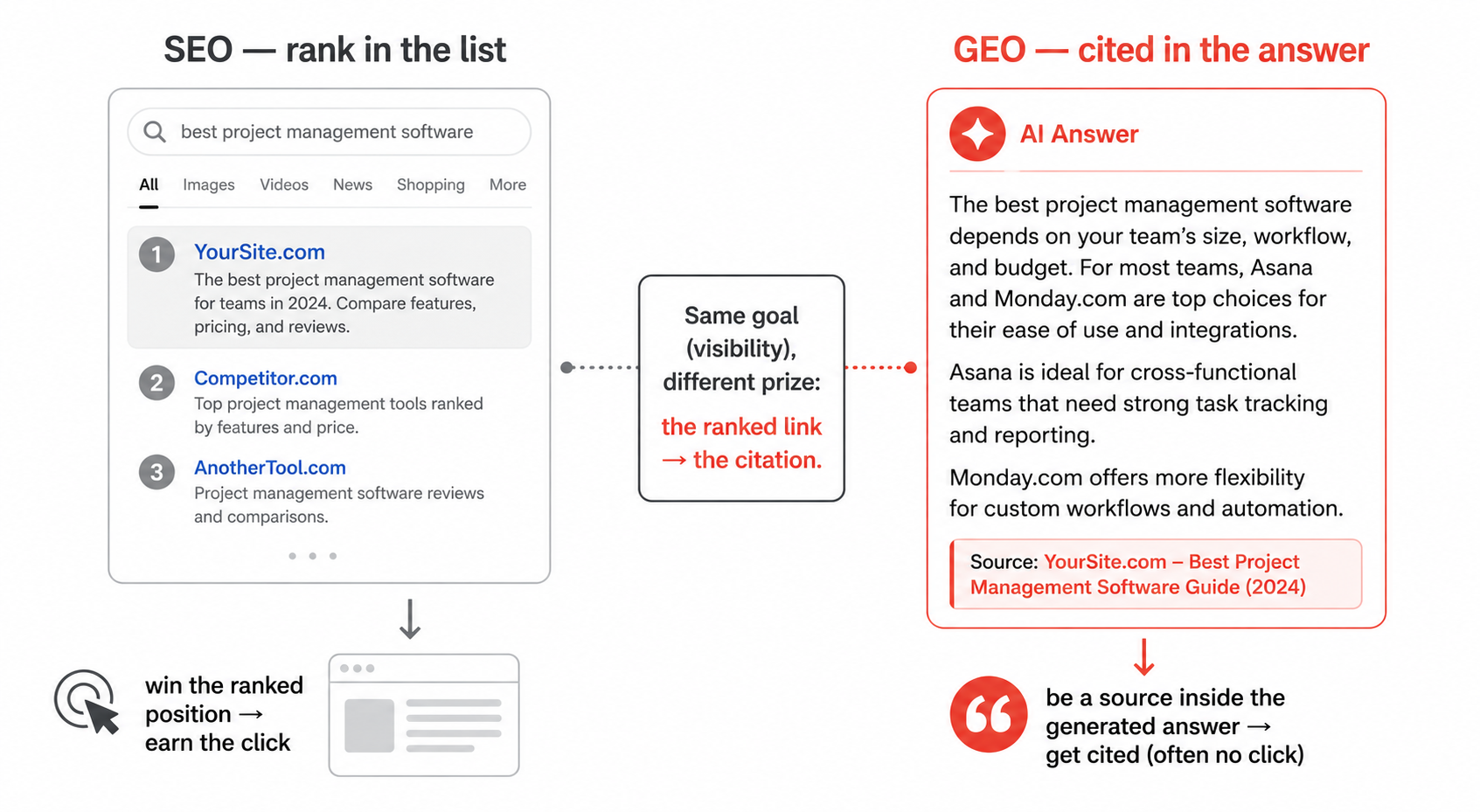
Generative Engine Optimization (GEO) is the practice of structuring your content so that AI systems like ChatGPT, Perplexity, Google's AI Overviews, and Gemini cite, quote, or recommend it when they answer a user's question. Where traditional SEO optimises to rank in a list of links and earn a click, GEO optimises to be a source inside the AI's generated answer, often without the user clicking through at all. In one line: SEO gets you ranked, GEO gets you cited.
The term is new (it entered the marketing vocabulary in 2025) and the field is genuinely unsettled, with plenty of vendor hype layered on top. But the underlying shift is real and worth understanding cleanly, because more and more people now ask an AI a question and read its synthesised answer instead of clicking through a list. This is the short, practical explainer: what GEO actually is, how it differs from SEO and its cousin AEO, and what it means for getting found. For the full practitioner playbook, see the GEO cornerstone; this piece is the clean definition underneath it.
Why GEO exists now
GEO exists because the way people search changed, and the old reward stopped paying out reliably. For two decades the model was simple: rank high in a list of links, earn the click. AI search broke that model in two ways at once.
First, AI Overviews and chatbots increasingly answer the question on the spot, so the click often never happens, one well-known analysis found AI Overviews cut click-through rates for top-ranking content by more than half. Second, huge numbers of people now skip the search box entirely and ask an LLM directly. In both cases, the user gets their answer from a synthesised response built out of sources, and the valuable position is no longer "ranked first in a list" but "cited inside the answer." GEO is simply the discipline that emerged to win that new position. It is not a fad term for the same old SEO; it is a response to a real change in where the visibility lives.
How an AI engine decides what to cite
To understand GEO you have to understand, briefly, how these systems build an answer, because that mechanism is what you are optimising for. When an AI engine answers a question, it does not just recall a fact, it typically searches, retrieves relevant material, and synthesises a response from multiple sources, a process built on retrieval (RAG). Crucially, it pulls in passages it can use, not whole pages.
So GEO is, at its core, the work of making your content easy for that process to find, lift, and trust. In practice that means a handful of things the engines consistently reward: content structured so a clean answer can be extracted (clear questions as headings, direct answers stated up front), strong trust and authorship signals (a named author, credible sources, visible dates), genuine specifics and data rather than vagueness, and real first-hand experience a model cannot synthesise from a hundred generic pages. The how-to detail lives in how I structure an article to be quotable by AI; the point here is just that GEO is concrete and mechanical, not mystical. You are writing so a machine can quote you and feel safe doing so.
GEO vs SEO vs AEO: the clean distinction
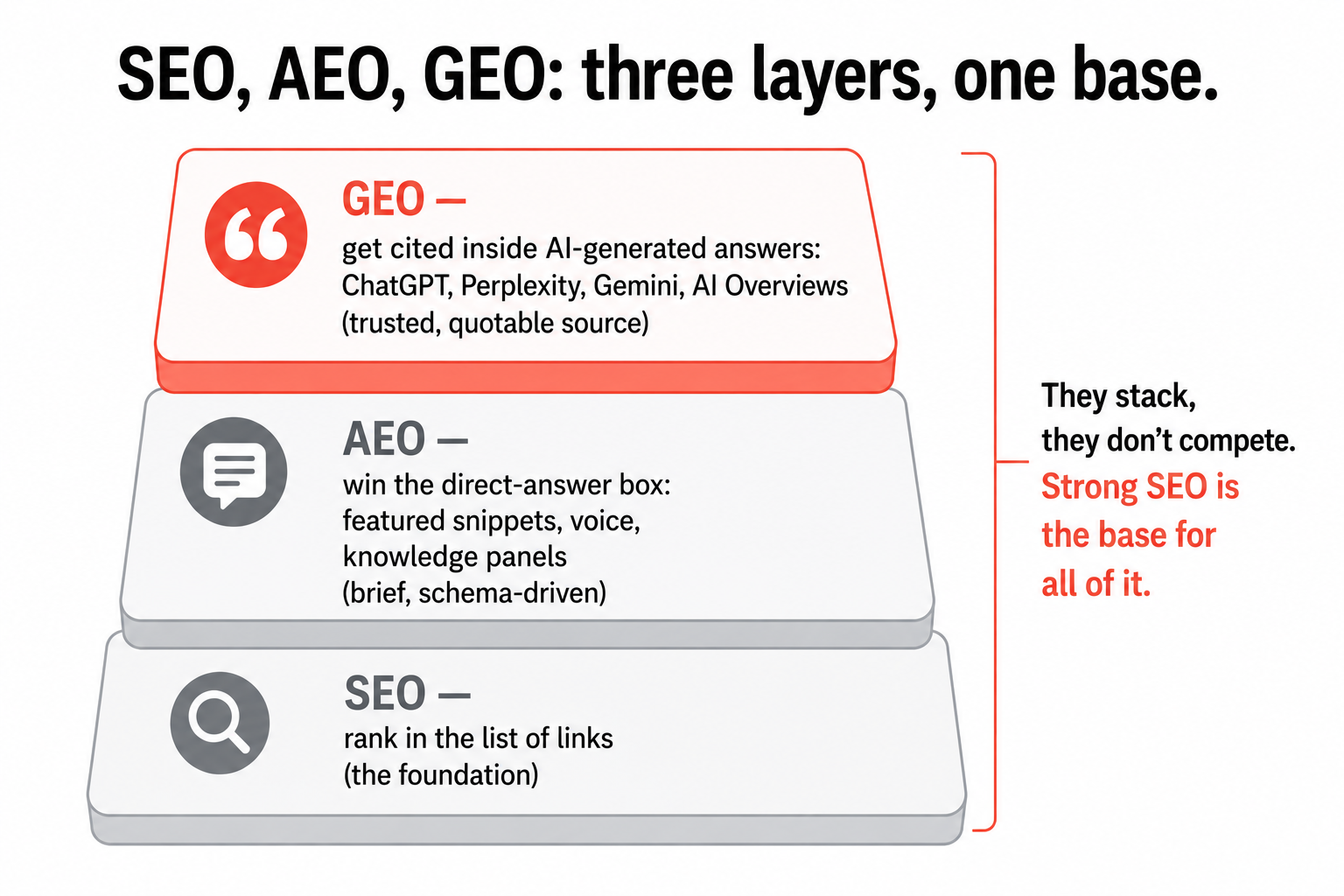
The three terms get muddled constantly, so here is the clean version. They are not competitors; they target different parts of how people find things, and the smart move is to stack them, not pick one.
SEO (Search Engine Optimization) optimises to rank in the traditional list of blue links on a search results page. The prize is the ranked position and the click.
AEO (Answer Engine Optimization) optimises to win the direct-answer slot, the featured snippet, the knowledge panel, the voice-assistant response, where an engine gives one concise answer rather than a list. It is narrower, tends to reward brevity and clean structured data, and is largely about Google and Bing's answer boxes plus voice. (I cover this in what is AEO.)
GEO (Generative Engine Optimization) optimises to be cited inside the longer, synthesised answers that generative AI produces, ChatGPT, Perplexity, Gemini, Google's AI Overviews, where the engine weaves multiple sources into a multi-paragraph response. It is the broadest of the three and the most about being a trusted, quotable source.
The relationship that matters: they build on each other, they do not replace each other. AI engines lean heavily on the same authority and relevance signals as traditional search, and research consistently shows AI answers often cite content that already ranks well. So strong SEO is the foundation, AEO wins the answer boxes, and GEO wins the AI citations. You are not choosing between them. You are stacking them on one solid base.
What GEO means for you, practically
Strip away the acronym anxiety and GEO comes down to one reassuring idea: the way to get cited by AI is, increasingly, just to be genuinely worth citing and to make it easy. You do not need a new toolset or a separate content operation. You need to keep your SEO foundations solid, then add the GEO layer on top, write the clearest, most trustworthy, most genuinely experienced content on the questions you want to own, structure it so a machine can lift a clean answer and credit you, and measure success the new way.
That last point is the practical shift worth internalising. Stop measuring only clicks and rankings, and start checking whether you are cited: periodically ask ChatGPT, Perplexity, Google's AI Mode, and Gemini the questions in your field and see whether your site gets named. Citation, not ranking, is the new scoreboard. That is GEO in a sentence: in a world where the AI answers first, the goal is to be the source it answers from.
So, to close the loop. GEO is optimising to be cited inside AI-generated answers, the natural evolution of SEO for a world where AI responds before the user clicks. It sits alongside SEO (rank the page) and AEO (win the answer box) as the third layer of modern discoverability, and it is won the same honest way the best SEO always was: be genuinely authoritative, be clear, be specific, and make it easy for the engine to quote you. The prize moved from the click to the citation. GEO is how you go and get it.
A few common questions
What is GEO (Generative Engine Optimization)? GEO is the practice of structuring content so AI systems like ChatGPT, Perplexity, Google AI Overviews, and Gemini cite or recommend it when they answer a question. Where SEO optimises to rank in a list and earn a click, GEO optimises to be a cited source inside the AI's generated answer, often without the user clicking through.
How is GEO different from SEO? SEO targets ranking position in the list of links; GEO targets being cited inside AI-generated answers. They're complementary, not opposed: AI engines rely heavily on the same authority and relevance signals as search, and AI answers often cite content that already ranks well. Strong SEO is the foundation GEO builds on.
What's the difference between GEO and AEO? AEO (Answer Engine Optimization) targets the direct-answer slots, featured snippets, knowledge panels, voice-assistant answers, which are concise and largely on Google and Bing. GEO targets the longer, synthesised answers generative AI produces across ChatGPT, Perplexity, Gemini, and AI Overviews. AEO wins the answer box; GEO wins the AI citation. Both build on SEO.
Do I need to choose between SEO, AEO, and GEO? No. They stack rather than compete. Keep strong SEO foundations (which all three rely on), use AEO to win direct-answer boxes, and add GEO to get cited in AI-generated answers. The most effective 2026 strategy combines all three on one solid base rather than treating them as alternatives.
You should also read:
What Is AEO (Answer Engine Optimization)?
Answer Engine Optimization (AEO) is the practice of structuring your content so it gets selected as the direct answer to a specific question, whether that is a Google featured snippet, a voice-assistant reply, or the answer an AI engine reads out when someone asks it…
Continue reading...
What Is Conversational AI, Really, and What It Still Can't Do
Conversational AI is the umbrella term for any technology that lets a machine understand, process, and respond to human language in something close to a natural conversation, by text or by voice. That is the whole definition. It is not one product or one technique.
Continue reading...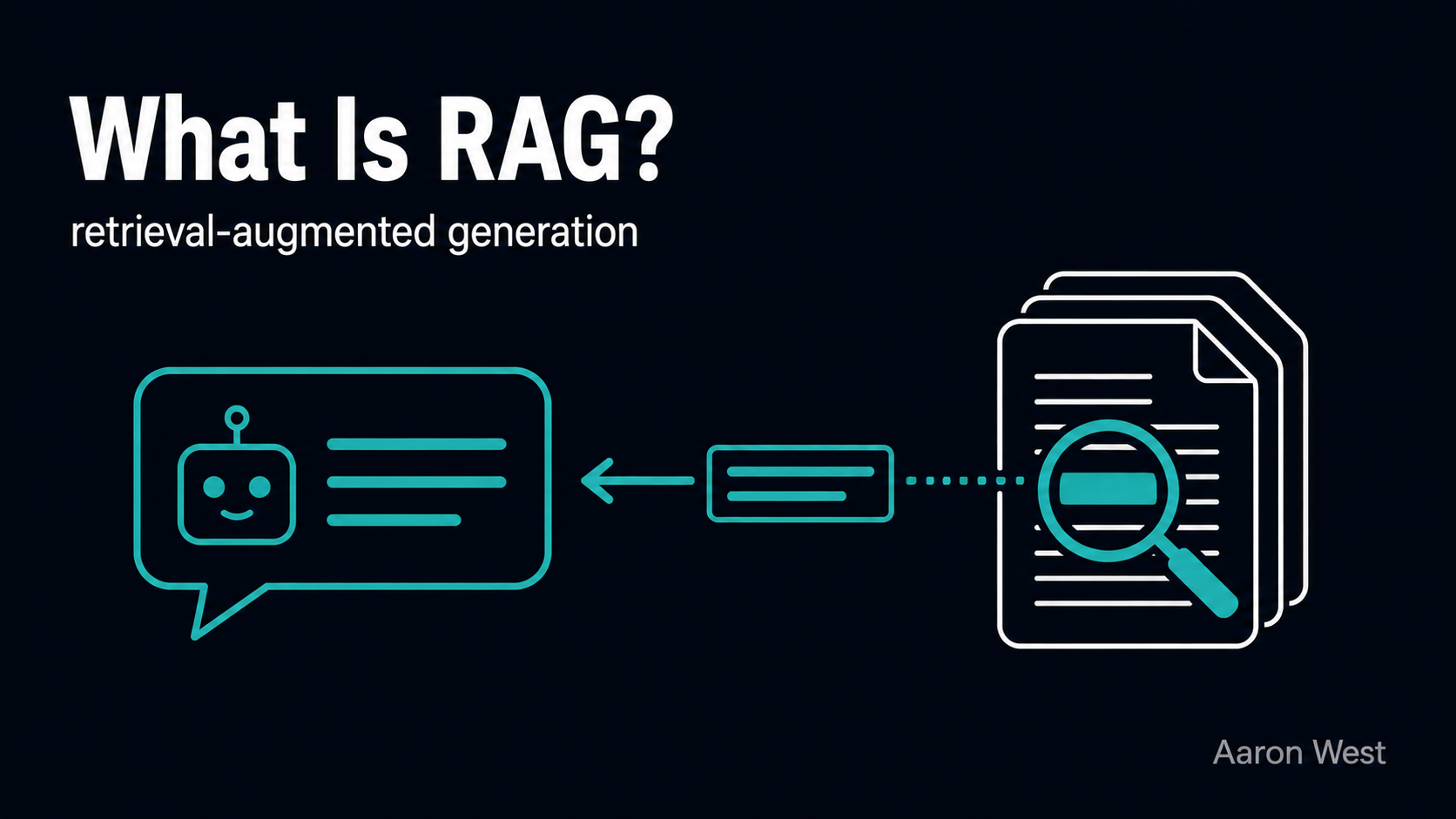
What Is RAG (Retrieval-Augmented Generation), and Why Everyone Is Using It
RAG, retrieval-augmented generation, is a way of making an AI model answer from a specific, trusted set of documents instead of relying only on what it absorbed during training. Before the model writes its answer, the system goes and fetches the most relevant material from…
Continue reading...