Dynamic and Competitive Pricing: When to Move With the Market

Table of Contents
Dynamic pricing means changing your prices in response to demand, time, inventory, or competitors. Competitive pricing means setting them relative to your rivals. Both can be smart in the right conditions and quietly destructive in the wrong ones, and the difference is almost never the algorithm. The real skill is knowing when the market genuinely should move your price and when reacting to it just hands your margin away in a race nobody wins.
This is a core of the Pricing pillar, under the cornerstone that price is a strategy. That cornerstone warned against copying competitors as a default; this piece is about the more sophisticated version of the same temptation, letting the market move your price automatically, and when that's genuinely the right call versus when it's just a faster way to give margin away.
What the two things actually are
Strip the jargon and there are two related ideas here. Dynamic pricing is changing a price in response to a signal: demand rising or falling, the time of day or season, how much stock is left, what a competitor just did. Competitive pricing is anchoring your price to your rivals', whether you match them, undercut them, or deliberately sit above them. The two overlap constantly, because "a competitor changed their price" is one of the signals a dynamic system reacts to.
Both have a legitimate place. The problem is that they're seductive, they feel data-driven and responsive, so stores reach for them as a default operating mode rather than as tools for specific situations. And used as a reflex, they take the most powerful lever in the business and quietly turn it against your own margin.
When moving the price genuinely helps
There are real conditions where letting the market move your price is exactly right:
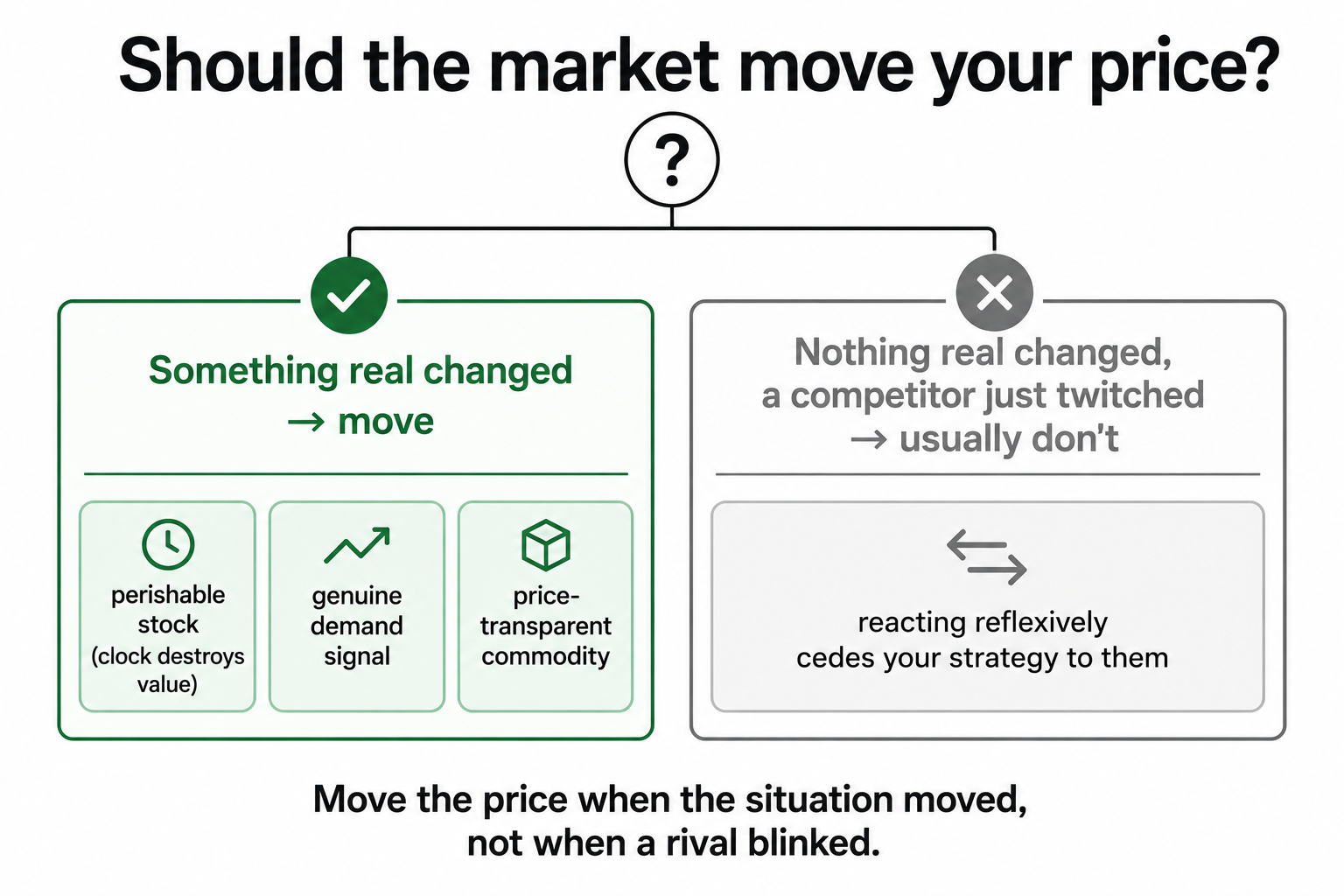
- Perishable or time-sensitive inventory. When the value of a unit decays to nothing at a deadline, an unsold seat after the event, a hotel room after the night, a fresh product near its date, moving price to fill that capacity is rational. A discount that fills a seat which would otherwise earn zero is pure upside. This is the logic airlines and event businesses live by, and it's sound wherever the clock destroys unsold value.
- Genuine demand signals. When demand is genuinely high, a flat price leaves money on the table; when it's genuinely low, a markdown clears stock you'd otherwise sit on. Moving with real demand, not imagined demand, captures value a static price misses.
- Price-transparent commodities. For undifferentiated products that customers compare directly across sellers, you often have to stay within a competitive band just to be considered. Here, watching the market isn't optional; it's table stakes.
Notice what these have in common: in each case, something real has changed, the clock, actual demand, a transparent market you genuinely compete in on price. The price moves because the situation moved.
The dangers nobody prices in
Now the part the dashboards don't show you. Reactive pricing carries costs that don't appear in the short-term sales number, and they compound.
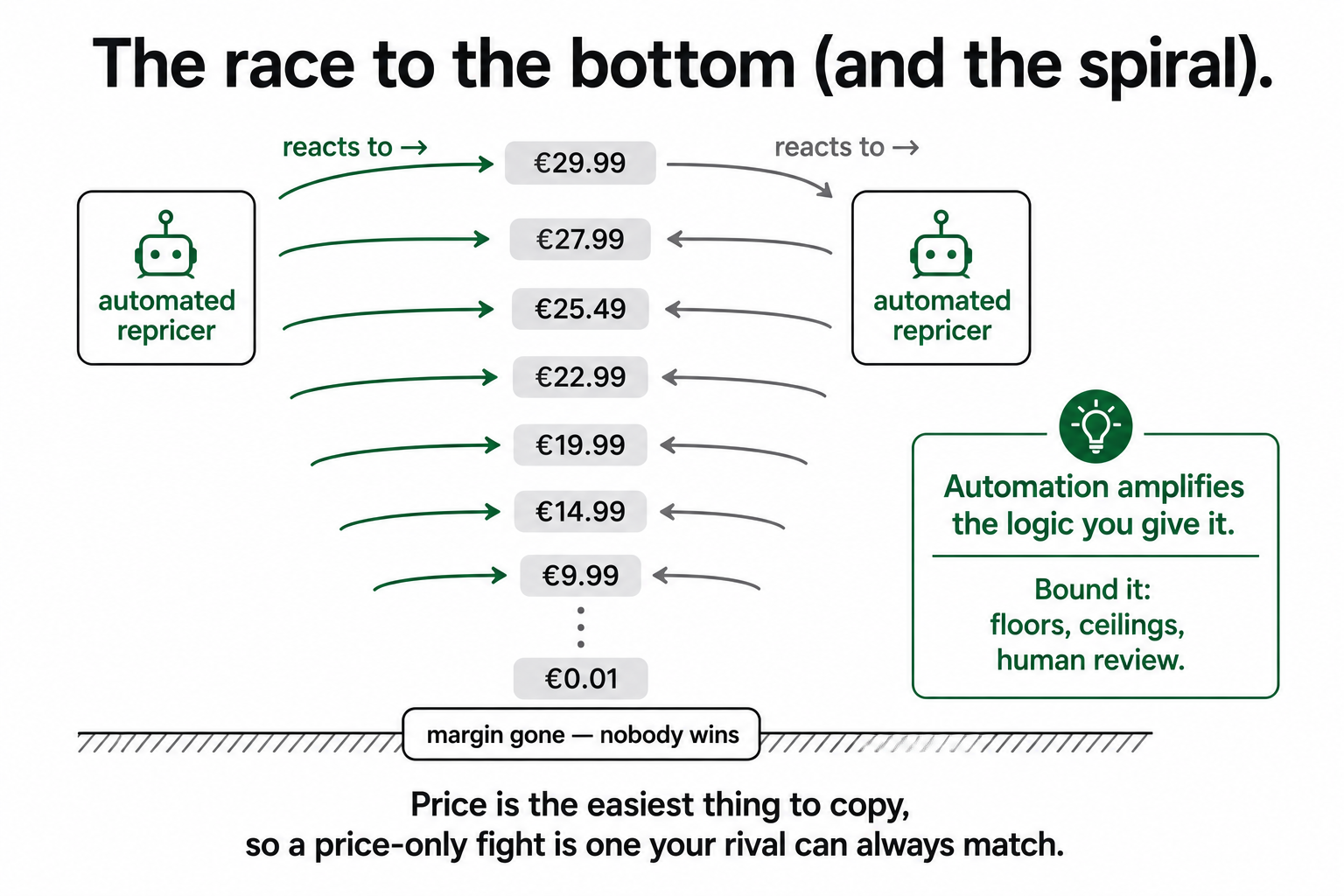
The first is the race to the bottom. Price is the single easiest thing for a competitor to copy, instantly and exactly. So a strategy built on being cheaper is a strategy your competitor can neutralise the moment they notice, and if everyone in a category competes mainly on price, margin erodes for all of them while customers pocket the difference. You can win on many things that are hard to copy. Price is not one of them.
The second is the algorithmic spiral. Automated repricing that reacts to a competitor who is also reacting to you creates a feedback loop with no human judgment in it, and these loops have famously driven prices down to nothing or, just as absurdly, up to impossible numbers, because each system was only ever reading the other. Automation amplifies whatever logic you hand it, including bad logic, which is exactly why anything this consequential needs bounds and a human check. An unbounded repricer is an irreversible, high-stakes action running without a gate, and that's a design mistake, not a feature.
The third is what it teaches your customers. If your prices visibly bounce around, customers learn the game: they wait for the dip, or they feel cheated when they discover they paid more than someone else. Either way you've spent trust, the same trust the honest-anchoring principle depends on, and once customers stop believing your price means anything, every price you show is weaker.
And the fourth is the quiet brand cost. A store that prices purely in reaction to competitors is signalling that it has no sense of its own value, only a position relative to someone else. That undercuts the positioning job the cornerstone described: your price is supposed to say what you are, and it can't, if it's only ever an echo of what your rivals are doing.
The judgment that keeps it useful
So how do you get the upside without the spiral? Ask one question before any price moves: what has actually changed? If the honest answer is something real, real demand, perishable stock running down, a transparent market you genuinely compete in, then moving the price is responding to reality, and that's sound. If the honest answer is just "a competitor moved," that is usually not a reason to move at all. Reacting reflexively to a rival's price hands your strategy to them, and you don't know whether they're running a loss-leader, clearing stock, or simply making a mistake you're about to copy.
And if you do automate any of this, bound it. Set a floor you won't price below and a ceiling you won't exceed, and put a human review on anything outside the normal band. Automated repricing without limits is the textbook case of automating an irreversible action without a gate; the bounds are what keep a useful tool from becoming a margin leak that runs while you sleep.
The honest position is that dynamic and competitive pricing are tools for specific conditions, perishability, transparency, real demand, not a default way to run. Used for what they're good at, they capture value a static price would miss. Used as a reflex, they turn your most powerful lever into something you're pointing at your own margin.
What this comes down to
The market should move your price when something real has changed: demand, value, the clock ticking down on perishable stock. It should not move your price just because a competitor twitched, because that cedes your strategy to a rival whose reasons you don't know and starts a race that destroys margin for everyone in it.
If you let software make these moves, give it limits and a human check, because an unbounded repricer reacting to another unbounded repricer is how prices spiral to absurd places with nobody minding the result. Move with the market when the situation genuinely calls for it. The rest of the time, hold your price and let it keep saying what you decided it should say.
A few common questions
What is dynamic pricing? Changing a price in response to a signal, demand, time, season, remaining stock, or a competitor's price. It's powerful where something real is shifting (perishable inventory whose value decays, genuine demand swings, transparent commodity markets) and risky where it's just a reflex, because reacting automatically to competitors can spiral margin down. The skill is knowing which situation you're in.
When does dynamic pricing genuinely make sense? When something real has changed. Three clear cases: perishable or time-sensitive inventory where unsold units lose all value at a deadline, genuine demand signals (high demand means a flat price leaves money on the table; low demand means a markdown clears stock), and price-transparent commodities where you must stay in a competitive band to be considered at all. In each, the price moves because the situation moved, not because a rival blinked.
Why is competing on price dangerous? Because price is the single easiest thing for a competitor to copy, instantly and exactly, so a strategy built on being cheaper can be neutralised the moment they notice. If everyone competes mainly on price, margin erodes for all of them. And pricing purely in reaction to rivals signals you have no sense of your own value, which undercuts the positioning job your price is supposed to do.
Is automated repricing a good idea? Only with bounds. Automated repricing that reacts to competitors who are reacting to you can spiral prices to nothing, or to absurd highs, because each system only reads the other and there's no judgment in the loop. If you automate it, set a floor and ceiling and put a human review on anything outside the normal band. An unbounded repricer is an irreversible, high-stakes action running without a gate.
You should also read:

Promotions Architecture: Running Offers Without Training Customers to Wait
A promotion should change a behaviour you actually wanted to change: bring in a new customer, clear specific slow-moving stock, reward your best customers, launch something. What it should not do is quietly hand a discount to someone who was going to buy at full…
Continue reading...
Psychological Pricing: What Actually Works and What's Folklore
Psychological pricing is the set of tactics that change how a price is perceived rather than what it costs you: charm pricing like €9.99, anchoring against a higher number, decoy options, and the rest. Some of it is genuinely robust, supported by decades of evidence.
Continue reading...
RAG Explained for E-Commerce: Giving a Bot Your Product Knowledge Without Retraining It
If you want an AI assistant that actually knows your store, your real products, your current prices, your live stock, your specific return policy, the technique you need is RAG, retrieval-augmented generation. It connects the AI to your live business data so it answers from…
Continue reading...