Promotions Architecture: Running Offers Without Training Customers to Wait

Table of Contents
A promotion should change a behaviour you actually wanted to change: bring in a new customer, clear specific slow-moving stock, reward your best customers, launch something. What it should not do is quietly hand a discount to someone who was going to buy at full price anyway. Most stores run promotions reactively, a sale whenever revenue looks soft, and the cumulative effect is that they train their best customers to never pay full price and teach the market that the brand is "really" worth the discounted number. Promotions aren't the problem. Unarchitected promotions are.
This is a core of the Pricing pillar, under the cornerstone that price is a strategy, and it's the natural partner to the discounting capstone that treats a discount as a loan against your margin. The question here is one level up: not "should I discount this," but "what is my whole approach to running offers, and is it building the brand or slowly eroding it."
Incremental or subsidised: the distinction that decides everything
Every promotion you run does one of two things, and telling them apart is the whole game.
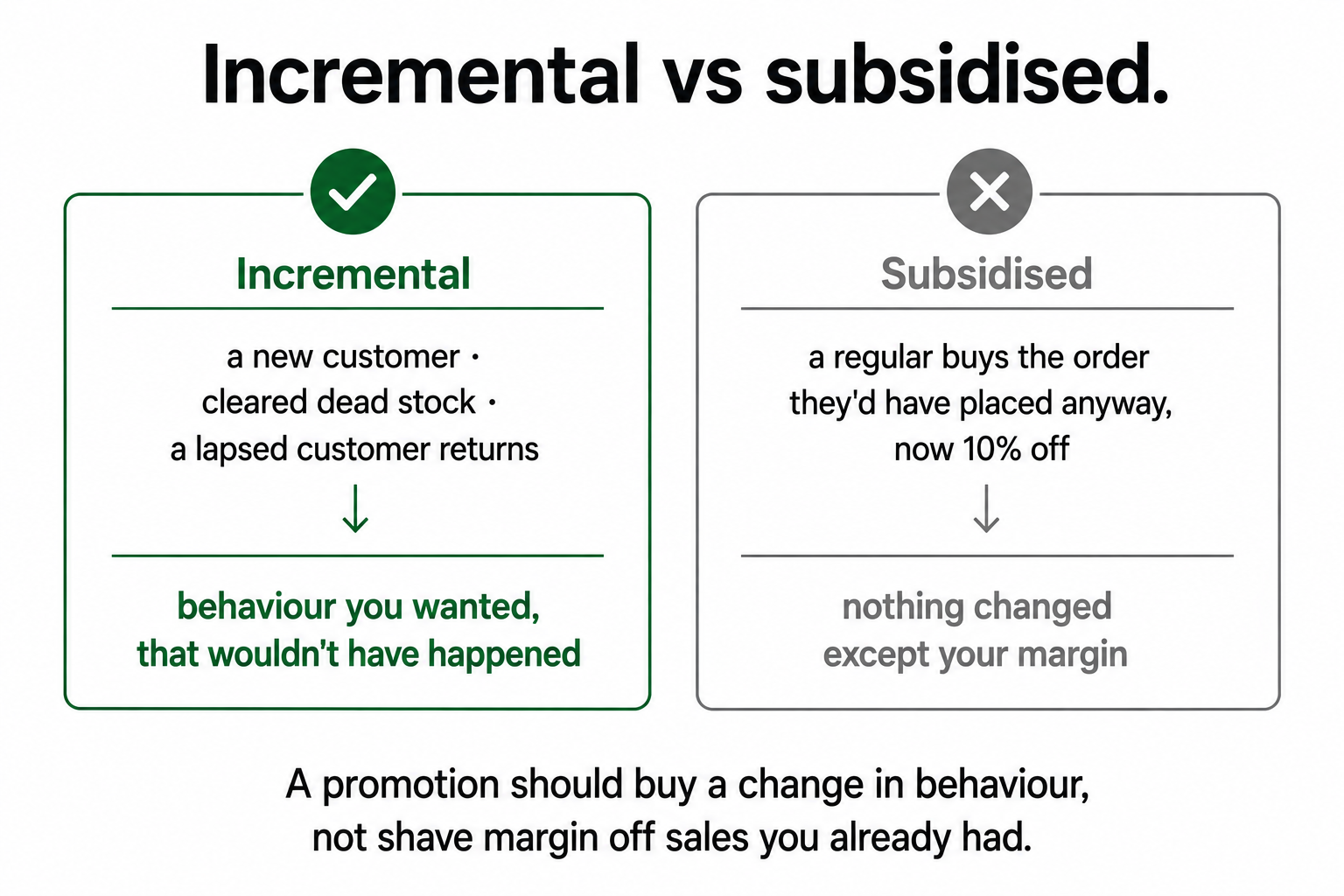
An incremental promotion causes something that wouldn't have happened otherwise: a customer who'd never have tried you places a first order, a piece of dead stock finally clears, a lapsed customer comes back. The discount bought you a real change in behaviour. A subsidised promotion just gives money away on behaviour that was already going to happen: the loyal customer who buys from you every month gets ten percent off the order they'd have placed at full price regardless. Nothing changed except your margin, which went down.
This is the same idea that runs through smart budget allocation in paid media: are you creating a sale or just claiming one that was coming anyway? A promotion that looks great on gross sales during the sale period can be almost entirely subsidised, you sold a lot, but you'd have sold most of it at full price, so all the discount did was shave the margin off sales you already had. The headline number lies. Incrementality is the truth.
The reactive-promotion trap
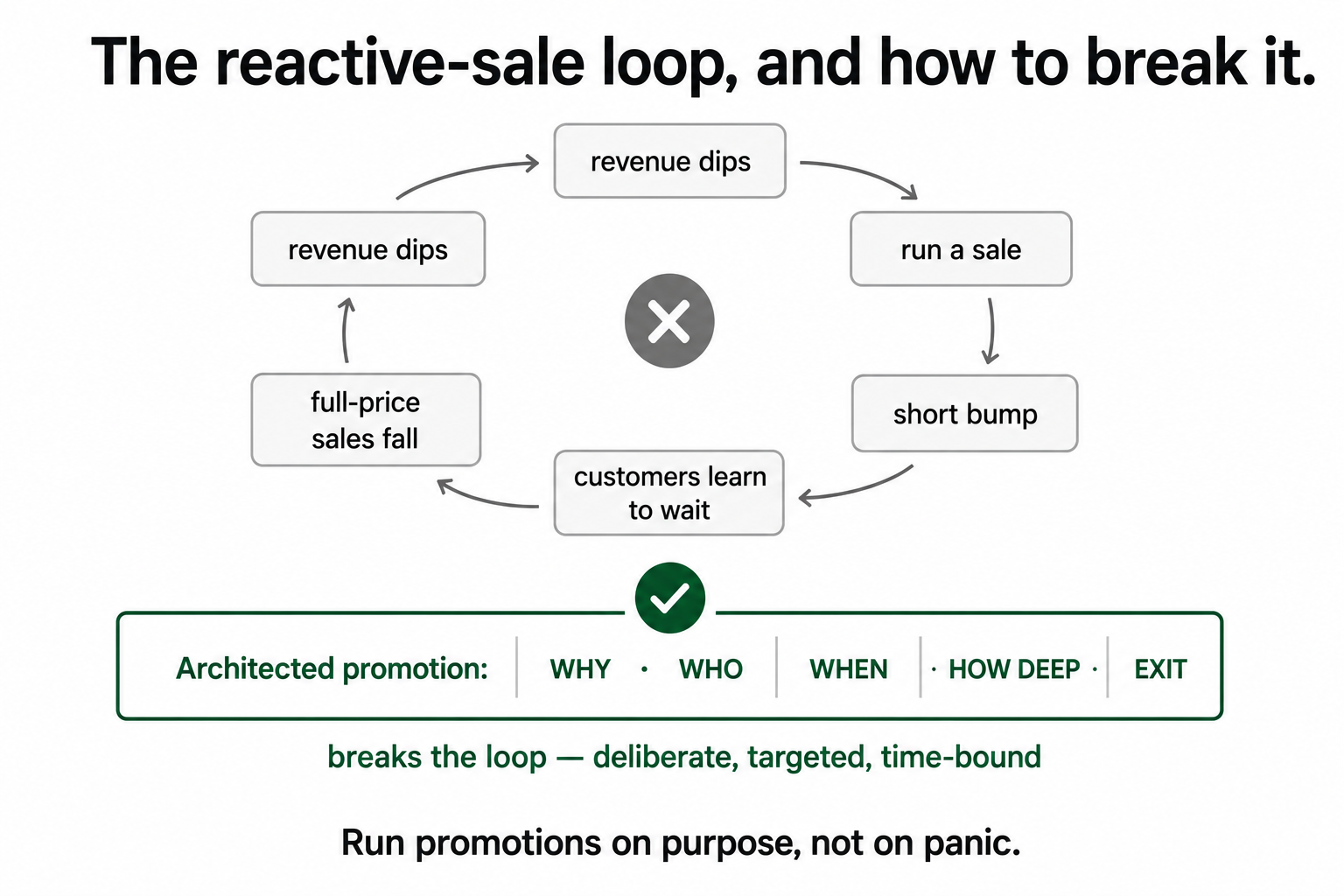
Here's how most stores end up in trouble without ever deciding to. Revenue looks soft this month, so they run a sale. Sales jump, the month is rescued, everyone's relieved. Next time revenue dips, they reach for the same lever, because it worked. And it keeps "working," in the sense that each sale produces a bump, right up until the point where customers have learned the pattern.
Once customers learn that a sale comes whenever things are quiet, two things happen, both bad. The customers who would have paid full price start waiting, because why pay full price when a discount is clearly coming? And the discounted price starts to feel like the real price, with the full price reading as the inflated one you're "supposed" to ignore. You haven't grown demand; you've moved it around in time and trained away your own full-price sales. The promotion that once rescued a soft month is now the reason your months are soft, and the only way out feels like a deeper discount, which teaches the lesson harder. That's the discount-as-loan dynamic playing out across the whole store.
What a promotions architecture actually is
The fix isn't "never discount." It's to stop running promotions on reflex and start running them on purpose. A promotions architecture is just a deliberate answer, for every offer before you launch it, to five questions:
- Why? The goal. Acquire new customers, clear specific stock, reward loyalty, launch a product. "Revenue is soft" is a symptom, not a goal, and it's the answer that leads straight into the trap.
- Who? Everyone, or a defined segment. A blanket sitewide sale discounts your full-price loyalists along with everyone else; a targeted offer reaches only the people whose behaviour you're trying to change.
- When? A reasoned calendar and genuine triggers, not a panic response to a dashboard. Seasonal moments and real events, not "it's been a slow week."
- How deep? The smallest discount that achieves the goal. Depth should be set by what it takes to move the behaviour, not by reflex. A bigger discount than necessary is wasted margin and a louder "wait for the sale" signal.
- The exit? It ends, clearly and on a date. A promotion with no end isn't a promotion; it's a price cut wearing a sale's clothing, and a permanent "sale" banner just becomes your real price (and, with a fake "was" reference, can cross into the deceptive-pricing territory the psychological-pricing piece flags).
Answer those five honestly and most of the bad promotions never launch, because they fail the "why" or the "who" before they start.
The disciplines that keep promotions healthy
A few principles follow directly from the five questions, and they're what separate a promotions programme that builds a brand from one that erodes it:
- Targeted beats blanket. A sitewide sale is the bluntest, most margin-wasteful tool you have, because it discounts everyone, including the people who'd happily have paid full price. A targeted offer, lapsed customers, a specific segment, a particular slow category, is more incremental and far less corrosive to your full-price norm. This is where promotions meet retention: a reward aimed at existing good customers builds the relationship instead of teaching deal-dependency.
- Smallest effective discount. Match the depth to the goal. If a small nudge clears the stock, don't run thirty percent because it feels more exciting. Every extra point of discount is margin gone and a stronger signal to wait.
- Protect the full-price norm. The default state of your store is full price; promotions are deliberate, occasional, reasoned exceptions. The moment "on sale" becomes the resting state, the full price stops meaning anything and you've repriced the whole store downward without deciding to.
- Judge on incrementality, not gross sales. A promotion's success isn't the sales total during the sale, which includes everyone who'd have bought anyway. It's whether it brought sales, customers, or behaviour you genuinely wouldn't have had, the same decision-metric discipline the rest of the hub argues for. A promotion that looks huge on gross revenue and tiny on incrementality is a margin giveaway with good optics.
What this comes down to
Every promotion you run teaches your customers something about what your product is worth. Run them deliberately, with a real reason, a defined audience, the smallest effective discount, and a clear end, and they teach "this brand discounts occasionally, for a reason." Run them on reflex, whenever the numbers look soft, and they teach the one lesson you cannot afford your best customers to learn: never pay full price, because a sale is always coming.
The reflex to "just run a sale" when revenue dips is the most expensive habit in e-commerce, because each one borrows a little more of your full-price credibility, and that's a loan that compounds. Architect your promotions around purpose and they're a precision instrument. Run them on panic and they slowly, quietly, become your real price.
A few common questions
What makes a promotion good or bad? Whether it's incremental or subsidised. A good promotion causes something that wouldn't have happened otherwise, a new customer, cleared dead stock, a lapsed customer returning. A bad one just hands a discount to someone who'd have bought at full price anyway, so nothing changes except your margin. A sale can look great on gross revenue while being almost entirely subsidised, which is why you judge it on incrementality, not the headline total.
Why is running frequent sales risky? Because customers learn the pattern. Once they know a sale comes whenever things are quiet, the ones who'd have paid full price start waiting, and the discounted price starts to feel like the real price. You don't grow demand; you move it around in time and train away your own full-price sales, so the promotion that rescued a soft month becomes the reason your months are soft, and the only apparent fix is a deeper discount that teaches the lesson harder.
What is a promotions architecture? A deliberate answer, for every offer before you launch it, to five questions: why (the real goal, not "revenue is soft"), who (blanket or a targeted segment), when (a reasoned calendar, not a panic response), how deep (the smallest discount that moves the behaviour), and the exit (a clear end date). Answering these honestly stops most bad promotions before they launch, because they fail the "why" or the "who."
Should I run a sitewide sale? Rarely. A sitewide sale is the bluntest tool you have because it discounts everyone, including the customers who'd happily have paid full price, so it's the least incremental and most brand-eroding option. Targeted offers, aimed at lapsed customers, a specific segment, or a particular slow category, change the behaviour you actually want to change while protecting your full-price norm. Reserve blanket sales for genuine, deliberate, time-bound moments.
You should also read:
On-Site Search: Where Your Highest-Intent Customers Live
The customer who uses your on-site search is usually the highest-intent visitor you have. They've told you, in their own words, exactly what they want. Get search right and they convert at a much higher rate than people who only browse. Get it wrong, returning…
Continue reading...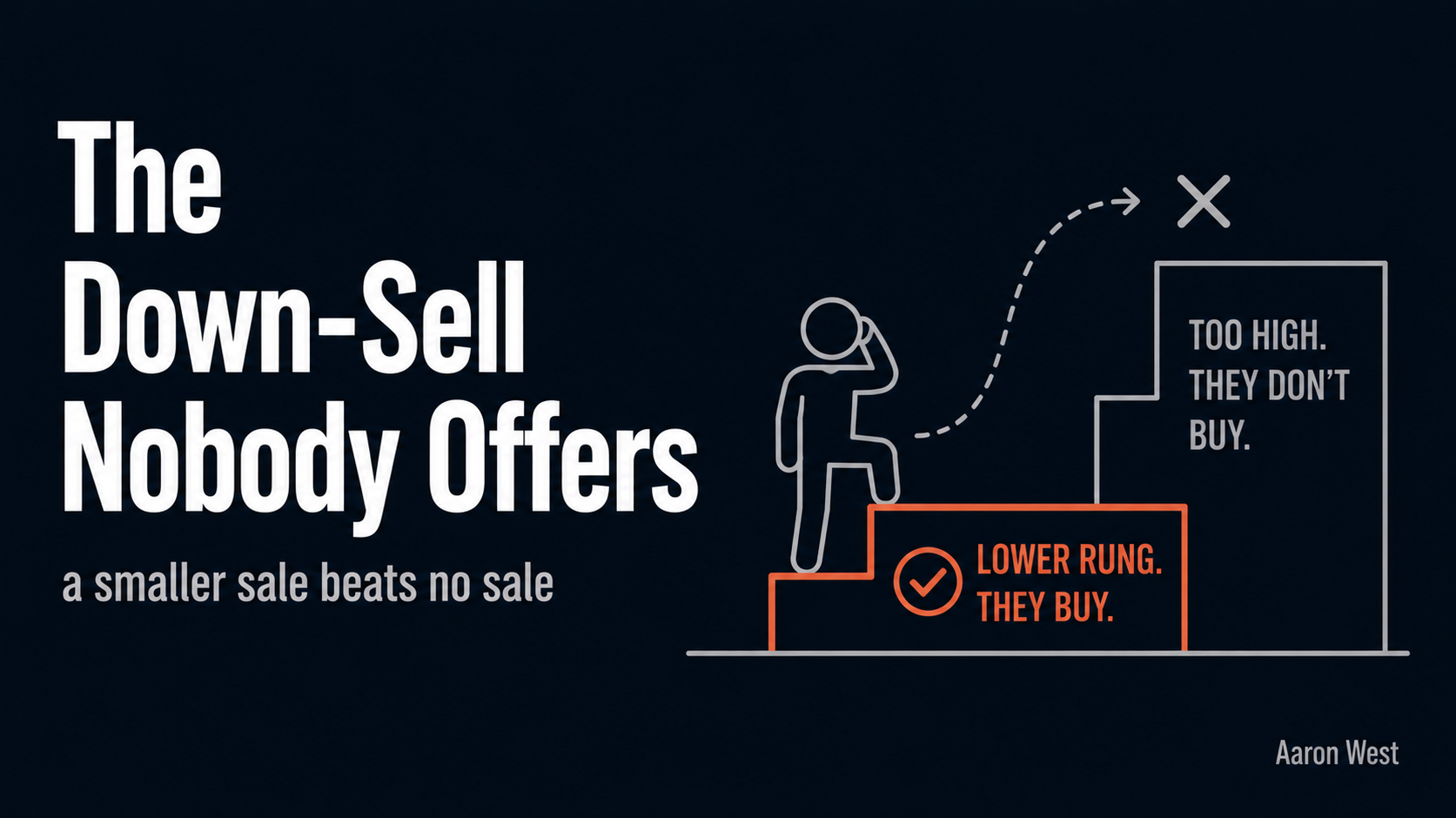
The Down-Sell Nobody Offers (and Why It Saves the Sale)
Almost every online store has an upsell. Almost none have a down-sell. We pour energy into getting customers to spend more, the upgrade, the add-on, the bundle, and we completely ignore the move that saves the sale when a customer is about to spend nothing.
Continue reading...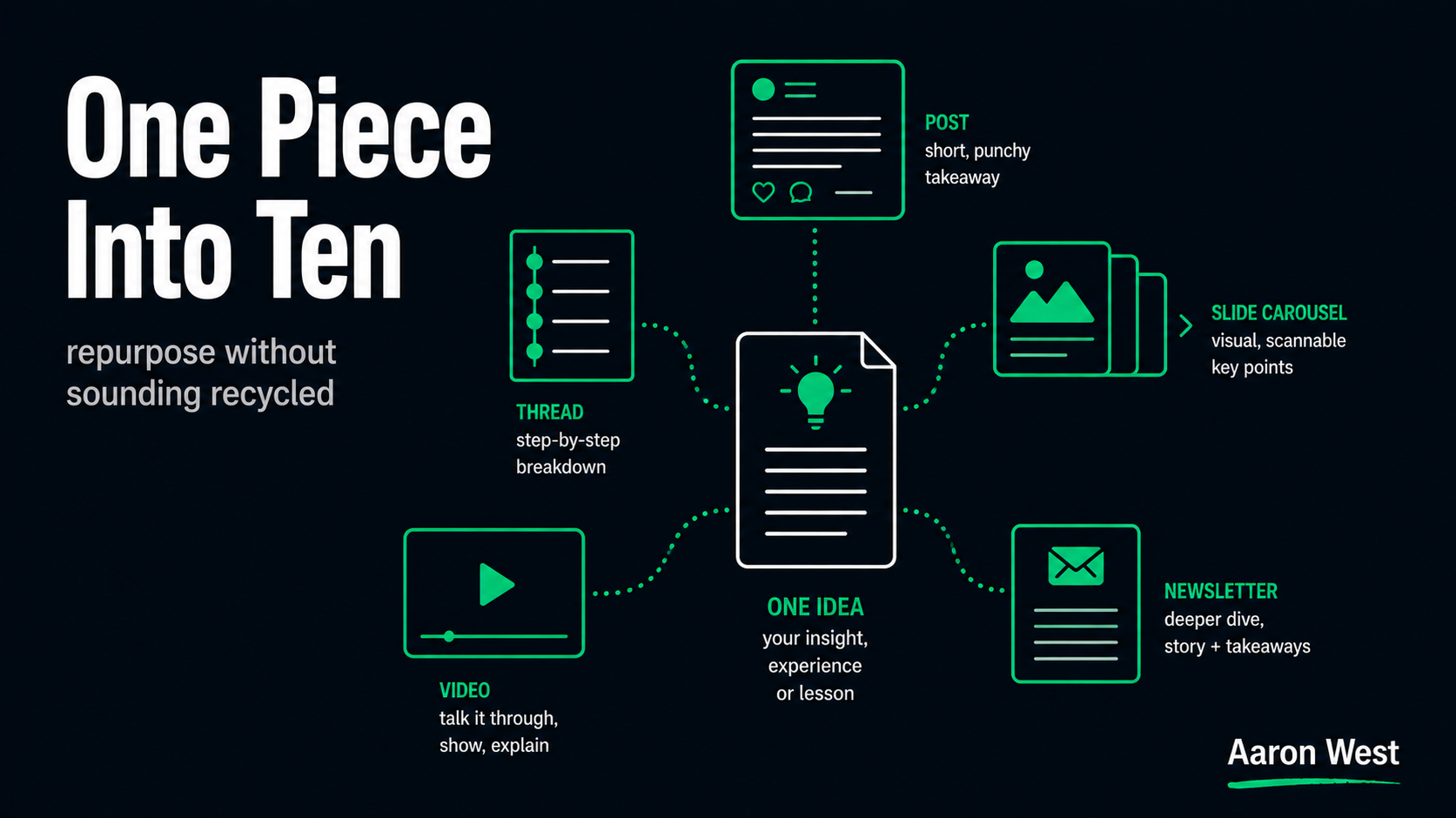
How I Use AI to Turn One Piece of Content Into Ten (Without It Sounding Recycled)
The promise of AI content repurposing is seductive: write one thing, turn it into ten, flood every channel. The reality is that most people do it badly, and badly here has a specific, recognisable shape, they take one post and paste a near-identical version onto…
Continue reading...