B2B Pricing and Quoting: Why There's No Such Thing as One Price

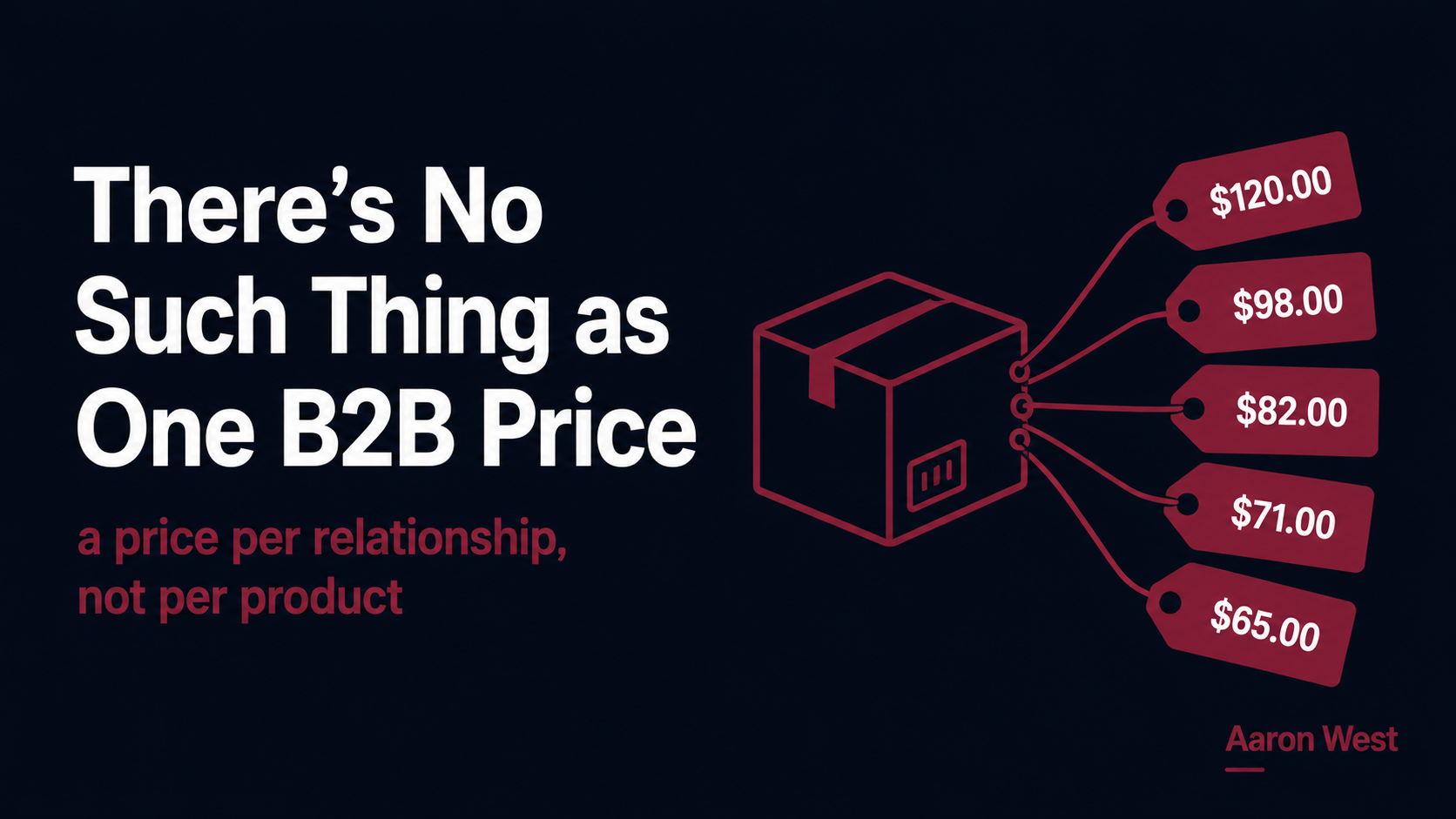
Table of Contents
In B2B, there is rarely one price. The same product sells at different prices to different customers, set by negotiated rates, volume tiers, and contracts, and a large share of B2B sales begin with a quote rather than a price tag. A B2B store's pricing job isn't to display a number on a page. It's to show each account its own correct price, and to make requesting and agreeing a quote effortless. Treat B2B pricing like B2C's single public number and you'll do one of two things: scare serious buyers away, or quietly leak margin.
This is a core of the B2B E-Commerce cluster, and it's the difference the consumer playbook handles worst. In B2C there's a public price and everyone pays it. In B2B there's a price per relationship, and that isn't a complication to hide. It's the model.
Why B2B pricing is plural
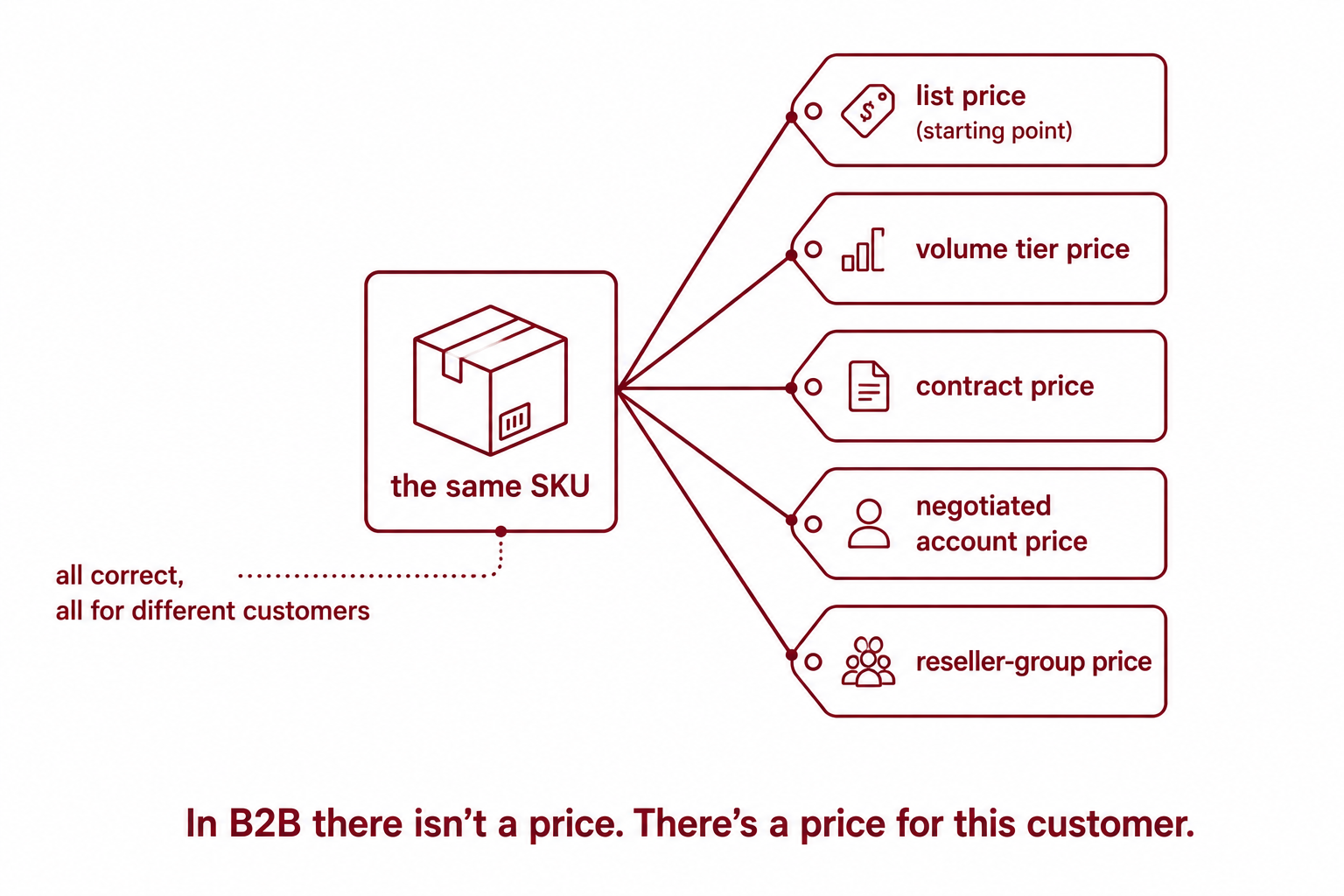
Start with the thing that breaks the consumer instinct: in B2B, one product legitimately has many prices. A small first-time buyer and a large contracted account pay different amounts for the identical item, and both prices are correct. That plurality comes from a few standard structures:
- Account-specific pricing. A negotiated rate agreed with a particular customer, often as part of a wider deal.
- Volume and tier pricing. The price drops as the quantity rises, because a buyer taking ten thousand units genuinely earns a better rate than one taking ten.
- Contract pricing. A fixed price locked in for the term of an agreement, regardless of what the list price does.
- Customer-group pricing. Whole segments, distributors, resellers, education, priced differently by policy.
None of these is an exception or a hack. Together they are B2B pricing. A store that can only show one public number can't represent any of them.
List price versus the real price
There's usually a list price, an RRP, a starting point. But in B2B the list price is rarely the price anyone serious actually pays; it's the opening position before account terms apply. This creates a trap with two bad exits.
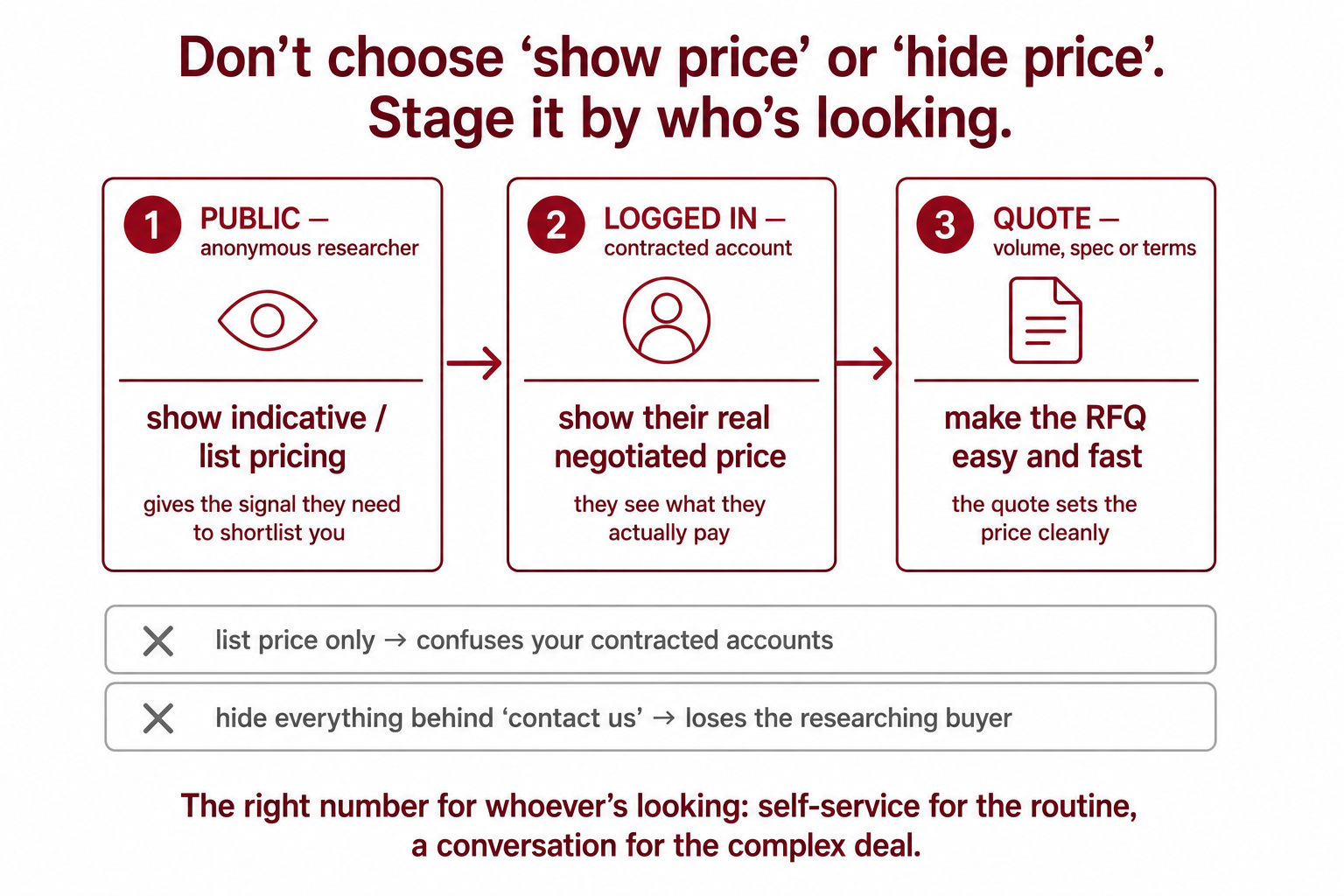
Show only the list price, and your contracted accounts see a number that's wrong for them, higher than what they've agreed, which is confusing at best and damaging at worst. Hide all pricing behind "contact us," and you lose the self-researching buyer who needs a price signal to put you on the shortlist, before anyone at your company knows they exist. Both exits cost you. The way through is not "show price or hide price." It's show the right price to the right account, which means pricing that's aware of who's logged in.
The quote is a pricing mechanism, not a fallback
When the right price genuinely depends on volume, specification, or terms, the quote isn't a failure to display a price. It's how the price gets set. A big share of B2B sales properly begin with a request for quote, and how your store handles that flow is a pricing decision in disguise.
The bad version treats the quote as a dead end: "price on application," a form into the void, silence for days. The good version treats it as a first-class pricing path, the buyer requests easily, you respond promptly, there's room to negotiate, and an accepted quote converts cleanly into an order at the agreed price. For a large or complex order, a fast, professional quote is your pricing page. Make it slow or painful and you've priced yourself out before you ever named a number.
The margin discipline underneath it all
Here's where B2B pricing gets dangerous, because every one of those negotiated prices is a margin decision, and they add up quietly. A volume discount is only worth giving if the volume actually pays for it. An account-specific rate is a permanent giveaway unless it's tied to something the account keeps doing. And the deepest trap is training your customers to always negotiate down: if every account learns that the first price is never the real price, you've taught your whole base to grind you on margin at every order.
This is the same logic as discounting in general, and it applies harder in B2B because the discounts are bigger and the relationships are longer. A discount is a loan against your margin, and a negotiated B2B rate is a standing one. Give it for a reason the account earns, document why, and review it, rather than letting "we always knock something off" become the culture. The lifetime value of a B2B account is large, which means a careless few points of margin given away on every order compounds into real money lost over years.
The transparency tension, resolved
Modern B2B buyers increasingly want to see a price without booking a sales call, the same self-service expectation they've learned as consumers. But pricing is account-specific, so you can't just slap one public number on everything. These two truths feel like they conflict. They don't, if you stage it:
Show indicative or list pricing publicly, so a researching buyer gets the signal they need to shortlist you. Show the account's real, negotiated price on login, so contracted customers see what they actually pay. And make the quote easy for everything that genuinely depends on volume, spec, or terms. That's self-service for the routine and human involvement for the complex deal, the same division that runs through all of good B2B. The buyer who wants a number gets one; the deal that needs a conversation gets one too.
What this comes down to
Stop looking for the one price. In B2B there isn't one. There's a price for this customer, at this volume, on these terms, and the store's job is to make that price easy to find, fair to both sides, and quick to agree, while protecting the margin that a careless discount habit quietly drains away.
Pricing per relationship is more work than a price tag. It's also the actual B2B model, and the stores that handle it cleanly win the buyers that the "one public number" stores either confuse or never see.
A few common questions
Why does B2B have different prices for different customers? Because B2B pricing is built on account-specific rates, volume and tier pricing, contract pricing, and customer-group pricing. The same product legitimately sells at different prices to a small first-time buyer and a large contracted account, and both are correct. A store that can only display one public number can't represent any of this, which is why consumer pricing logic fails in B2B.
Should a B2B store show prices publicly or hide them? Neither extreme works. Show only the list price and contracted accounts see a number that's wrong for them; hide everything behind "contact us" and you lose self-researching buyers who need a price signal to shortlist you. The answer is to show indicative or list pricing publicly, the account's real negotiated price on login, and make quoting easy for anything that depends on volume, spec, or terms.
What is an RFQ and how does it relate to pricing? RFQ means "request for quote." When the right price depends on volume, specification, or terms, the quote is how the price actually gets set, so it's a pricing mechanism, not a fallback. A good store treats it as a first-class flow: easy to request, promptly answered, room to negotiate, and a clean path from accepted quote to order. For a large order, a fast professional quote is effectively your pricing page.
What's the biggest pricing mistake in B2B? Training your customers to always negotiate down. If every account learns the first price is never the real price, you've taught your whole base to grind your margin on every order. A negotiated B2B rate is a standing loan against your margin, so give discounts for reasons the account earns, document them, and review them, rather than letting "we always knock something off" become the culture.
You should also read:
Product Taxonomy: The Structure Everything Else Depends On
Product taxonomy is how you classify and organise your products, the categories, subcategories, and attributes that everything else is built on top of: search, filters, navigation, category pages, recommendations. It's the most unglamorous decision in merchandising and quietly the most consequential, because when the structure…
Continue reading...
Psychological Pricing: What Actually Works and What's Folklore
Psychological pricing is the set of tactics that change how a price is perceived rather than what it costs you: charm pricing like €9.99, anchoring against a higher number, decoy options, and the rest. Some of it is genuinely robust, supported by decades of evidence.
Continue reading...
Pricing Is a Strategy, Not a Number You Pick
Pricing is the most powerful lever in your business and the one most stores treat most carelessly. A change in price flows almost entirely to profit, signals your quality, positions your brand, and decides who buys from you, yet most stores set prices by adding…
Continue reading...