B2B E-Commerce Is Not B2C With Bigger Orders

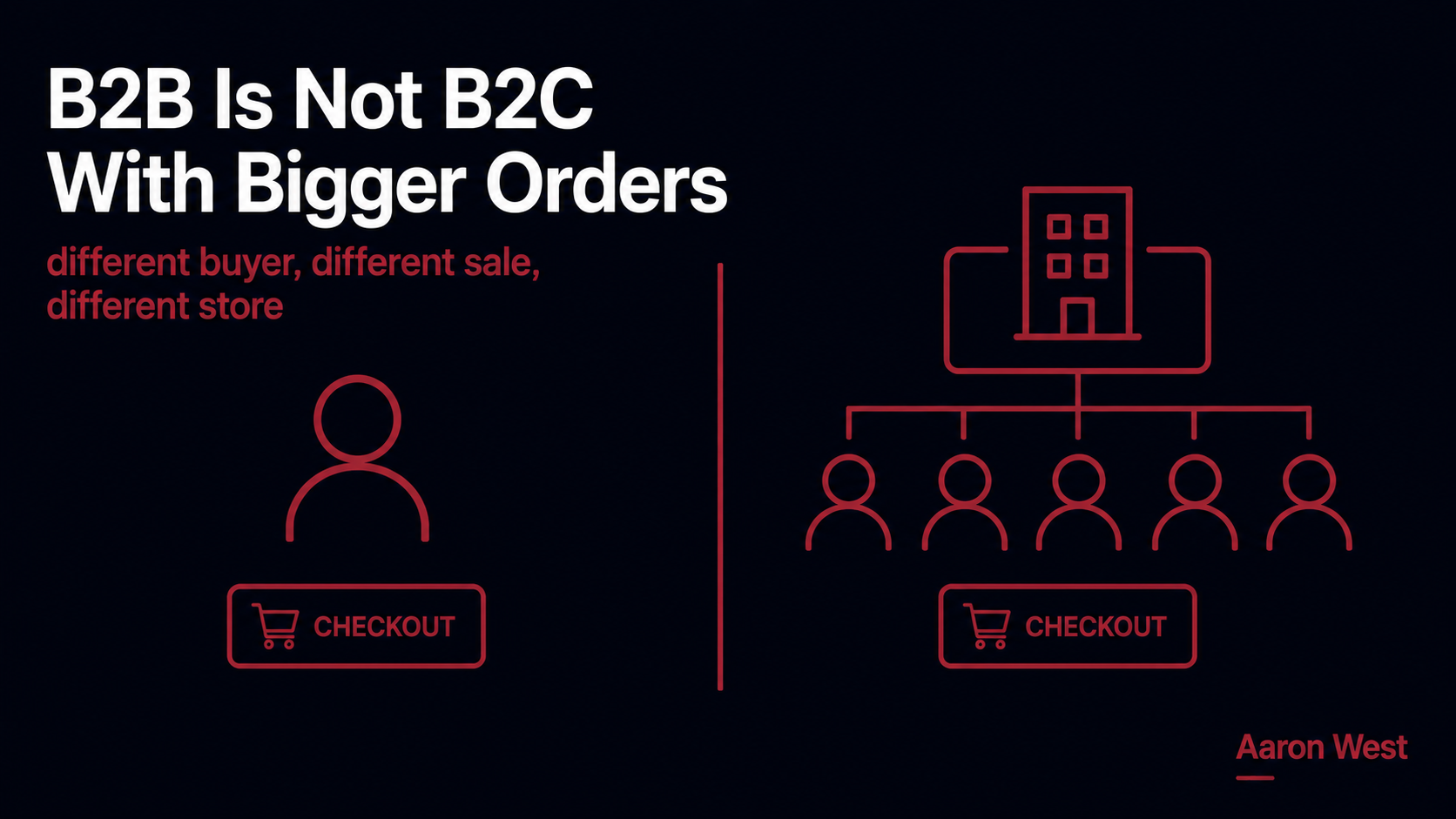
Table of Contents
B2B e-commerce is selling to other businesses through an online channel, and the single most expensive mistake is treating it as B2C with bigger order values. The buyer is a professional spending someone else's money, the purchase usually involves several people and an approval chain, the price is often negotiated rather than posted, the payment is on terms rather than a card, and the relationship matters more than any one transaction. Get that difference and the rest of B2B follows. Miss it and you build a beautiful consumer store that B2B buyers can't actually use.
This is the cornerstone of the B2B E-Commerce cluster. It exists because most "B2B e-commerce" advice is really B2C advice with the word "trade" sprinkled on top, and the gap between the two is the whole subject.
What B2B e-commerce actually is
B2B e-commerce is businesses buying from businesses online: wholesale and distribution, manufacturing supply, parts and components, office and operational supplies, software and services bought by a company. The defining feature isn't the size of the order. It's that the customer is an organisation, not a person spending their own money on something they want.
That one fact, the customer is an organisation, reshapes everything. An organisation buys differently from a person: more rationally, more slowly, with more people involved, on terms, and as part of an ongoing operational relationship rather than a one-off purchase. The store that serves that buyer well looks quite different from a consumer storefront, even when it's selling similar things.
The core difference: the buyer is not a consumer
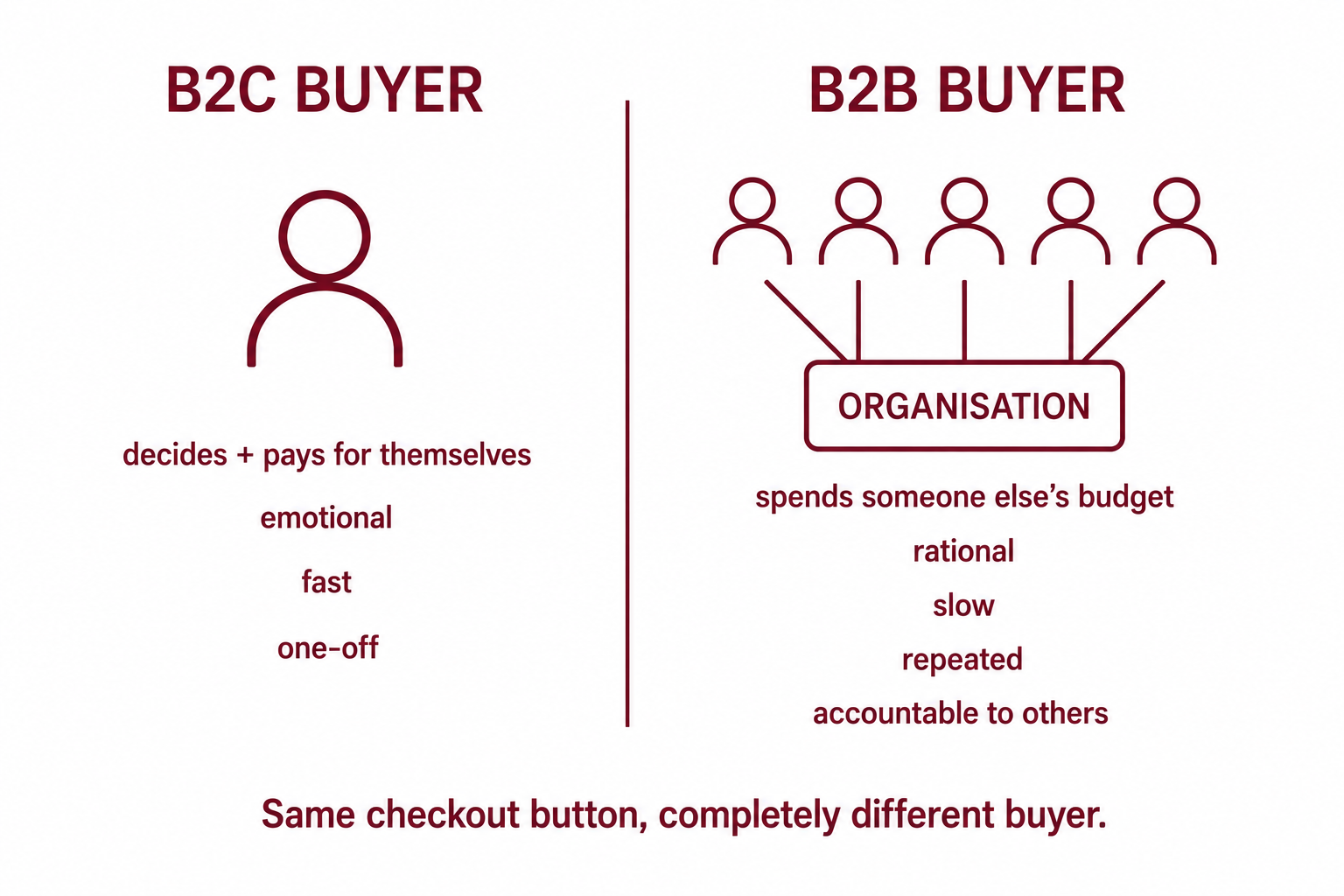
Start with the buyer, because everything else flows from it. A B2C buyer decides and pays for themselves. The decision is often emotional, usually quick, and the consequences land on the person making it. The whole consumer playbook, persuasive imagery, urgency, the frictionless one-click checkout, is tuned to a single person feeling a want and acting on it.
A B2B buyer is a professional doing a job. They're frequently spending a budget that isn't theirs, accountable to colleagues and a manager, buying rationally against requirements, and likely to buy the same thing again and again. They don't want to be persuaded; they want to be enabled, to find the right product, get the right price, get it approved, and reorder it without friction next quarter. The emotional one-click model isn't just unnecessary for them. It actively gets in the way.
The five ways B2B genuinely differs
Underneath the surface, five mechanics separate B2B from B2C. Each one breaks the consumer model in a specific way.
1. The buying unit is a committee, not a person. A B2B purchase typically involves several people, the person who needs it, the person who researches it, the person who approves it, sometimes a procurement function. The "one shopper, one decision, add to cart" model assumes a single decision-maker, but in B2B the person clicking often can't authorise the spend at all.
2. Price is negotiated, not posted. In B2B the same product frequently has different prices for different customers, account-specific rates, volume tiers, contract pricing. This is the exact opposite of B2C's single public price, and it means "show price, add to cart" is often the wrong default. Many B2B sales begin with a request for a quote, not a price tag.
3. Payment is on terms, not on the card. B2B routinely runs on purchase orders, invoicing, and net-30 or net-60 terms backed by a credit line, not a card charged at checkout. "Pay now" can be precisely the wrong checkout for a buyer whose finance team pays on terms thirty days later.
4. Orders are large, repeated, and rules-bound. Minimum order quantities, scheduled reorders, contract catalogs that limit what an account can buy, approval limits per user. The order isn't a one-off impulse; it's part of a recurring operational rhythm with rules attached.
5. The relationship outlasts the transaction. Behind most B2B commerce sits a sales rep, an account manager, or a contract. The online channel supports that relationship, it rarely replaces it. The transaction is one moment in a relationship measured in years, not a self-contained event.
What this means for the store you build
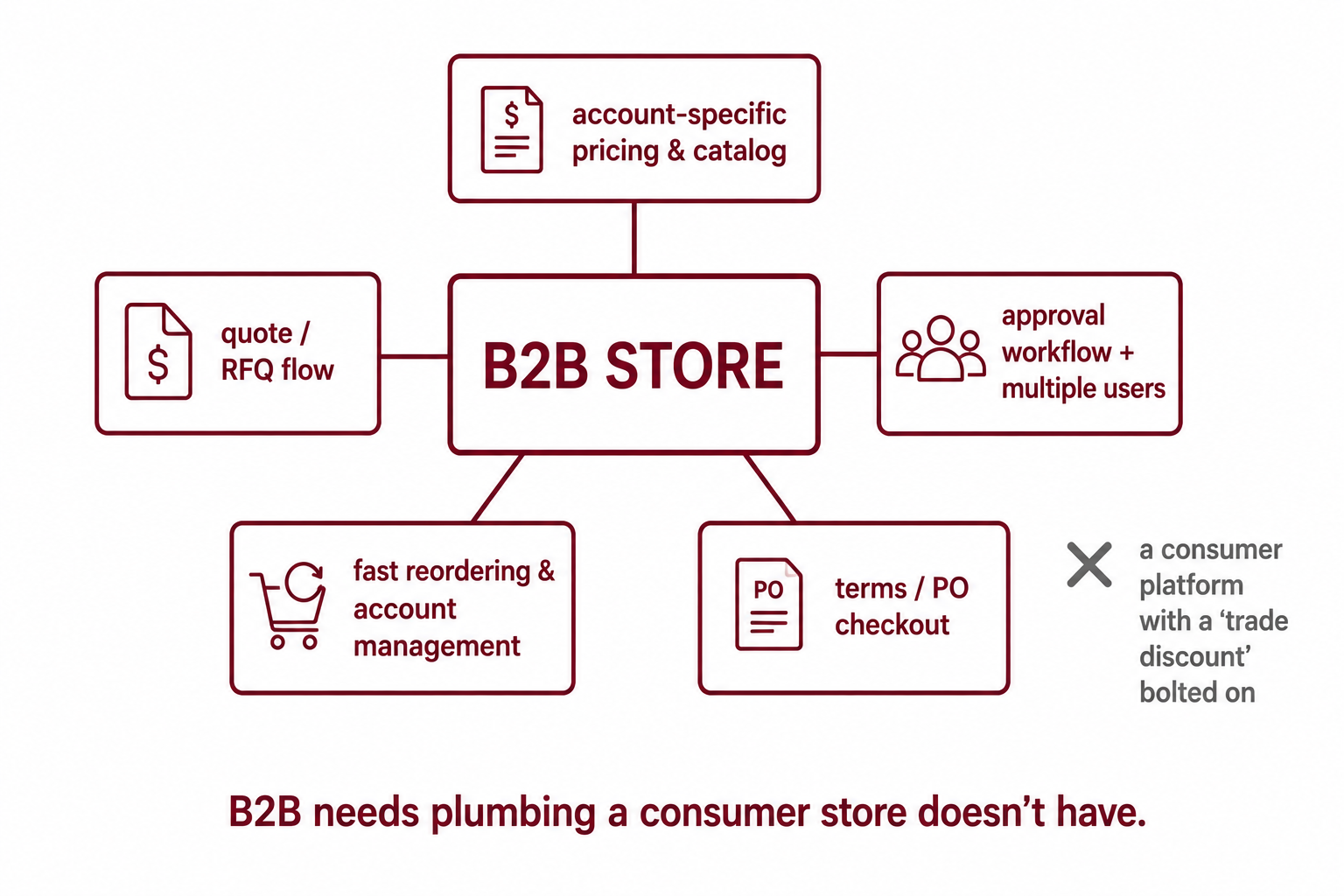
Those five differences aren't abstract. They translate into concrete things a B2B store needs that a B2C store simply doesn't:
- Customer-specific catalogs and pricing, so each account sees its own negotiated prices and the products it's actually allowed to buy.
- Quote and RFQ flows, so a buyer can request a price and you can respond, negotiate, and convert it to an order, rather than hitting a dead "call us" wall.
- Approval workflows and multiple users per account, so a buyer can build an order and route it to whoever signs off.
- Reordering and account management, so the repeat business, which is where B2B money actually lives, is effortless.
- Terms-based checkout, so a buyer can order on a purchase order or invoice, not just a card.
The recurring failure in B2B e-commerce is bolting these onto a platform built for consumers and discovering it fights you at every turn. Choosing or building for these requirements from the start, the kind of decision the platform-choice framework is for, is most of getting B2B right.
What people get backwards
Here's the trap on the other side. Because B2B is more complex, teams sometimes build a clunky, ugly, hard-to-use B2B portal and excuse it with "B2B buyers don't care about experience." That was never quite true, and today it's badly wrong.
B2B buyers are also consumers in their own lives. They've been trained by good consumer experiences to expect self-service, fast search, clear product data, and a checkout that works. They now want a B2C-quality experience, but on top of B2B mechanics, not instead of them. The winning B2B store has consumer-grade usability and business-grade plumbing at the same time: as easy to use as a good consumer site, and able to handle quotes, approvals, terms, and account pricing underneath. Teams that pick only one, slick but unable to handle a quote, or capable but miserable to use, lose to the ones that do both.
A forward note worth holding: this is also where the next shift is heading. As AI agents start to act in commerce, B2B buying, with its structured, repeatable, rules-based nature, is squarely in their path; agent-assisted quoting and reordering is a realistic near-term direction, not science fiction. The B2B stores built on clean, structured, machine-readable foundations now are the ones that will be ready for it.
What this comes down to
The bigger order value is the least interesting thing about B2B. The committee, the negotiated price, the terms, the rules, and the long relationship, that's the actual subject, and the store has to serve all of it without losing the usability buyers now expect.
So stop building B2B as B2C with a trade discount. It's a different sale, with different mechanics, wearing a consumer-grade interface on top. Build for the buyer you actually have, an accountable professional inside an organisation, not the impulse shopper you wish they were, and the rest of B2B starts to make sense.
A few common questions
What is B2B e-commerce? Selling to other businesses through an online channel, wholesale, distribution, supplies, components, software bought by a company. The defining feature isn't order size; it's that the customer is an organisation rather than a person spending their own money. That reshapes everything: organisations buy more rationally and slowly, with more people involved, on terms, as part of an ongoing operational relationship rather than a one-off purchase.
How is B2B e-commerce different from B2C? Five core ways. The buying unit is a committee, not a single person (the one clicking often can't authorise the spend). Price is negotiated, not posted (account-specific and volume pricing, often starting with a quote). Payment is on terms, not a card (purchase orders, net-30/60, credit lines). Orders are large, repeated, and rules-bound (minimum quantities, reorders, contract catalogs, approval limits). And the relationship outlasts the transaction (a rep or account manager sits behind it). The bigger order value is the least important difference.
What does a B2B store need that a B2C store doesn't? Customer-specific catalogs and pricing (each account sees its own negotiated prices and permitted products), quote/RFQ flows, approval workflows with multiple users per account, easy reordering and account management, and terms-based checkout (pay by PO or invoice, not just card). Bolting these onto a consumer platform is the recurring failure; serving them from the start is most of getting B2B right.
Do B2B buyers care about user experience? Yes, more than ever. B2B buyers are consumers in their own lives and have been trained to expect self-service, fast search, clear data, and a checkout that works. They want a B2C-quality experience on top of B2B mechanics, not instead of them. The winning B2B store is as easy to use as a good consumer site and able to handle quotes, approvals, terms, and account pricing underneath, both at once.
You should also read:
The E-Commerce Manager's Guide to AWS Without an Engineering Degree
You do not need to understand all of AWS. You need to understand maybe six services and one mental model, and that is enough to make good decisions, ask the right questions, and stop nodding along blankly when your developers or a vendor start talking…
Continue reading...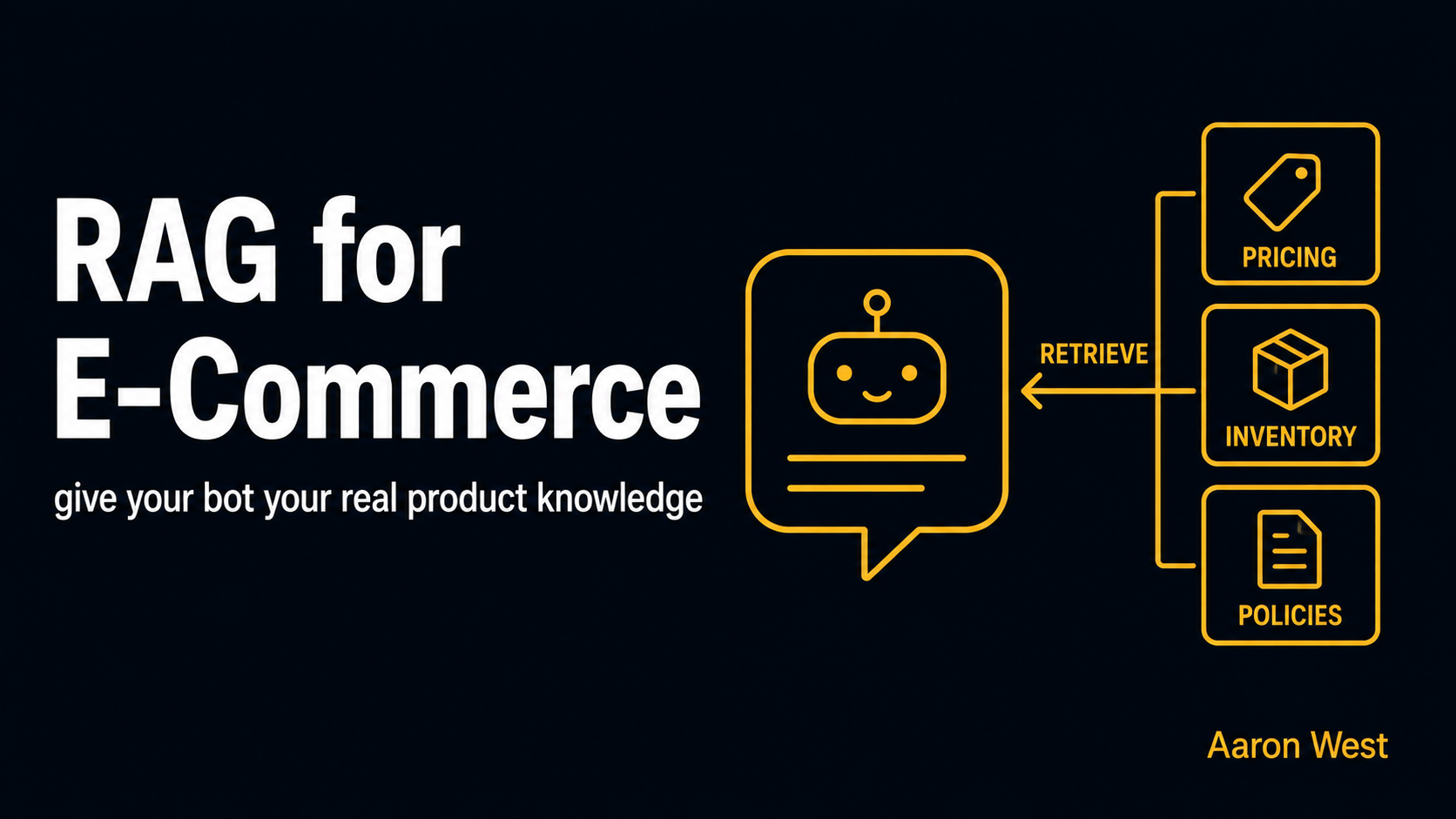
RAG Explained for E-Commerce: Giving a Bot Your Product Knowledge Without Retraining It
If you want an AI assistant that actually knows your store, your real products, your current prices, your live stock, your specific return policy, the technique you need is RAG, retrieval-augmented generation. It connects the AI to your live business data so it answers from…
Continue reading...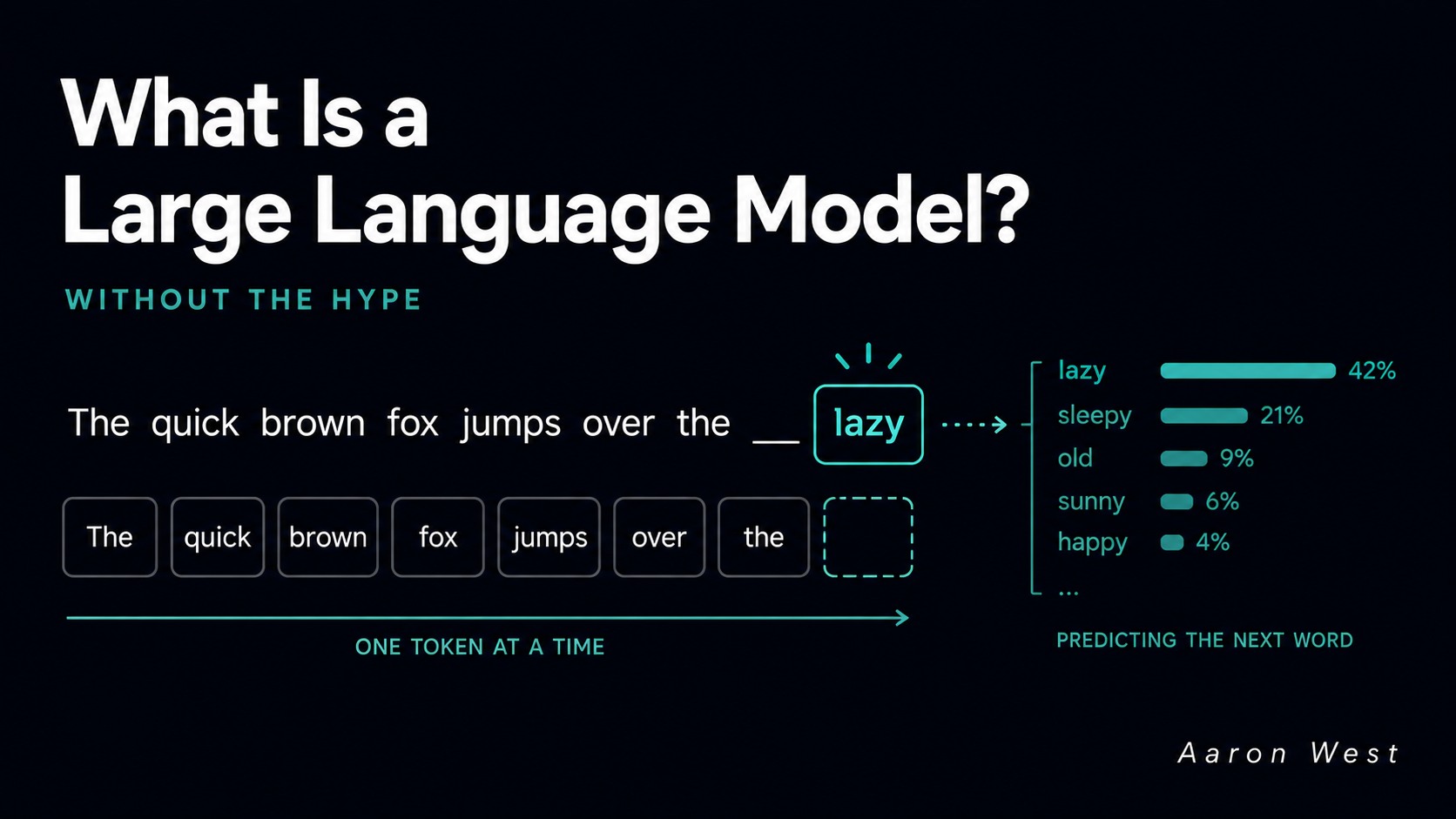
What Is a Large Language Model, Without the Hype
A large language model is a system that has been trained to do one deceptively simple thing: predict the next word. Show it a stretch of text, and it guesses what most likely comes next, then it guesses again, and again, one piece at a…
Continue reading...