How B2B Buyers Actually Buy: The Process Your Store Has to Serve

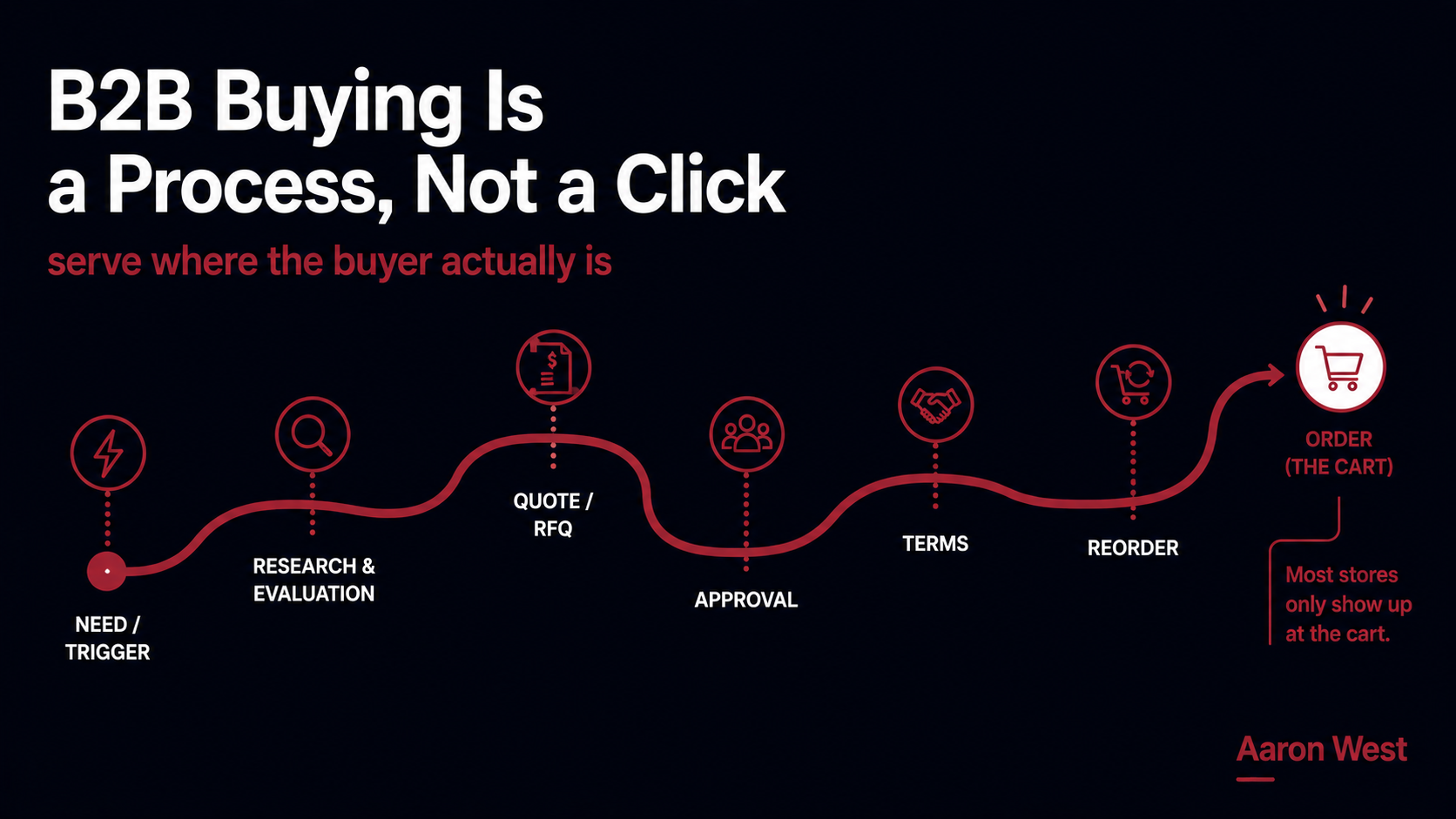
Table of Contents
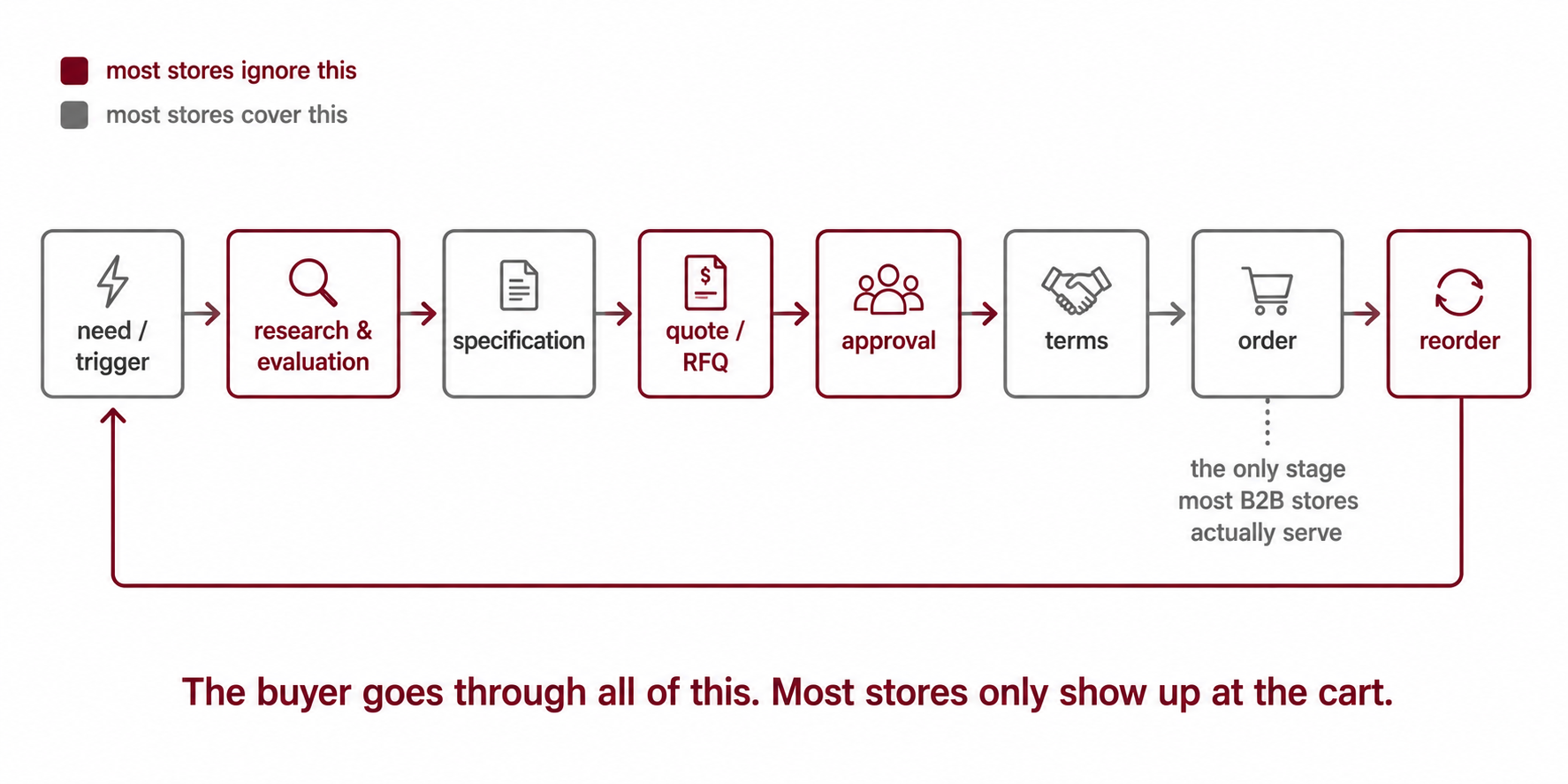
A B2B purchase isn't a click, it's a process: a need gets identified, options get researched and compared, a specification gets set, a quote gets requested, an internal approval is sought, terms are agreed, an order is placed, and then it's reordered on a schedule. Your store's job isn't to force that process into a consumer checkout. It's to support the buyer at each stage where they actually are. Most B2B stores fail because they're built for the last step and ignore the five before it.
This is a core of the B2B E-Commerce cluster. The consumer funnel is roughly "see, want, buy." The B2B process is longer, involves several people, and is mostly rational, and the store that only handles "buy" loses to the one that helps at "research," "quote," and "reorder."
The B2B buying process, stage by stage
Strip a B2B purchase down and it runs through recognisable stages, even when they overlap or loop:
A need or trigger appears, something runs low, a project starts, a contract comes up for renewal. Then research and evaluation, where the buyer works out what their options are and compares them, often almost entirely on their own. Then a specification, the exact requirements firming up. Then a quote or RFQ, because the price often isn't simply posted. Then internal approval, getting the spend signed off by whoever holds the budget. Then negotiation and terms. Then the order. And then, crucially, reorder and account management, the repeat business that makes a B2B customer valuable.
Each of those stages is a place your store can help or get in the way. A store designed only for the order step quietly fails the buyer at all the others, and the buyer takes the whole purchase, including the lucrative repeat business, somewhere that helped earlier.
The research stage is where you win, and it's invisible
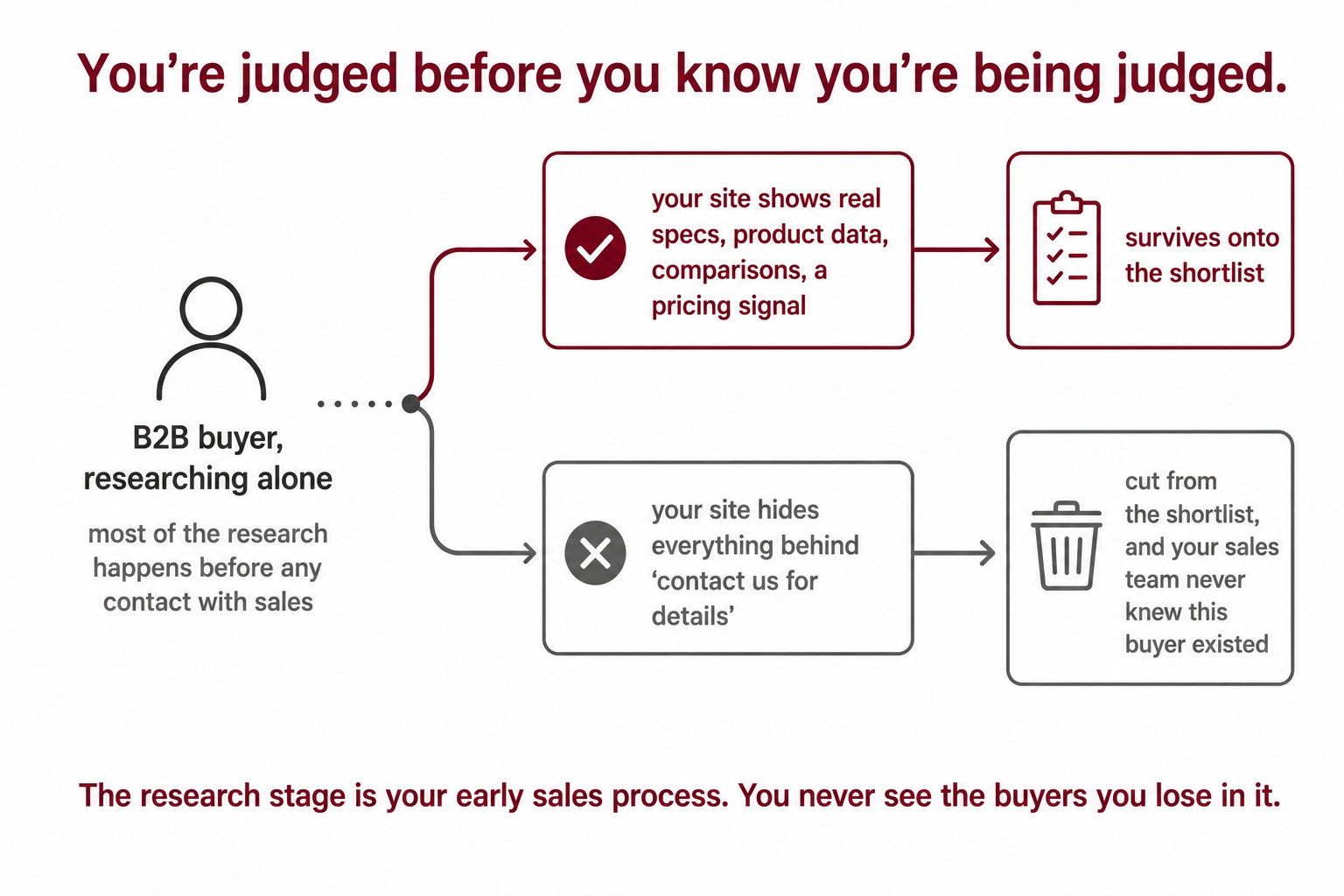
Here's the stage that decides most B2B sales, and the one most stores neglect because they never see it happen. B2B buyers do the large majority of their research independently, before they ever contact your sales team or fill in a form. They're comparing options, checking specifications, and forming a shortlist quietly, on your website and others.
That means the information your site provides is your early sales process. If a buyer can't find detailed product data, real specifications, clear comparisons, and enough of a pricing signal to evaluate seriously, you're eliminated from the shortlist before anyone at your company knows the buyer existed. The instinct to hide everything behind "contact us for details" feels like it protects the relationship; in reality it removes you from the evaluation entirely. Rich, honest, accessible information early is how you survive the stage you can't see.
The quote and RFQ flow
Because B2B prices are so often negotiated rather than posted, a huge share of B2B sales begin with a request for a quote, not an add-to-cart. This is a genuinely B2B-specific mechanic, and how you handle it separates a working B2B store from a frustrating one.
The bad version is a dead end: "price on application, call us," a form that vanishes into a void, days of silence. The good version treats the quote as a first-class flow, the buyer requests it easily, you respond promptly, there's room to negotiate, and an accepted quote converts cleanly into an order. The quote isn't an interruption to the sale; in B2B it frequently is the start of the sale, and a store that makes it smooth wins business from competitors who make it painful.
Approval and the buying committee
Remember that the person browsing your site often can't actually authorise the purchase. In B2B the buyer who builds the order and the person who approves the spend are frequently different people, and a store that ignores this has designed for a decision-maker who isn't the one on the screen.
Serving this means supporting more than one user per account, with roles and approval limits, so a buyer can assemble an order and route it to whoever needs to sign off, all inside the system rather than via a chain of forwarded emails and spreadsheets. It's unglamorous plumbing, but without it you've built a store that lets people want to buy and then leaves them stuck at the one step that actually releases the money.
Reorder and account management: where the real money is
The most valuable thing about a B2B customer is that they come back, repeatedly, often on a predictable schedule. Which means the highest-leverage feature in a B2B store is frequently the most boring one: fast, frictionless reordering. Order history, saved lists, quick reorder, an account dashboard that makes "the usual, again" effortless.
A B2B customer's lifetime value lives in the reorders, not the first order, so the reorder experience deserves more attention than the acquisition flow, and usually gets less. The store that makes reordering effortless quietly locks in the repeat revenue that is the whole point of B2B, while competitors pour their energy into a flashy first-purchase experience the buyer goes through once. This is also where the channel earns its keep against a human rep: nobody wants to phone in the same standing order every month when the website can do it in three clicks.
The self-service shift, and its limit
B2B buyers increasingly want to do all of this without talking to anyone, researching, quoting, approving, ordering, and reordering on their own time, the same self-service expectation they've learned as consumers. A modern B2B store should let them, because forcing a sales call into every routine transaction is friction the buyer now resents.
But self-service has a limit, and respecting it matters. For the routine, the reorder, the standard quote, the catalog browse, self-service should be complete and frictionless. For the consequential, a large or unusual order, a complex negotiation, a problem, the option to reach a human must stay easy to find. The pattern is the same one that governs support generally: self-service for the routine, human for the high-stakes. Strip the humans out entirely and you save cost while losing exactly the relationship that B2B runs on.
What this comes down to
A B2B buyer goes through this whole process whether your store helps or not. The need, the research, the spec, the quote, the approval, the order, the reorder, all of it happens regardless. The only question is whether your store shows up at each stage or only at the cart.
The stores that win B2B are the ones present where the buyer actually is: giving them what they need to research, making the quote easy, supporting the approval, and making the reorder effortless. Serve the process, not the click. The cart is the last and least of it.
A few common questions
What does the B2B buying process look like? It runs through stages, even when they overlap: a need or trigger, research and evaluation (largely done independently), a specification, a quote or RFQ, internal approval, negotiation and terms, the order, and then reorder and account management. Each stage is a place your store can help or get in the way, and a store built only for the order step quietly fails the buyer at all the others.
Why does the research stage matter so much? Because B2B buyers do most of their research independently, before ever contacting sales, the information your site provides is your early sales process. If a buyer can't find detailed specs, real product data, comparisons, and a usable pricing signal, you're cut from the shortlist before anyone at your company knows they existed. Hiding everything behind "contact us" feels protective but actually removes you from the evaluation.
What is an RFQ flow and why does a B2B store need one? RFQ means "request for quote." Because B2B prices are often negotiated rather than posted, many sales begin with a quote request instead of an add-to-cart. A good B2B store treats this as a first-class flow, easy to request, promptly answered, room to negotiate, and a clean path from accepted quote to order, rather than a "price on application, call us" dead end. The quote isn't an interruption to the sale; it's frequently the start of it.
What's the most valuable feature in a B2B store? Usually the most boring one: fast, frictionless reordering, order history, saved lists, quick reorder, an account dashboard. B2B is repeat business, and a customer's lifetime value lives in the reorders, not the first order, so the reorder experience deserves more attention than the acquisition flow and usually gets less. Make "the usual, again" effortless and you lock in the repeat revenue that is the whole point of B2B.
You should also read:
B2B Platforms and Integration: The Plumbing a Consumer Store Doesn't Have
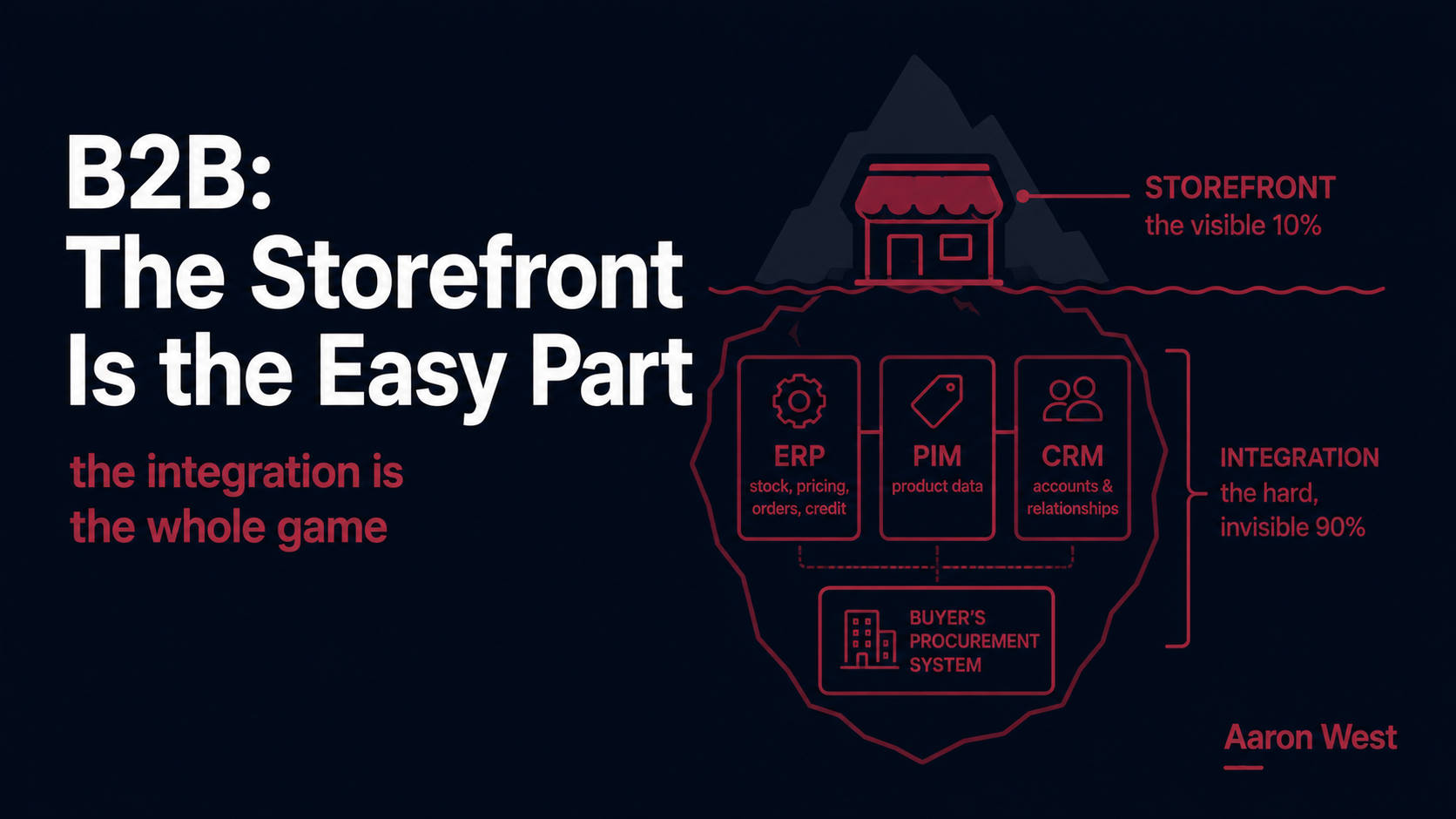
A B2B store needs capabilities a consumer platform doesn't ship with: account-specific catalogs and pricing, multiple users per account with roles and approvals, quote and RFQ flows, terms-based checkout, and easy reordering. But the harder, less visible requirement is integration, the B2B store has to…
Continue reading...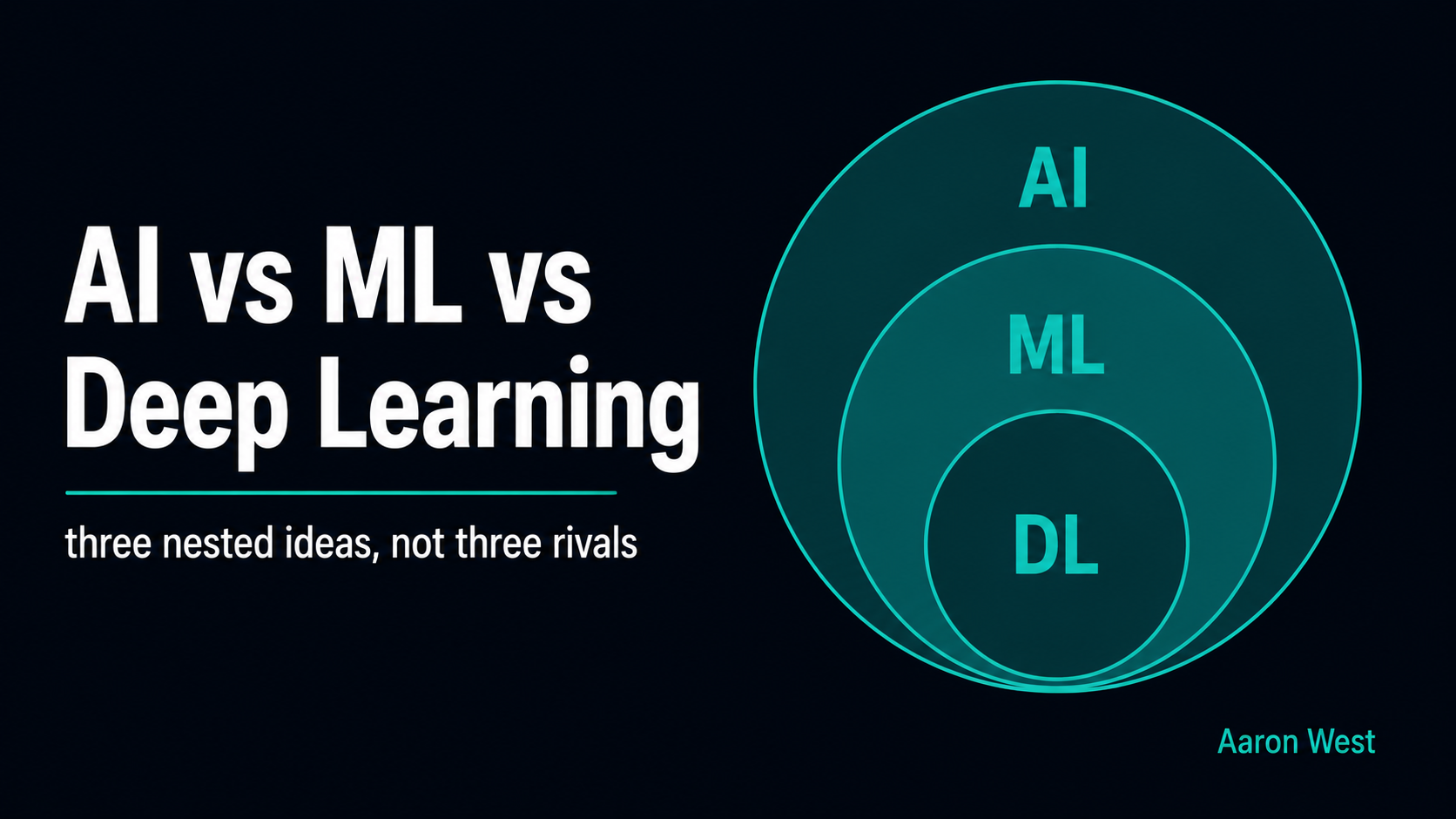
AI vs Machine Learning vs Deep Learning: The Distinction That Actually Matters
Artificial intelligence, machine learning, and deep learning are not three competing things you choose between. They are three nested ideas, each one a more specialised part of the one before it. AI is the big outer goal: machines doing things that would normally need human…
Continue reading...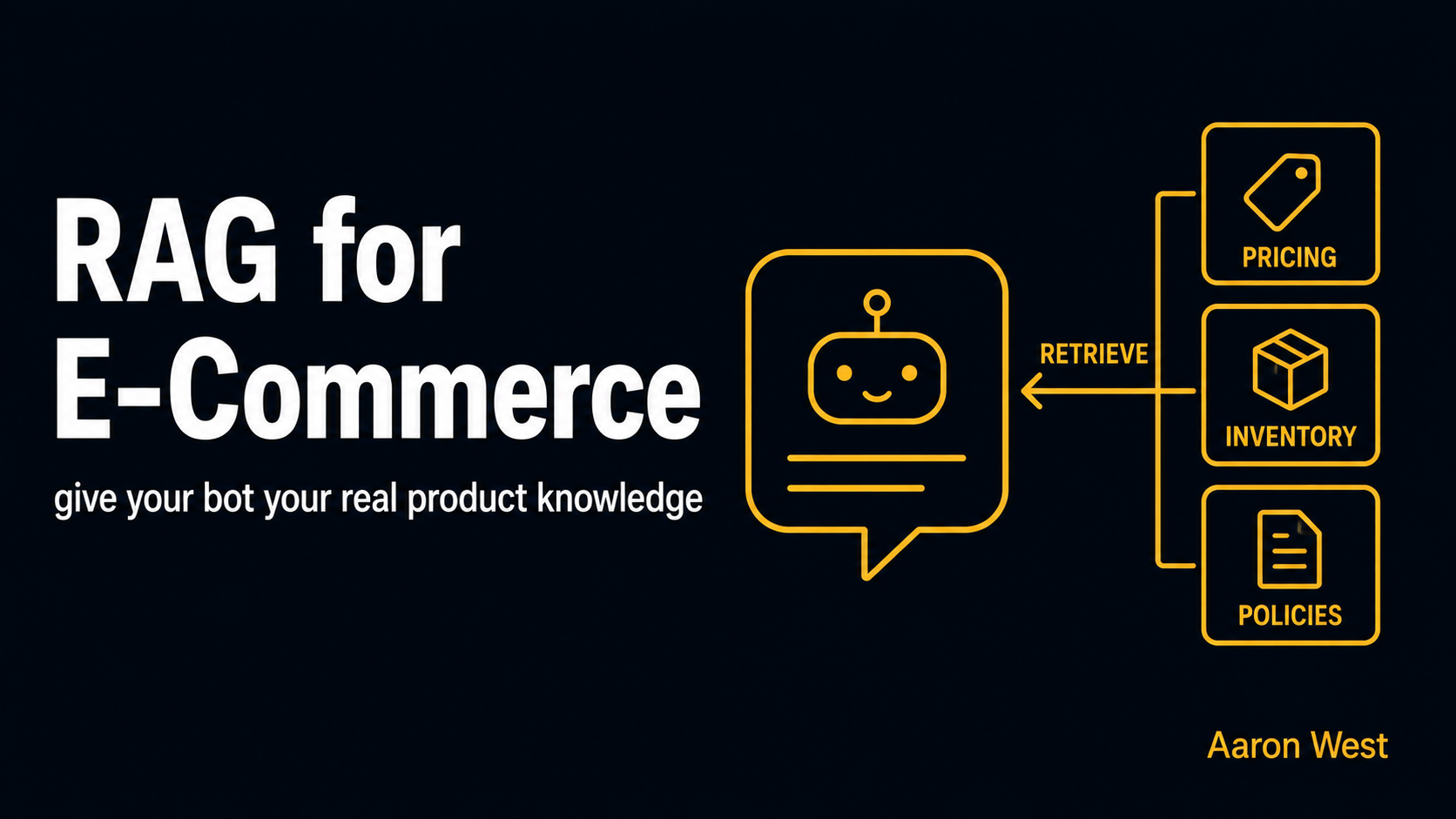
RAG Explained for E-Commerce: Giving a Bot Your Product Knowledge Without Retraining It
If you want an AI assistant that actually knows your store, your real products, your current prices, your live stock, your specific return policy, the technique you need is RAG, retrieval-augmented generation. It connects the AI to your live business data so it answers from…
Continue reading...