B2B Platforms and Integration: The Plumbing a Consumer Store Doesn't Have

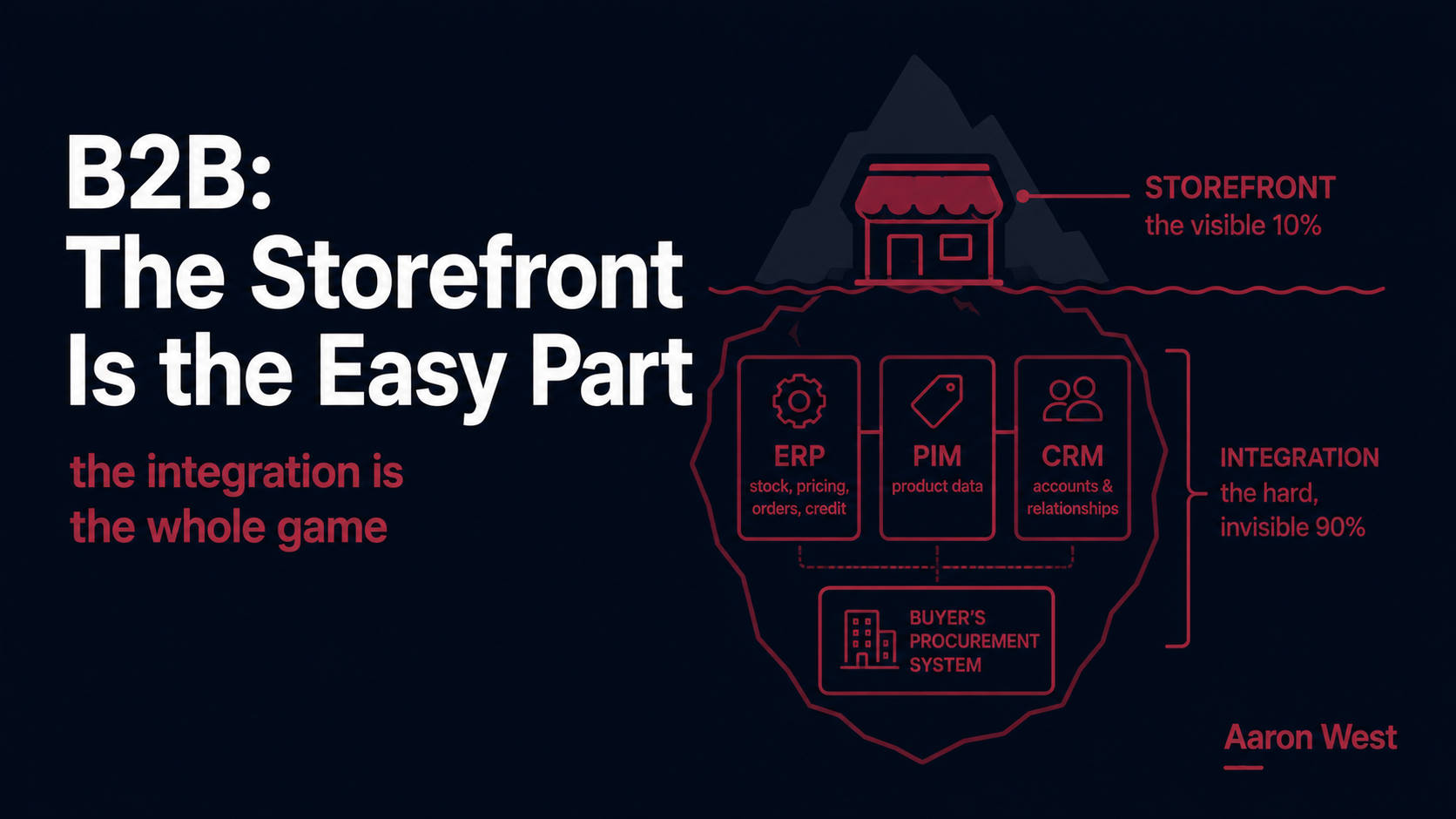
Table of Contents
A B2B store needs capabilities a consumer platform doesn't ship with: account-specific catalogs and pricing, multiple users per account with roles and approvals, quote and RFQ flows, terms-based checkout, and easy reordering. But the harder, less visible requirement is integration, the B2B store has to connect cleanly to the back-office systems that actually run the business. The platform decision for B2B is less about how the storefront looks and more about whether it can talk to your systems of record. Pick on the integrations, not the theme.
This is a core of the B2B E-Commerce cluster, and it's where B2B projects quietly succeed or fail. In B2C, the store is mostly the storefront. In B2B, the store is a front-end sitting on top of the systems that run the business, and the connection between them is the part that's hard.
What B2B needs that consumer platforms don't
The storefront features are the visible half, and they're real requirements. A B2B platform has to handle account hierarchies and multiple users per customer (with roles and spending limits), account-specific catalogs and pricing (each account sees its own products and its own prices), quote and RFQ flows, terms-based checkout (purchase orders and invoicing, not just card), and frictionless reordering. A consumer platform ships with none of these by default, which is exactly why bolting "B2B mode" onto a store built for shoppers fights you at every turn.
But list those features and you've only described the window. The building behind it is the integration.
The integration reality
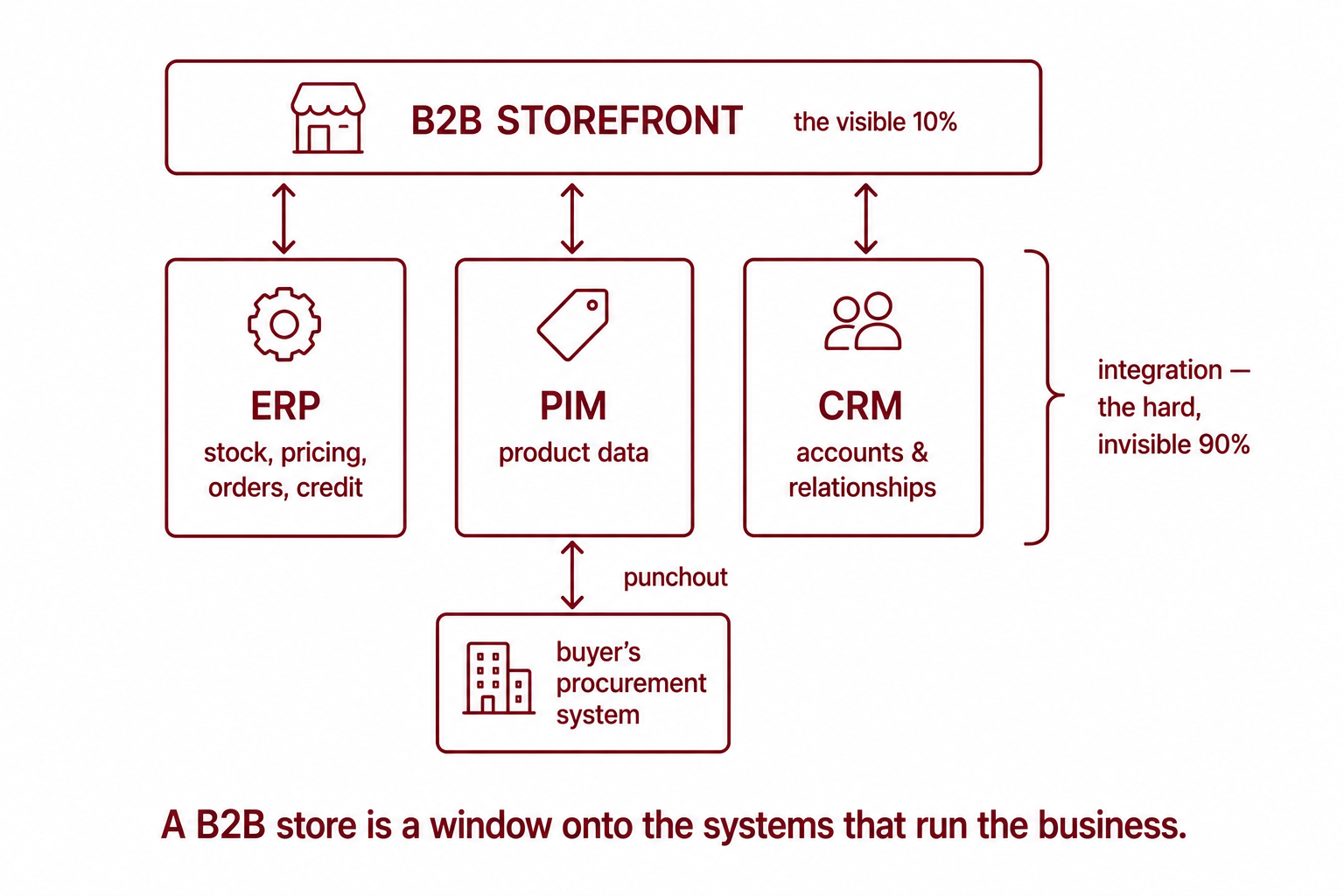
Here's the part the storefront demos never show. A B2B operation runs on back-office systems that existed long before the website: an ERP holding inventory, pricing, orders, and customer credit; often a PIM holding the product data; frequently a CRM holding the accounts and the relationships the sales team manages. The B2B store is a window onto these systems, not a separate island with its own copy of the truth.
That means the real work is connection. When a buyer logs in, the account-specific price has to come from the system that holds it. When they check stock, the number has to be real, not last night's snapshot. When they place an order, it has to flow into the ERP that fulfils and invoices it. When they check an order's status, it has to reflect what the back office actually knows. Real-time or near-real-time integration with the systems of record, for pricing, stock, and order status, is what separates a working B2B store from a pretty catalog that lies to its customers. A consumer store can often get away with a looser connection. A B2B store can't, because its customers are buying large, repeatedly, on terms, and a wrong number costs real money on both sides.
Punchout and procurement integration
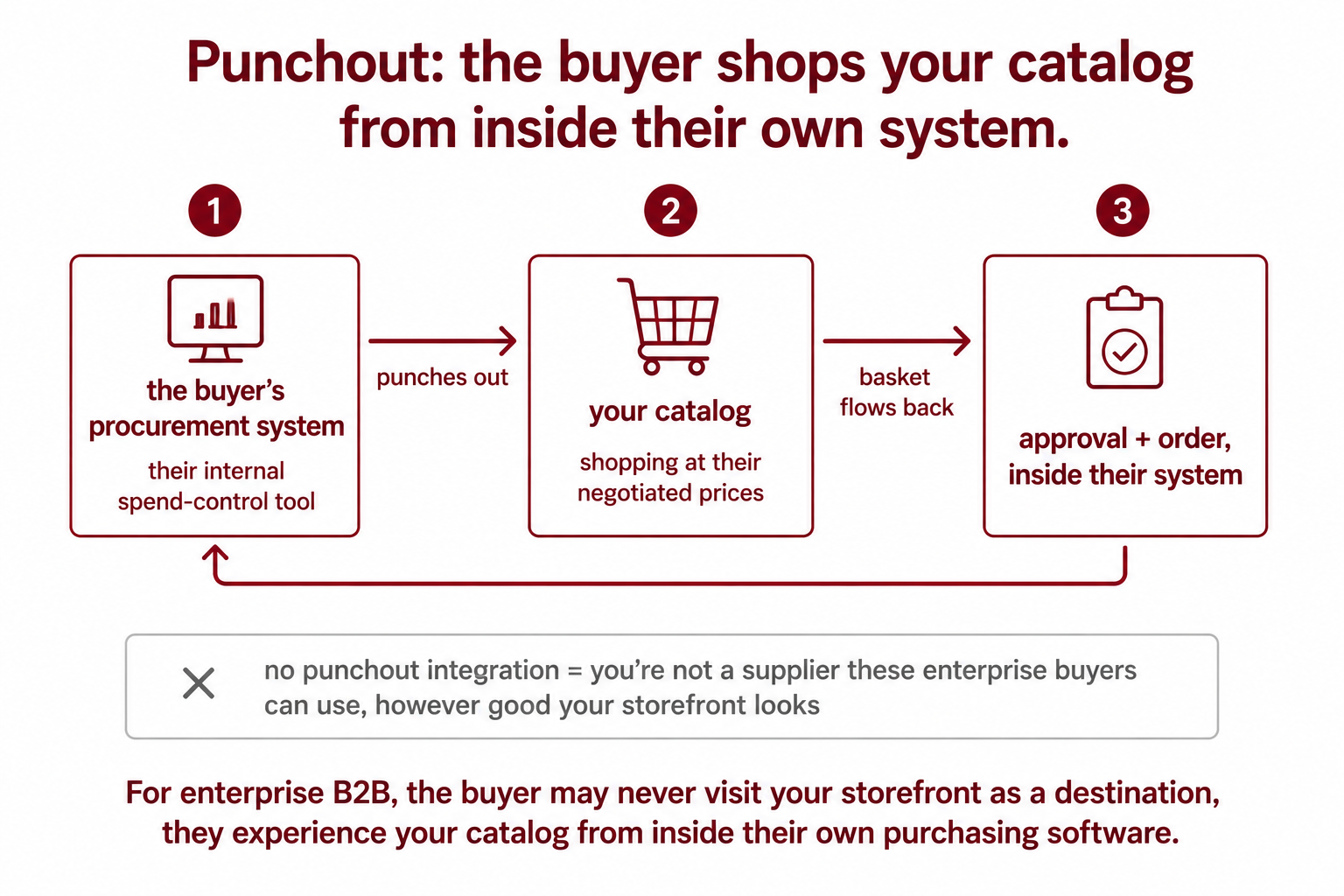
Here's a genuinely B2B-specific piece that has no consumer equivalent at all. Large buyers often don't purchase by visiting your website directly; they buy through their own procurement system, the internal tool their organisation uses to control and approve spending. For those buyers, your store may need to integrate with that procurement system through what's usually called punchout: the buyer "punches out" from their procurement tool into your catalog, shops at their negotiated prices, and the basket flows back into their system for approval and ordering.
It sounds technical, and it is, but the point is simple. For enterprise B2B, the buyer may never see your storefront as a destination; they experience your catalog from inside their own purchasing software. If your store can't integrate that way, you're simply not a supplier those buyers can use, no matter how good the storefront is. This is invisible to anyone who's only done B2C, and decisive for selling to large organisations.
Build versus buy for B2B
So how do you get all this? The same build-versus-buy logic that applies everywhere applies here, with a B2B twist. Broadly, three paths: a B2B-native platform that ships the account pricing, quoting, approvals, and integration hooks out of the box; a general platform with B2B modules or extensions bolted on; or a custom build.
The honest guidance: a B2B-native platform usually wins, because the plumbing you need is hard, generic, and already solved, exactly the kind of commodity capability you should buy rather than build. Bolting B2B onto a consumer platform can work for simpler needs but fights you as the account, pricing, and integration requirements deepen. And custom is rarely worth it unless your model is genuinely unusual, because you'd be rebuilding solved problems and then maintaining them forever. Crucially, choose on whether the platform handles your account structure, your pricing rules, and your integration needs, not on which storefront demo looked nicest. The demo is the 10% you can see. The integration is the 90% that decides whether it works.
The data foundation under all of it
One last thread, because it ties the whole pillar, and the whole hub, together. Every B2B capability depends on clean, connected data in the systems of record. Account-specific pricing is only right if the ERP's pricing is right. Stock is only trustworthy if the inventory data is. The catalog is only usable if the product data is clean. Garbage in the ERP becomes garbage in the store, shown to a buyer placing a large order on terms.
This is also why the integration work pays off twice. The same clean, connected, structured data that makes your B2B store reliable for human buyers is exactly what makes it legible to AI agents as agent-assisted buying reaches B2B. Doing the unglamorous data and integration work isn't just this year's reliability. It's next year's readiness.
What this comes down to
A B2B store is a front-end on the systems that run your business. Judge the platform on whether it connects to them cleanly, account pricing from the system that holds it, real stock, orders that flow into the ERP, procurement integration where you need it, not on how the demo storefront looks.
The theme is the smallest decision you'll make. The integration is the whole game, and it's the part that's invisible right up until the day a wrong number costs a customer a large order. Get the plumbing right, and the storefront takes care of itself.
A few common questions
What does a B2B e-commerce platform need that a B2C one doesn't? On the storefront: account hierarchies and multiple users per account with roles and limits, account-specific catalogs and pricing, quote/RFQ flows, terms-based checkout (purchase orders, invoicing), and easy reordering. But the harder requirement is integration with the back-office systems of record, ERP, often a PIM, frequently a CRM, because a B2B store is a window onto those systems, not a separate island. Consumer platforms ship with none of this by default.
Why is integration the hard part of B2B e-commerce? Because a B2B store has to show the truth from the systems that actually run the business: account-specific prices from the system that holds them, real stock numbers, orders that flow into the ERP for fulfilment and invoicing, accurate order status. Real-time or near-real-time integration is what separates a working store from a pretty catalog that lies to its customers, and B2B customers, buying large, repeatedly, on terms, can't tolerate wrong numbers the way a casual consumer might.
What is punchout in B2B e-commerce? Large buyers often purchase through their own procurement system rather than by visiting your website. Punchout lets a buyer "punch out" from their procurement tool into your catalog, shop at their negotiated prices, and send the basket back into their system for approval and ordering. For enterprise B2B, the buyer may never use your storefront as a destination; if you can't integrate this way, you're not a supplier they can use, however good the storefront looks.
Should I build a custom B2B platform or buy one? Usually buy a B2B-native platform, because the plumbing you need, account pricing, quoting, approvals, integration hooks, is hard, generic, and already solved, exactly the kind of commodity capability to buy rather than rebuild. Bolting B2B onto a consumer platform works for simpler needs but fights you as requirements deepen; custom is rarely worth it unless your model is genuinely unusual. Choose on whether it handles your account structure, pricing rules, and integration needs, not on the storefront demo.
You should also read:
How B2B Buyers Actually Buy: The Process Your Store Has to Serve
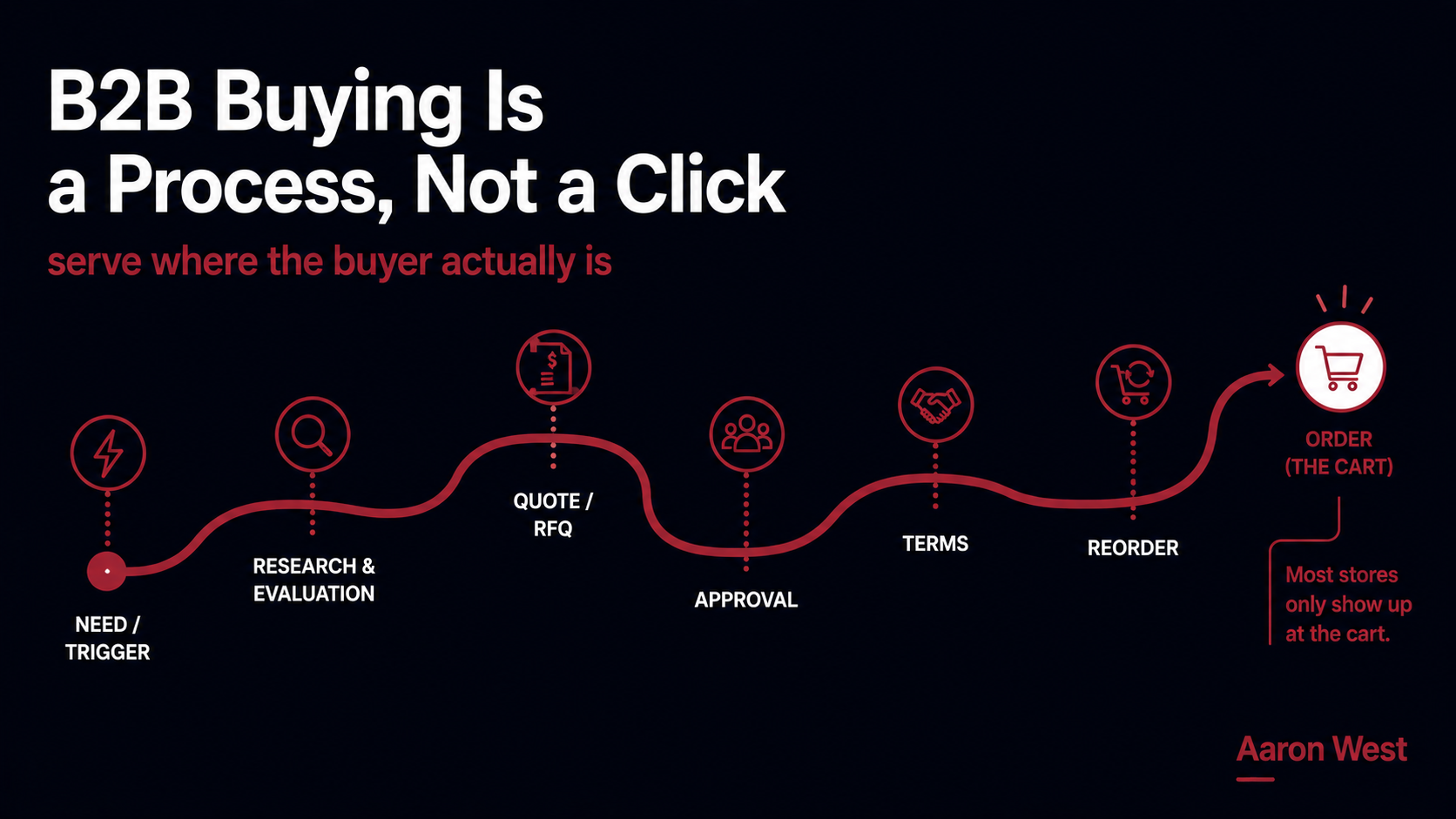
A B2B purchase isn't a click, it's a process: a need gets identified, options get researched and compared, a specification gets set, a quote gets requested, an internal approval is sought, terms are agreed, an order is placed, and then it's reordered on a schedule.
Continue reading...
Payments Are the Plumbing That Decides Whether You Get Paid
Payments are the infrastructure that turns a customer's intention to buy into money in your account, and they're the part of e-commerce nobody thinks about until they fail, at the worst possible moment: the instant a ready customer is trying to pay. Treating payments as…
Continue reading...
Cultural UX: Why the Same Store Converts Differently Across Markets
The same store, identically built and perfectly translated, will convert at different rates in different markets, and the gap usually isn't the product or the price. It's culture: what signals trust, how people expect to shop, pay, and be spoken to, and what feels normal…
Continue reading...