Cultural UX: Why the Same Store Converts Differently Across Markets

Table of Contents
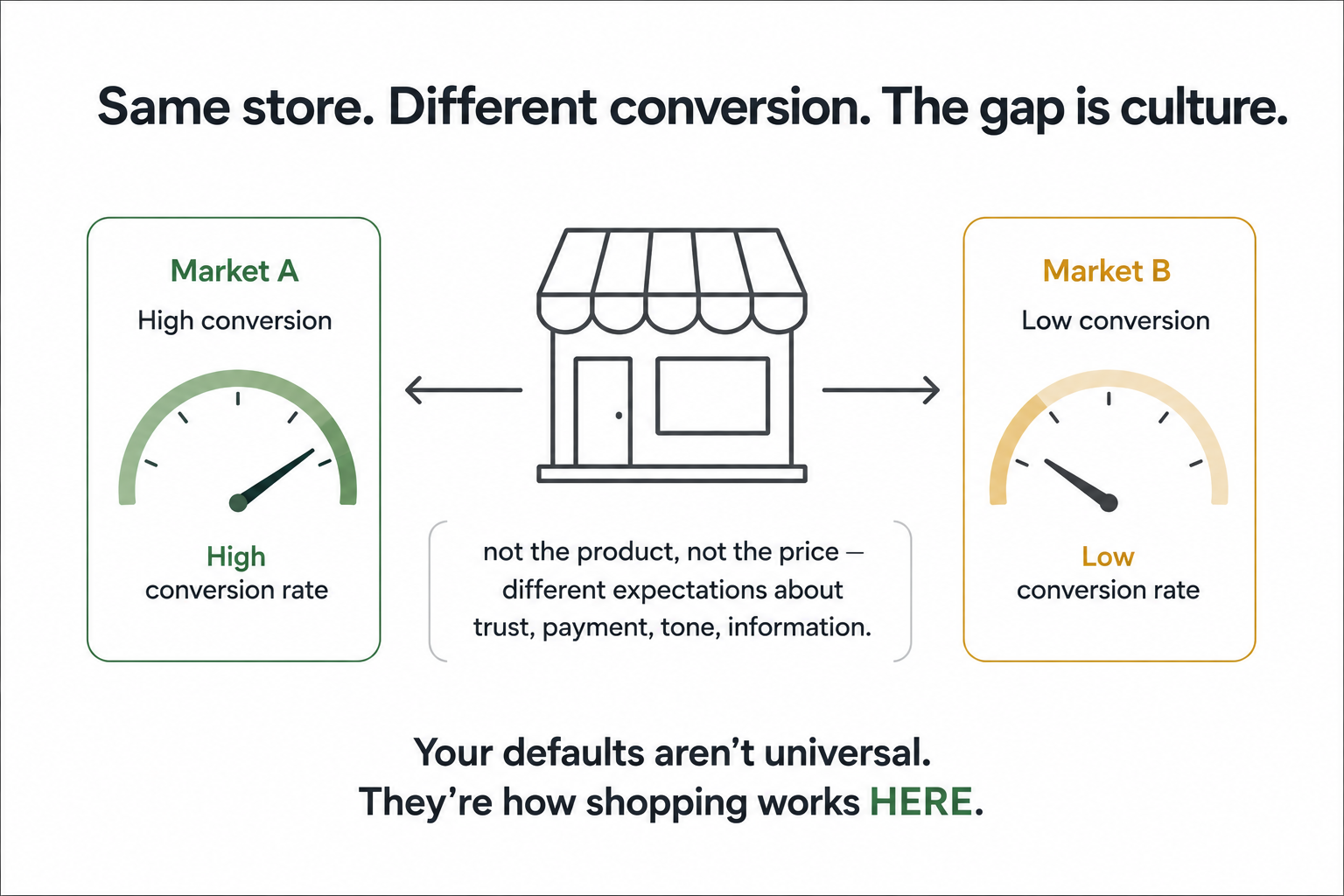
The same store, identically built and perfectly translated, will convert at different rates in different markets, and the gap usually isn't the product or the price. It's culture: what signals trust, how people expect to shop, pay, and be spoken to, and what feels normal versus what feels off. Two markets can look at the same page and one buys while the other hesitates, for reasons that have nothing to do with what you're selling.
This is the culture-and-expectations dimension from the internationalisation cornerstone, and it's the one most likely to be either ignored or done badly, because the lazy version of it is national stereotyping, and the careful version is real work. Here's the difference, and how to design for a market that isn't yours without resorting to clichés about it.
The thing to get straight first: your defaults aren't universal
Every store is built on a pile of invisible assumptions about how shopping works: how much information people want before they buy, how they expect to pay, what makes a store look trustworthy, how formal the tone should be, how much reassurance they need at checkout. You didn't decide most of those consciously. They came from the market you built in. They feel like "how e-commerce works." They're actually "how e-commerce works here."
When you enter a new market, those defaults travel with you, unexamined, and some of them are wrong for the new place. The conversion gap is the sound of your home-market assumptions meeting people who don't share them. The store is the same. The expectations it's bumping into are not.
That's the whole concept of cultural UX: noticing that your defaults are local, and designing for the new market's expectations instead of assuming yours are neutral. The trap is what people do instead, which is reach for stereotypes.
Why you can't design from stereotypes
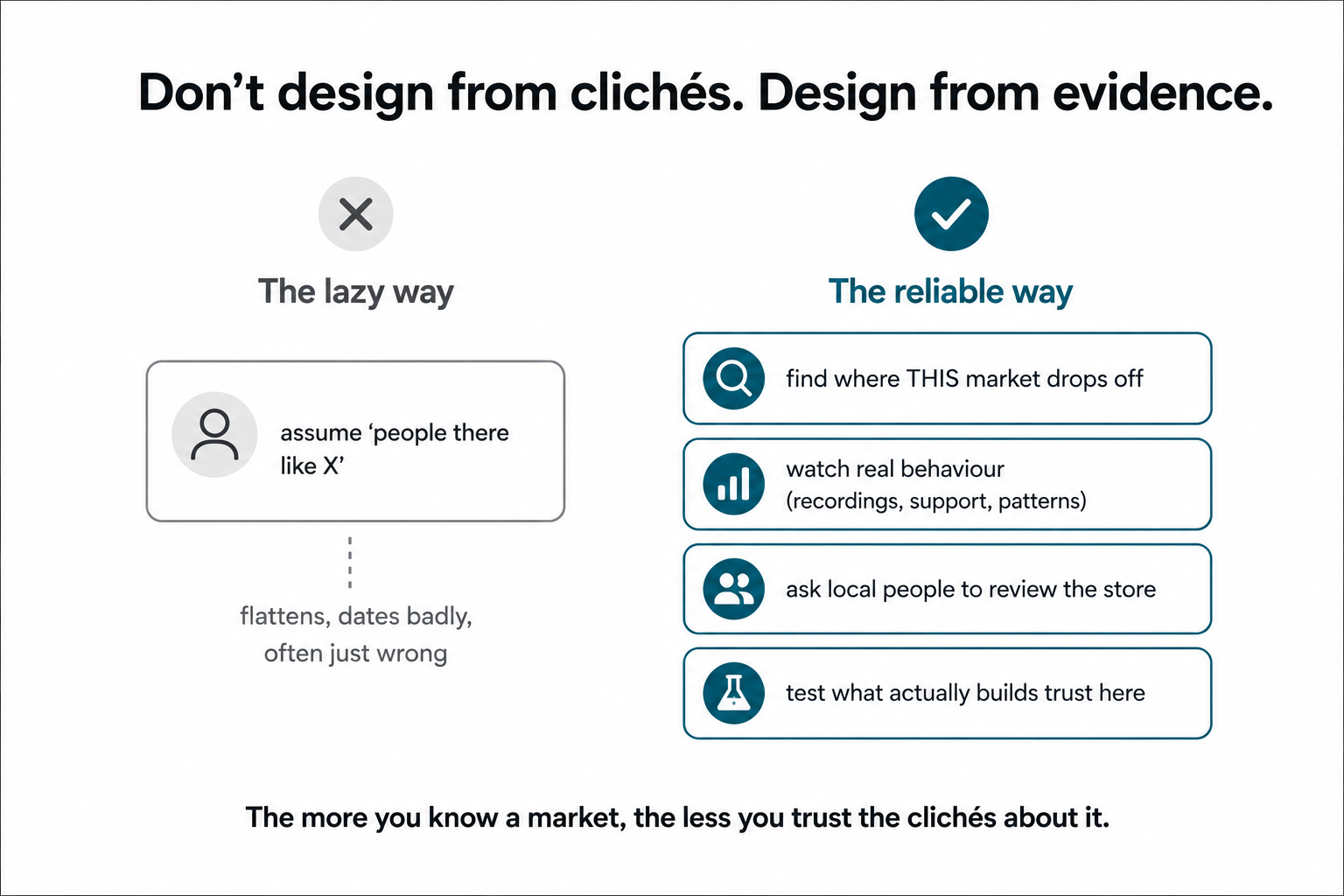
The tempting shortcut is a list: "in this culture people like X, in that culture they prefer Y." Avoid it. Cultural generalisations are unreliable for the same reason any stereotype is: they flatten huge, varied populations into a caricature, they're often outdated, and they're frequently just wrong. Designing your store around "people from there are like this" is how you build a different kind of foreign-feeling store, one that's foreign and slightly insulting.
I say this as someone who has spent a career across languages and cultures: the more you actually know about a market, the less you trust the clichés about it. Real markets are full of variation, subcultures, and individuals who don't fit the template. The generalisation that feels like insight is usually just the most visible stereotype wearing a suit.
So cultural UX is not a knowledge problem you solve by learning facts about a culture. It's an evidence problem you solve by watching what real people in that market actually do.
The method that actually works: local evidence
If you can't design from stereotypes, what do you design from? The same thing good UX always comes from, just applied honestly to a market that isn't yours: evidence.
- Find where this market actually drops off. Your funnel exists in every market, but the friction points differ. Look at where people in the new market abandon, and you'll often find it's a specific step, a payment option, a form field, a moment that needs more reassurance, not a vague "cultural fit" problem. This is where stores lose the sale, measured per market rather than assumed.
- Watch real behaviour, don't theorise. Session recordings, on-site behaviour, support questions, and real purchase patterns from that market tell you more than any cultural essay. The data is local even when your intuition isn't.
- Ask local people. The cheapest and most underused method: have actual people from the market look at your store and tell you what feels off, what they'd hesitate over, what's missing, what reads as untrustworthy. They'll catch in five minutes what you'd never see, because they have the defaults you lack.
- Pay special attention to trust. The cues that say "this store is safe" are some of the most culturally variable signals there are, which is why the local version of trust isn't a badge matters so much. What reassures in one market can read as meaningless, or even suspicious, in another. Test what actually reassures this market, rather than copying your home cues across.
The pattern is the same throughout: replace assumption with evidence. Your home-market intuition is exactly the thing you can't trust here, so don't lean on it, and don't replace it with a stereotype. Replace it with what the market shows you.
What cultural UX actually is
Cultural UX isn't a set of facts about other cultures. It's a discipline of humility plus evidence: the humility to assume your defaults are local rather than universal, and the discipline to find out what a specific market actually expects by watching what its people actually do. It's the opposite of the stereotype list, and it's the reason two identical stores can convert completely differently across a border.
The store didn't change. The people did. So design for the people who are actually there, using what they show you, not for the market you came from and not for the cartoon of the market you're entering. That's slower than a list of cultural tips, and it's the only version that works.
A few common questions
Why does the same store convert differently in different countries? Because conversion depends on expectations, and expectations are cultural: how much information people want before buying, how they expect to pay, what makes a store look trustworthy, how formal the tone should feel. Your store carries your home market's assumptions, and where those don't match the new market, conversion drops, even with the same product, price, and a perfect translation.
How do I design for a culture I'm not part of? Not from stereotypes. Cultural generalisations are unreliable and often insulting. Design from local evidence instead: find where that market actually drops off in your funnel, watch real behaviour, ask actual local people to review your store, and test what genuinely builds trust there. Replace your home-market intuition with what the market shows you.
Aren't there general rules about what different cultures prefer? Be very cautious with them. Real markets are full of variation and individuals who don't fit any template, and "rules" about cultural preference are often outdated or simply wrong. The more you genuinely know a market, the less you trust the clichés. Treat any generalisation as a hypothesis to test locally, never a fact to design around.
What's the most culturally variable part of a store? Trust signals are among the most variable. The cues that reassure shoppers, the guarantees, the proof, the payment options, the small print they look for, differ a lot by market, and a cue that builds confidence at home can read as meaningless or even suspicious elsewhere. Test what actually reassures the specific market rather than copying your home signals across.
You should also read:
Upsell, Cross-Sell, Down-Sell: The Three Moves Most Stores Get Wrong
Raising the average order value, getting each customer who already chose to buy to spend a little more, is usually the fastest and cheapest way to grow an e-commerce business. You are not paying to acquire anyone or convince anyone, you are making more of…
Continue reading...
Where Online Stores Lose the Sale
Most online stores spend almost all their energy trying to get more people to show up, and almost none on the fact that the overwhelming majority of the people who already showed up leave without buying. This is backwards. You have, sitting in your analytics…
Continue reading...
Cross-Channel Deduplication: When Every Platform Claims the Same Sale
If you add up the conversions your ad platforms report, Google Ads says it drove these sales, Meta says it drove those, your email tool claims some too, and the total comes out higher than the number of actual orders in your shop, you have…
Continue reading...