Going International Isn't Just Translating Your Site

Table of Contents
Going international is not a translation project. It's the decision to run a different business in every market you enter, one that happens to share your products. The stores that treat it as "translate the site, switch the currency, hit launch" are the ones that quietly underperform in market after market and never quite understand why the orders don't come.
I've spent my career working across languages and markets, and the failure pattern is almost always the same. A team clones the home site, runs it through translation, adds a currency toggle, and calls it an international launch. The site is now readable in five countries and genuinely persuasive in one: the one it was built for. This piece is the map of what going international actually takes, so you can decide to do it properly or decide not to do it at all, which are the only two good options.
Why "translate and toggle" fails
The reason the naive approach disappoints is that language is the most visible part of selling in a new market and the smallest part of succeeding in one. You can translate every word on the page perfectly and still feel foreign to the person reading it, because what makes someone trust a store enough to enter their card details is built from a hundred signals, and almost none of them are the dictionary meaning of your product copy.
A shopper in a new market arrives with different expectations about how a trustworthy store looks, how they expect to pay, how fast they expect delivery, what a fair return policy is, even how formal or familiar the tone should be. Translation answers none of those. It converts your words and leaves everything that actually drives the decision untouched. So you get the worst kind of result: a site that's technically correct and quietly unconvincing, which is much harder to diagnose than a site that's obviously broken.
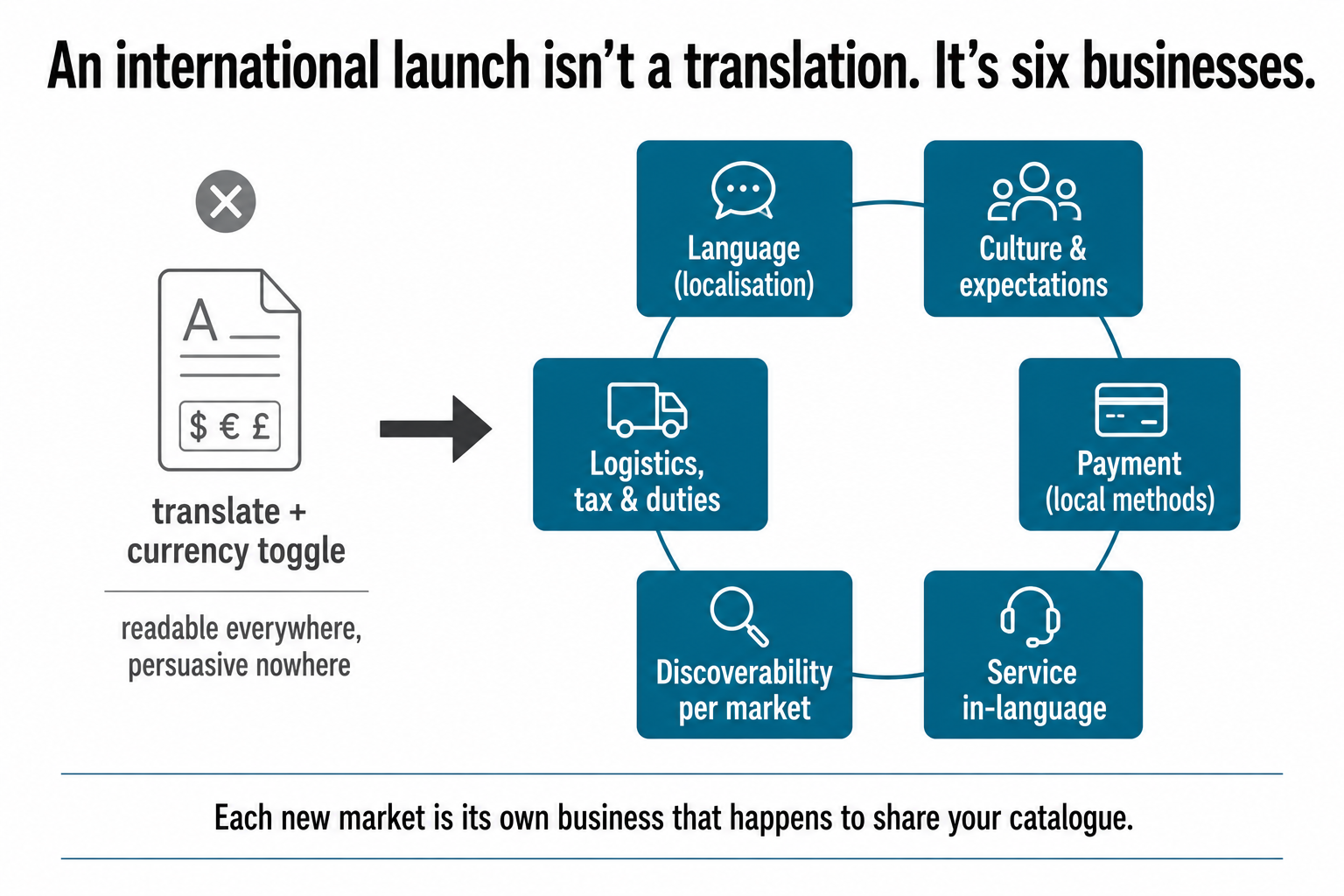
Going international properly means treating each new market as its own business that happens to share your catalogue. Here is what that business is made of.
The six dimensions of a real market entry
A serious market entry has to answer six questions, and language is only the first.
Language, properly done. Not translation, localisation, which is a different and deeper thing: adapting the whole experience so it reads as if it were built by someone from that market, not converted into their language. The gap between the two is wide enough that it gets its own piece, because it's the single most misunderstood part of going international.
Culture and expectations. How people shop, what signals trust, what tone feels right, what's normal and what's off-putting, all of it varies by market. The same page can feel reassuring in one country and pushy in another. Getting this right is the difference between feeling native and feeling like a tourist who learned the language.
Payment. People pay differently in different places, and it isn't a preference, it's often a hard requirement. A market where shoppers expect a specific local payment method will simply not convert on the methods that work at home, no matter how good the rest of the store is. Offer the wrong payment options and you lose the sale at the very last step, after you paid to win everything before it.
Logistics, tax, and duties. The unglamorous half of going international, and the half that turns a clean plan into a real operation. Shipping across borders, customs, duties, local tax obligations, returns that have to physically come back across a border, none of it is exciting, and all of it is decisive. This is where "we'll figure it out" quietly becomes "we lose money on every order." It needs real planning, not a footnote.
Discoverability, per market. Ranking and being found at home does nothing for you abroad. Each market has its own search behaviour, its own language of queries, its own competitive landscape. Being discoverable in a new market is its own project, the international face of getting found in the AI era, and it doesn't come free with a translated page.
Service in the customer's language. When something goes wrong, and it will, the customer needs help in their language, with someone who understands their context. Multilingual support is one of the most underestimated parts of operating internationally, and one I've seen up close: it's far more than running replies through translation, because the hard cases are exactly the ones where nuance and tone decide whether you keep the customer. The same lesson runs through the multilingual chatbot problem.
The opinion most expansion decks won't tell you
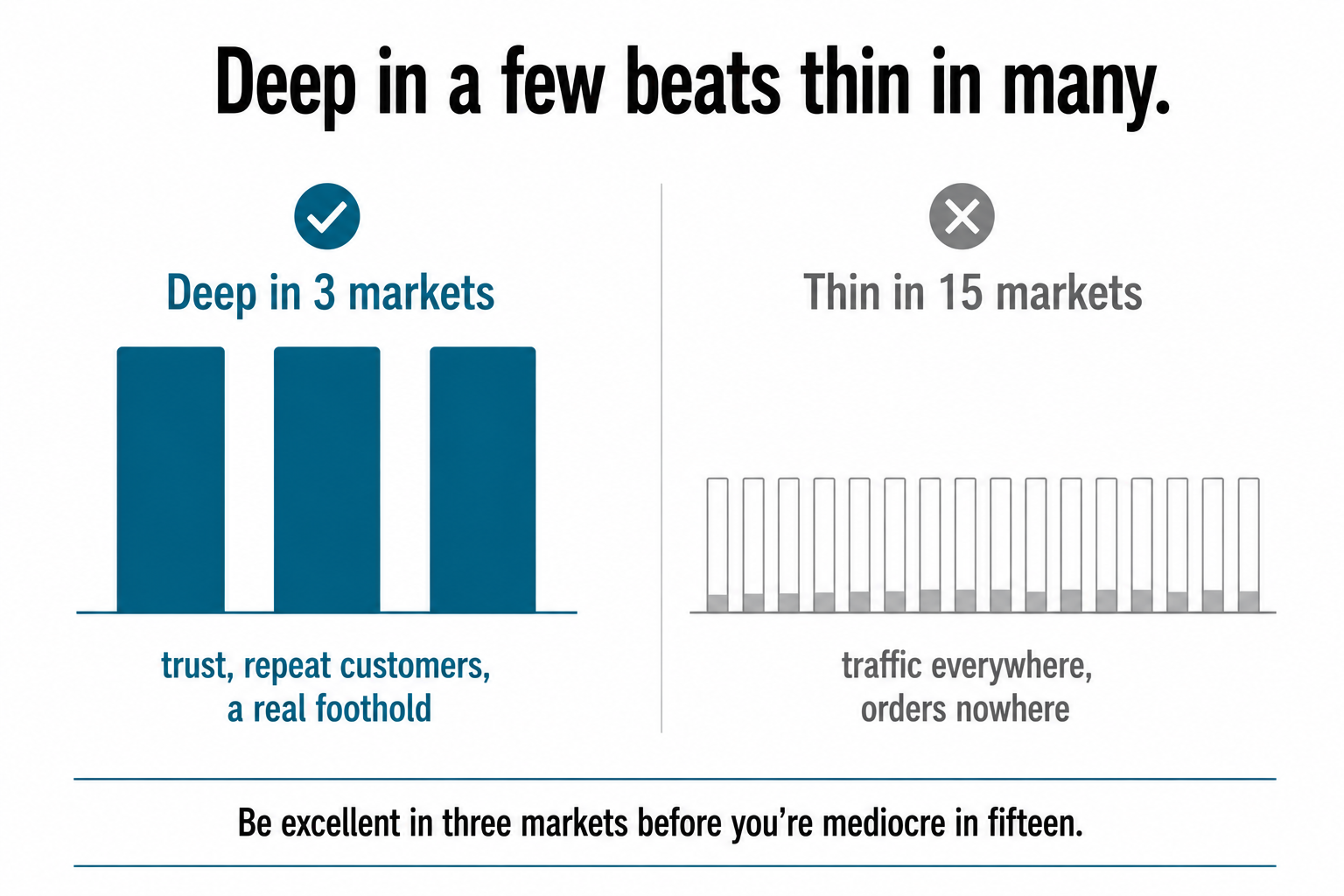
Here's the part that gets left out of the optimistic expansion plan: doing all six of those things, in one market, is a serious amount of work. Doing them in fifteen markets at once is not ambition, it's dilution. You end up badly present everywhere and genuinely strong nowhere, paying to acquire traffic in a dozen countries that converts like a translated afterthought, because that's what it is.
The teams I've watched win internationally do the opposite of what the toggle approach tempts you into. They pick markets deliberately, few at a time, and they go deep: real localisation, the right local payment methods, a logistics plan that actually works, support in the language. The teams that lose go wide and shallow, switch on fifteen flags, and then puzzle over why the international numbers never match the home market.
So the honest rule is: be excellent in three markets before you're mediocre in fifteen. A market you enter properly compounds, it earns trust, word of mouth, repeat customers, a real foothold. A market you enter with a translated site and a currency toggle just teaches the people there that you're not really for them. Better to not be in a market than to be in it badly, because a bad first impression in a new market is expensive to undo.
How to actually start
If you're weighing an international move, the sequence that keeps you out of trouble is unglamorous and reliable.
Start by choosing one market on evidence, not enthusiasm: where is demand already showing up, where can you actually fulfil and support, where does the maths work after shipping and duties. Then build that one market as its own small business across all six dimensions, not just the language. Prove it converts and operates profitably. Then, and only then, use what you learned to enter the next one. The second market is far cheaper than the first, because you've already built the muscle. The fifteenth-at-once is the one that bankrupts the plan.
The mistake is almost never moving too slowly into international. It's moving too widely, too shallowly, and mistaking a translated site for a market entry.
What going international actually is
Strip it down and international commerce isn't a feature you switch on. It's a series of market entries, each of which you either commit to properly or shouldn't make. The currency toggle and the translated page are the easy 10% that's visible. The other 90%, the payment, the trust, the logistics, the discoverability, the service, is the part that decides whether anyone actually buys.
Going international isn't translating your store. It's earning the right to sell in a place that isn't yours, one market at a time. Do that, and each market you win makes the next one easier. Skip it, and you've just built a beautifully translated reason for people in five countries not to trust you.
A few common questions
Isn't going international mostly about translating the site? No, and that's the most expensive misconception in the whole topic. Translation makes your store readable in another language; it does almost nothing for the things that actually drive the purchase, which are payment methods, trust signals, delivery expectations, discoverability, and cultural fit. Translation is the visible 10%. The other 90% is where success or failure is decided.
What does a real international market entry require? Six things, not one: proper localisation (not just translation), cultural and trust adaptation, the right local payment methods, a working cross-border logistics, tax, and duties plan, discoverability in that market's language and search behaviour, and customer service in the customer's language. Each new market is effectively its own business that shares your catalogue.
How many markets should I expand into at once? Far fewer than you'll be tempted to. Being excellent in three markets beats being mediocre in fifteen. A market entered properly compounds into trust and repeat business; a market entered with a translated site and a currency toggle just signals to people there that you're not really for them. Go deep, market by market.
Which market should I start with? Choose on evidence, not enthusiasm: where demand is already appearing, where you can actually fulfil and support, and where the economics work after shipping and duties. Build that one market fully across all six dimensions, prove it converts and operates profitably, then use what you learned to enter the next.
You should also read:
Validation and Order Approval: The Step That Protects Your Margin
Validation is the step where a merchant confirms a tracked affiliate sale is genuine, not returned, cancelled, or fraudulent, before the commission is approved and paid. It is the control that stops you paying for sales that never really stuck, and it works through a…
Continue reading...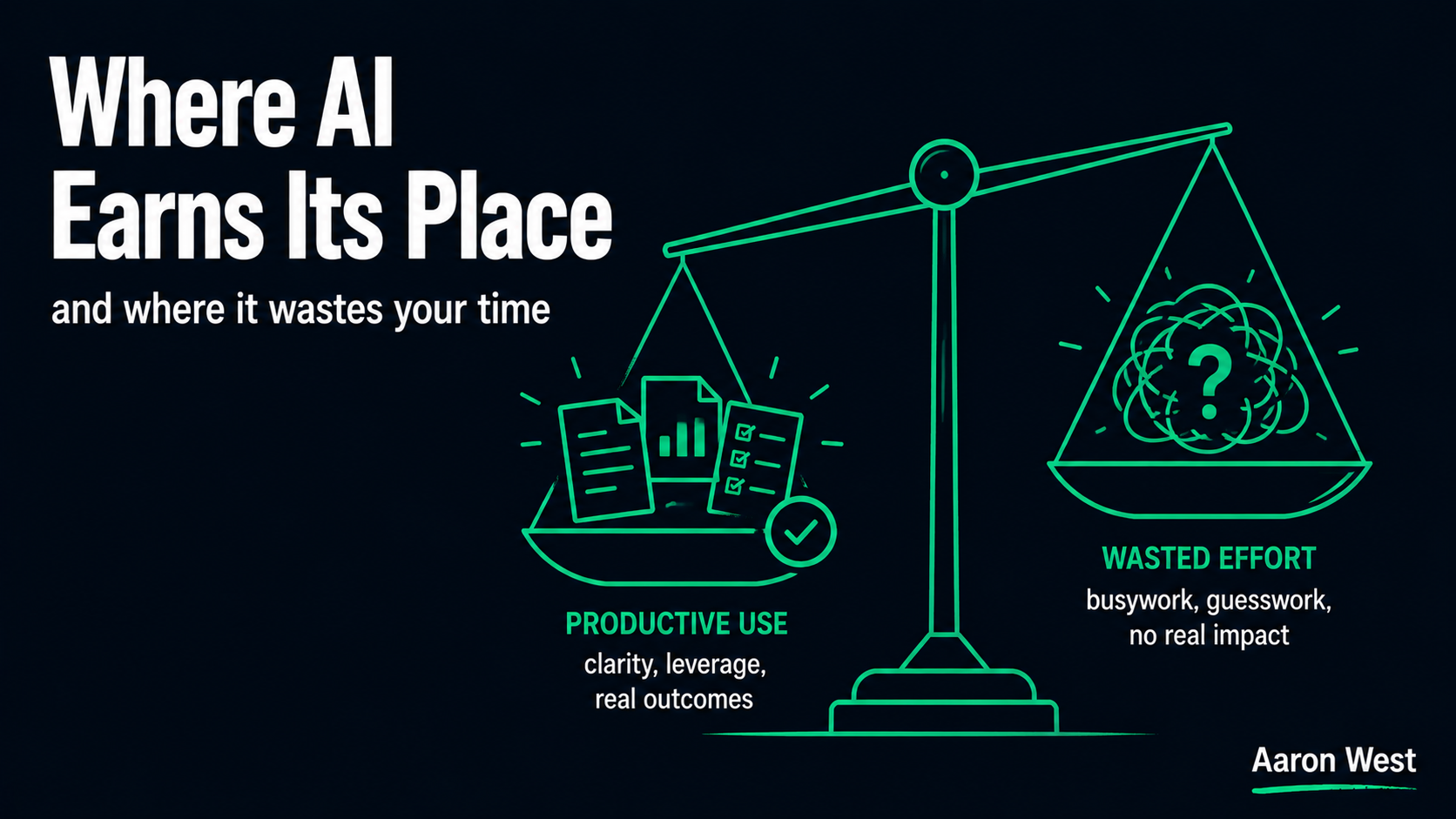
Using AI in Real E-Commerce Work: Where It Earns Its Place and Where It Wastes Your Time
After actually using AI across real e-commerce work rather than reading about it, here is the honest summary: AI is genuinely transformative for a specific, narrow band of tasks, and a confident waste of time for a surprising number of others. The skill in 2026…
Continue reading...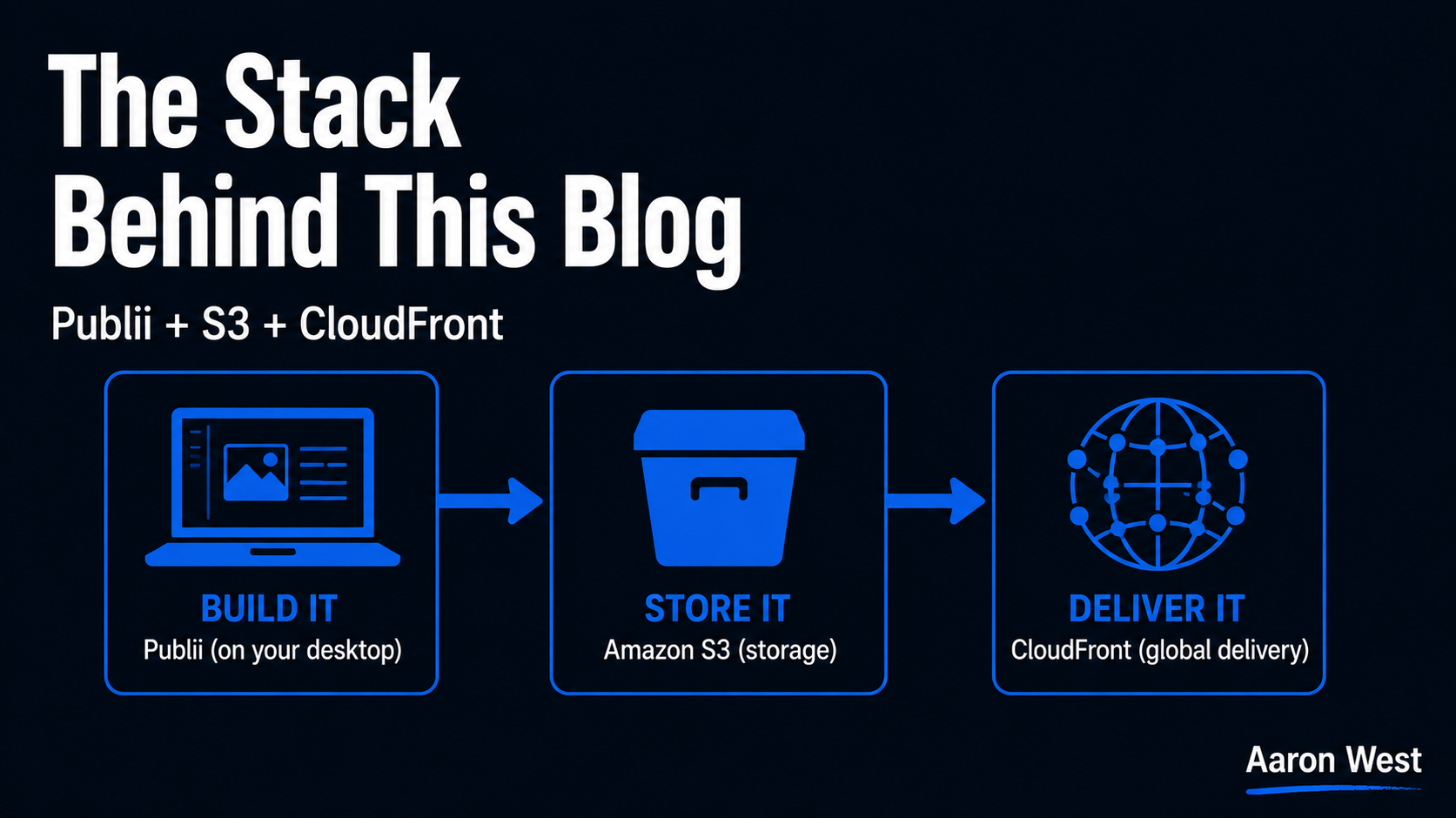
The Static-Site Stack Behind This Blog: Publii, S3, and CloudFront
This blog has no database, no web server running around the clock, and nothing on it that can really be "hacked" in the usual sense. It is a set of plain HTML files, built on my own laptop, stored in AWS, and delivered fast to…
Continue reading...