Cleaning Messy Product Data With AI: The Workflow That Actually Works

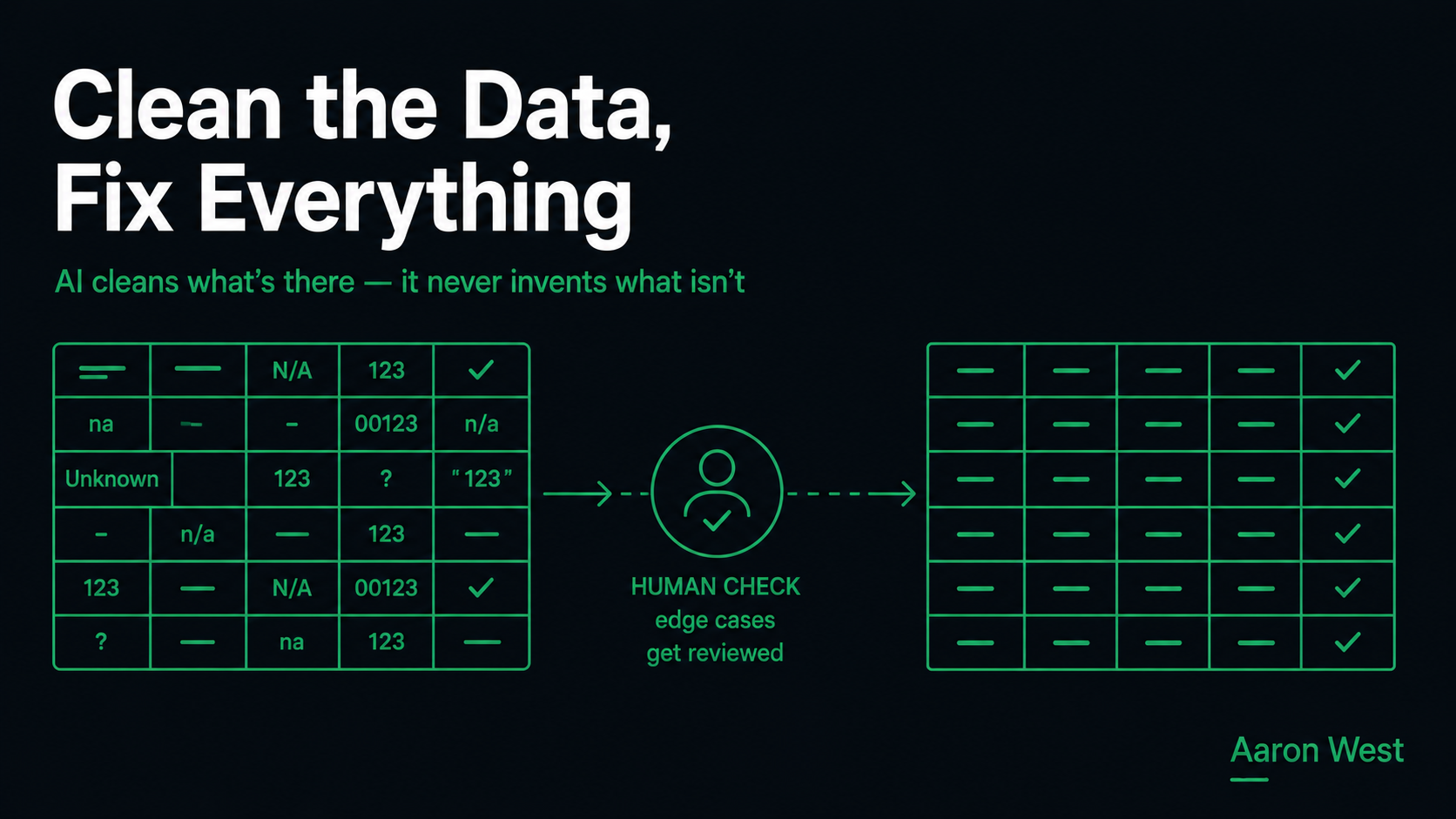
Table of Contents
Messy product data, inconsistent attributes, missing fields, junk descriptions, duplicate entries, is the silent tax on every part of your store. It breaks search, it breaks filtering, it breaks your feeds, and most people never trace the problem back to its source. AI is the first tool that can clean and enrich that data at scale instead of one painful row at a time. But "clean it with AI" only works as a supervised workflow, not a magic button, because the one thing you cannot let it do is confidently invent data.
This is a core of the AI in the Workflow cluster, and the companion to the product-assets piece.
The tax nobody sees
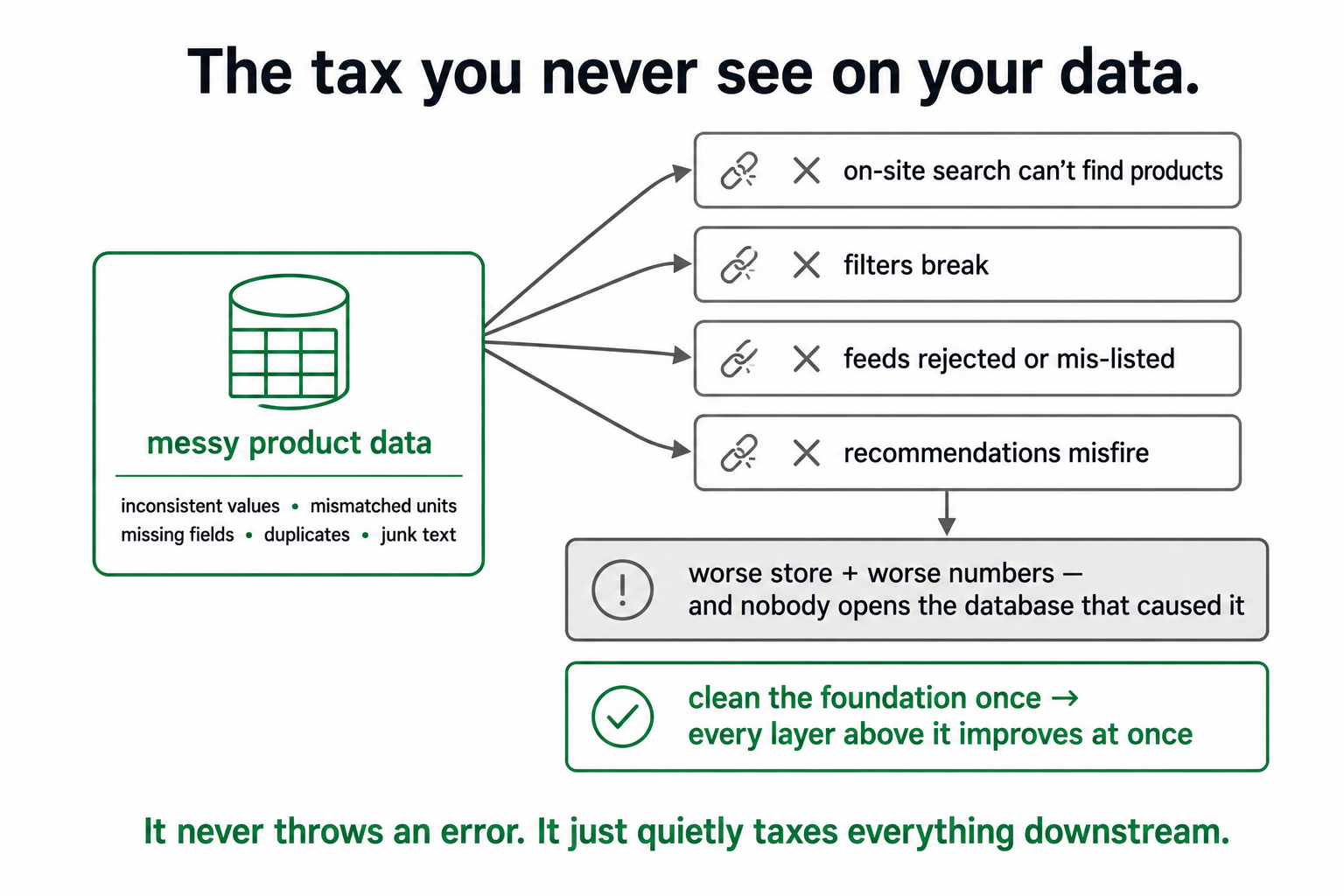
Messy product data looks harmless because it's invisible until you go looking. It's the same attribute written five different ways ("red," "Red," "crimson," "RED-01"). It's units that don't match (some weights in grams, some in kilograms). It's missing fields, half your products have a material listed and half don't. It's vague descriptions, duplicate entries, and free-text fields stuffed with information that should be structured.
None of that throws an error. It just quietly degrades everything downstream. On-site search can't find products whose attributes are inconsistent. Filters break when the values don't line up. Product feeds get rejected or mis-list items. Recommendations misfire. The customer experiences a worse store and you experience worse numbers, and the root cause is sitting in a database nobody wants to open. That's the tax: invisible, constant, and paid everywhere at once.
Cleaning versus enriching: two different jobs
These get lumped together and shouldn't be, because AI does them differently.
Cleaning is fixing what's wrong: standardising those five spellings of "red" into one, converting all weights to the same unit, removing duplicates, correcting formats. You're not adding information, you're making the information you have consistent and correct.
Enriching is adding what's missing: extracting a material from a description that mentions it but never filled the field, categorising an uncategorised product, generating tags, filling gaps from data that already exists elsewhere in the record. You're making thin records complete.
AI is good at both, but the distinction matters for the guardrail later: cleaning works with what's there, and enriching must only ever derive from what's there, never conjure what isn't.
The workflow that actually works
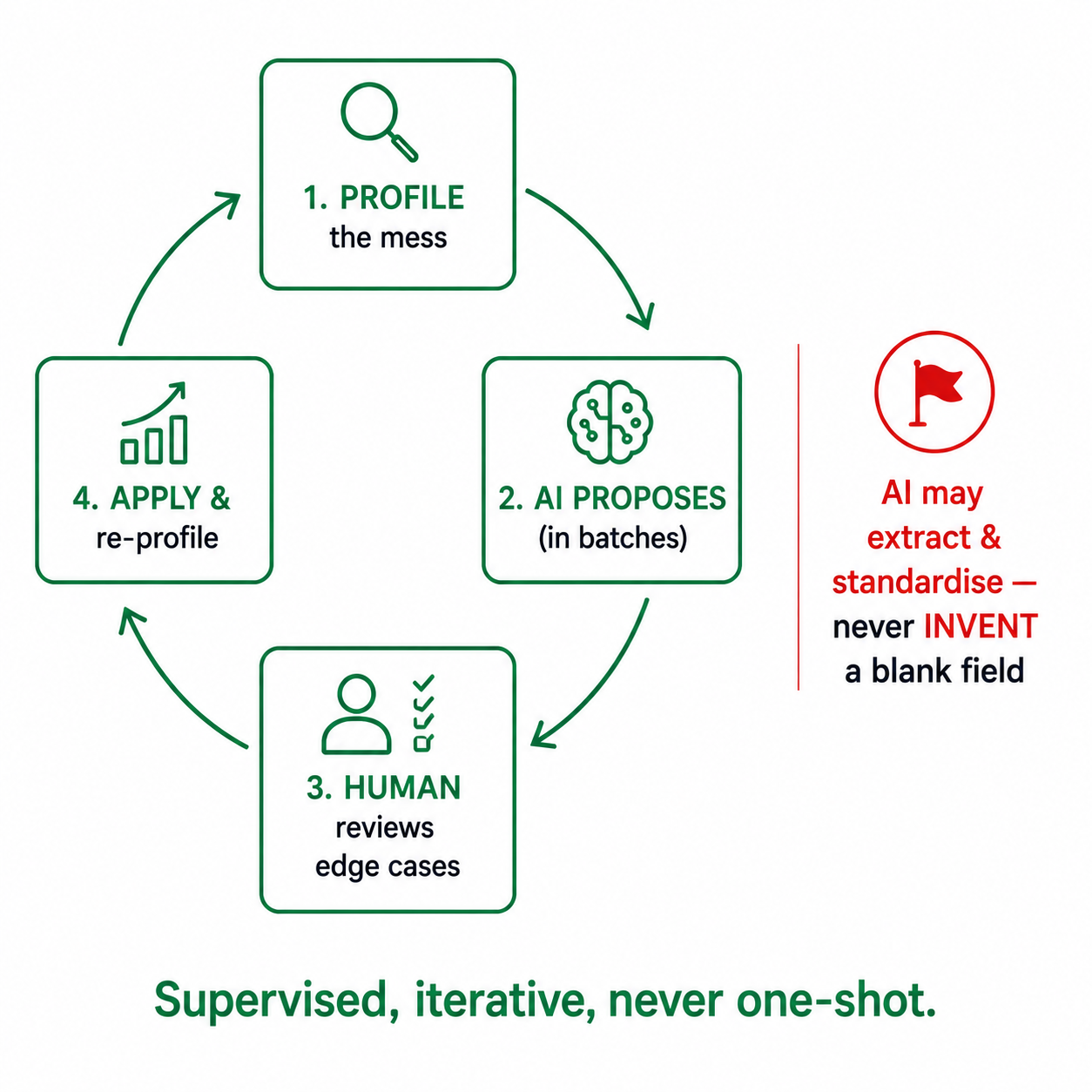
The failure mode is obvious and common: point AI at a messy database, say "clean this," and accept whatever comes back. That produces clean-looking data riddled with confident errors. The workflow that works is supervised and iterative.
- Profile the mess first. Before changing anything, understand what's actually wrong and how much, which fields are inconsistent, which are empty, where the duplicates are. You can't fix what you haven't measured, and this is the same "understand it before you automate it" discipline that applies to any process.
- Let AI propose, in structured batches. Have it suggest standardised values, extracted attributes, and duplicate candidates, as proposals, not changes. Work in batches you can actually review, not one giant run.
- A human reviews the edge cases. Spot-check the confident changes, and look hard at anything AI flagged as uncertain. This is where errors get caught before they're written. Never blanket-accept.
- Apply, re-profile, repeat. Apply the reviewed batch, profile again to see what's left, and go again. Data cleaning is a loop, not a one-shot event, especially as new products keep arriving messy.
The supervision isn't friction to remove later. It's the part that makes the output trustworthy.
The red line: never invent
Here is the rule that separates safe AI data work from a slow-motion disaster: never let AI invent data it cannot derive from what already exists.
Extracting "100% cotton" from a description that says "100% cotton" and putting it in the material field is fine, the fact was already there, AI just moved it. Guessing that a product is cotton because the field was blank is a fabrication, and a fabricated attribute is worse than a missing one. A missing field is honest about not knowing. A fabricated field is a confident lie that becomes a wrong filter result, a wrong line in a feed, and a returned order from a customer who believed the page. This is the same boundary as everywhere AI touches the operation, the where-it-breaks discipline: AI may transform and extract from what exists; it may not assert what isn't there.
Why it's worth the effort
The reason data cleaning earns priority over flashier projects is that it compounds. Product data is the foundation, and clean data makes everything built on it better at the same time: search returns the right products, filters work, feeds get accepted, descriptions generate from accurate inputs, recommendations make sense. Fix the foundation once and every layer above it improves, which is the opposite of most fixes, where you improve one thing and leave the rest untouched.
That's why "boring" data work is some of the highest-leverage work in e-commerce, and why AI making it finally tractable at scale is genuinely a big deal.
What this comes down to
Messy product data is the foundation everything else stands on, and it's been too big to fix by hand and too nuanced to fix with rigid rules, which is exactly why it stays messy. AI changes that, it can clean and enrich at scale, as long as you keep it supervised and hold one line absolutely: it cleans and enriches what's there, and it never invents what isn't.
Profile first, let AI propose, review the edge cases, repeat. Do that, and fixing your data is no longer the project nobody has time for. It's the project with the best return you'll find.
A few common questions
What counts as "messy" product data? Inconsistent attributes (the same value written several ways), mismatched units, missing fields, duplicate entries, vague descriptions, and information buried in free text that should be structured. None of it throws an error, which is why it's invisible, but it quietly degrades on-site search, filtering, product feeds, and recommendations all at once. The customer gets a worse store and you get worse numbers, and the cause is data nobody wants to open.
What's the difference between cleaning and enriching data? Cleaning fixes what's wrong: standardising inconsistent values, converting units, removing duplicates, correcting formats, without adding new information. Enriching adds what's missing: extracting an attribute from a description, categorising, tagging, filling gaps from data already in the record. AI does both, but enriching must only ever derive from information that already exists, never conjure values that don't.
How do you actually clean data with AI without making it worse? Use a supervised, iterative workflow: profile the mess first so you know what's wrong and how much; let AI propose standardised values and extracted attributes in reviewable batches rather than one giant run; have a human review the edge cases and anything flagged as uncertain; then apply, re-profile, and repeat. The supervision is what makes the output trustworthy, pointing AI at a database and accepting whatever comes back produces clean-looking data full of confident errors.
What's the one rule for AI and product data? Never let it invent data it can't derive from what exists. Extracting an existing fact into a field is fine; guessing a fact to fill a blank is a fabrication, and a fabricated attribute is worse than a missing one because it becomes a wrong filter, a wrong feed, and a returned order. A missing field is honest about not knowing; a fabricated field is a confident lie. AI may transform and extract; it may not assert what isn't there.
You should also read:
Using AI to Process Product Assets at Scale
Processing product assets, the images, the copy, the metadata, for hundreds or thousands of products is exactly the kind of high-volume, repetitive, judgment-adjacent work AI is genuinely good at. It's one of the few places in an e-commerce operation where AI earns its place almost…
Continue reading...
RAG Explained for E-Commerce: Giving a Bot Your Product Knowledge Without Retraining It
If you want an AI assistant that actually knows your store, your real products, your current prices, your live stock, your specific return policy, the technique you need is RAG, retrieval-augmented generation. It connects the AI to your live business data so it answers from…
Continue reading...
Everything I Know About Building Chatbots That Actually Work
The hard part of building a chatbot was never the technology. I learned this in 2019, building a natural-language chatbot from scratch for a large hotel group, across dozens of locations and several languages, back when "conversational AI" was a research term and not a…
Continue reading...