Using AI to Process Product Assets at Scale

Table of Contents
Processing product assets, the images, the copy, the metadata, for hundreds or thousands of products is exactly the kind of high-volume, repetitive, judgment-adjacent work AI is genuinely good at. It's one of the few places in an e-commerce operation where AI earns its place almost immediately. The trick is using it for the scale and the first draft, never for the final call.
This is a core of the AI in the Workflow cluster. Product assets are where catalogs quietly go to die, and where AI quietly saves them.
The work nobody wants and every store has
"Product assets" means the three things every product needs before it can sell well: a decent image (or several), a real description, and clean, complete metadata (the attributes, categories, and tags that let the product be found and filtered). One product is a few minutes of work. Now multiply by a few thousand SKUs, with new ones arriving constantly and old ones needing updates, and you have one of the largest, most thankless workloads in e-commerce.
It's also a genuine bottleneck. Products sit unpublished because nobody's written the copy. They rank badly because the metadata is thin. They get returned because the image didn't match. The asset backlog isn't an aesthetic problem, it's a revenue problem, and it's too big to brute-force by hand.
Why this is an ideal AI job
Most automation advice tells you to automate repetitive work with rigid rules. Product assets resist that, because they're repetitive and varied: every product is a bit different, so a fixed script can't write the description or judge the image. For years that left this work stuck, too big for humans, too nuanced for rules.
That gap, high volume, pattern-based, but with enough variation that rigid logic can't handle it, is exactly the "messy middle" where AI earns its place over traditional automation. An AI can read a product's attributes and draft a sensible description, look at an image and write alt text, or pull structured data out of a paragraph of marketing text. That's new, and it's genuinely useful.
The three asset types, and how AI helps each
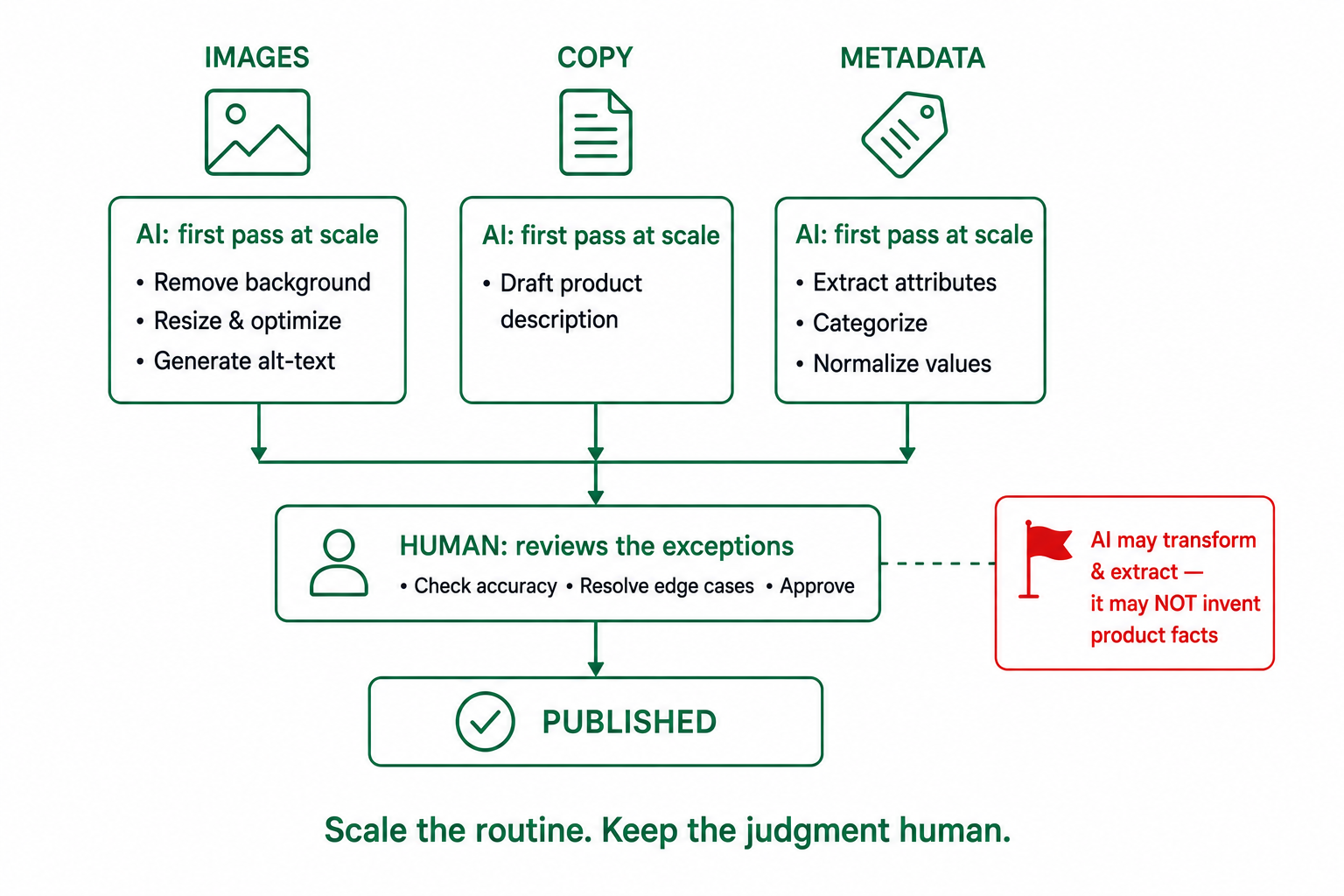
Images. AI handles the mechanical work at scale: removing or standardising backgrounds, resizing and reformatting to spec, generating descriptive alt text for accessibility and search, and flagging images that don't meet your standards so a human can fix them. The line to hold: process and describe real product images. Don't generate fake ones, a synthetic image of a product the customer then receives differently is a trust and returns problem waiting to happen.
Copy. AI is a strong first-drafter. Feed it a product's real attributes and it'll produce a serviceable description, summarise long specs, adapt tone, or translate for another market. The output is a draft, not a final, and it gets a human edit before it ships, exactly the discipline in the product-descriptions piece. First draft at scale, human polish where it counts.
Metadata. This is often the highest-leverage use. AI can extract structured attributes from messy free-text ("100% cotton, machine washable" becomes material and care fields), categorise products, suggest tags, and flag gaps. It turns the unstructured into the structured, which is the foundation everything else, search, filtering, feeds, depends on (more in the data-cleaning sibling).
The pattern that actually works
The mistake at both extremes is the same mistake: handing over the whole job. "AI does it all" produces confident errors at scale, a hallucinated spec replicated across a thousand products. "Humans do it all" never clears the backlog. The pattern that works sits between them.
AI does the first pass across everything, fast and tireless. Then a human reviews the exceptions, the items AI flagged as uncertain, the edge cases, a spot-check of the rest. The leverage comes from AI handling the routine 80% and surfacing the 20% that needs a person, instead of a human grinding through 100% or AI silently shipping mistakes through 100%. You're not replacing the judgment. You're removing the manual labour around it so the judgment has time to happen.
The guardrail that matters most
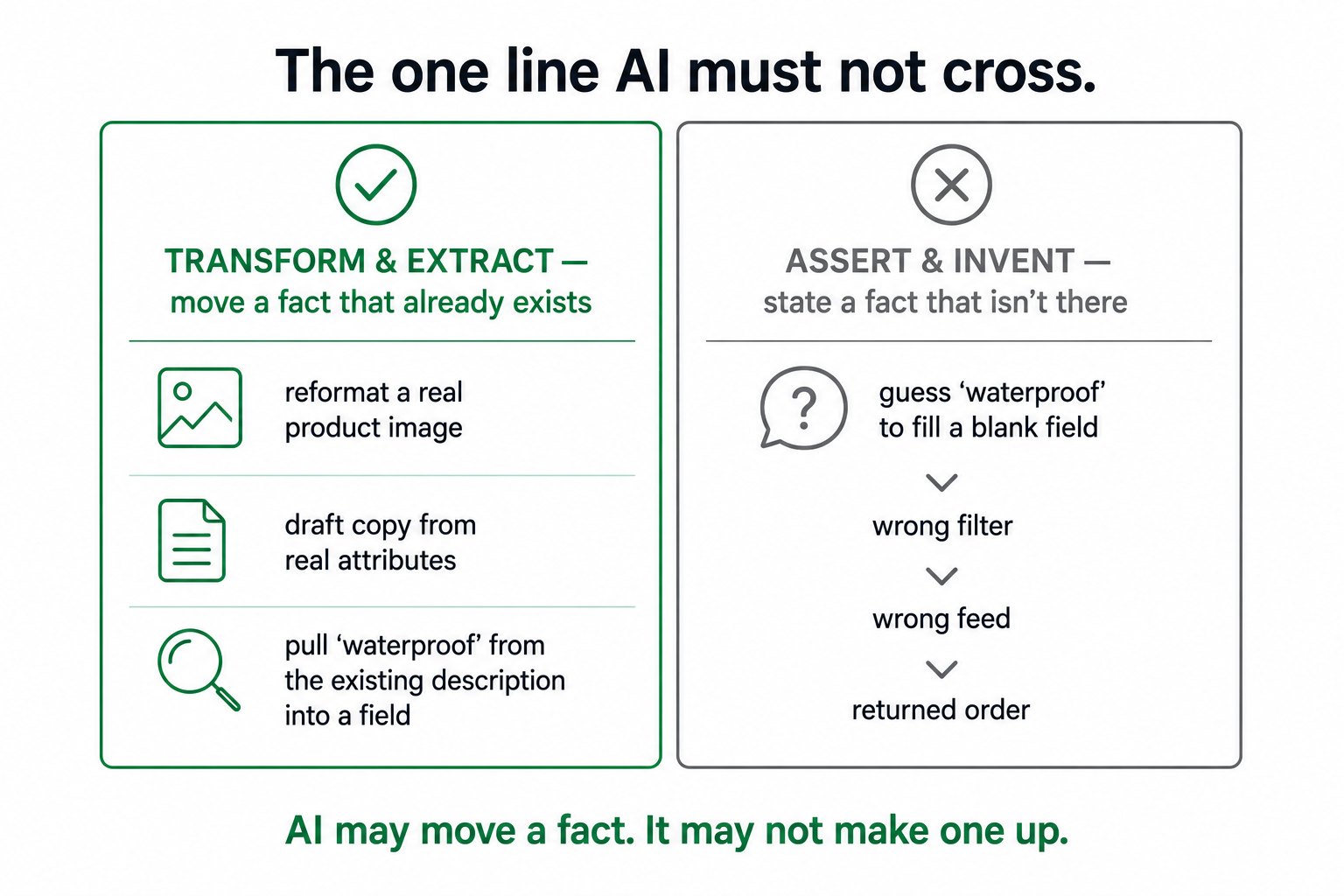
One rule sits above the rest: never let AI invent product facts. Extracting "waterproof" from an existing description is fine, that fact already exists, AI is just moving it into a field. Guessing that a product is waterproof because the field was blank is a fabrication, and a fabricated spec becomes a wrong filter, a wrong feed, and eventually a returned order from a customer who trusted what the page said.
So the boundary is clean: AI may transform and extract from what already exists. It may not assert what isn't there. Anything customer-facing and factual keeps a human gate, the same where-AI-breaks discipline that applies everywhere AI touches the operation. Get that boundary right and the rest is upside.
What this comes down to
Product assets are the bottleneck AI was practically built for: enormous, repetitive, pattern-based, and just varied enough that nothing before AI could touch them at scale. Used well, AI clears the backlog that's been keeping products unpublished, unranked, and inconsistent, and it does it as a tireless first-pass assistant, not a final authority.
Scale the routine. Keep the judgment, and the facts, human. That's the whole discipline, and it's the difference between AI that quietly fixes your catalog and AI that quietly fills it with confident mistakes.
A few common questions
What does "processing product assets at scale" mean? Handling the images, copy, and metadata that every product needs, across hundreds or thousands of SKUs at once instead of one at a time. It's one of the largest, most repetitive workloads in e-commerce, and a genuine bottleneck: products sit unpublished without copy, rank badly with thin metadata, and get returned when images don't match. AI is well-suited to clearing this backlog because the work is high-volume and pattern-based but too varied for rigid rules.
How does AI help with product images, copy, and metadata? Images: standardising backgrounds, resizing to spec, generating alt text, and flagging off-standard images, processing real product photos, not generating fake ones. Copy: drafting descriptions from real attributes, summarising, translating, and adapting tone, as a first draft a human then edits. Metadata: extracting structured attributes from messy free text, categorising, tagging, and flagging gaps, which is often the highest-leverage use because clean metadata is the foundation for search, filtering, and feeds.
Should AI do the whole job? No. "AI does it all" produces confident errors replicated across thousands of products; "humans do it all" never clears the backlog. The pattern that works is AI doing the first pass across everything, then a human reviewing the exceptions AI flagged plus a spot-check of the rest. The leverage is AI handling the routine majority and surfacing the minority that needs judgment, so you remove the manual labour around the decision without removing the decision.
What's the one rule for using AI on product data? Never let it invent product facts. Extracting an existing fact from a description into a field is fine; guessing a fact to fill a blank is a fabrication, and a fabricated spec becomes a wrong filter, a wrong feed, and a returned order. AI may transform and extract from what exists; it may not assert what isn't there. Anything customer-facing and factual keeps a human gate.
You should also read:
Cleaning Messy Product Data With AI: The Workflow That Actually Works
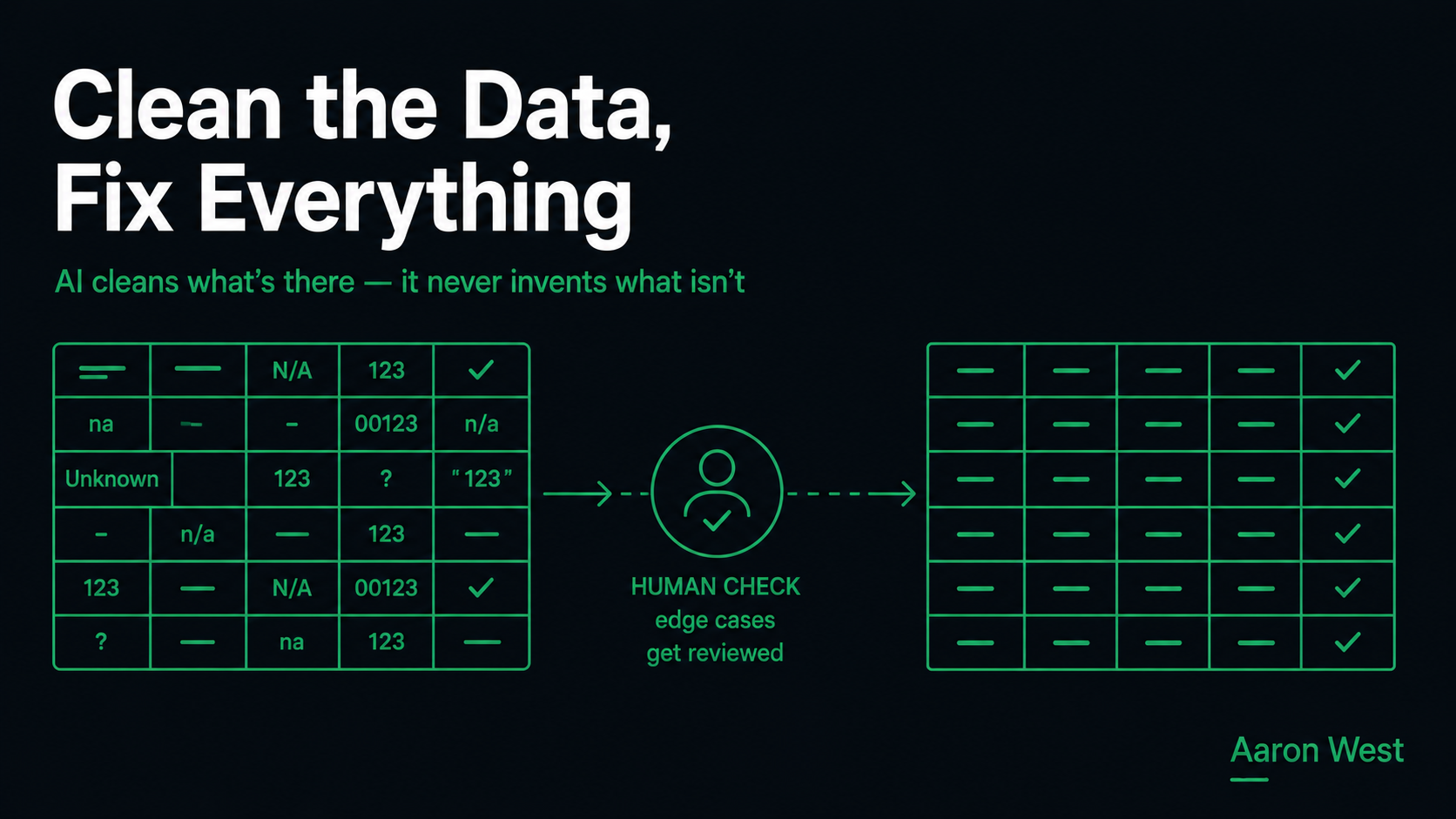
Messy product data, inconsistent attributes, missing fields, junk descriptions, duplicate entries, is the silent tax on every part of your store. It breaks search, it breaks filtering, it breaks your feeds, and most people never trace the problem back to its source. AI is the…
Continue reading...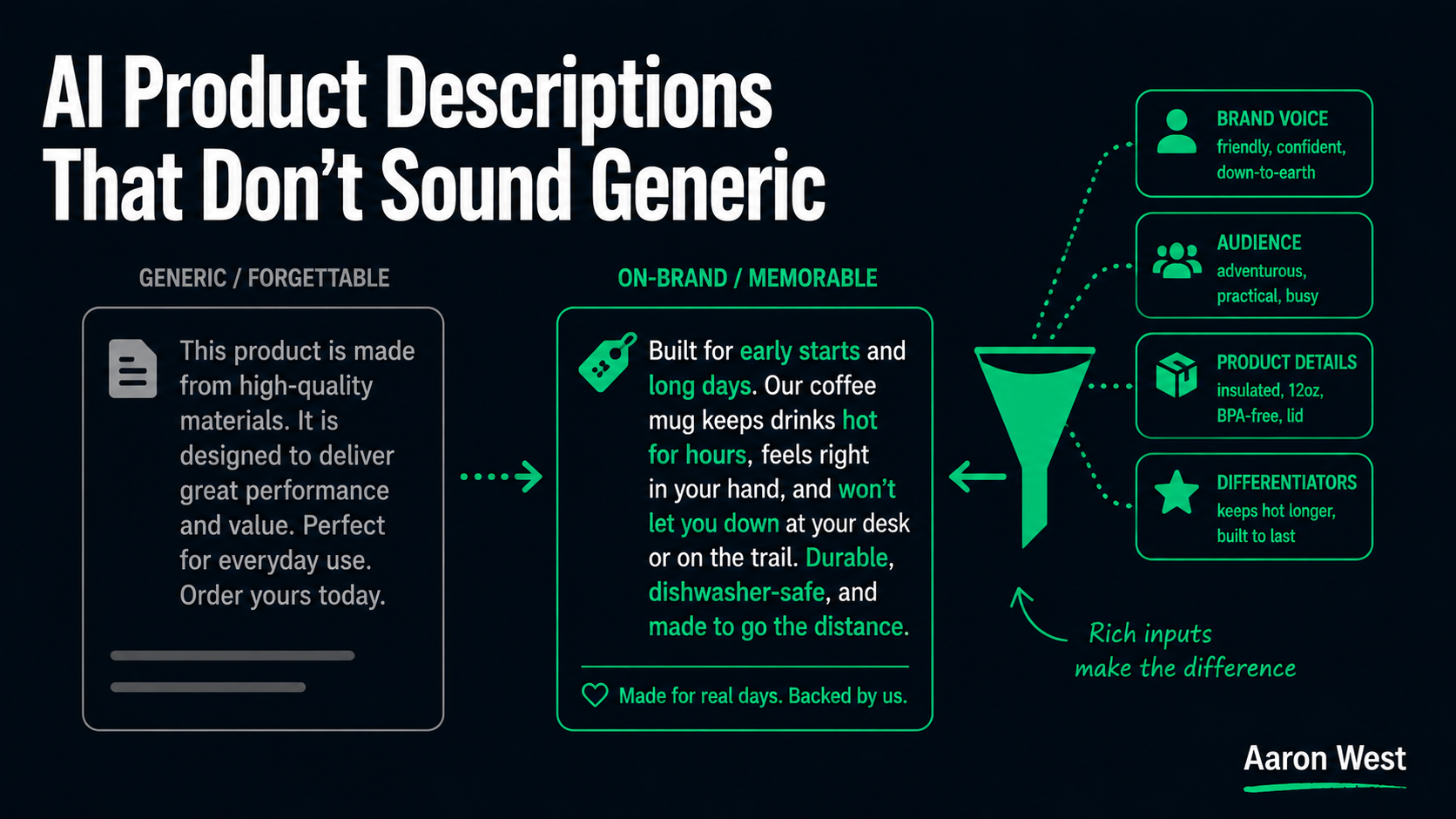
AI for Product Descriptions That Don't Sound Generic
The most common complaint about AI-written product descriptions is that they all sound the same, bland, interchangeable, like they could describe any product from any store. The complaint is fair, and here is the part nobody selling AI tools wants to say plainly: when AI…
Continue reading...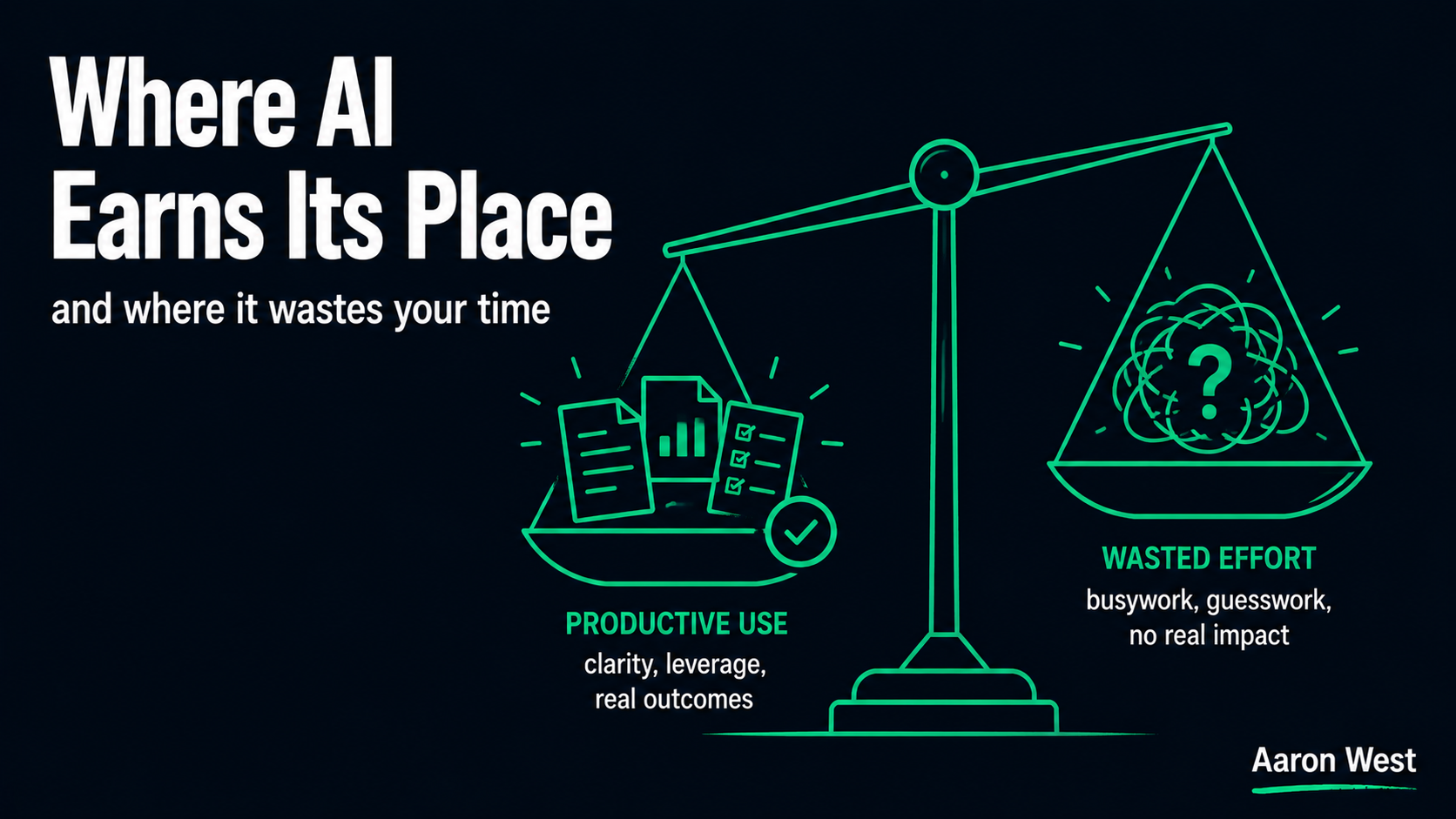
Using AI in Real E-Commerce Work: Where It Earns Its Place and Where It Wastes Your Time
After actually using AI across real e-commerce work rather than reading about it, here is the honest summary: AI is genuinely transformative for a specific, narrow band of tasks, and a confident waste of time for a surprising number of others. The skill in 2026…
Continue reading...