Building an Internal AI Assistant on Your Own Knowledge Base

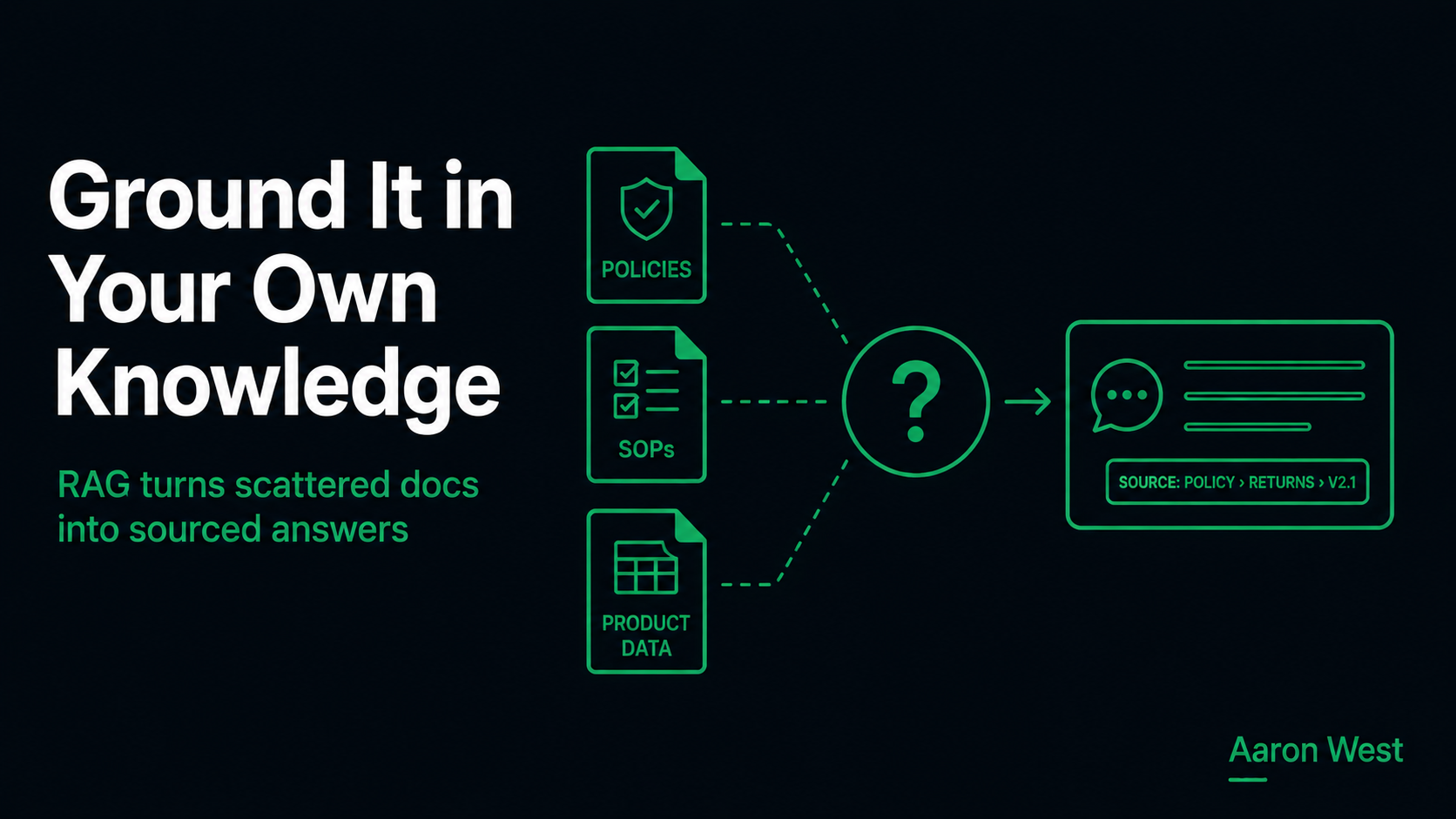
Table of Contents
An internal AI assistant is a chatbot that answers your team's questions from your own documents, your policies, product data, standard procedures, past support tickets, instead of from the public internet. It's one of the highest-value and lowest-risk ways to put AI to work in an e-commerce operation. And the technique that makes it actually useful instead of confidently wrong has a name: retrieval. The assistant looks things up in your knowledge base and answers from what it finds, rather than from memory.
This is a core of the AI in the Workflow cluster. I've built conversational AI systems before this wave of tools made it fashionable, and the lesson that mattered most then is the one that matters most now: an assistant is only as trustworthy as what it's grounded in.
The problem it solves
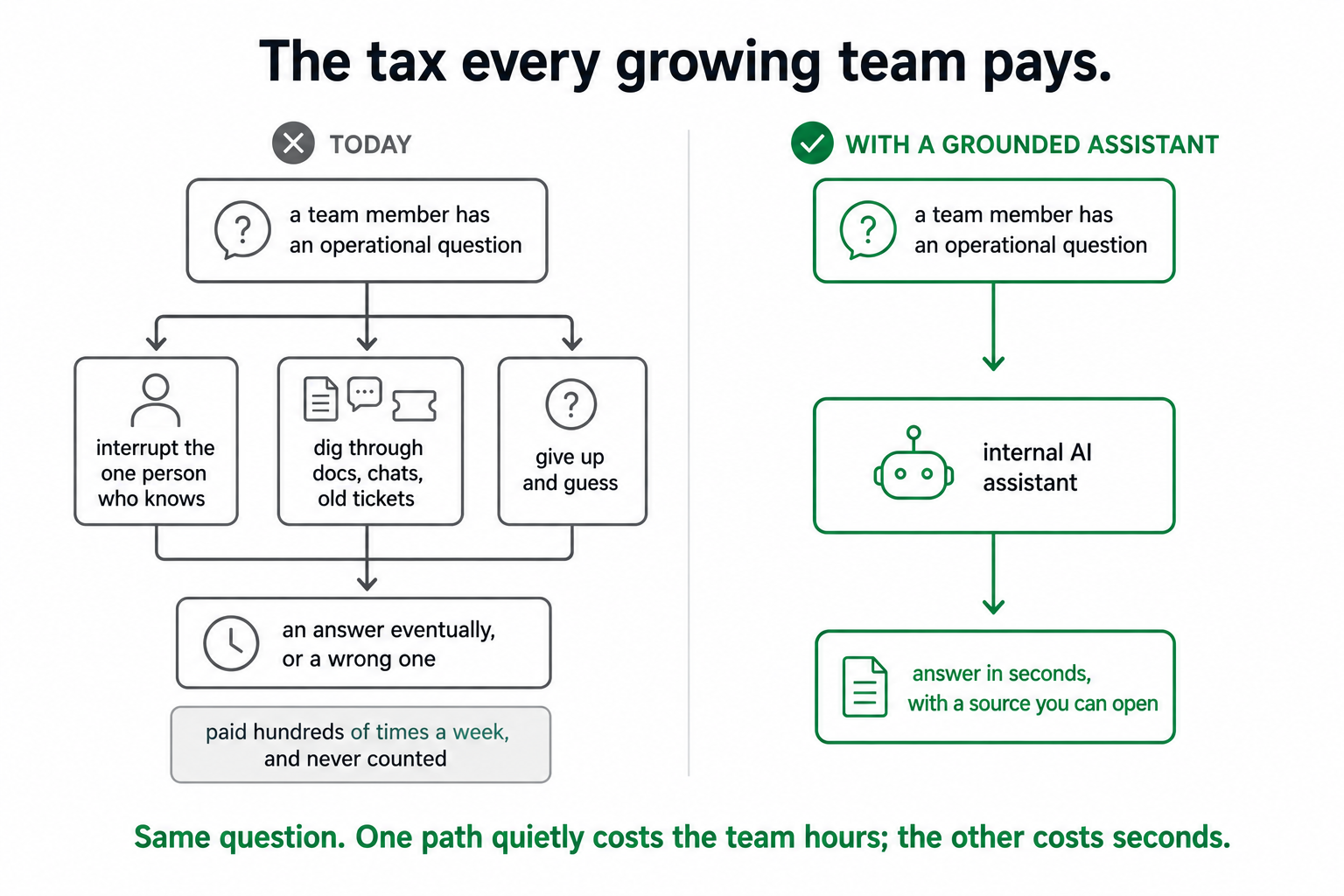
Most teams are drowning in their own knowledge. The answer to "what's our policy on damaged returns?" or "how do we handle a duplicate order?" or "what's the spec on this product line?" exists somewhere, in a document, a buried chat thread, a process doc, or in one experienced person's head. The cost isn't that the knowledge is missing. It's that finding it means asking around and waiting, interrupting the one person who knows, or giving up and guessing.
That "ask around and wait" tax is paid hundreds of times a week across a busy operation, and it gets worse as the team and the documentation grow. An internal assistant grounded in that scattered knowledge turns the question into "ask and get the answer, with a source," in seconds. That's the value, and it's large precisely because the problem is so constant and so invisible.
Why RAG is the key
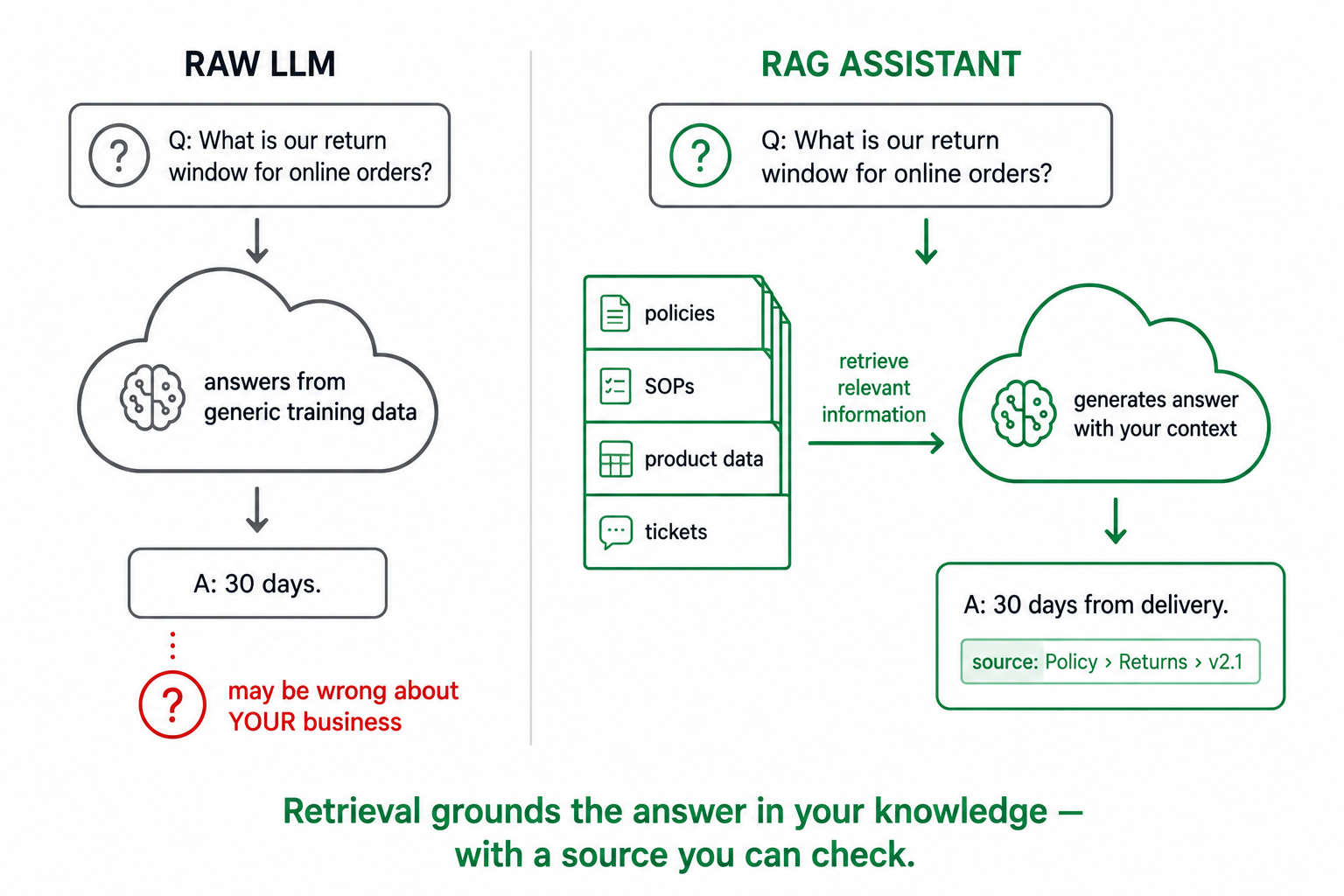
Here's the part that separates a useful internal assistant from a liability. A raw large language model answers from its training data, everything it learned from the public internet. Ask it about your business and it will answer confidently from generic knowledge that may be wrong, outdated, or simply invented, because it has no access to your actual documents. That's the hallucination problem, and it's fatal for an internal tool people are supposed to trust.
Retrieval-augmented generation, RAG, fixes this. Instead of answering from memory, the assistant first retrieves the relevant passages from your knowledge base, then answers using what it found, and shows you which document it came from. (There's a fuller explanation in the retrieval piece.) The difference is everything: the assistant stops guessing about your business and starts reading from it. Its answers are grounded in your real, current documents, with a citation you can check. That grounding is what makes an internal assistant safe to rely on, and it's why "just use a chatbot" and "build a RAG assistant on your own docs" are completely different projects.
Why it's lower-risk than customer-facing AI
A lot of AI caution is about customer-facing deployments, and rightly so: a public chatbot that gets something wrong does it in front of a customer, with your brand attached. An internal assistant is a much safer place to get real value from AI, for three reasons.
The audience is internal and competent, your team can sanity-check an answer in a way a customer can't, because they know the business well enough to notice when something's off. There's no public brand exposure if it stumbles. And because it cites its source, the person asking can open the document and verify before acting on anything important. That combination, knowledgeable users, no public exposure, verifiable answers, makes an internal assistant the natural first serious AI project for most operations. You build real capability and real judgment about what AI can and can't do, in the lowest-stakes setting available.
What actually makes it work
The technology is the easy part now. The things that decide whether an internal assistant is useful or useless are unglamorous:
- Garbage in, garbage out. The assistant is only as good as the knowledge base behind it. Feed it contradictory, outdated, or messy documents and it will confidently serve contradictory, outdated answers. Clean, current source material is the whole game.
- Keep it sourced. Every answer should point to the document it came from. This isn't a nice-to-have, it's what lets people trust the tool and catch the rare wrong answer. An assistant that cites is one you can verify; one that doesn't is one you have to take on faith.
- Scope it. A focused assistant over a defined set of real documents (returns policies, fulfilment procedures, product specs) beats a vague "ask me anything." Narrow and reliable earns trust; broad and flaky loses it fast.
- Keep it current. Stale documents produce confidently outdated answers, which are arguably worse than no answer, because people act on them. The knowledge base needs an owner and a refresh habit, or the assistant slowly becomes a liar nobody notices.
The guardrails
Even grounded and sourced, an internal assistant will occasionally get something wrong, so deploy it with the same discipline as any AI in the operation. It advises; humans decide, especially on anything consequential. Don't wire it to take irreversible actions on its own, the human-in-the-loop principle applies here exactly as it does to automation: keep a person on the decisions that are expensive to undo. And be deliberate about what you put in it, an assistant is only as secure as the system it runs on, so sensitive data belongs only in a setup that's actually secured for it.
None of this is a reason not to build one. It's the difference between an assistant that quietly makes the team faster and one that quietly causes a mess.
What this comes down to
An internal AI assistant grounded in your own knowledge is the rare AI project that's genuinely high-value and genuinely low-risk. It takes the institutional knowledge scattered across your documents, chats, and people's heads and turns it into instant, sourced answers, paying back the constant, invisible "ask around and wait" tax that every growing operation pays.
Build it on retrieval so it reads from your business instead of guessing about it. Keep the knowledge clean, current, and sourced. And let it advise while humans decide. Do that, and you've got the most useful AI most operations will deploy, and the safest place to learn what AI can really do for you.
A few common questions
What is an internal AI assistant? A chatbot that answers your team's questions from your own documents, policies, product data, standard procedures, past tickets, rather than from the public internet. It solves the constant "ask around and wait" tax: the answer to an operational question usually exists somewhere in a doc, a chat thread, or one person's head, and an internal assistant turns finding it into "ask and get the answer, with a source," in seconds.
Why does an internal assistant need RAG? Because a raw language model answers from generic training data and has no access to your actual documents, so it will answer confidently and possibly wrongly about your business, that's the hallucination problem. Retrieval-augmented generation (RAG) fixes it: the assistant first retrieves the relevant passages from your own knowledge base, then answers from what it found, with a citation. That grounding is what makes its answers accurate about your business and safe to rely on.
Why is an internal assistant lower-risk than a customer-facing one? Three reasons: the audience is your team, who can sanity-check an answer because they know the business; there's no public brand exposure if it stumbles; and because it cites its source, people can verify before acting on anything important. That combination makes it the natural first serious AI project, you build real capability in the lowest-stakes setting available.
What makes an internal assistant actually useful? Unglamorous things: clean, current source documents (garbage in, garbage out, it's only as good as its knowledge base); every answer sourced so people can trust and verify it; a defined scope rather than "ask me anything"; and a habit of keeping the documents current so it doesn't serve confidently outdated answers. Plus the guardrails: it advises while humans decide, it isn't wired to take irreversible actions, and sensitive data goes only in a properly secured setup.
You should also read:

Why Your Product Images Are Slowing Down Your Conversion Rate
The single biggest thing slowing down your online store is almost certainly the very thing you put there to sell the product: the images. On a typical e-commerce page, images make up more than half of everything the browser has to download, and unoptimised product…
Continue reading...
RAG Explained for E-Commerce: Giving a Bot Your Product Knowledge Without Retraining It
If you want an AI assistant that actually knows your store, your real products, your current prices, your live stock, your specific return policy, the technique you need is RAG, retrieval-augmented generation. It connects the AI to your live business data so it answers from…
Continue reading...
Intent-Based vs Generative Bots: Why the Best Systems Use Both
The loudest take in 2026 is that the old rule-based chatbot is dead, that large language models have made the intent-based bot obsolete, and that you should rip out the scripts and let a generative model handle everything. It is a clean story, and it…
Continue reading...