Unit Economics: The Only Numbers That Decide Whether You Have a Business

Table of Contents
Unit economics is the profit or loss on a single sale after every cost that sale actually causes, and it's the only thing that decides whether growth makes you richer or just busier. If you lose money on one order, you lose more money on a thousand. Scale doesn't fix bad unit economics; it multiplies whatever they already are.
This is a reference piece in the E-Commerce Foundations cluster, and it's the most important one, because every other number in e-commerce is decoration if the single sale doesn't make money.
The most dangerous business is the one growing on broken economics
Picture a store that's growing fast. Revenue up every month, orders climbing, everyone celebrating. And quietly losing money on every single order. This is the most dangerous situation in commerce, and it's dangerous precisely because it's growing, because growth hides it. Cash keeps flowing in from new sales, the bank balance looks alive, and the structural problem, that each sale costs more than it earns, stays invisible right up until the moment the cash runs out and it's suddenly the only thing anyone can see.
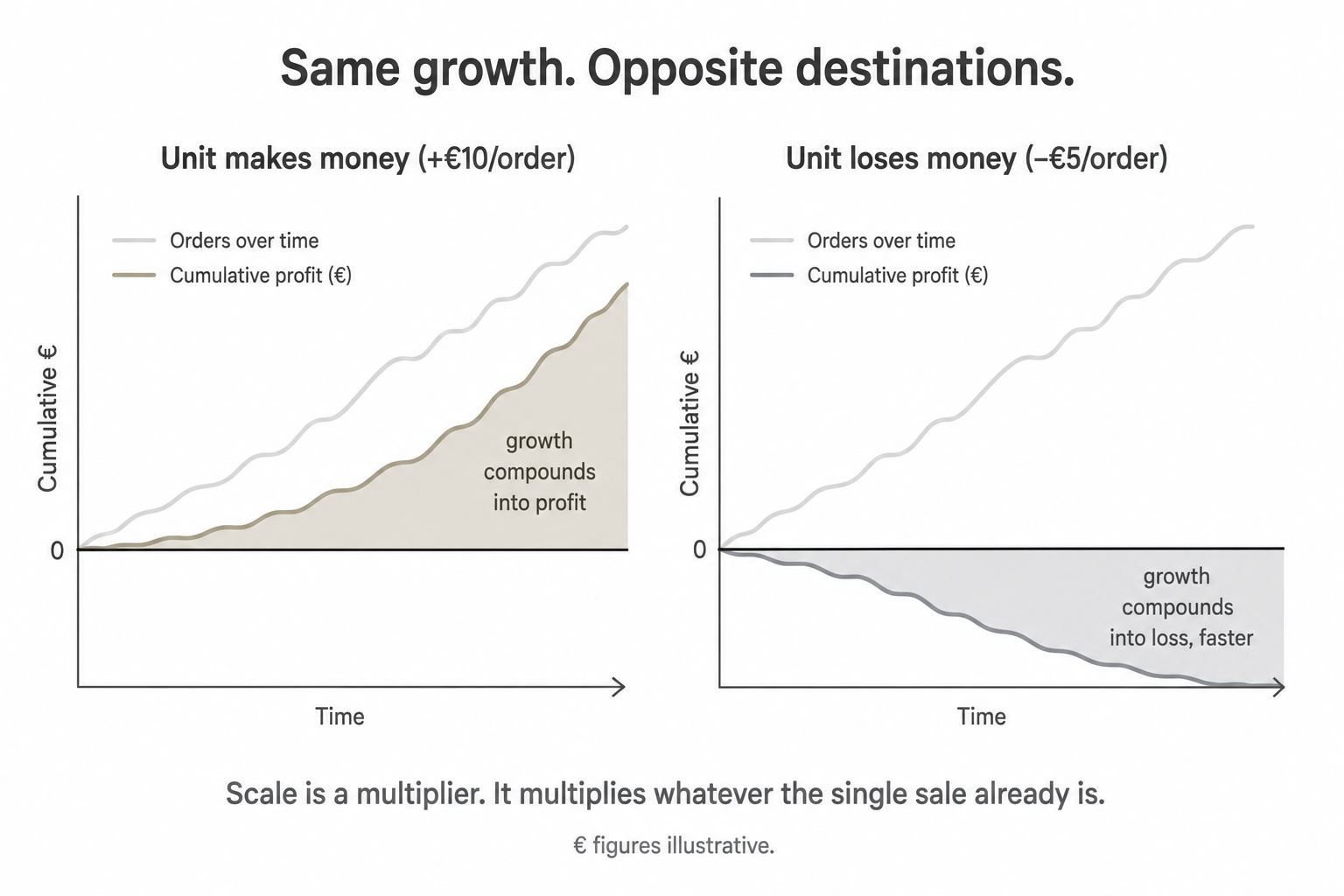
Good unit economics make growth a compounding gift. Bad unit economics make growth a faster way to go broke. Same growth, opposite outcome, and the only thing that decides which is the profit on a single sale.
What unit economics actually is
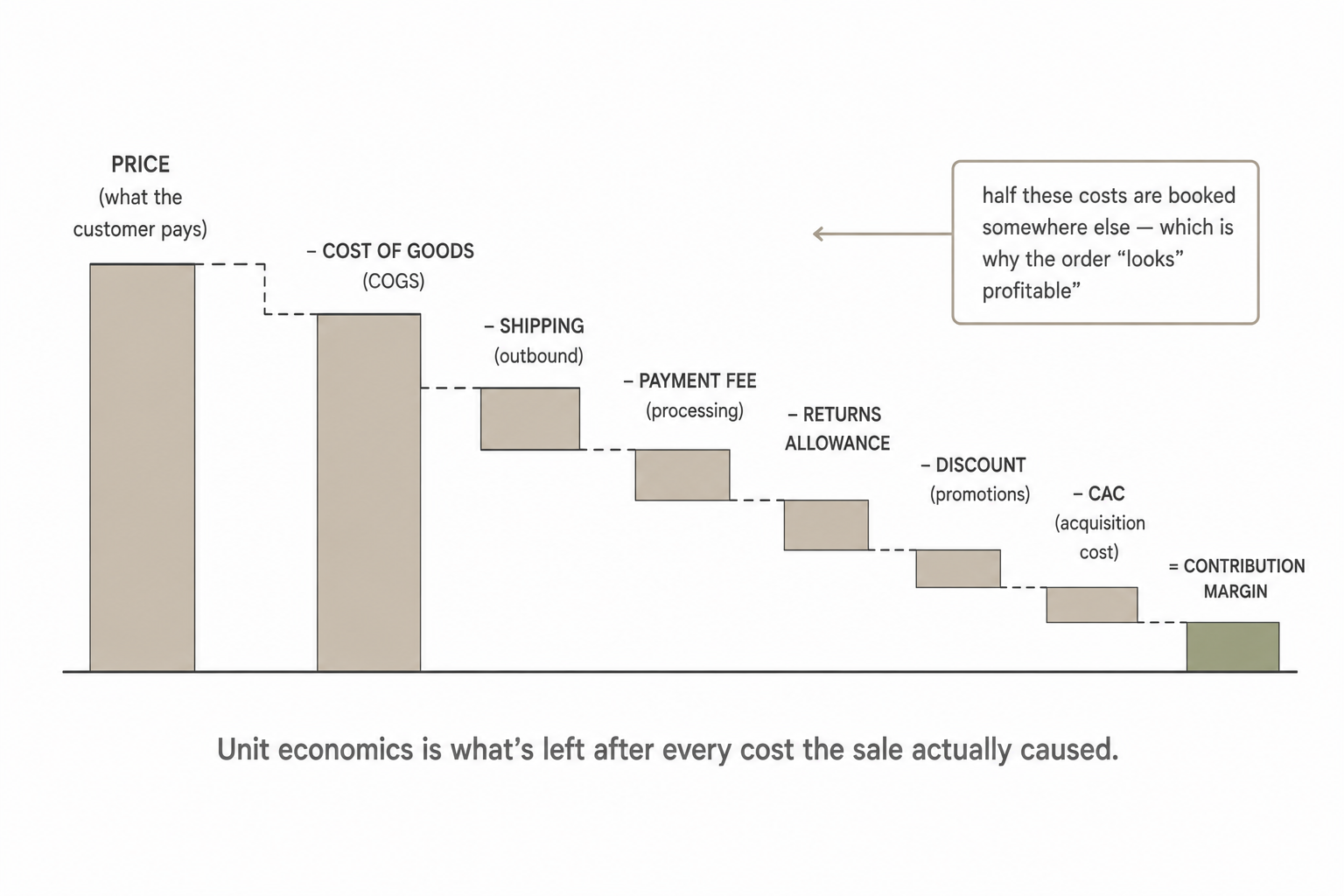
At its core it's one number: the contribution margin on a single order. Take the price the customer paid, then subtract every cost that order actually caused, the cost of the goods, the shipping, the payment processing fee, an allowance for the share of orders that get returned, any discount applied, and the cost of acquiring that customer in the first place. What's left is what the order genuinely contributed to the business. If it's positive, the sale made money. If it's negative, you paid for the privilege of making it.
That's the whole concept. The difficulty isn't the idea, it's that most of those costs are easy to overlook, which is exactly why so many "profitable" orders aren't.
The two numbers that matter
Unit economics really comes down to two figures sitting next to each other:
- Contribution margin per order (what one sale contributes after its own variable costs).
- CAC, the cost to acquire the customer who placed it.
The rule is brutally simple. If contribution margin is lower than CAC, every new customer you acquire loses you money. You can have beautiful branding, a slick site, and a growth chart that points up and to the right, and still be running a machine that turns marketing spend into losses. The two numbers next to each other tell you, in one glance, whether you have a business or a very convincing way to set money on fire. (Customer lifetime value is just this same logic extended across the whole relationship instead of one order.)
The costs people forget (why the "profitable" order isn't)
The reason a store can believe its orders are profitable while they aren't is that the costs are scattered. The order looks profitable on the product page because half of what it really costs is booked somewhere else in the accounts. The usual suspects:
- Payment fees, a few percent of every transaction, quietly skimmed off the top.
- Returns, both the lost sale and the cost of processing and often discarding the returned item. If a slice of orders come back, every order carries a share of that cost.
- Free shipping, which isn't free, you're paying it, you've just hidden it from the customer and sometimes from yourself.
- Discounts, which come straight out of the thinnest part of the margin.
- The true blended CAC, not the click cost, but the full marketing spend divided by the customers it actually won, including all the spend that won nobody.
Add those back honestly and the comfortable margin often turns thin or negative. The order didn't change; your view of it did.
Why growth multiplies it
This is the part that makes unit economics non-negotiable. Whatever the economics of one order are, scale multiplies them. Sell a hundred orders that each contribute €10 and you've made €1,000. Sell a hundred that each lose €5 and you've lost €500, faster than you lost it at ten orders. Scaling a business with negative unit economics isn't growth, it's buying revenue with your own cash and calling it success.
When I ran small businesses years ago, the lesson arrived without any of this vocabulary: the only question that ever mattered was whether the thing I'd just sold made money after everything it cost me to sell it. Get that one sale right and more sales is the best news there is. Get it wrong and more sales is just the problem, arriving faster. The arithmetic is the same whether you're selling groceries on a street corner or scaling a store across markets.
The discipline
The discipline is unglamorous and most people skip it: know your contribution margin per order before you spend a euro trying to scale. Not the blended P&L at the end of the quarter, which mixes everything together and hides the per-order truth, but the honest, fully-loaded margin on a single representative sale. Once you know that one number, every growth decision gets clearer. You know what you can afford to spend to acquire, how much room a discount really has, and whether "more orders" is the answer or the accelerant on a problem.
What this comes down to
You don't have a business until the unit makes money. Until then you have a project that consumes cash, however impressive the growth chart looks. Get the single sale genuinely profitable, fully loaded, every real cost subtracted, and then scale it, because scale is a multiplier and you want it multiplying a profit, not a loss.
Scaling first, on the hope that volume will fix the economics, is how confident, fast-growing companies quietly disappear. The order has to make money before the thousand orders can.
A few common questions
What are unit economics, simply? The profit or loss on a single sale after every cost that sale actually caused, the price minus the cost of goods, shipping, payment fees, a returns allowance, any discount, and the cost of acquiring the customer. What's left is the contribution margin: positive means the sale made money, negative means you paid to make it. It's the most important number in e-commerce because every other figure is decoration if the single sale doesn't make money.
Why are unit economics so important? Because scale multiplies them. Good unit economics plus growth is compounding profit; bad unit economics plus growth is compounding loss, arriving faster. The most dangerous business is one growing quickly on broken economics, because growth hides the problem, cash keeps flowing in from new sales, until it suddenly doesn't. The profit on a single sale is the only thing that decides whether growth makes you richer or just busier.
Why do orders that look profitable actually lose money? Because the costs are scattered and easy to forget. The order looks profitable on the product page because much of what it really costs is booked elsewhere: payment fees skimmed off every transaction, returns (the lost sale plus processing), "free" shipping you're quietly absorbing, discounts that come from the thinnest part of the margin, and the true blended cost of acquisition, the full marketing spend divided by customers actually won, not just the click cost. Add those back and a comfortable margin often turns thin or negative.
What's the one discipline that prevents this? Know your contribution margin per order, fully loaded with every real cost, before you spend anything trying to scale. Not the blended end-of-quarter P&L that mixes everything together and hides the per-order truth, but the honest margin on a single representative sale. Once you know that number, every growth decision gets clearer: what you can afford to spend to acquire, how much room a discount has, and whether more orders is the answer or just the problem arriving faster.
You should also read:
Validation and Order Approval: The Step That Protects Your Margin
Validation is the step where a merchant confirms a tracked affiliate sale is genuine, not returned, cancelled, or fraudulent, before the commission is approved and paid. It is the control that stops you paying for sales that never really stuck, and it works through a…
Continue reading...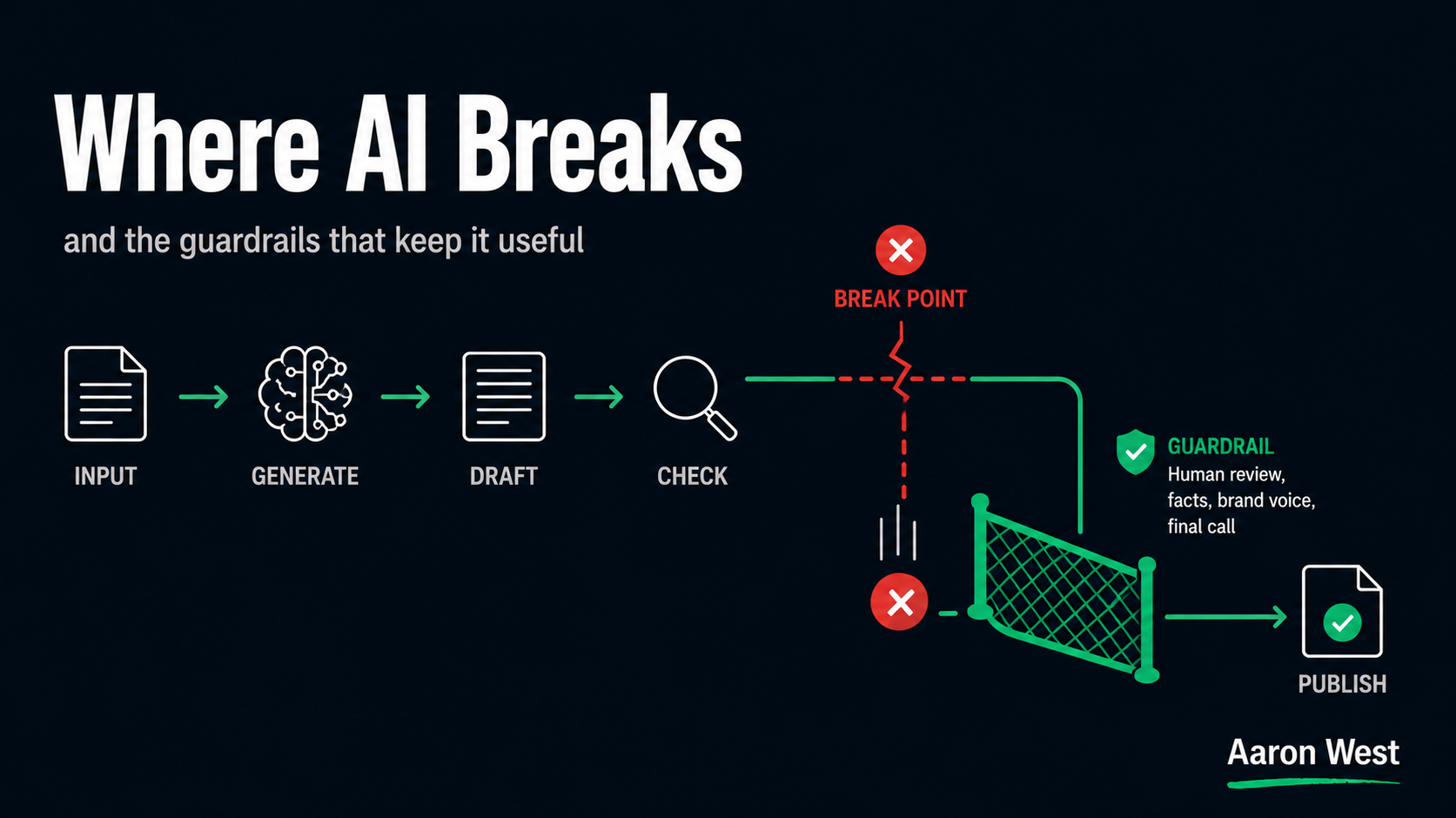
Where AI Breaks in E-Commerce Ops (and the Guardrails That Keep It Useful)
AI does not fail randomly in e-commerce operations. It fails in a handful of specific, predictable ways, and once you know them, you can build the guardrails that let you use AI confidently instead of nervously. The failures are not exotic. They are the same…
Continue reading...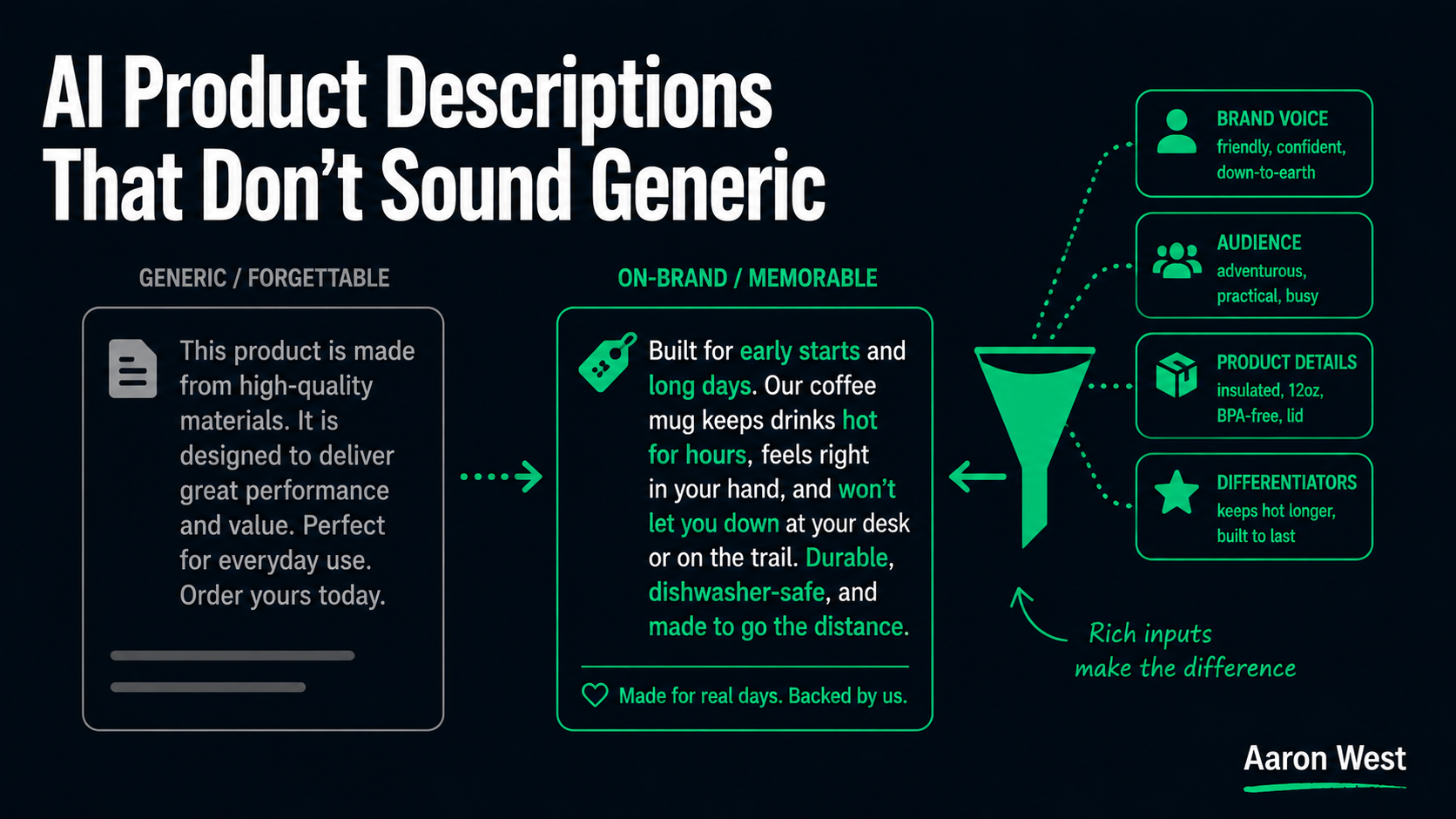
AI for Product Descriptions That Don't Sound Generic
The most common complaint about AI-written product descriptions is that they all sound the same, bland, interchangeable, like they could describe any product from any store. The complaint is fair, and here is the part nobody selling AI tools wants to say plainly: when AI…
Continue reading...