Newsletter Strategy: A Newsletter Is a Relationship, Not a Mailing List

Table of Contents
A newsletter is a relationship, not a mailing list. Most things called newsletters are just recurring promotions, and they train people to ignore them. The ones that work give the reader a reason to open that isn't "buy something," and that, counterintuitively, is exactly what makes the selling emails land when you do send them.
This closes the Email & SMS pillar, and it's the broadcast half done with intent, building on the cornerstone's point that the channel you own is only as valuable as the trust you keep in it. A newsletter is the clearest test of whether you're treating that owned channel as a relationship or as a megaphone. Here's the difference, and why being worth reading is the whole strategy.
The promo-only newsletter trains people to ignore you
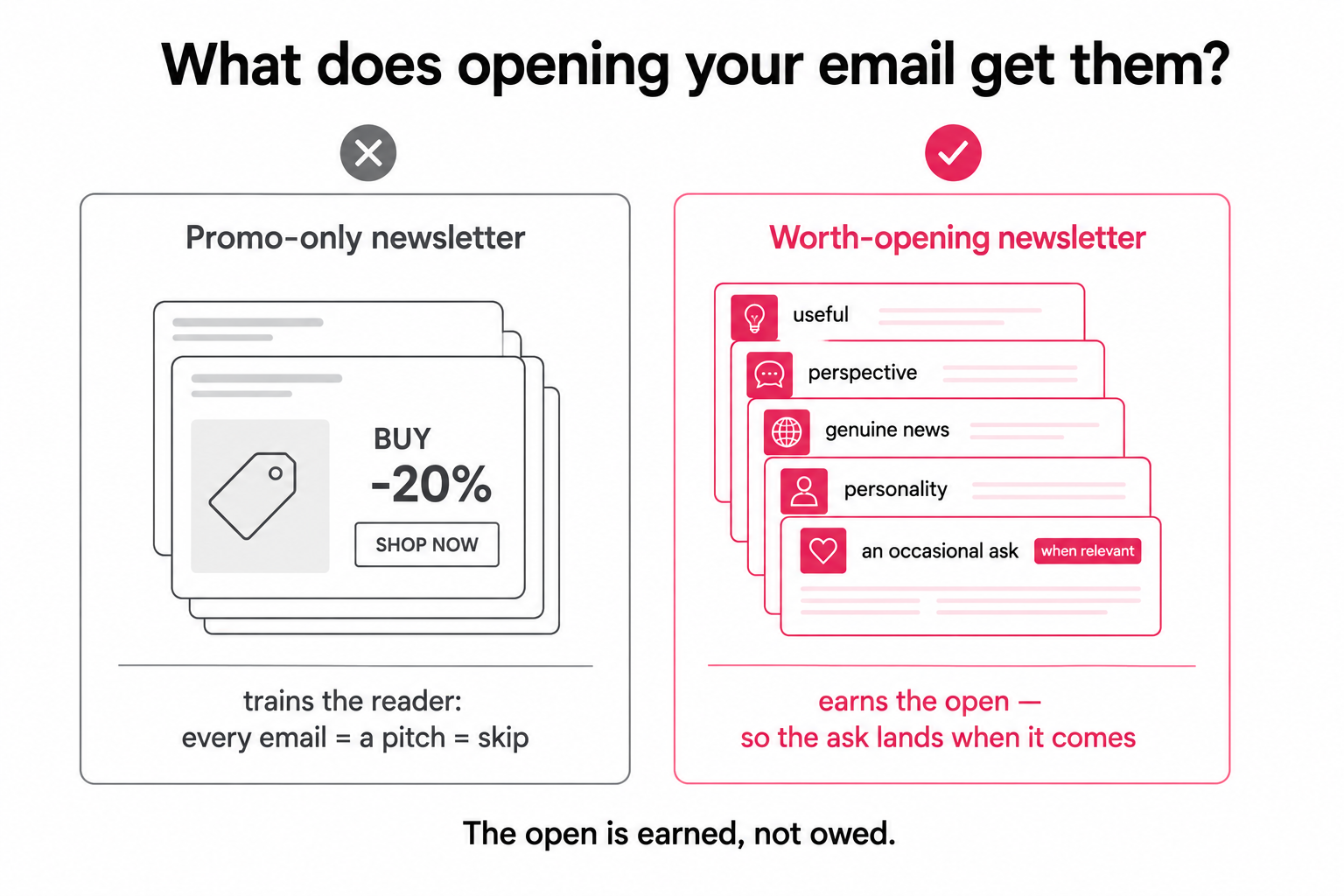
Open most brand "newsletters" and they're a stack of products, a discount code, and a call to buy. There's nothing inherently wrong with any one of those emails. The problem is the pattern: when every send is an ask, you teach the reader a simple rule, this brand's emails are sales pitches, and a sales pitch is the easiest thing in an inbox to skip.
That training is the real cost, and it compounds. Each promo-only email lowers the odds the next one gets opened, because the reader has learned there's nothing inside but a pitch. It's the broadcast version of the trap in why more emails isn't a retention strategy: volume without value doesn't build a relationship, it erodes one. Eventually you're sending to a list that's stopped opening, which is the same as not having the channel at all, except you're still paying to maintain it.
The brands that get newsletters right understood something the promo-only ones missed: the open is earned, not owed. Having someone's email address is permission to show up, not a guarantee they'll read you. You earn the open by being worth opening, and you can't be worth opening if the only thing inside is ever a request for their money.
What a newsletter is actually for
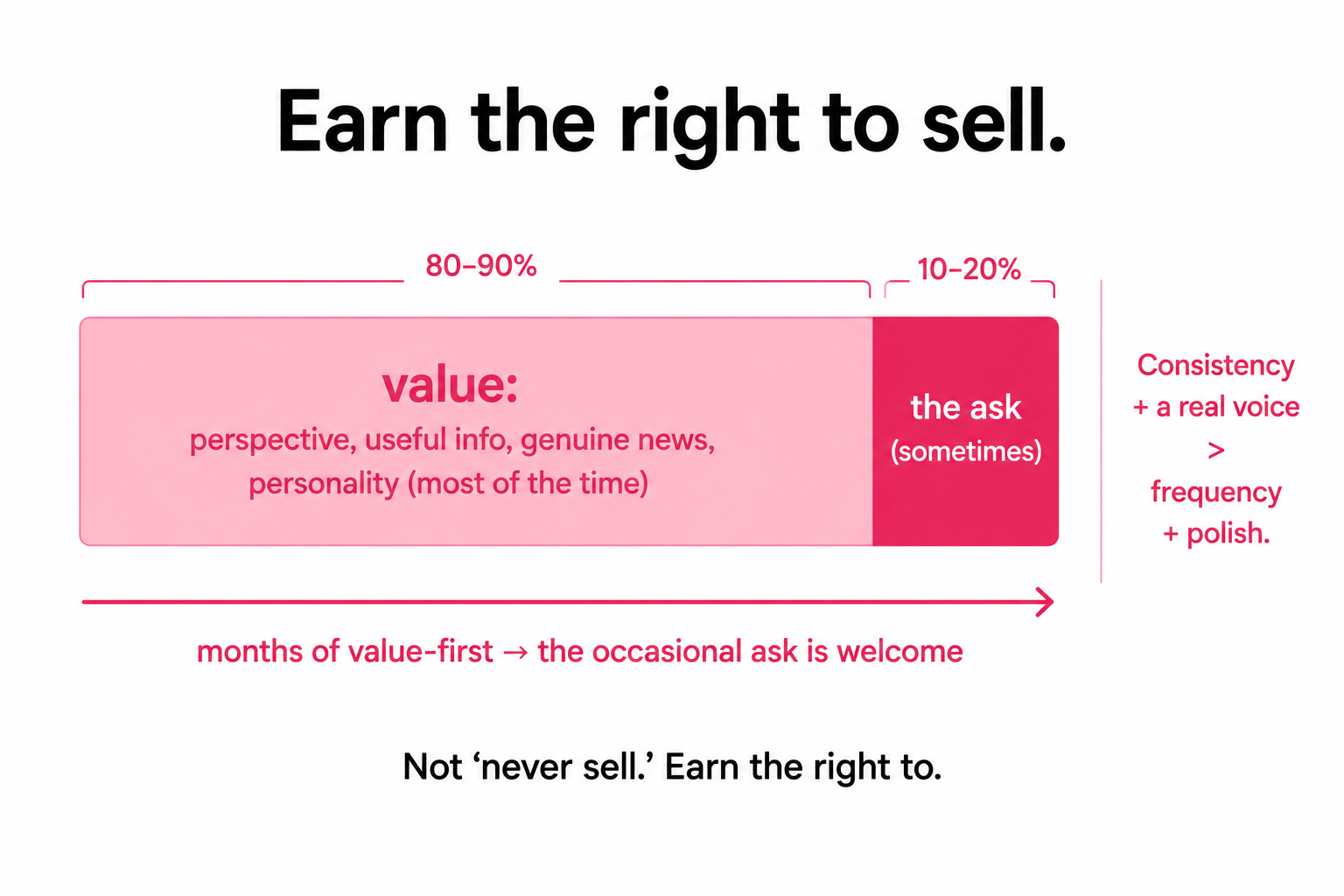
If not selling, then what? A newsletter's job is to be worth opening when you're not asking for anything. That means giving the reader something of value in its own right: a useful perspective, information they're glad to have, genuine news worth knowing, a bit of personality that makes the sender feel like a person rather than a brand template. Value first, and consistently, so that opening your email becomes a small positive habit rather than a decision to skip.
The compounding effect is the whole point. When most of what you send is worth reading, the relationship strengthens with every send instead of wearing thin. And then, when you do have something to sell, the ask is welcome, because you've spent months earning attention rather than spending it down. This is the owned-channel logic from the cornerstone made concrete: the trust is the asset, the newsletter is how you build it, and the selling is what the trust eventually pays for.
I'll say this from running my own owned audience, the blog you're reading and the posts that carry it: the work that pays off is showing up consistently with something worth someone's time, not the occasional big push. Consistency and a real voice beat frequency and polish. People come back for a sender who reliably gives them something and sounds like a human, and they tune out a sender who only ever appears with a hand out.
Consistency and voice are the strategy
Two things separate a newsletter people actually read from one they let pile up unread, and neither is clever.
The first is consistency. A newsletter is a habit you build with the reader, and habits need a rhythm. Showing up reliably, whatever cadence you choose, teaches the reader to expect you and makes the open automatic. Sporadic newsletters, a flurry then silence then a flurry, never establish that rhythm, so every send starts from cold. You don't need to send often. You need to send dependably.
The second is voice. A newsletter that sounds like a committee wrote it is easy to ignore, because there's no one on the other end to have a relationship with. A newsletter that sounds like a person, with a point of view, the occasional opinion, a way of seeing things, gives the reader someone to come back to. Personality isn't decoration here, it's the thing that makes a one-to-many broadcast feel like it's from someone rather than something. The brands that win the inbox mostly sound human in it.
Put those together and the balance falls out naturally: be worth reading most of the time, sell some of the time, and sound like a person throughout. Not "never sell," which is its own kind of failure, just earn the right to, repeatedly, by being someone the reader is glad to hear from.
What a newsletter actually is
A newsletter isn't a delivery mechanism for promotions. It's the slow, compounding work of becoming a sender people are glad to hear from, so that the channel you own stays worth owning. Give value most of the time, show up consistently, sound like a person, and the occasional ask lands because you earned the attention to make it.
If your newsletter is only worth opening when there's a discount inside, it isn't a newsletter. It's a coupon you email. Be worth reading first, and the selling takes care of itself.
A few common questions
What makes a good email newsletter? Being worth opening when you're not asking for anything. A good newsletter gives the reader genuine value (a useful perspective, information worth having, real news, some personality) most of the time, so the relationship compounds. That earned attention is what makes the occasional sales email actually land, rather than get skipped like every other pitch.
Why do people ignore brand newsletters? Usually because every send is an ask. When a newsletter is just recurring promotions, it trains the reader that the brand's emails are sales pitches, and a pitch is the easiest thing in an inbox to skip. Each promo-only send lowers the odds the next one is opened, until you're mailing a list that's stopped reading.
How often should I send a newsletter? Dependably more than frequently. A newsletter is a habit you build with the reader, and habits need a consistent rhythm more than a high volume. Pick a cadence you can sustain and keep to it; sporadic bursts never establish the habit, so every send starts from cold. Consistency beats frequency.
Should a newsletter ever sell? Yes, just not every time. The goal isn't "never sell," it's to earn the right to sell by being worth reading the rest of the time. When most of what you send gives value, the occasional ask is welcome because you've built up attention rather than spent it down. A newsletter that's only ever a pitch is really just a coupon you email.