Email Is Still the Highest-Leverage Channel You Own

Table of Contents
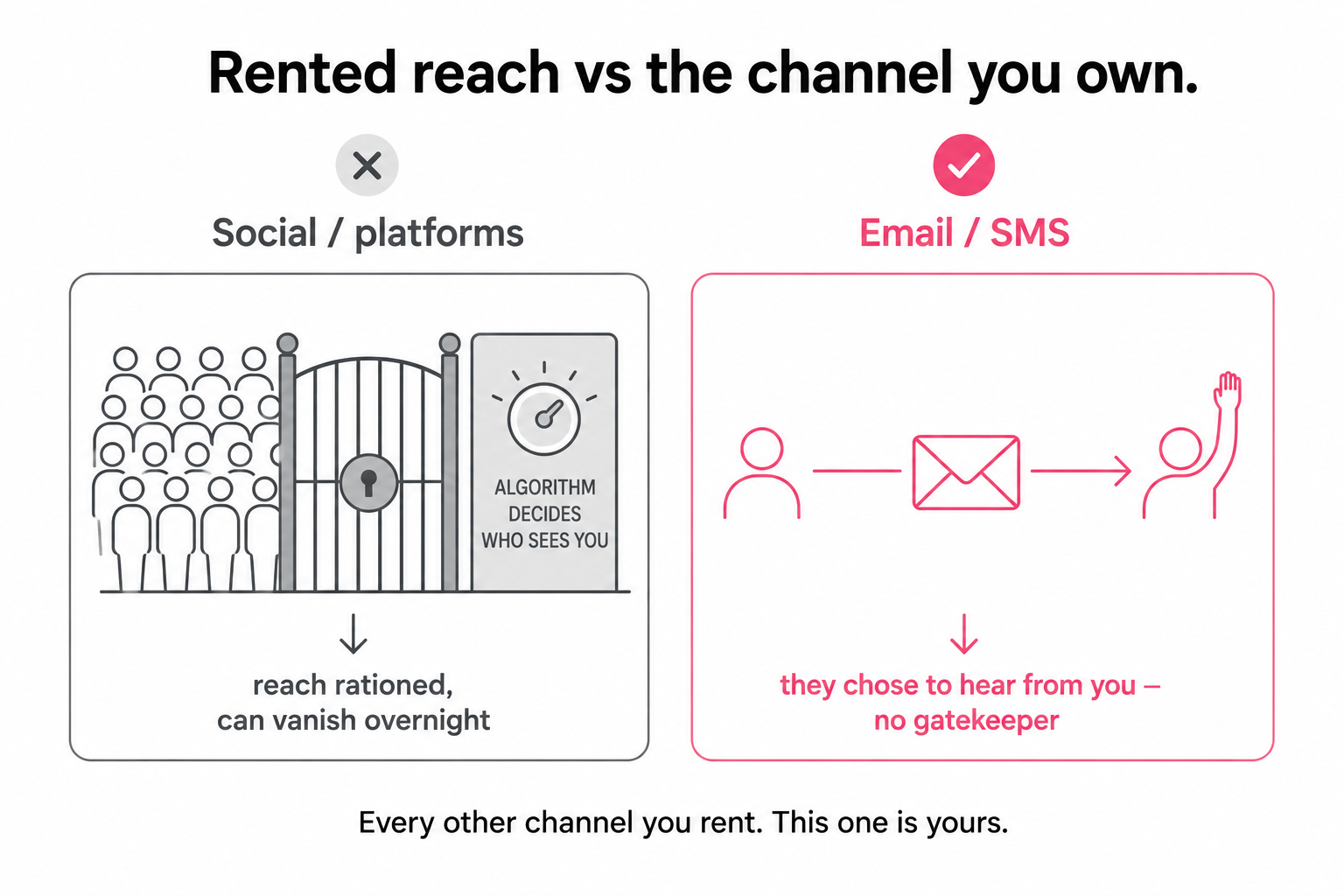
Email is still the highest-leverage channel in marketing, and the reason has nothing to do with it being clever or new. It's that you own it. No algorithm decides who sees your email. You reach the people who chose to hear from you, directly, on your terms, with no gatekeeper rationing your reach based on this quarter's priorities. In a world where every other channel is rented, that ownership is the entire advantage.
This opens the Email & SMS pillar, and it sits right next to a lesson I learned the hard way and wrote about in why you shouldn't build your audience on rented land: a platform can bury your reach overnight and never tell you why. Email is the answer to that problem. It's the channel that survives a platform's bad mood, because it was never the platform's to begin with. Here's why that matters more than any tactic, the two jobs email actually does, and the trap that wastes the whole advantage.
Why "owned" is the whole point
Think about what you're actually doing when you build reach on a social platform. You're growing an audience on land you rent, and your access to that audience is granted at the platform's discretion and withdrawn the same way. One algorithm change and the people who chose to follow you stop seeing you, with no notice and no appeal.
Email is the opposite. Someone gave you their address and said, in effect, "you can reach me directly." That permission doesn't route through anyone else's algorithm. When you send, it arrives. Whether they open it is up to your relevance and their trust, which is exactly as it should be, but whether it reaches them at all is not subject to a third party's mood. That's the leverage, and it's structural, not clever. The same logic runs under CRM as a discipline: the relationships you own are the ones that compound, and the ones you rent are the ones that can vanish.
This is why the unglamorous channel keeps outlasting the exciting ones. Social platforms rise and fall and change their rules. Email has quietly remained the highest-leverage thing most businesses own, not because it's fashionable, but because it's theirs. A list you've built and earned the trust of is an asset. Rented reach is a liability dressed as an asset, right up until the day it's withdrawn.
The two jobs email does (and most teams do one)
Email isn't one thing. It's two completely different jobs that happen to share an inbox, and understanding the split is the foundation of the whole pillar.
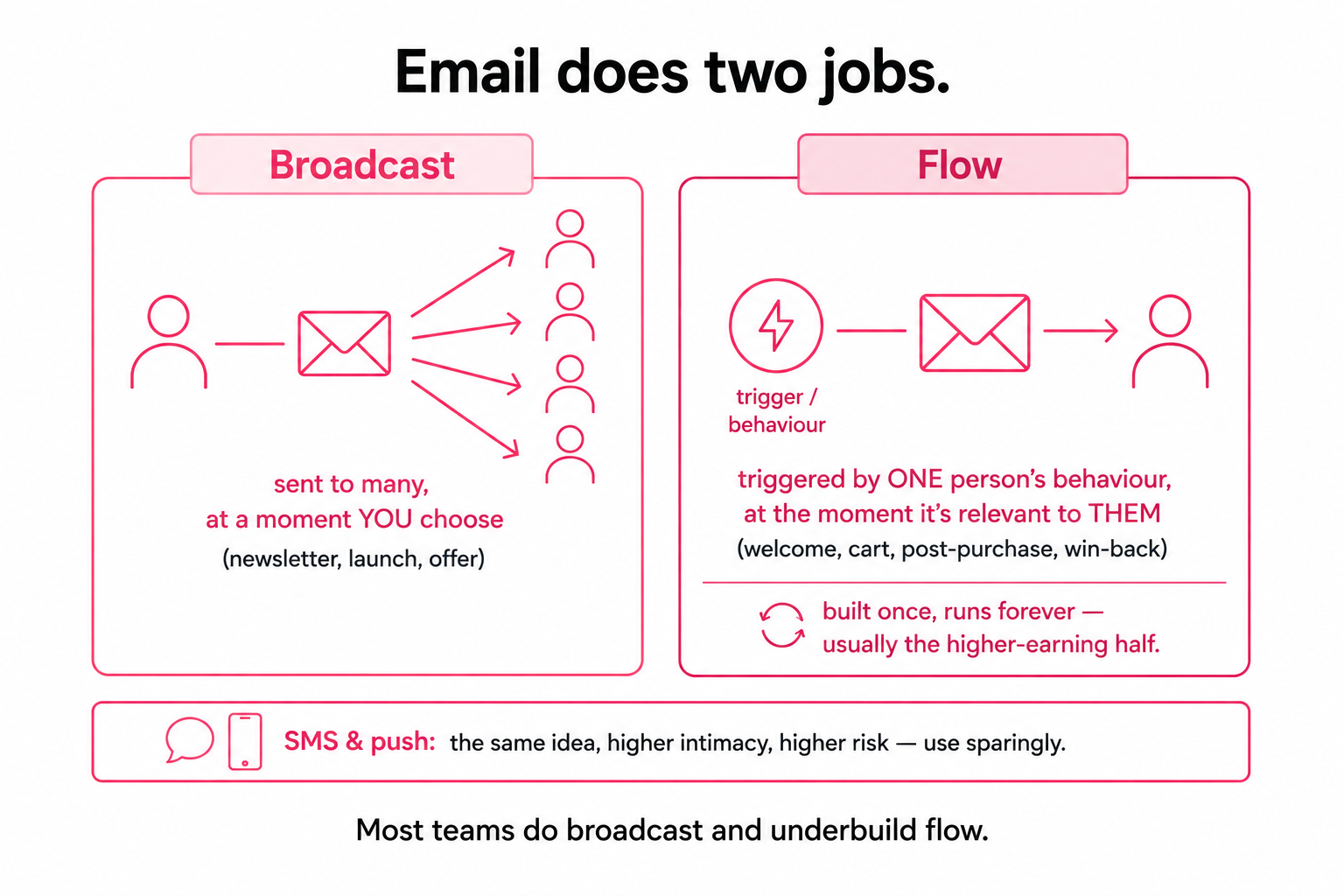
Broadcast is the message you send to many people at a moment you choose: the newsletter, the launch announcement, the seasonal offer. It carries your voice and your news, it builds the relationship at scale, and it's the half most teams think of as "email marketing."
Flow is the message triggered by one person's behaviour, sent at the moment it's most relevant to them: the welcome when they join, the nudge when they leave something in a cart, the follow-up after a purchase, the gentle return when they've drifted away. Flow is automated, it's built once and runs forever, and it's the half most teams underbuild or skip.
The split matters because the two halves earn differently, and I go deep on it in broadcast versus flow. For now, the headline: flow tends to quietly out-earn broadcast, because relevance and timing are everything in email, and a flow email arrives at the exact moment a person did something, which is the most relevant a message can be. Broadcast is relevant when you decide to send it. Flow is relevant when the customer decides. Build only broadcast and you've left the higher-leverage half of your owned channel switched off.
The trap: an owned channel is the one you can abuse fastest
Here's the catch that comes with ownership. Because no algorithm stands between you and the inbox, nothing stops you from sending too much. The platform won't throttle you. The only thing protecting the relationship is your own restraint, and restraint is exactly what teams abandon when a number needs hitting.
So the most common way to wreck the highest-leverage channel you own is to treat it as a megaphone: more sends, more promotions, more "just checking in," on the theory that more email equals more revenue. It doesn't, and I made the full argument in why more emails isn't a retention strategy. Volume without relevance trains people to ignore you, then to unsubscribe, then to mark you as spam, which quietly damages your ability to reach even the people who do want to hear from you. The channel's superpower, that your messages actually arrive, is also the thing you can burn fastest.
The discipline is to treat the list as a relationship, not a resource to mine. Every send either earns its place in someone's inbox or spends down the trust that makes the channel valuable. Owning the channel doesn't mean you can send freely. It means you're the only one responsible for not ruining it.
SMS and push: the same idea, turned up
SMS and push notifications are the same principle at higher intensity. They're even more owned, even more direct, and even more abusable, because they interrupt more. A text or a push lands in a more personal, more immediate space than an email, which makes it powerful for the genuinely timely (an order shipped, a back-in-stock they asked for) and corrosive for the trivial.
The rule of thumb: the more intimate the channel, the higher the bar for sending. Email tolerates a regular rhythm. SMS tolerates much less, and punishes overuse much faster. Use the intimate channels for things that are actually time-sensitive and actually wanted, and you keep their power. Use them as another broadcast pipe and people opt out fast, often with irritation. (And because these channels are also the most heavily regulated, consent and the rules around it genuinely matter here, which is a real legal matter to get right, not advice I can give you in a blog.)
What this channel is actually for
Strip it down and the case for email and SMS is the case for owning anything: the things you own compound, and the things you rent can be taken away. Email is the highest-leverage channel in marketing because it's the one place you reach the people who chose you, directly, with no one in between deciding whether you're allowed to. That's worth more than any single platform's reach, because it doesn't evaporate when the platform changes its mind.
Build it like it matters. Earn the permission, respect it, send things worth receiving, and use the intimate channels sparingly. The channel you own is the one nobody can throttle, and in a rented world, that makes it the most valuable ground you have.
A few common questions
Is email marketing still worth it? Yes, and arguably more than ever, because its advantage is structural rather than fashionable. Email is the channel you own: no algorithm decides who sees it, so you reach the people who chose to hear from you directly. As social platforms change their rules and ration reach, the owned channel is the one that keeps working.
Why is email called "high-leverage"? Because every other channel rents you access to an audience, while email is an audience you own. A list you've earned the trust of is an asset you can reach repeatedly with no gatekeeper, which compounds over time. Rented reach can be withdrawn; an owned list can't be, as long as you don't abuse it.
What's the difference between broadcast and flow email? Broadcast is sent to many people at a moment you choose (newsletters, launches, offers). Flow is automated and triggered by one person's behaviour, sent at the moment it's most relevant to them (welcome, abandoned cart, post-purchase, win-back). You need both, and flow is the half most teams underbuild, even though it usually earns more.
Is SMS better than email? Not better, more intimate, which means more powerful and more dangerous. SMS and push land in a more personal space, so they're excellent for genuinely timely, genuinely wanted messages and corrosive for trivial ones. The more intimate the channel, the higher the bar for sending, and the faster overuse gets you ignored or opted out.
You should also read:
Support Is a Retention Channel, Not a Cost to Minimise
Most companies treat customer support as a cost centre to be minimised: deflect the tickets, cut the handle time, shrink the team, get the cost-per-contact down. That framing is the central mistake in how businesses think about support. Support is a retention channel. It's where…
Continue reading...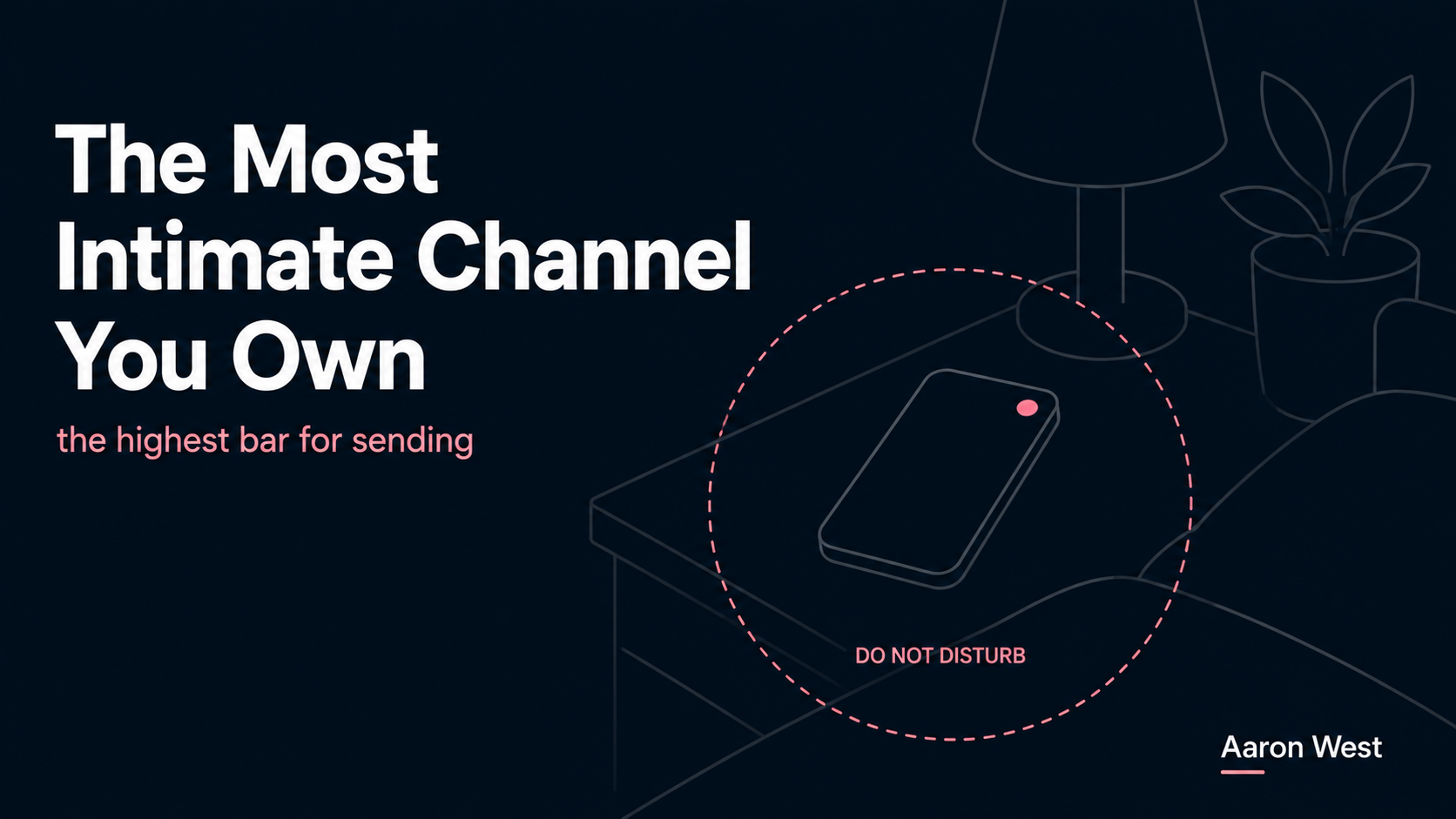
SMS and Push: The Most Intimate Channels You Own, and the Highest Bar for Using Them
SMS and push notifications are the most intimate channels you own, which makes them the most powerful and the easiest to ruin. The rule for both is the same: the more personal the channel, the higher the bar for sending. Use them for the genuinely…
Continue reading...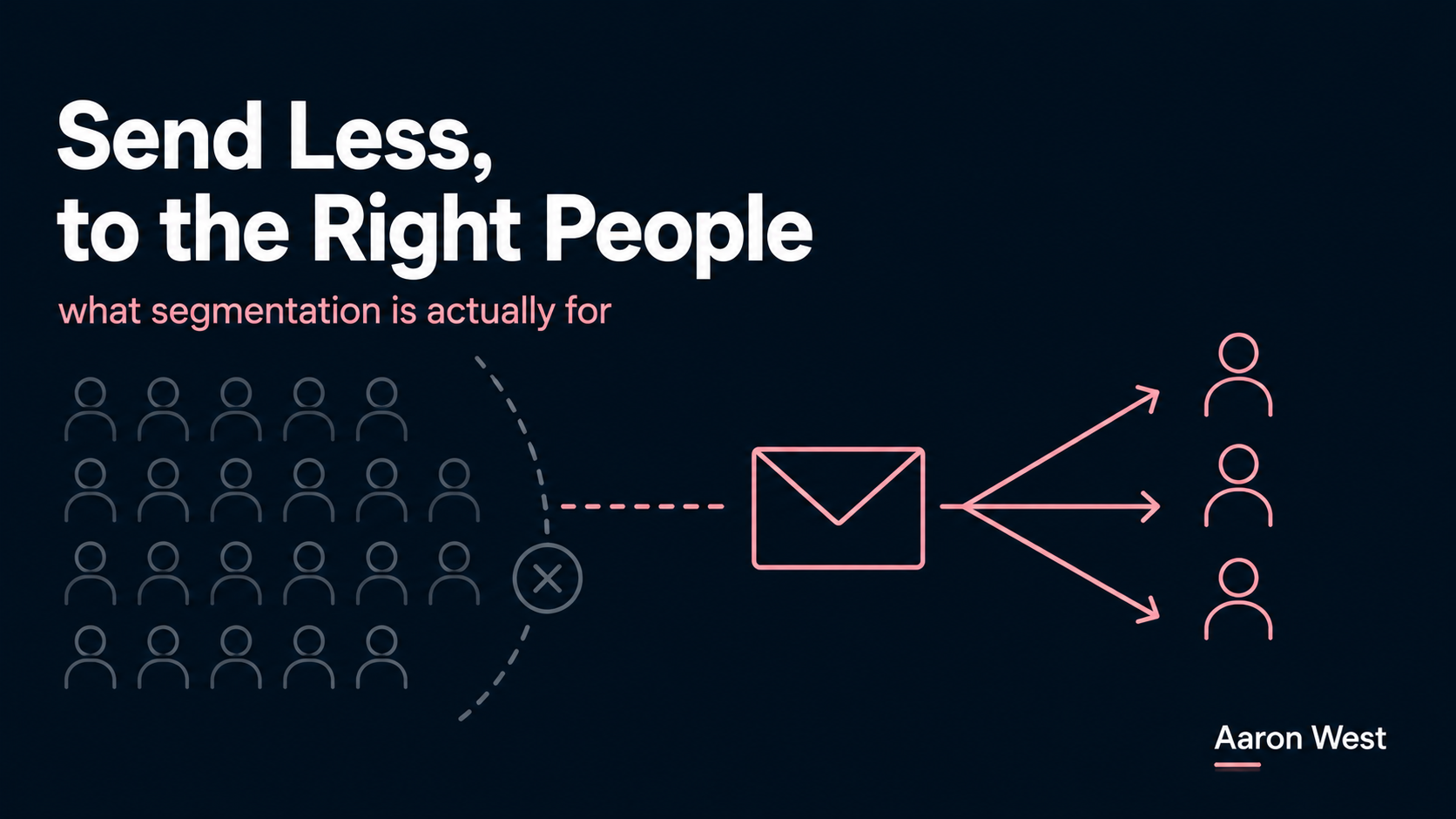
Email Segmentation: Sending Less to the Right People, Not More
Segmentation isn't about slicing your list into clever demographic buckets. It's about sending less email to more relevant people, the discipline of not sending a message to everyone just because you can. Done right, it's the opposite of the megaphone, and sending less to the…
Continue reading...