Email Segmentation: Sending Less to the Right People, Not More

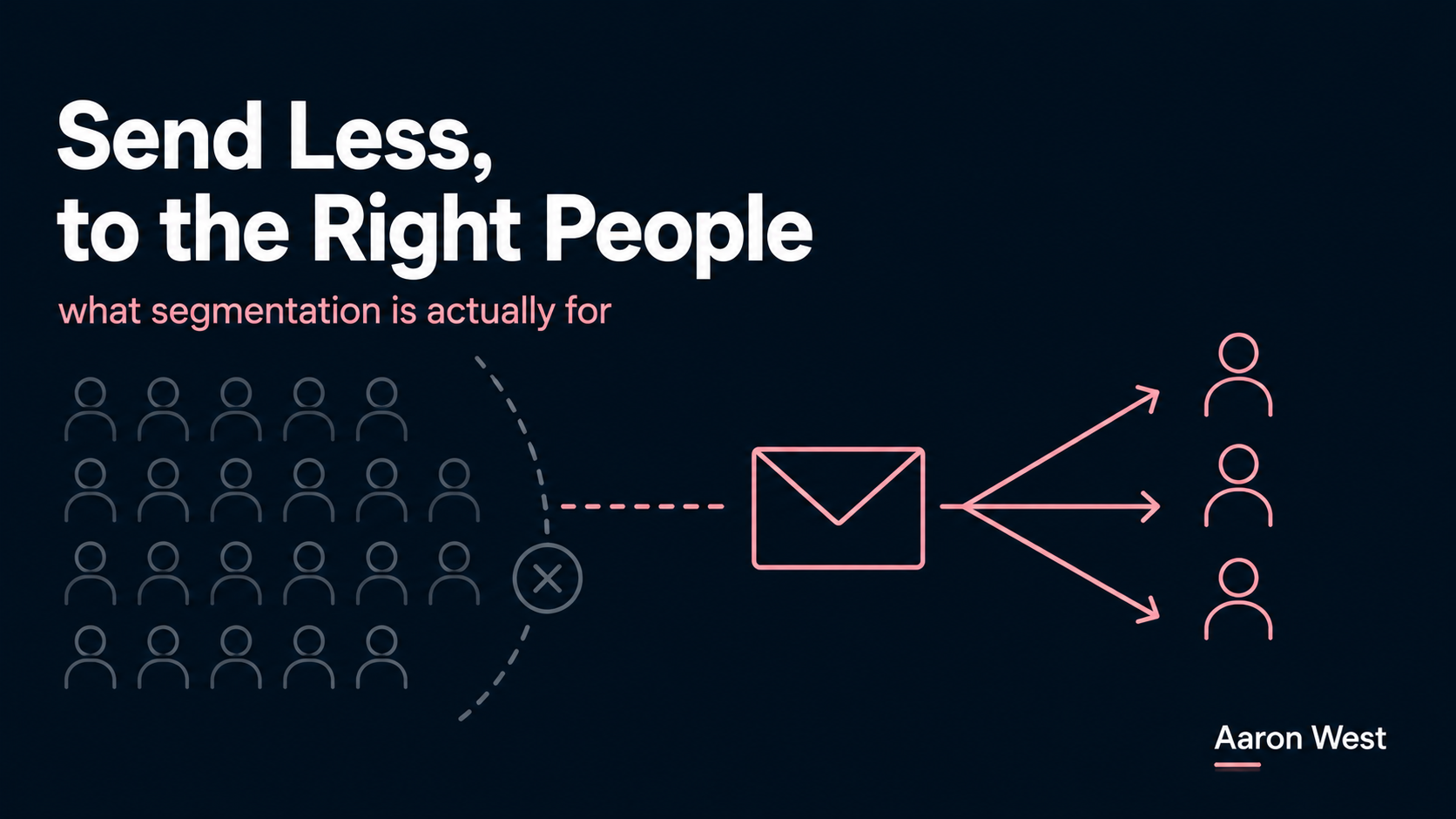
Table of Contents
Segmentation isn't about slicing your list into clever demographic buckets. It's about sending less email to more relevant people, the discipline of not sending a message to everyone just because you can. Done right, it's the opposite of the megaphone, and sending less to the right people reliably beats blasting the whole list.
This is the second core of the Email & SMS pillar, and it's the practical counterweight to the trap in the cornerstone: an owned channel is the one you can abuse fastest, because nothing throttles you but your own restraint. Segmentation is what restraint looks like in practice. Here's the version that works, the version that doesn't, and why sending less is so often the way to earn more.
The reframe: segmentation means sending less
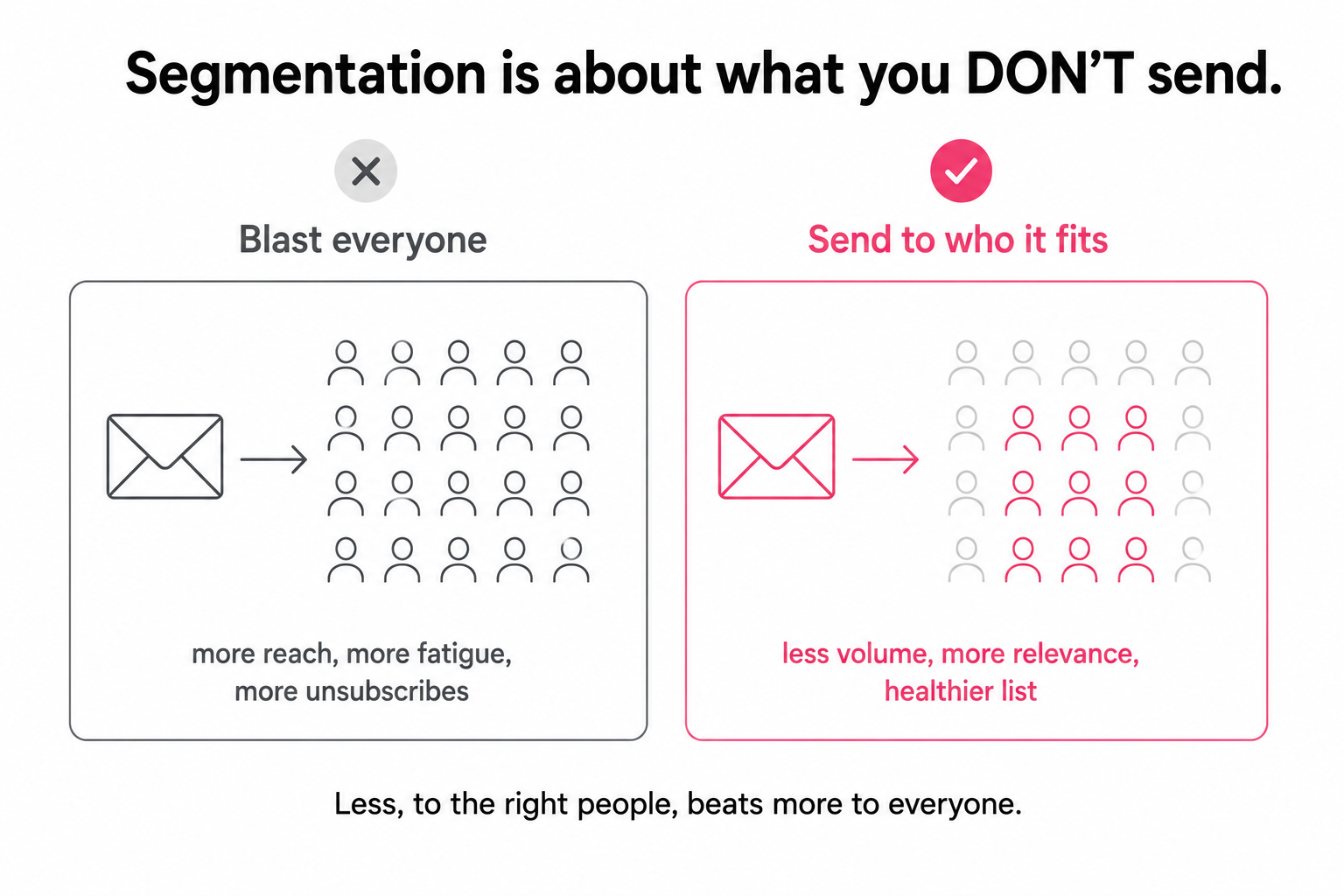
Most people hear "segmentation" and picture sophistication, carving the list into ever-finer slices so you can send more, targeted messages. That's backwards. The real value of segmentation is the messages you don't send: not mailing the people for whom a given message isn't relevant.
This matters because relevance is the whole game in email, and irrelevance is expensive in a way that's easy to miss. Every irrelevant send nudges a person a little closer to tuning you out, unsubscribing, or marking you as spam, the exact damage covered in why more emails isn't a retention strategy. Segmentation is the tool that lets you stop doing that on purpose. You decide who a message is actually for, and you spare everyone else. The list stays healthier, and the people who do get the message are the ones it was meant for.
So the mental shift is from "how do I slice the list so I can send more" to "how do I make sure I'm not sending this to people it doesn't fit." Same tool, opposite spirit, and the second one is the one that works.
Demographics are the lazy way. Behaviour is the real way.
When teams do segment, they usually reach for demographics first: age, gender, location. It feels like segmentation, but demographics are a weak proxy for what someone actually wants from you. Two people the same age in the same city can have completely different relationships with your store, and treating them the same because a spreadsheet field matches misses the point.
The segmentation that actually predicts relevance is behavioural. What has this person browsed? What have they bought? How recently? How engaged are they, do they open and click, or have they gone silent? Behaviour is the closest thing you have to someone telling you what's relevant to them, because it's what they actually did rather than what category they fall into. Someone who just bought a specific product, someone who browsed a category three times this week, someone who hasn't opened anything in months, those are meaningfully different people, and behaviour is how you tell.
This is the same engine as flow email from broadcast versus flow: behaviour is the signal. Flows react to a single behaviour in real time; behavioural segmentation groups people by their patterns so your broadcasts can be relevant too. Both beat sending the same thing to everyone for the same reason: they're driven by what people did.
The deliverability reason to send less
There's a mechanical reason segmentation matters that most people never connect to relevance: your ability to reach the inbox at all depends partly on engagement. When you keep emailing people who never open, mailbox providers read that as a signal that your mail isn't wanted, and that can quietly suppress your reach to everyone, including the people who do want to hear from you.
This produces a genuinely counterintuitive result: sending less email to your disengaged contacts can improve how reliably you reach your engaged ones. Cutting the dead weight isn't just politeness, it protects the channel. Which is why one of the most valuable segments you can build is simply "engaged versus not," and why continuing to blast people who've clearly stopped caring hurts you twice, once in their irritation and once in your deliverability.
Start simple, and don't over-segment
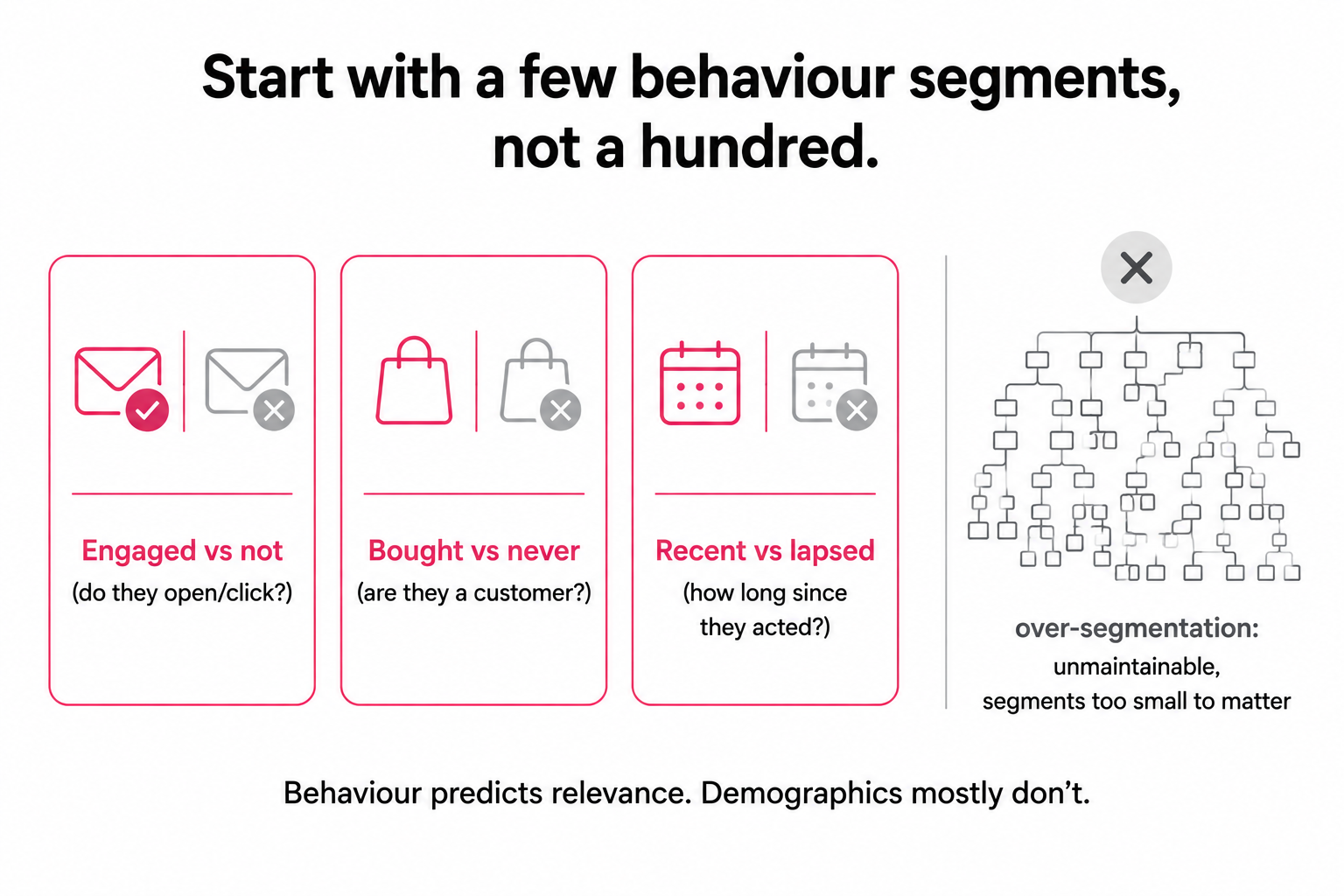
If behaviour is the key, the temptation is to build dozens of finely-tuned segments. Resist it. The opposite failure of blasting everyone is over-segmentation: slicing the list so finely that you can't maintain it, or each segment is too small to be worth a tailored message. Complexity you can't sustain is worse than simplicity you can.
A handful of behaviour-based segments, used consistently, beats an elaborate scheme used once and abandoned. Start with the few that obviously matter: engaged versus not, customers versus non-customers, recent versus lapsed. Those three alone let you stop sending the wrong things to the wrong people, which is most of the win. Add more only when a real, repeating need appears, not because finer slicing feels more sophisticated.
The honest pattern across most teams is one of two extremes: no segmentation at all, blasting everyone, or over-segmentation into a scheme too complex to keep running. The win sits in between, and it's unglamorous: a few good segments, applied every time you send.
What segmentation actually is
Segmentation isn't a cleverness contest. It's the discipline of not sending the wrong message to the wrong person, built on what people actually did rather than what bucket they fall into, kept simple enough to use every time. It protects the relationship, it protects your reach to the inbox, and it makes every send land better because it only goes to people it fits.
Less, to the right people, beats more to everyone. Segmentation is just the name for having the discipline to do that on purpose.
A few common questions
What is email segmentation, really? It's the practice of sending a given message only to the people it's relevant to, rather than to your whole list. The real value is in the sends you avoid: not mailing people for whom a message doesn't fit. Done well, it's the opposite of blasting everyone, and it protects both the relationship and your ability to reach the inbox.
Should I segment by demographics? Demographics like age and location are a weak proxy for what someone wants from you, so they're the lazy version. Behavioural segmentation (what someone browsed or bought, how recently, how engaged they are) predicts relevance far better, because it's based on what people actually did rather than what category they fall into.
Why does sending less email improve results? Partly relevance, partly deliverability. Emailing people who never open signals to mailbox providers that your mail isn't wanted, which can suppress your reach to everyone, including engaged readers. So cutting sends to disengaged contacts can actually improve how reliably you reach the people who do want to hear from you.
How many segments should I have? Fewer than you think. Over-segmentation (slicing so finely you can't maintain it, or segments too small to matter) is a real failure mode. Start with a few that obviously matter: engaged versus not, customers versus non-customers, recent versus lapsed. Add more only when a genuine, repeating need appears.
You should also read:
Email Is Still the Highest-Leverage Channel You Own
Email is still the highest-leverage channel in marketing, and the reason has nothing to do with it being clever or new. It's that you own it. No algorithm decides who sees your email. You reach the people who chose to hear from you, directly, on…
Continue reading...
The Engagement Trap: Why "More Emails" Is Not a Retention Strategy
When retention numbers are soft, the most common reflex in the building is also the most damaging: send more emails. More newsletters, more promotions, more "we miss you" nudges, on the theory that more contact means more engagement means more sales. It is intuitive, it…
Continue reading...
Reviews Are the One Voice on Your Page a Shopper Trusts More Than Yours
There is exactly one voice on your product page that a shopper trusts more than your own, and it is not yours. It is other customers. Everything you write about your product, however honest, carries an unavoidable discount in the reader's mind, because they know…
Continue reading...