Getting Found Inside a Marketplace: Listing SEO and Marketplace Ads

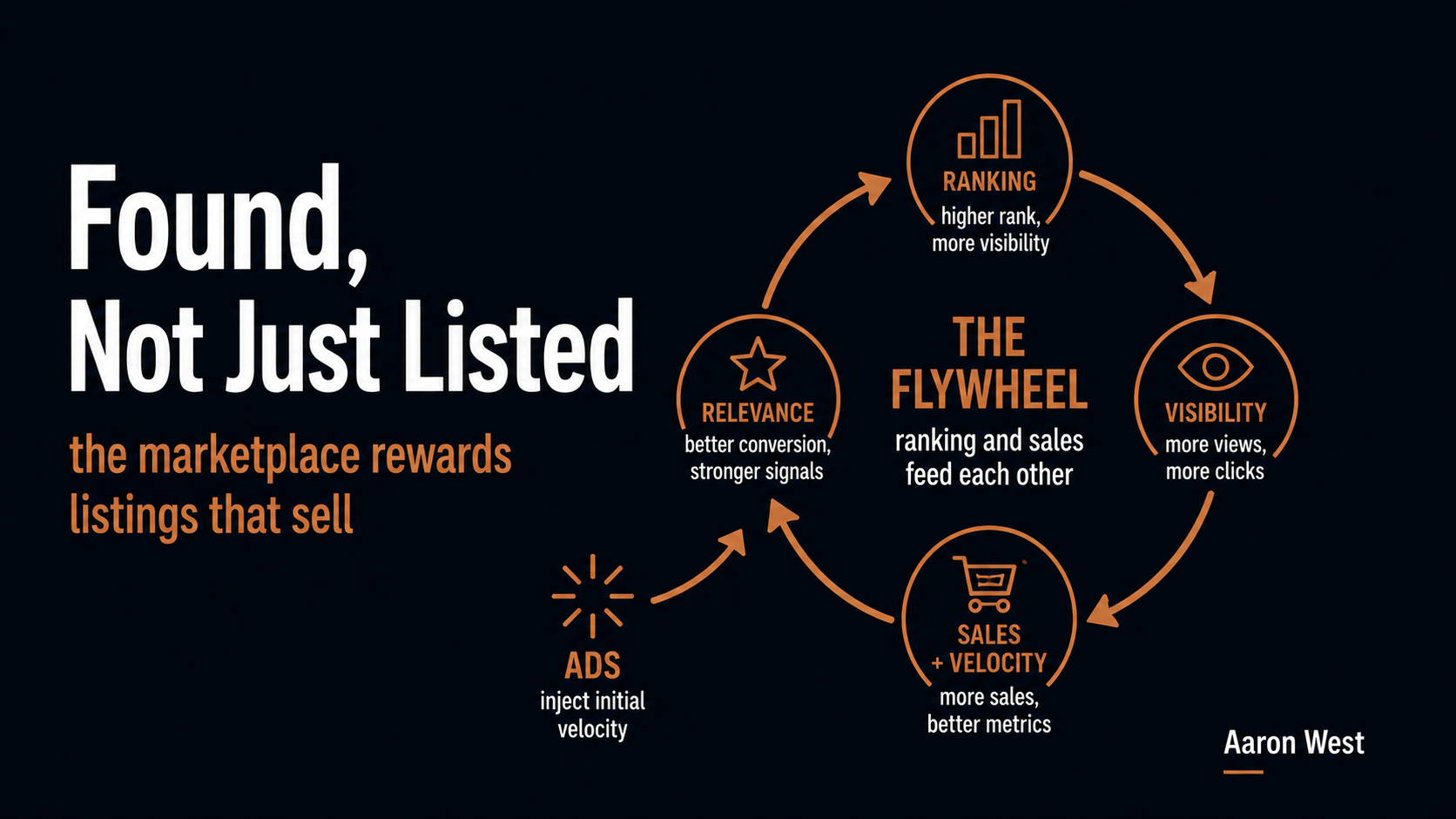
Table of Contents
Being listed on a marketplace is not the same as being found on it. Inside a marketplace, visibility is its own competition, won through the marketplace's search algorithm (listing optimisation) and its advertising system (paid placement). The defining mechanic is that marketplace search rewards listings that convert: relevance, plus sales velocity, plus conversion rate. That creates a flywheel where ranking drives sales and sales drive ranking, and the way in is a well-structured listing plus, usually, some paid placement to get the flywheel turning.
This is a core of the Marketplaces & Multichannel pillar, under the cornerstone that own store versus marketplace is a reach-versus-control trade-off and a sibling to the piece on operating inside someone else's house. It's the discoverability layer: once you're selling there, how do you actually get seen?
Being on it is not being found on it
A marketplace has an enormous catalogue, and most of it never gets seen. Listing a product is the price of entry, not a guarantee of visibility, the same way putting up a web page doesn't mean anyone finds it. So the moment you're on a marketplace you're in a fresh discoverability competition, parallel to web SEO and your own store's traffic problem but played entirely inside the platform, by the platform's rules.
The mistake is to list and wait, treating "we're on the marketplace now" as distribution. It isn't. It's a starting line in another race.
How marketplace search actually works
Here's the mechanic that explains everything else. A web search engine roughly optimises for relevance and authority. A marketplace search engine optimises for what makes the marketplace money: listings that are both relevant to the query and likely to sell. That single difference reshapes how you get found.
So the ranking factors cluster around three things: relevance (does the listing genuinely match what the shopper typed, through its title, attributes, and terms), conversion (when shoppers see this listing, do they buy it), and sales velocity (is it actually selling, and selling recently). The platform wants to show the listings most likely to turn a search into a purchase, because that's its revenue, so it surfaces what's already converting.
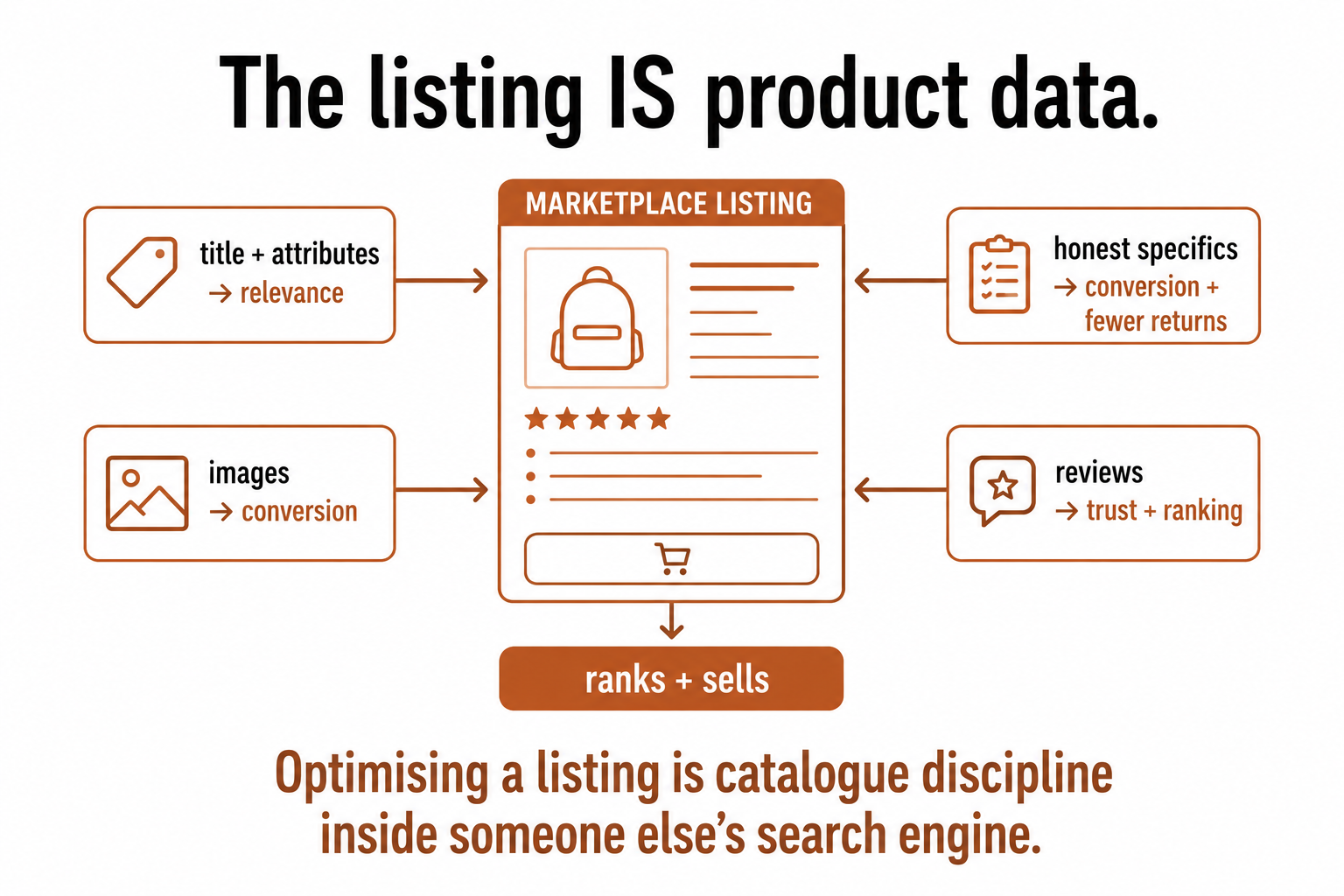
That produces a flywheel, and understanding it is most of the game: ranking drives visibility, visibility drives sales, and sales (conversion plus velocity) drive ranking back up. A listing that sells gets shown more, which makes it sell more. The flip side is the cold-start problem: a brand-new listing has no sales velocity, so it ranks low, so it struggles to build the velocity it needs to rank, a chicken-and-egg trap that's exactly why marketplace ads exist.
Your listing is product data doing discoverability
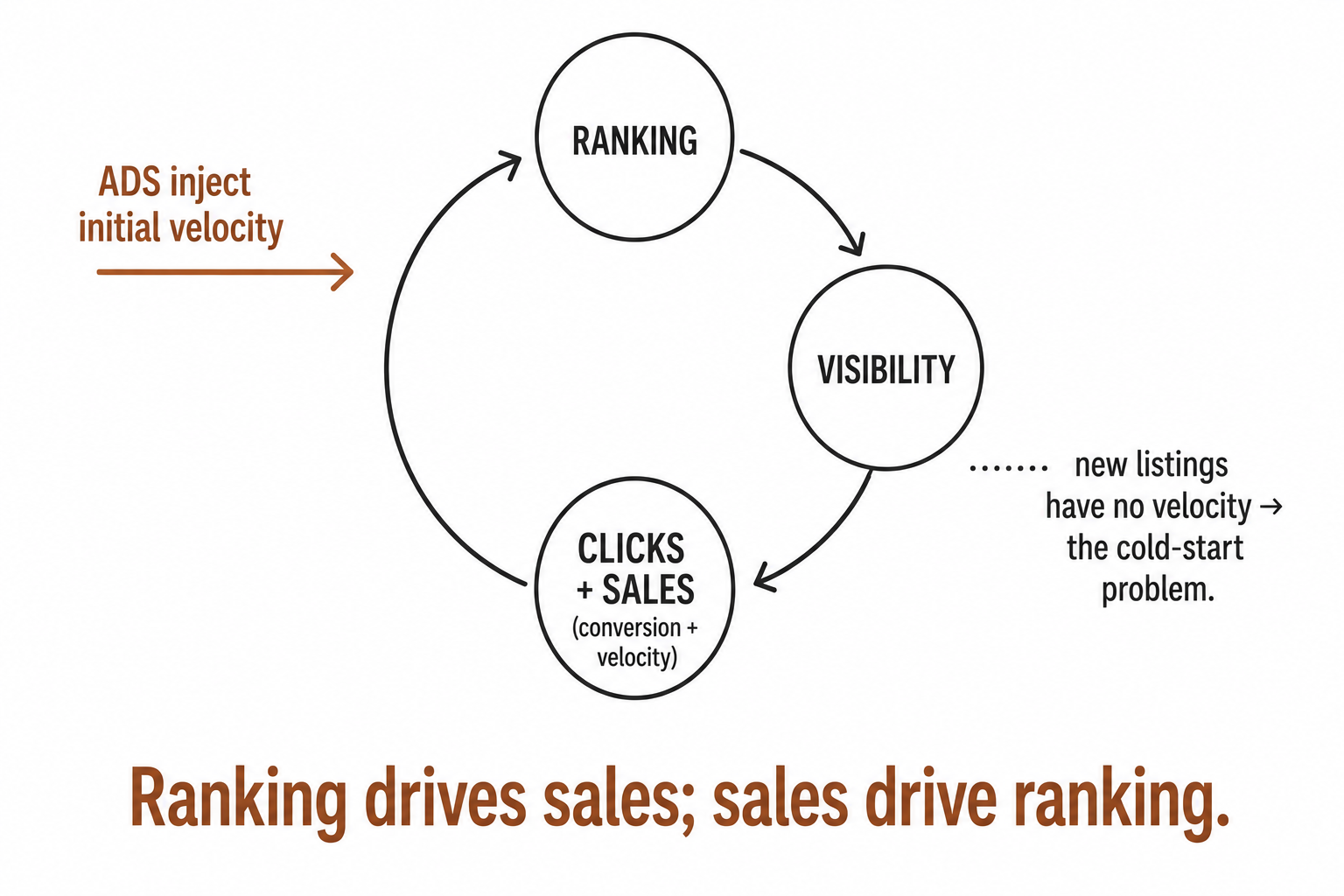
Here's where the marketplace work connects straight back to the catalogue. Optimising a marketplace listing isn't a separate dark art; it's structured product data applied inside the platform's search engine. The same disciplines that make your own catalogue work make a listing rank and convert:
- A relevant, complete title and the right attributes, so the listing matches the queries and filters shoppers actually use. This is the data-model discipline, structured facts, not buried prose, doing the relevance job.
- Strong images, because they drive the conversion the algorithm rewards, the imagery standards that decide whether a shopper buys once they've seen the listing.
- Honest, specific copy, which lifts conversion and cuts returns, the description discipline again, except here a high return rate also damages your standing with the platform.
In other words, a well-optimised listing is just clean product data plus conversion craft, working as ranking fuel. The store that took the catalogue seriously already knows how to win here.
And then there are reviews, which on a marketplace are unusually powerful, they drive both conversion (shoppers trust them) and ranking (the platform reads them as a quality and conversion signal), and they're the trust the marketplace lends you in place of your own brand. Earning them honestly is core to visibility. Trying to manipulate them is against the rules and a fast route to the suspension the previous piece warned about.
Ads: buying the placement you haven't earned yet
The paid lever is marketplace advertising, often called retail media: ads that buy placement at the top of search results and category pages. It's how you solve three problems the organic flywheel can't solve on its own, getting initial visibility for a new listing (the cold-start fix), defending a position competitors are bidding against, and scaling a proven winner faster than organic velocity alone would.
The deeper point is the interplay between ads and organic. Ads buy the early sales velocity that a new listing needs, and that velocity then feeds the organic ranking flywheel, so the smart play is to use ads to launch a listing into the velocity it needs to rank on its own, then let organic carry more of the load as the flywheel turns. Ads to start it; organic to sustain it.
The current-state detail, the specific ad formats, how the platforms' systems work right now, and how retail media is evolving, lives in the dedicated retail-media piece, because that's the part that dates and needs keeping current. Here the durable point is enough: ads buy placement, placement buys velocity, and velocity is what the organic algorithm rewards.
What this comes down to
Getting onto a marketplace is the easy part. Getting found on it is the whole game, and it's a game with a clear logic: the marketplace rewards listings that sell, which means your structured product data, your images, your honest copy, your reviews, and your conversion rate are your ranking, and ads are how you start the flywheel before organic velocity can carry it.
So treat a marketplace listing as exactly what it is, your catalogue discipline applied inside someone else's search engine, with paid placement to break the cold-start trap. List and wait, and you'll sit invisible in a catalogue of millions. Optimise the listing, earn the reviews, and use ads to start the flywheel, and you turn a listing into a position that keeps selling because it's already selling.
A few common questions
How does search ranking work on a marketplace? Differently from a web search engine. A marketplace optimises for what makes it money: listings that are both relevant to the query and likely to sell. So ranking centres on relevance (title, attributes, terms matching the search), conversion (do shoppers buy when they see it), and sales velocity (is it selling recently). That creates a flywheel, ranking drives visibility, visibility drives sales, and sales drive ranking, which is why a listing that sells gets shown more and sells more.
Why can't a new listing get seen? The cold-start problem. Marketplace ranking rewards sales velocity, but a brand-new listing has no sales yet, so it ranks low, so it struggles to get the visibility it needs to build velocity, a chicken-and-egg trap. This is exactly why marketplace ads exist: they buy the initial placement and sales velocity a new listing can't earn organically, which then feeds the ranking flywheel so organic can take over.
How do I optimise a marketplace listing? Treat it as structured product data plus conversion craft, because that's what it is. A relevant, complete title and the right attributes do the relevance job; strong images and honest, specific copy drive the conversion the algorithm rewards (and the honesty cuts returns, which protects your standing); and reviews, earned honestly, drive both conversion and ranking. It's the same catalogue discipline that makes your own store work, applied inside the marketplace's search engine.
Do I need marketplace ads? Often, at least to start. Ads buy placement the organic flywheel can't give a new listing, solving the cold-start problem, and they're also used to defend a position or scale a proven winner. The smartest use is to launch a listing into the sales velocity it needs to rank organically, then let organic carry more of the load. Ads to start the flywheel; organic to sustain it. The current ad formats and platforms change, so check the up-to-date retail-media detail separately.
You should also read:

Selling on a Marketplace: The Rules of Someone Else's House
Selling on a marketplace means operating in someone else's house, and the rule that governs everything is this: the platform's interests overlap with yours, but they are not the same. It optimises for the buyer's experience and for its own revenue, not for any individual…
Continue reading...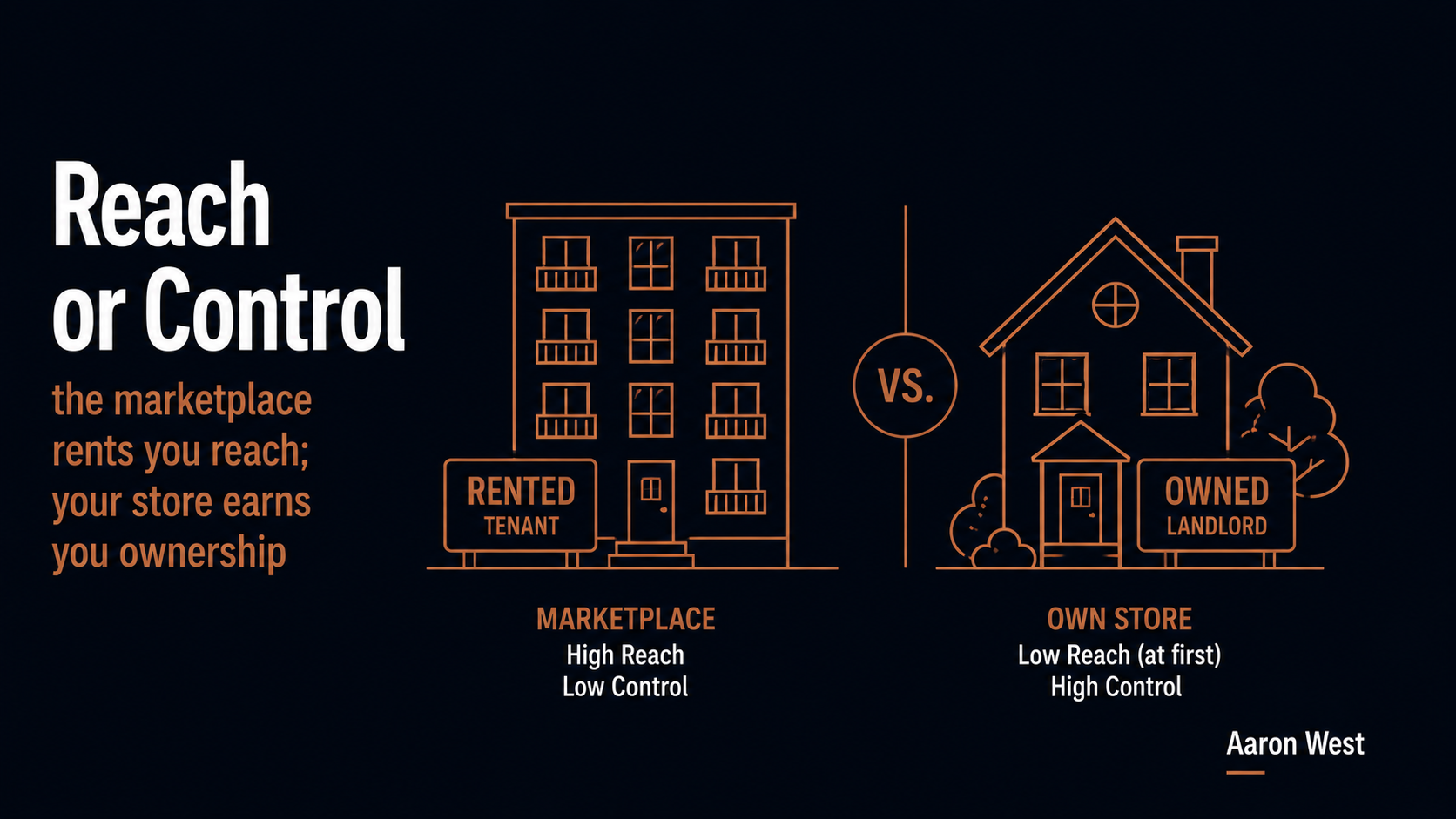
Your Own Store vs the Marketplace: The Strategic Trade-Off
The choice between selling on your own store and selling on a marketplace isn't about which is better. It's about what you're willing to trade. A marketplace gives you instant reach, access to enormous existing demand, in exchange for operating in someone else's house: their…
Continue reading...
In-House vs 3PL vs Dropship vs Marketplace Fulfilment: The Real Trade-Offs
The core fulfilment question is who actually does it, and the four main models, in-house, third-party logistics (3PL), dropshipping, and marketplace fulfilment, trade control, cost, scale, and customer experience against each other differently. There's no best model, only the right fit for your stage, your…
Continue reading...