Your Own Store vs the Marketplace: The Strategic Trade-Off

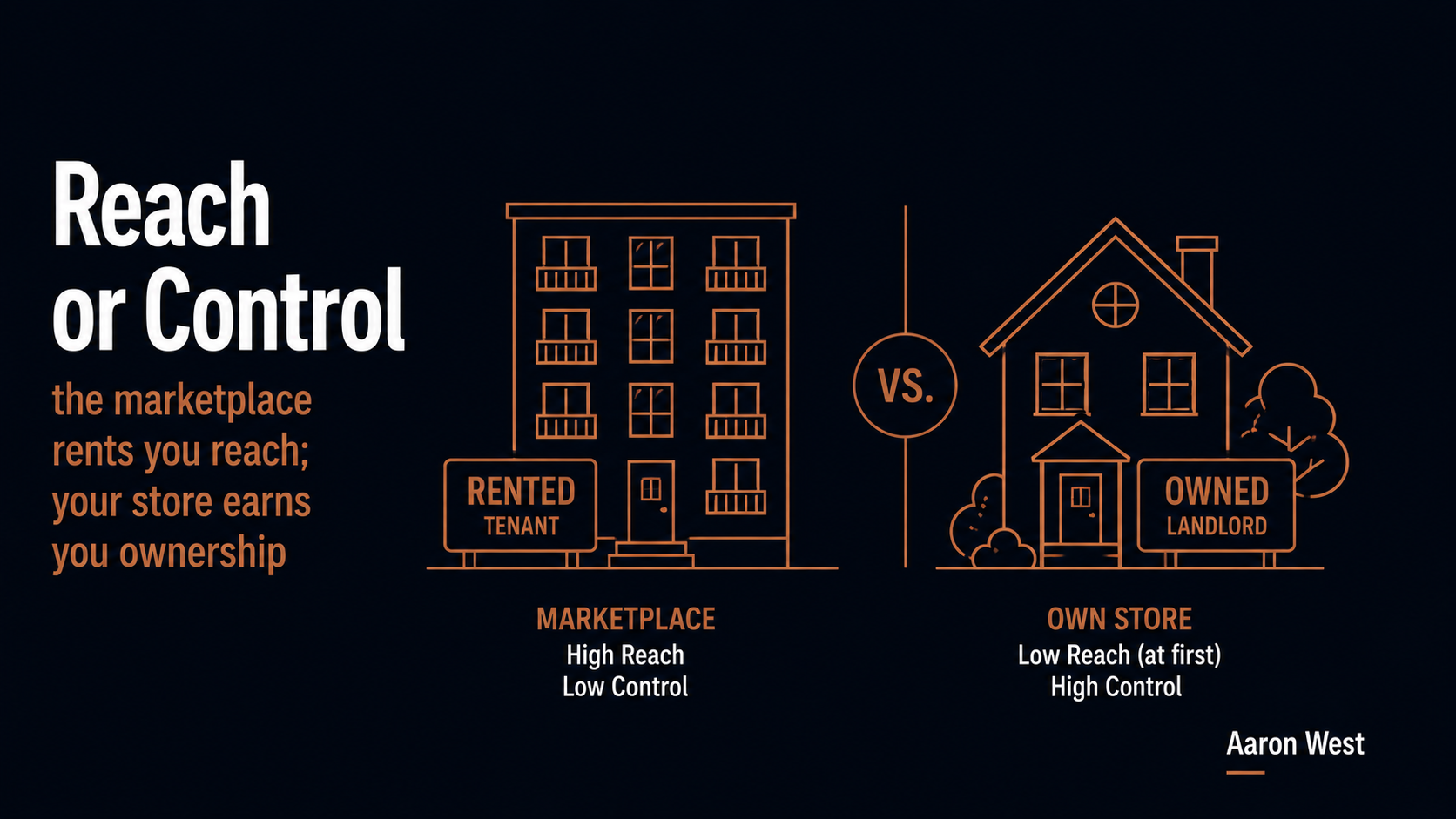
Table of Contents
The choice between selling on your own store and selling on a marketplace isn't about which is better. It's about what you're willing to trade. A marketplace gives you instant reach, access to enormous existing demand, in exchange for operating in someone else's house: their rules, their fees, their customer relationship, and their freedom to compete with you. Your own store gives you control, margin, data, and the customer relationship, in exchange for having to generate all of your own demand. Most mature businesses end up running both, deliberately, with each channel playing a different role.
This opens the Marketplaces & Multichannel pillar, and it's the cornerstone the cluster links up to: selling on the big marketplaces, getting visible inside them, and running multiple channels without losing your margin or your mind. The whole pillar rests on one idea: a channel is a set of trade-offs, and the strategy is knowing exactly what each one is for.
Two models, opposite trade-offs
Strip away the detail and there are two fundamentally different ways to sell, with opposite shapes.
The marketplace. You list your products on a platform that already has millions of buyers, a large general marketplace, a category specialist, wherever your buyers already are. The upside is immediate: instant reach, built-in trust (the customer trusts the platform even before they trust you), and existing traffic you didn't have to earn. The downside is that you're a tenant. It's their platform, so it's their rules, their fees and commissions, their checkout, and crucially their customer relationship and their data. They can change the terms, they can suspend an account, and they can watch what sells and compete with you directly. You get reach, and you give up control.
Your own store. Your domain, your design, your rules, your margin, your customer data, and your direct relationship with the buyer. The upside is ownership: you keep more of the money, you own the relationship, and nobody can change your terms or evict you. The downside is that you start with zero traffic and have to generate every visit yourself, through search, ads, content, email, affiliate, the whole hub. You're the landlord. You get control, and you give up the easy reach.
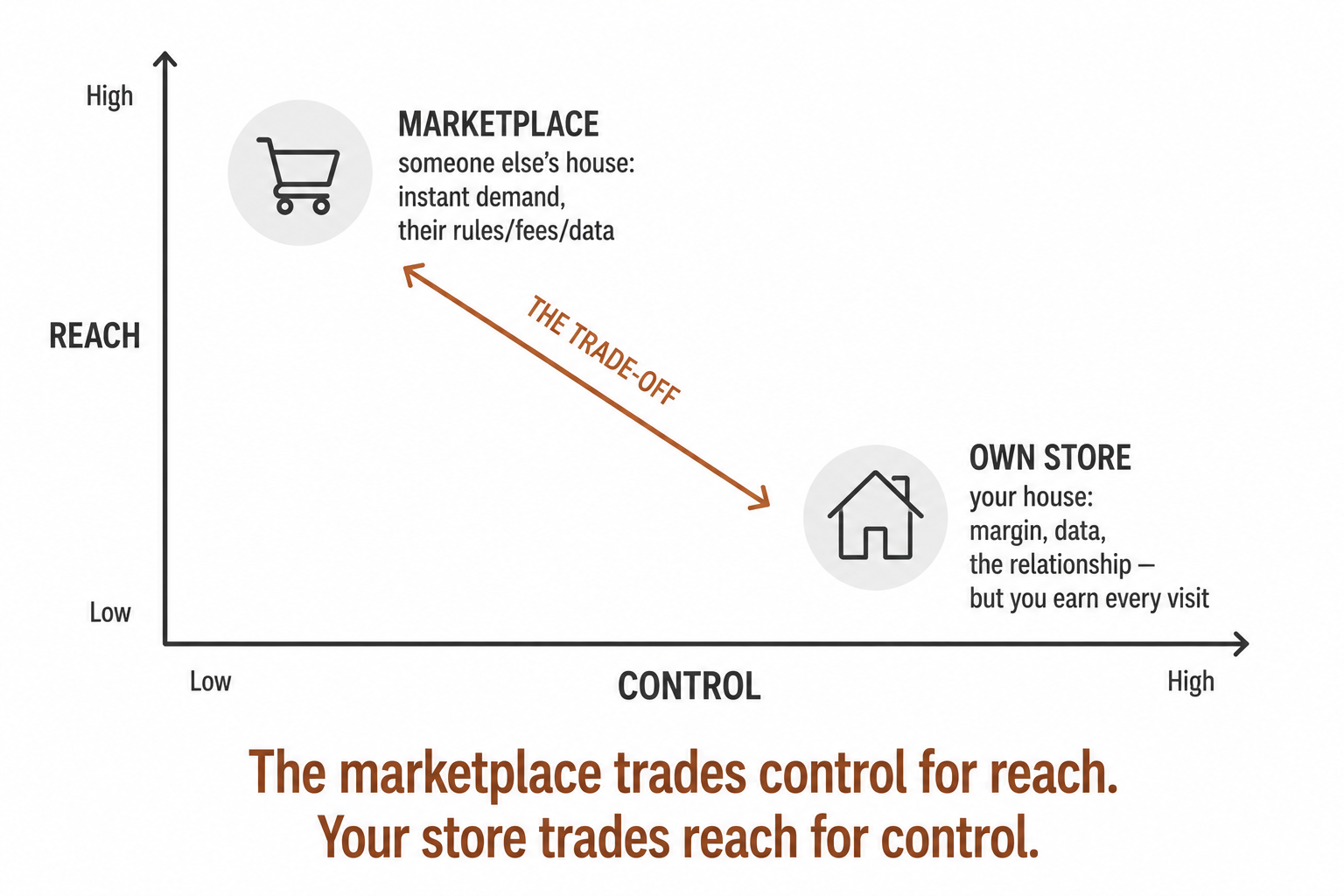
Neither side is free. The marketplace trades control for reach; your own store trades reach for control. That single sentence is the whole decision.
What you actually give up on a marketplace
The reach is obvious and seductive, which is why the costs are the part worth spelling out, because they're the ones stores undercount when the easy demand is right there.
- The customer relationship and the data. This is the big one. On most marketplaces the platform owns the customer; you often don't get the email, can't build a CRM relationship, and can't market to that buyer again on your own terms. You made the sale, but you didn't gain a customer you can retain, you can't keep a customer you don't own.
- Margin. Fees and commissions are real and significant, and they come off every order, forever. Reach isn't free; you rent it per sale.
- Brand control. A constrained storefront, your product shown next to direct competitors and often next to the platform's own-brand version, with limited room to tell your story.
- Dependence and risk. Rules change, fees rise, algorithms shift, accounts get suspended. A business built entirely on a marketplace is built on rented land, and the landlord can change the rent or the locks. That's not hypothetical; it's the structural risk of the model.
- The competition risk. The marketplace sees exactly what sells, and a platform that also sells its own products has both the data and the incentive to compete with your bestsellers directly.
None of these means "don't use marketplaces." They mean use them with your eyes open about what the reach costs.
What you give up with your own store
The own-store cost is simpler to state and harder to pay: demand. All of it. There's no built-in traffic, no platform handing you buyers, no borrowed trust. Every visit has to be earned, through SEO, paid media, content, email, affiliate partnerships, the entire discipline the rest of this hub is about. It's slower, it's harder, and it's more expensive up front. But what you build, you own: the traffic, the relationship, the data, the brand, and the margin. The own store is the asset; the marketplace is the rental.
Why most businesses run both
Put those trade-offs side by side and the strategic answer usually isn't "pick one." It's "use each for what it's good at," because their strengths are exactly each other's weaknesses.
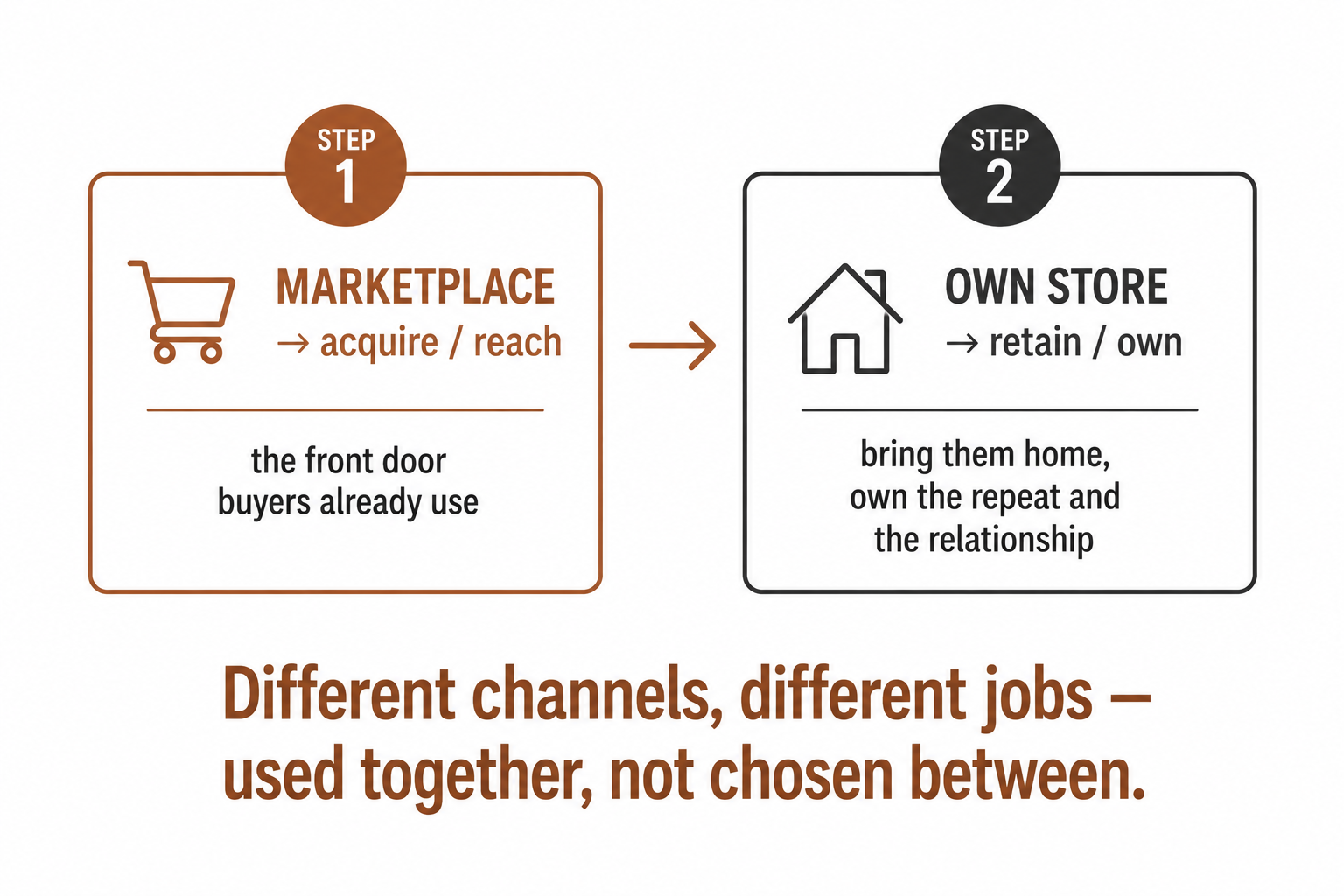
The marketplace is excellent at reach and acquisition: it puts you in front of buyers who'd never have found your own store, where they're already shopping and ready to buy. Your own store is excellent at margin, relationship, and retention: it's where you keep more of the money and own the repeat purchase. So the mature play is to use the marketplace's reach to acquire, and your own store to retain, let new customers discover you where they already are, then give them every reason to come home and buy direct next time. Different channels, different jobs, working together rather than competing.
That framing also exposes the two strategic mistakes. Marketplace-only leaves you with no owned asset, no customer relationship, and total dependence on a platform that can change the terms, the rented-land trap in its purest form. Own-store-only, when your category genuinely lives on a marketplace, leaves enormous reach on the table out of principle. The judgment is matching your channel mix to your category, your margins, and your brand goals, not picking a side as ideology.
How marketplaces connect to the rest
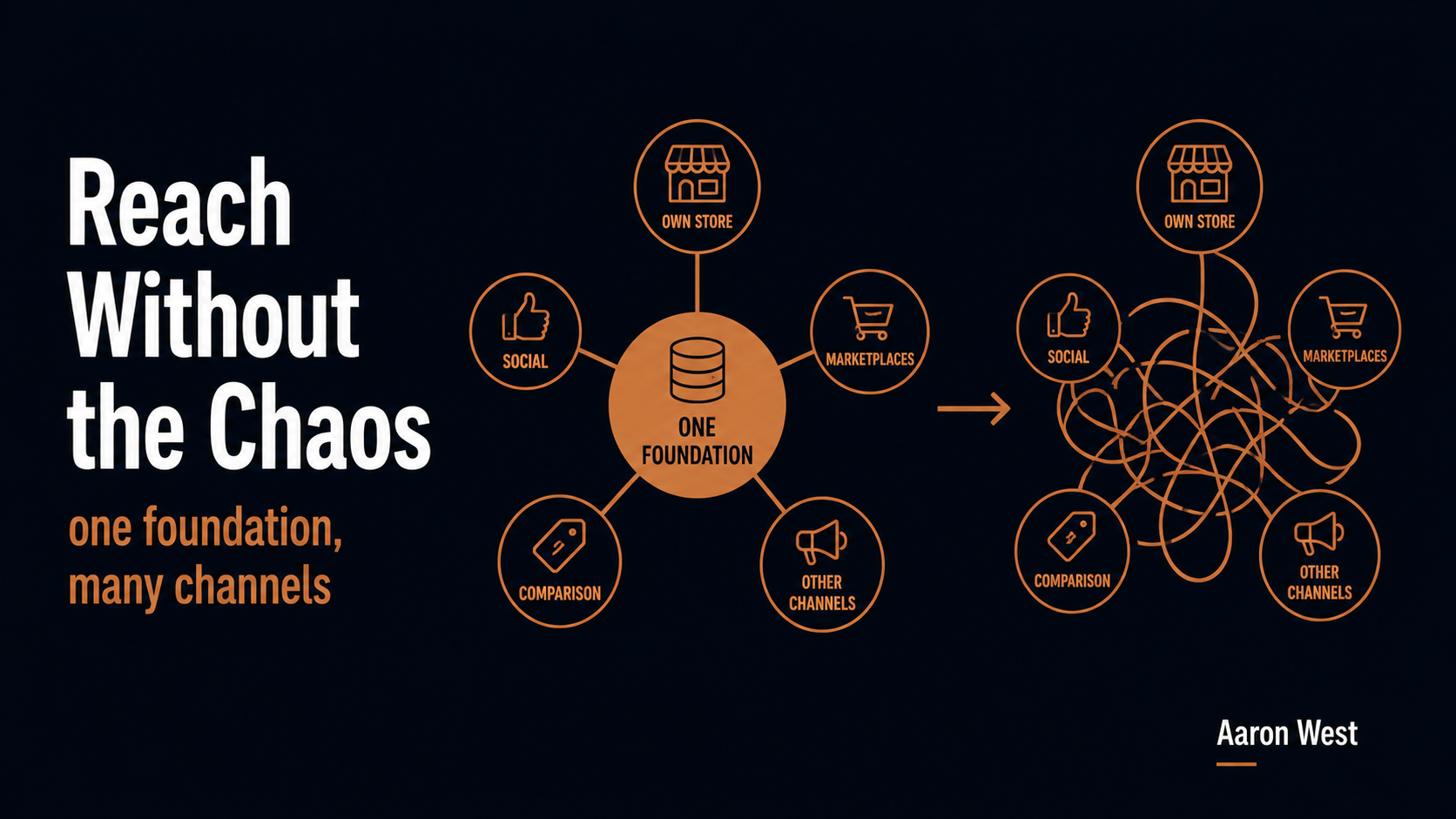
Three quick links into the cluster and the wider hub, because marketplaces don't sit in isolation. They run on your product feed, so everything the catalogue work said about clean, structured data applies directly to whether your marketplace listings even go live. They often impose or offer their own fulfilment, which is its own trade-off of convenience against control and cost. And getting visible inside a marketplace increasingly means paying for it through retail media and marketplace ads, advertising where the buyer is already standing. The cluster pieces go into each.
What this comes down to
Your own store and the marketplace aren't rivals to choose between. They're two channels with opposite trade-offs: the marketplace rents you reach, your store earns you ownership. The mistake is treating it as a question of loyalty, either "real brands sell direct" or "just go where the buyers are", when it's really a question of what each channel is for.
So use the marketplace for what it's genuinely good at, putting you in front of buyers you'd never otherwise reach, while building the owned store and customer relationship that no platform can take away from you. Sell where the buyers are. Just don't build your house on land you're only renting.
A few common questions
Should I sell on a marketplace or build my own store? Usually both, because they have opposite trade-offs. A marketplace gives instant reach and existing demand but you operate in someone else's house, their rules, fees, customer relationship, and data, and they can compete with you. Your own store gives control, margin, data, and the relationship, but you must generate all your own traffic. The strategic answer is to use each for its strength: the marketplace to acquire, your own store to retain.
What do you actually give up by selling on a marketplace? More than the commission. You typically give up the customer relationship and data (the platform owns the customer, so you often can't retain them on your own terms), a meaningful slice of margin to fees, brand control (a constrained storefront beside competitors), and you take on dependence and risk (rules and fees change, accounts get suspended). A platform that sells its own products can also see what's working and compete with your bestsellers. None of that rules marketplaces out; it means using them with eyes open.
Why is it risky to sell only on a marketplace? Because you're building on rented land. You have no owned asset, no direct customer relationship, and total dependence on a platform that can change the rent or the locks, raise fees, shift algorithms, or suspend the account. You can make real revenue and still not own anything durable. The fix isn't to abandon the marketplace; it's to use its reach to acquire customers while building an owned store and relationship the platform can't take away.
How do I decide my channel mix? Match it to your category, margins, and brand goals rather than to ideology. If your category genuinely lives on a marketplace, refusing to sell there on principle leaves huge reach on the table; if your margins are thin or your brand and relationship are the whole point, leaning on your own store makes sense. Most mature businesses run both, using the marketplace as the acquisition front door and the owned store as the place they retain customers and keep the margin.
You should also read:
Multichannel Without Losing Your Margin or Your Mind
Selling across multiple channels multiplies your reach and your complexity at the same time, and it goes wrong in two predictable ways. You lose your margin: every channel has different costs and fees, so selling the same product everywhere without per-channel margin awareness quietly bleeds…
Continue reading...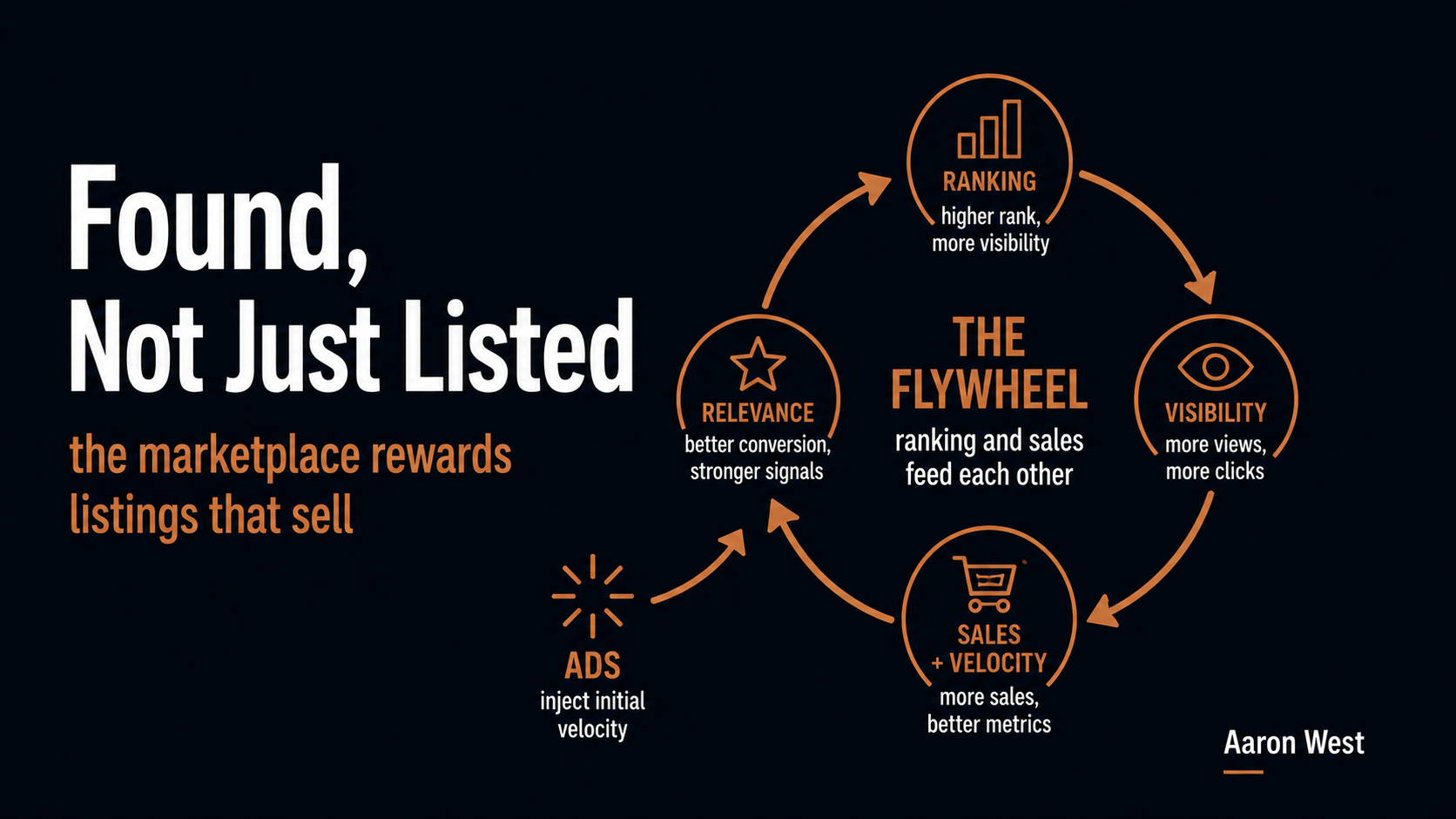
Getting Found Inside a Marketplace: Listing SEO and Marketplace Ads
Being listed on a marketplace is not the same as being found on it. Inside a marketplace, visibility is its own competition, won through the marketplace's search algorithm (listing optimisation) and its advertising system (paid placement). The defining mechanic is that marketplace search rewards listings…
Continue reading...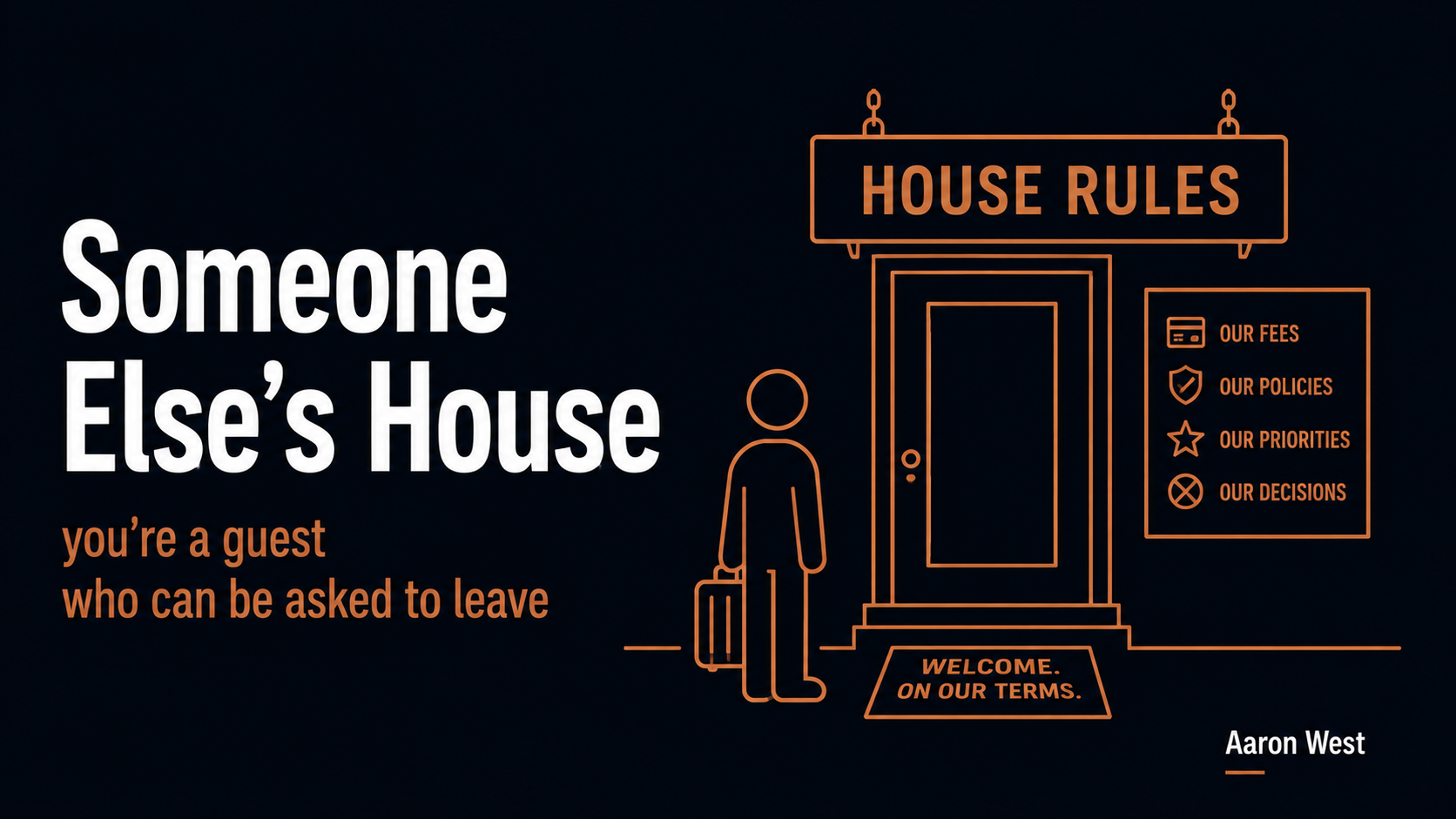
Selling on a Marketplace: The Rules of Someone Else's House
Selling on a marketplace means operating in someone else's house, and the rule that governs everything is this: the platform's interests overlap with yours, but they are not the same. It optimises for the buyer's experience and for its own revenue, not for any individual…
Continue reading...