In-House vs 3PL vs Dropship vs Marketplace Fulfilment: The Real Trade-Offs

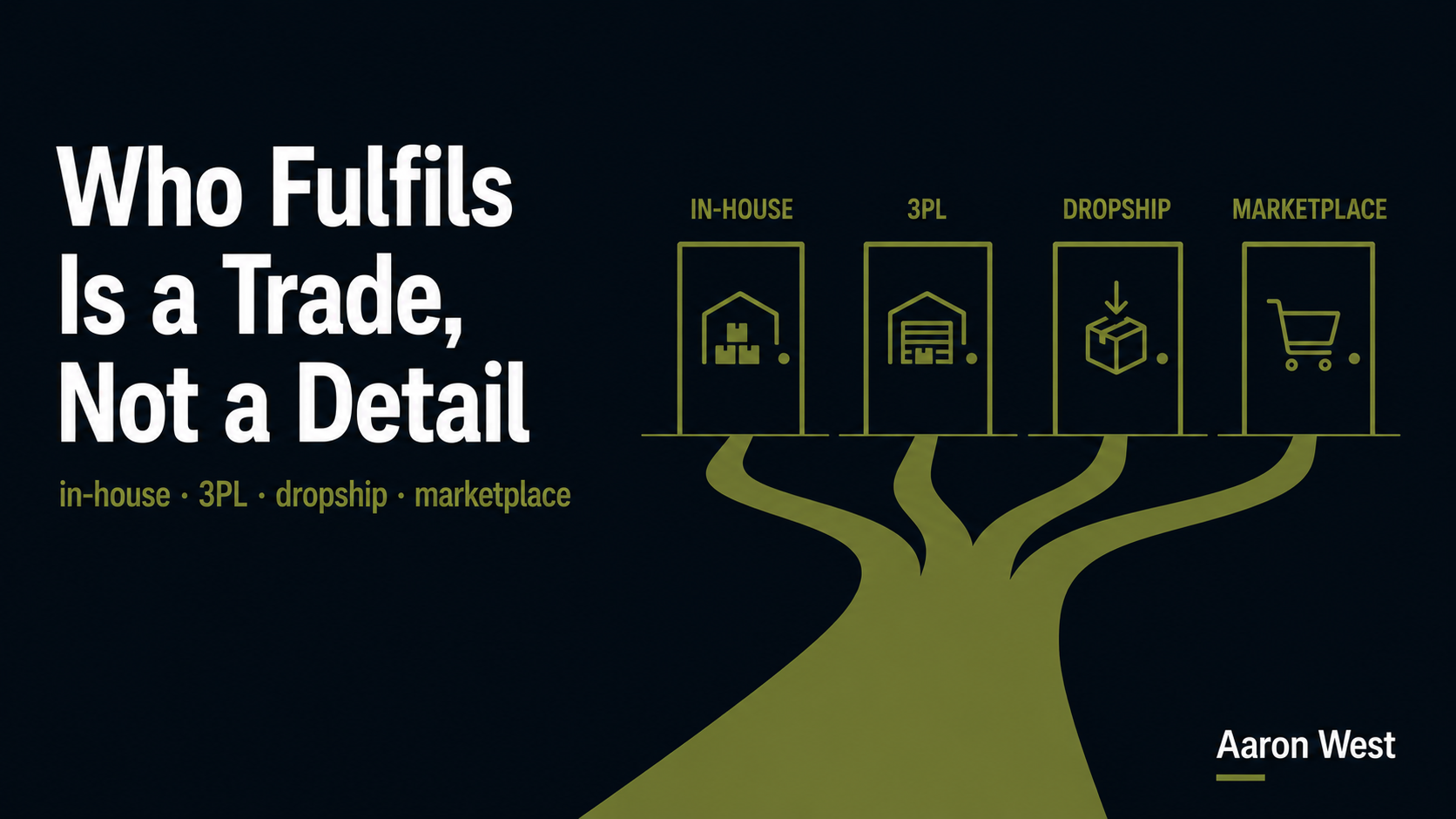
Table of Contents
The core fulfilment question is who actually does it, and the four main models, in-house, third-party logistics (3PL), dropshipping, and marketplace fulfilment, trade control, cost, scale, and customer experience against each other differently. There's no best model, only the right fit for your stage, your margins, your product, and how much the customer experience matters to your brand. And the most common expensive mistake is choosing on cost or convenience alone, then discovering too late what you gave up in control.
This is a core of the Logistics pillar, under the cornerstone that fulfilment is a customer-experience decision, not a back-office one. Who fulfils your orders isn't a logistics detail; it decides how much of your customer's only physical experience of your store you actually control.
The four axes every model trades on
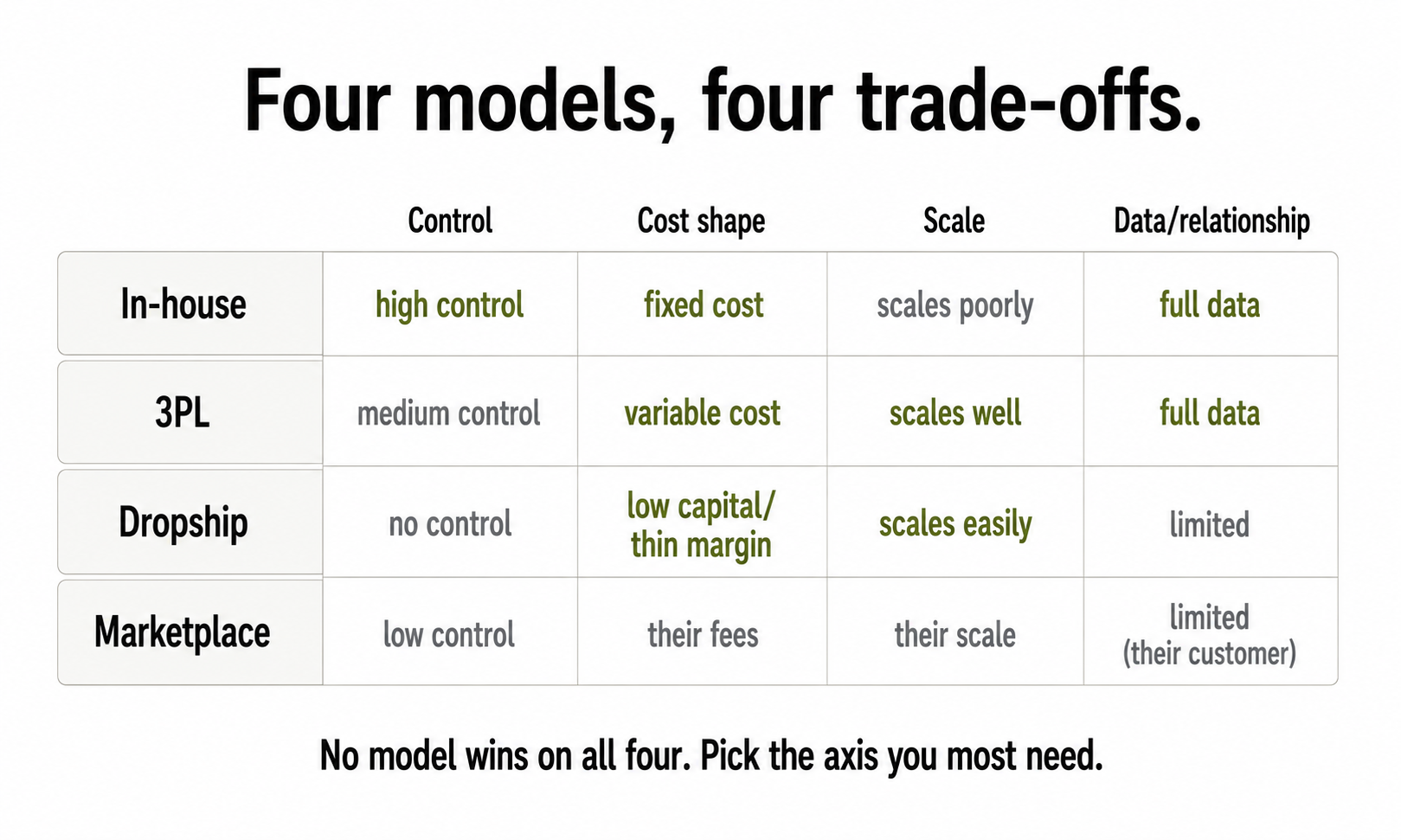
Before the models themselves, the four things they trade against each other, because the right choice is just a question of which of these you most need:
- Control of the experience: speed, accuracy, packaging, the unboxing, how returns are handled.
- Cost, and its shape: fixed (your own warehouse and staff) versus variable (per-order fees).
- Scale: whether it grows smoothly with you or breaks at peaks.
- Data and relationship: whether the customer is yours, with their data and the direct relationship, or partly someone else's.
No model wins on all four. Each trades some to get others, and knowing which axis matters most to you is the whole decision.
The four models
In-house: you hold the stock and ship it yourself. You control everything, the experience, the packaging, the speed, the accuracy, the brand moment, you keep all the margin, and you own all the data and the relationship. The price is that it doesn't scale smoothly (a demand peak that your own warehouse and team can't absorb becomes a crisis), it ties up capital in space, stock, and labour, and it's a whole operational discipline you now have to run well on top of actually selling. In-house fits the early, low-volume stage, and it fits brands where the physical experience is the brand and the control is worth the cost and effort.
3PL: a third party warehouses your stock and fulfils for you. You ship inventory to a fulfilment provider; they pick, pack, and ship. You offload the operational burden, it scales with volume far better than doing it yourself, and at scale it's often faster and cheaper than a DIY operation, while you keep ownership of the inventory. The trade is control: their packaging and process are the default unless you pay for custom, you depend on their reliability (their bad day is your customer's bad experience), and there's a per-order cost and integration overhead. This is where most scaling stores land, because operations stop being a sensible use of their attention.
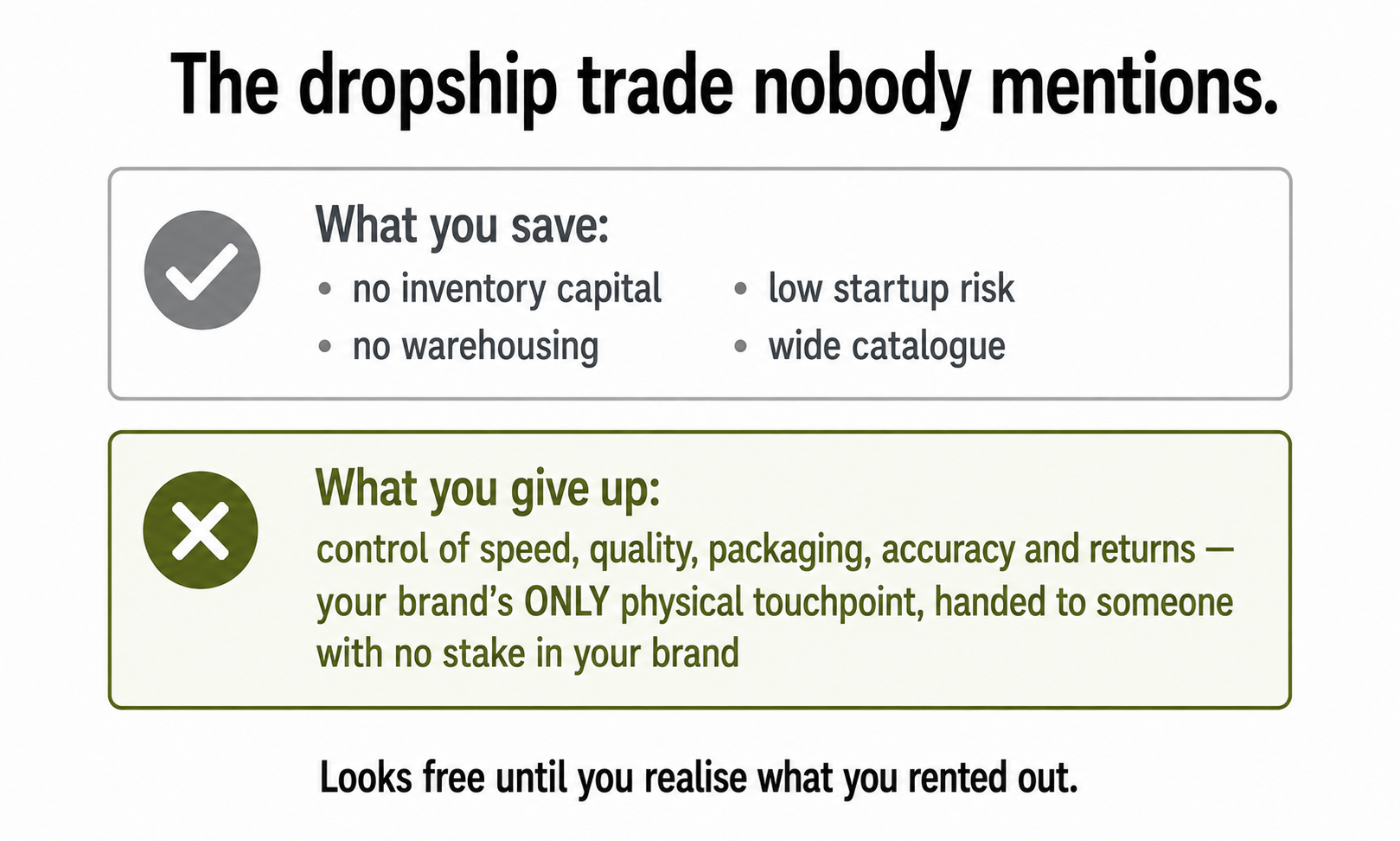
Dropshipping: the supplier holds the stock and ships direct; you never touch the product. The appeal is obvious: no inventory capital, no warehousing, low startup risk, and a wide catalogue without committing to stock. The cost is the one the cornerstone warned about, and it's bigger than it looks: you control none of the experience. Speed, quality, accuracy, packaging, and returns are all the supplier's, and those are exactly the things customers judge you on. Margins are thin, consistency is a risk, and the deep problem is structural: you've outsourced your brand's only physical touchpoint to someone who has no stake in your brand. Dropshipping fits testing a product or a market at low risk. It's a shaky foundation for a brand that wants to compete on experience.
Marketplace fulfilment: you sell on a marketplace and use its fulfilment network. You get the marketplace's scale, speed, logistics muscle, and, crucially, its customer trust and reach, and the operational side is handled for you. The trade is that you play by their rules, pay their fees, get limited data and a diluted relationship (the customer is partly theirs, not yours), and your brand is subordinated to the marketplace's. It fits when reach and solved operations matter more than control and ownership, and it's often run alongside your own store rather than instead of it, the topic the marketplaces pillar gets into.
How to actually choose
The decision is a fit, made on four things:
- Stage. Early and low-volume often suits in-house (or dropship to test a product cheaply); scaling volume usually pushes you to a 3PL; reaching a big existing audience fast pulls toward marketplace fulfilment.
- Margin. Thin margins can't always absorb 3PL or marketplace fees, and dropshipping's thin margins are structural, not a phase. The model has to survive your unit economics.
- Product. Heavy, fragile, perishable, custom, or regulated products change the maths and sometimes rule models out entirely.
- How much experience matters to your brand. If you compete on the physical experience, keep control (in-house, or a 3PL with custom packaging). If the product is a commodity and the experience is generic anyway, outsourcing that experience costs you little.
Most stores end up running a mix, in-house for the hero products where experience matters, a 3PL for the bulk, a marketplace for reach, and revisiting the split as they grow, because the model that fits you at launch rarely fits you at volume.
The mistake to avoid
The expensive error isn't picking the "wrong" model, it's picking on a single axis and discovering the rest of the trade too late. Choosing dropship purely because it needs no capital, then finding you have no control over the experience customers blame you for. Choosing a marketplace purely for reach, then finding you don't own the customer or the data. Choosing in-house purely for control, then drowning when a peak arrives you can't staff for. Each is a real model with a real fit; each becomes a trap when chosen on cost or convenience without counting what it costs you elsewhere.
Decide on the full trade, not the one axis that's easiest to see, exactly the same discipline the cornerstone asked for: total value across control, cost, scale, and relationship, not the single cheapest or most convenient option.
What this comes down to
There's no winning fulfilment model, only the one that fits where you are and what you're competing on. Control costs money and effort; outsourcing costs control; and dropshipping in particular looks free until you realise you've rented out your brand's only tangible moment to a stranger. Pick deliberately, knowing exactly which of the four axes you're trading away, and revisit the choice as you scale, because the model that's right at launch is rarely the one that's right at volume.
The question was never "which model is best." It's "which trade can I live with, at this stage, for this product, for this brand" and being honest that every model is a trade.
A few common questions
What are the main e-commerce fulfilment models? Four: in-house (you hold stock and ship it yourself, maximum control but it ties up capital and scales poorly), 3PL (a third party warehouses and ships for you, scales well but you lose some experience control and pay per order), dropshipping (the supplier ships direct and you never touch the product, no capital but no control over the experience), and marketplace fulfilment (you use a marketplace's network for its scale, trust, and reach, but accept its rules, fees, and diluted customer relationship). They trade control, cost, scale, and data differently.
Which fulfilment model is best? There isn't one; it's a fit decision. Match it to your stage (early suits in-house or dropship-to-test, scaling suits a 3PL, reaching a big audience suits marketplace), your margins (thin margins can't always absorb 3PL or marketplace fees), your product (heavy, fragile, or custom items change the maths), and how much the customer experience matters to your brand (compete on experience, keep control; commodity, outsource freely). Many stores run a mix and revisit it as they grow.
Is dropshipping a good idea? For testing a product or market at low risk, yes. As a foundation for a brand that competes on experience, it's shaky, because you control none of the things customers judge you on, speed, quality, accuracy, packaging, returns, all of which are the supplier's, and your margins are structurally thin. The hidden cost is that you've outsourced your brand's only physical touchpoint to someone with no stake in your brand. It looks free until you realise what you gave up.
What's the most common fulfilment mistake? Choosing a model on a single axis, usually cost or convenience, and discovering the rest of the trade too late: dropship for no capital but no control, a marketplace for reach but no ownership of the customer, in-house for control but no ability to absorb a peak. Each is a real model with a real fit; each becomes a trap when chosen without counting what it costs you on the other axes. Decide on the full trade-off, not the one number that's easiest to see.
You should also read:
Your Own Store vs the Marketplace: The Strategic Trade-Off
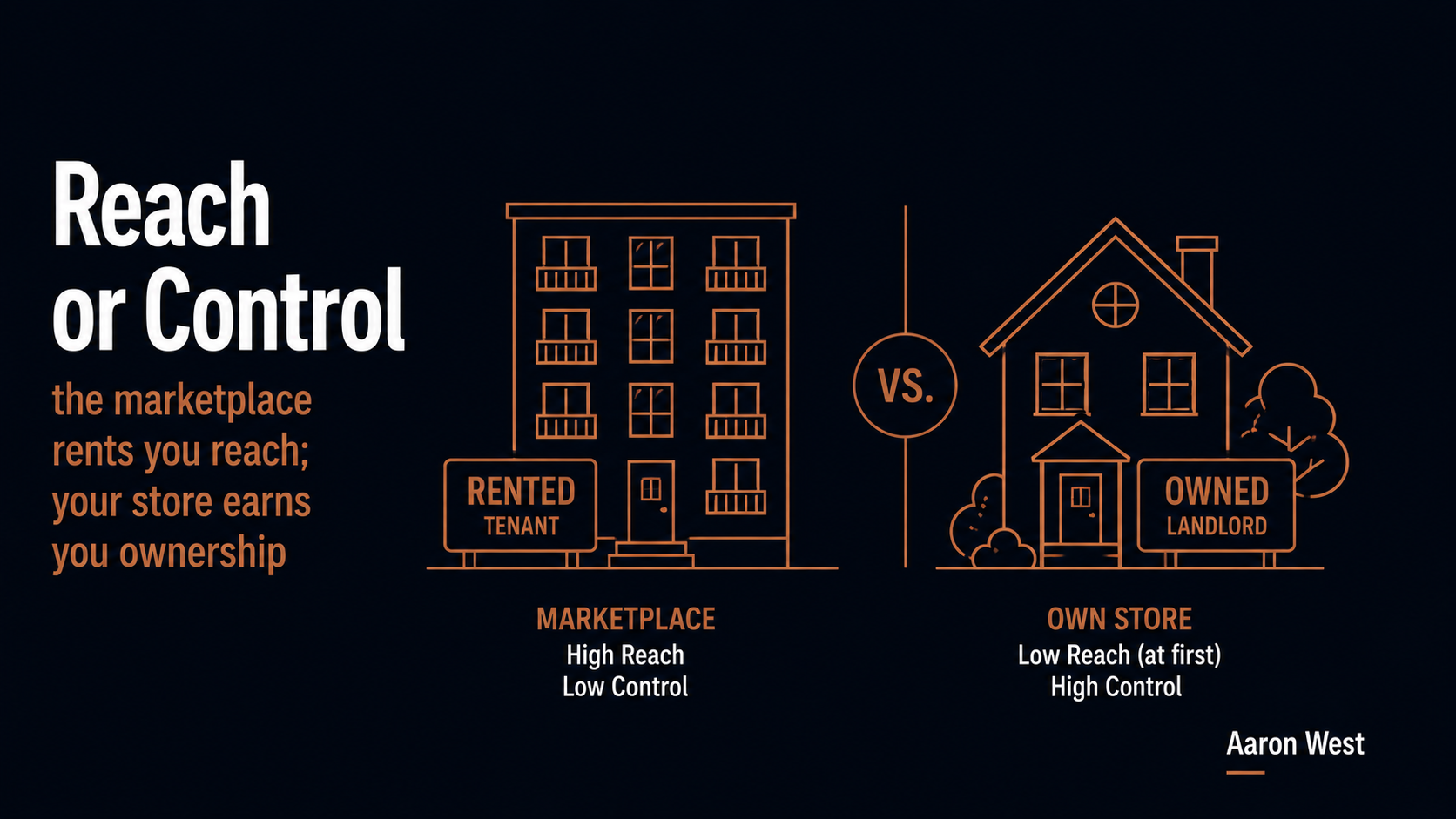
The choice between selling on your own store and selling on a marketplace isn't about which is better. It's about what you're willing to trade. A marketplace gives you instant reach, access to enormous existing demand, in exchange for operating in someone else's house: their…
Continue reading...
Multilingual Support: The Reality Nobody Plans For
Supporting customers in multiple languages is not a translation problem. It's an operations problem. The naive version, translate your help articles and bolt machine translation onto the live chat, looks complete and breaks in ways that stay invisible right up until a frustrated customer is…
Continue reading...
Cashback and Loyalty Publishers: How They Really Work (and What They Cost You)
Cashback and loyalty publishers are affiliate partners that share part of their commission back with the shopper, as cash, points, or perks, so the customer gets rewarded for buying and the publisher earns the rest. They are usually large, high-reach platforms, they are often among…
Continue reading...