Fulfilment Is a Customer-Experience Decision, Not a Back-Office One

Table of Contents
Fulfilment, getting the order picked, packed, shipped, and delivered, is usually run as a back-office cost to minimise. But it's really a customer-experience decision, because it's the only physical, tangible contact a customer ever has with your store, and the place your delivery promise is either kept or broken. How fast, how reliably, and how well you fulfil shapes conversion before the sale and loyalty after it, which means optimising fulfilment for cost alone quietly trades away revenue and retention you never see leave.
This opens the Logistics, Fulfilment & Shipping pillar, and it's the cornerstone the cluster links up to: who should actually do your fulfilment, how to think about inventory, shipping strategy, and click-and-collect. But it rests on one reframe, the same one that runs through the returns pillar next door: the part of the business that looks like a cost to suppress is usually an experience that decides whether customers come back.
The back-office framing, and what it misses
Judged as logistics, fulfilment is about cost per order and warehouse efficiency, and those things genuinely matter. A store that fulfils expensively and chaotically has a real problem. But cost-per-order is only half the picture, because fulfilment is also the moment an abstract online purchase becomes a physical, judged reality in someone's hands, and that moment carries far more weight in how a customer feels about you than its line on a logistics report suggests.
The danger of the pure back-office lens is the same one the cost-centre view causes everywhere: you optimise the number you can see (cost per order) and quietly damage the thing you can't (the experience that drives repeat business and the delivery promise that drives the sale in the first place). Fulfilment isn't only an output to make cheaper. It's an input into conversion and retention, and treating it as the former alone leaves money on the table at both ends.
The only physical touchpoint you have
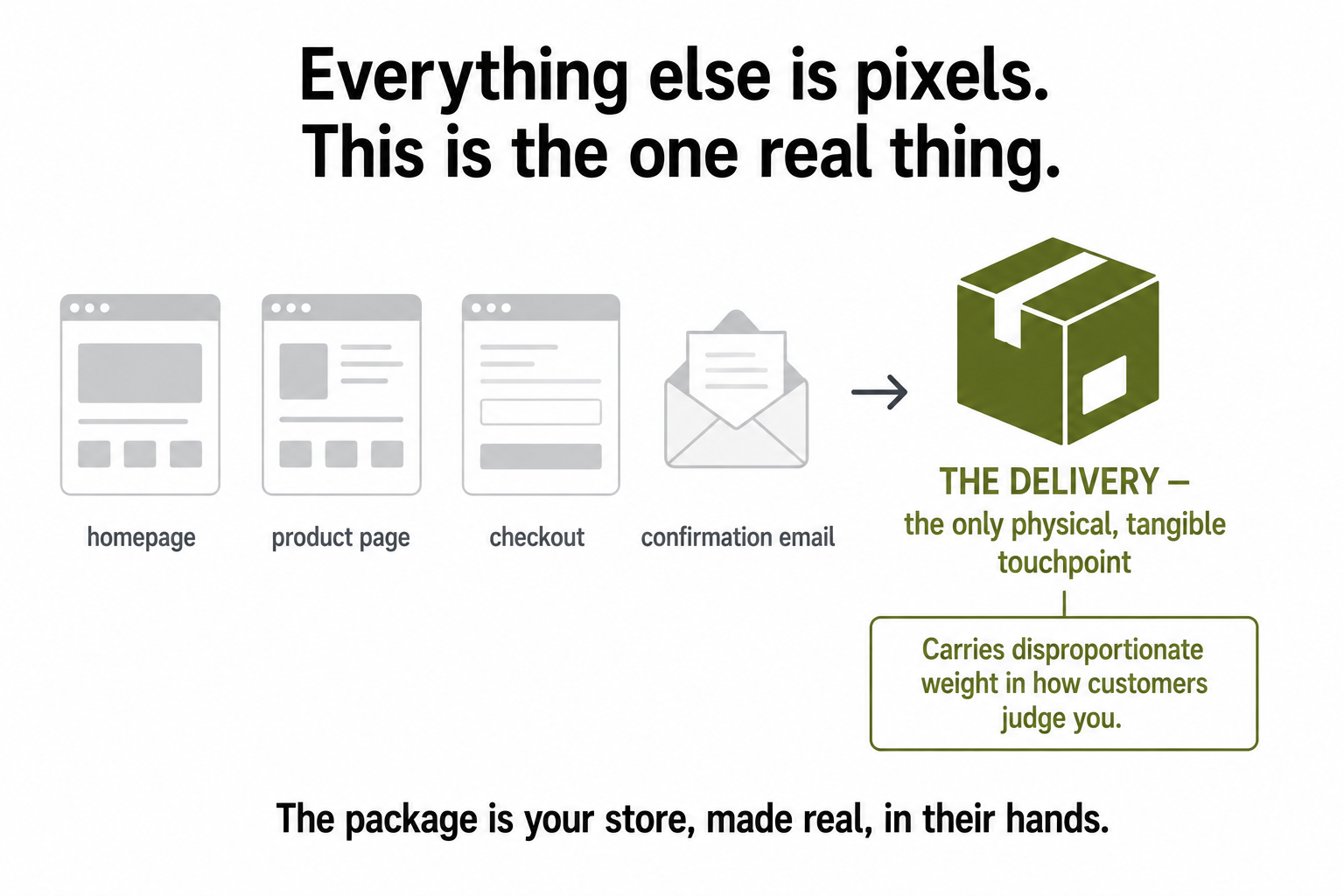
Here's the fact that should reframe how seriously you take fulfilment: everything else about your store is pixels. The homepage, the product page, the checkout, the confirmation email, all of it is screen. The package that arrives is the one tangible thing the customer actually experiences, the only moment your store exists as a physical object in their world.
That gives it disproportionate weight. A delivery that's fast, intact, accurate, and even pleasant to receive is a concrete, physical confirmation that trusting you was the right call. A delivery that's late, damaged, wrong, or a hassle is an equally concrete confirmation of the opposite, and it lands harder than any on-screen frustration because it's real and it's in their hands. You can have a beautiful site and a smooth checkout and still undo all of it with the one part of the experience the customer can actually touch.
Fulfilment decides three things, and only one is a cost
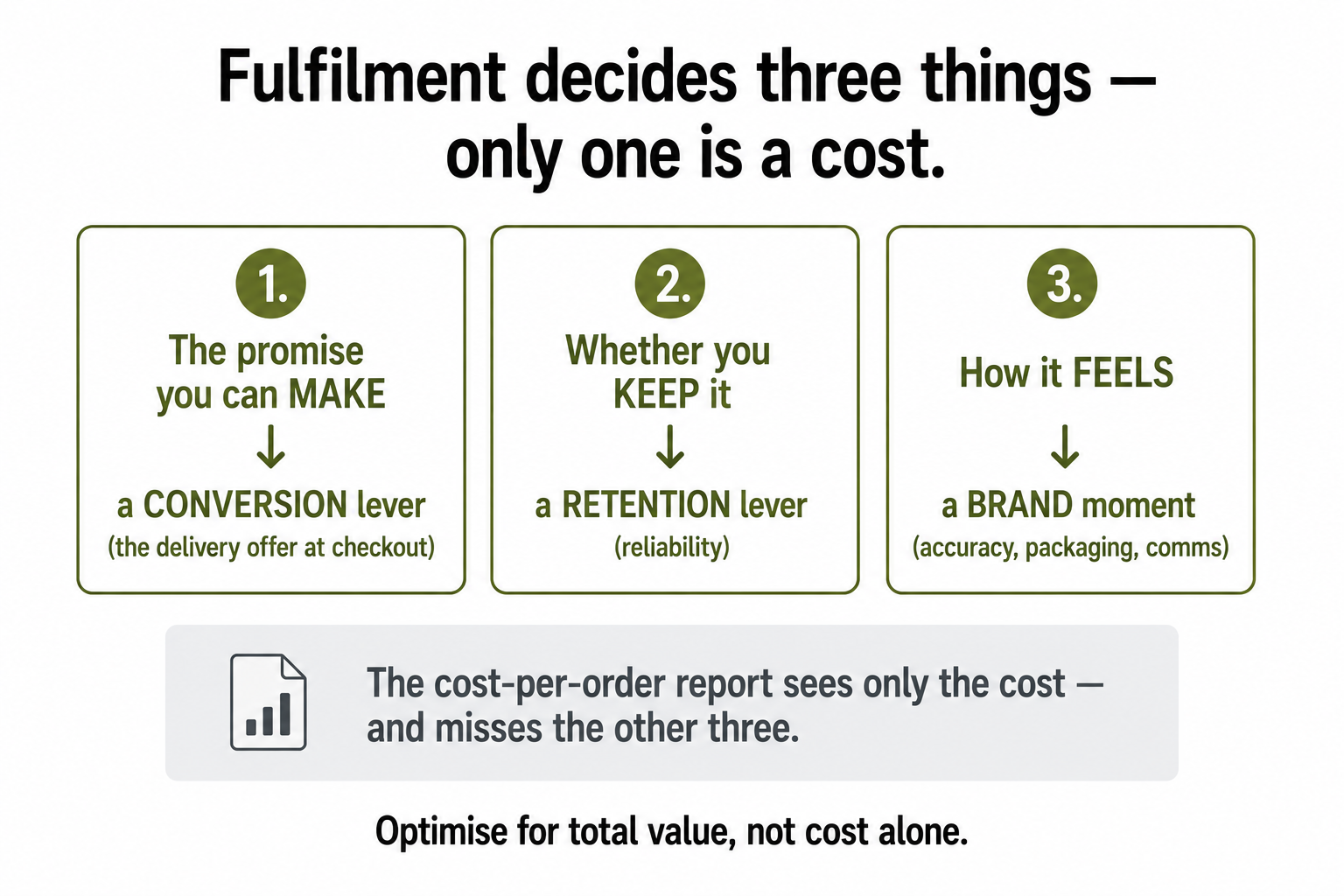
Look at what fulfilment actually controls and it splits into three jobs, of which the cost-centre view only sees the last:
The promise you can make (a conversion lever). What you can offer at checkout, how fast, how much it costs the customer, what options exist, is set by your fulfilment capability, and the delivery promise is a real conversion factor. Slow, expensive, or vague delivery loses sales at the last step; fast, clear, well-priced delivery wins them. So your fulfilment setup is a conversion input before it's ever a fulfilment output.
Whether you keep it (a retention lever). Making a delivery promise is conversion; keeping it is retention. A late, damaged, or wrong delivery is one of the fastest ways to lose a customer you just won, because it breaks a promise at the most concrete possible moment. A reliably kept promise is the quiet foundation of trust that brings people back.
How it feels (a brand moment). Accuracy, packaging, communication along the way, the small experience of receiving the order. This is the part that can turn a transaction into a relationship, the closest a pure-online store gets to the feeling of being handed something in a good shop.
Only the cost of all this shows up on the logistics report. The conversion it enables, the retention it protects, and the brand impression it makes are all real and all invisible to a cost-per-order lens, which is exactly why fulfilment optimised purely for cost so often quietly costs more than it saves.
The cost tension, named honestly
None of this means "always pick the fastest, fanciest fulfilment." Better fulfilment, faster shipping, nicer packaging, more reliable carriers, more locations, costs more, and that trade-off is real and unavoidable. A store can absolutely over-invest in fulfilment its margins and customers don't require.
The point is what you're optimising. The decision isn't "minimise cost per order"; it's "choose the fulfilment that maximises total value, sales won, plus customers retained, minus cost." Sometimes that means spending more (where speed or reliability genuinely wins and keeps customers) and sometimes less (where customers don't care and the spend is vanity). It's the same discipline the payments pillar keeps returning to: run the maths on the whole picture, not on the one cost you can see most easily. Fulfilment optimised for cost alone wins the cost line and can lose the larger sum.
The forward and the reverse are one job
One more thing the back-office lens tends to split apart: fulfilment isn't only sending things out. It's also getting things back, the reverse logistics of returns. A store that ships beautifully forward and handles returns terribly has only done half the job, and the customer experiences both halves as one thing: how good this store is at the physical side of the deal. The forward journey wins the sale and the first impression; the reverse journey, handled well, wins the loyalty when something goes wrong. Treating them as one connected experience, rather than "fulfilment" in one department and "returns" as a cost in another, is part of seeing the whole picture.
What this comes down to
Fulfilment is the one moment your online store stops being a screen and becomes a real thing in someone's hands. It sets the delivery promise that helps win the sale, it keeps (or breaks) that promise in a way that decides whether they come back, and it's the single most physical impression your brand ever makes. Run it purely for cost and you'll win the cost-per-order metric while quietly losing the conversions and the customers it was silently deciding all along.
It's not the back office. It's the only part of your store the customer can actually hold, and the parts of the business you can hold tend to be the ones people remember.
A few common questions
Isn't fulfilment just a logistics cost to minimise? Cost per order matters, but it's only half the picture. Fulfilment is the one physical, tangible contact a customer has with your store, and it shapes conversion before the sale (through the delivery promise you can make at checkout) and retention after it (through whether you keep that promise). Optimising it for cost alone quietly trades away sales and repeat business that never show up on the logistics report, the same cost-centre mistake stores make with returns and support.
Why does fulfilment affect conversion? Because the delivery promise, how fast, how much it costs the customer, what options exist, is a real factor in whether someone completes the purchase, and that promise is set by your fulfilment capability. Slow, expensive, or vague delivery loses sales at the last step; fast, clear, well-priced delivery wins them. So your fulfilment setup is a conversion input before it's ever a fulfilment output.
What does fulfilment actually decide? Three things, of which only the last is a cost: the promise you can make (a conversion lever, the delivery offer at checkout), whether you keep it (a retention lever, reliability), and how it feels (a brand moment, accuracy, packaging, communication). The cost-per-order report only sees the cost and misses the other three, which is why fulfilment optimised purely for cost so often costs more than it saves.
Should I always invest in faster, premium fulfilment? No. Better fulfilment costs more, and you can over-invest in speed and packaging your margins and customers don't require. The right question isn't "minimise cost" or "maximise speed", it's "maximise total value", sales won plus customers retained minus cost. Sometimes that means spending more where speed and reliability genuinely win and keep customers, and sometimes less where customers don't care. Run the maths on the whole picture, not the one cost that's easiest to see.
You should also read:
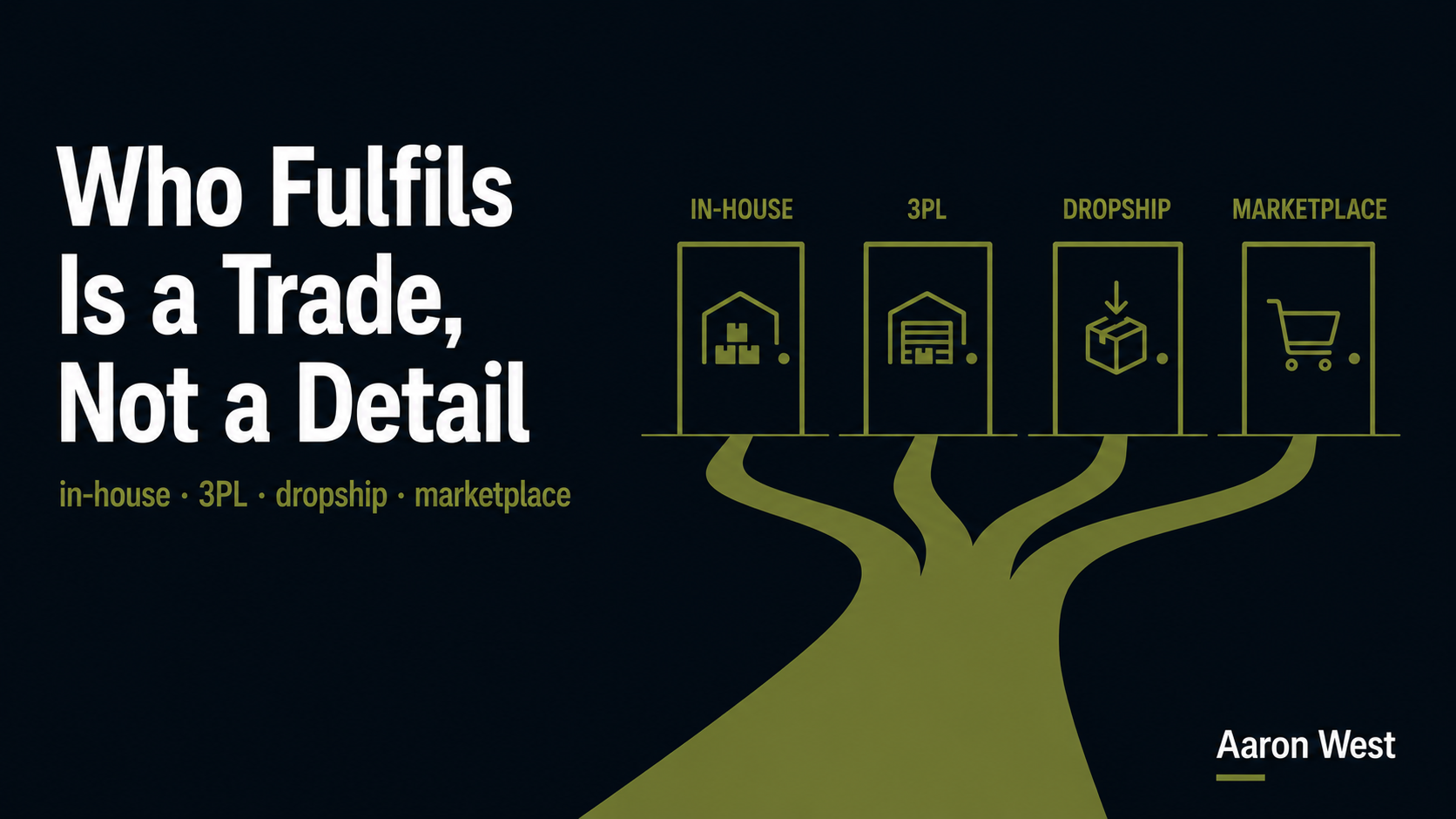
In-House vs 3PL vs Dropship vs Marketplace Fulfilment: The Real Trade-Offs
The core fulfilment question is who actually does it, and the four main models, in-house, third-party logistics (3PL), dropshipping, and marketplace fulfilment, trade control, cost, scale, and customer experience against each other differently. There's no best model, only the right fit for your stage, your…
Continue reading...