Re-Platforming Without Torching Your SEO and Your Sanity

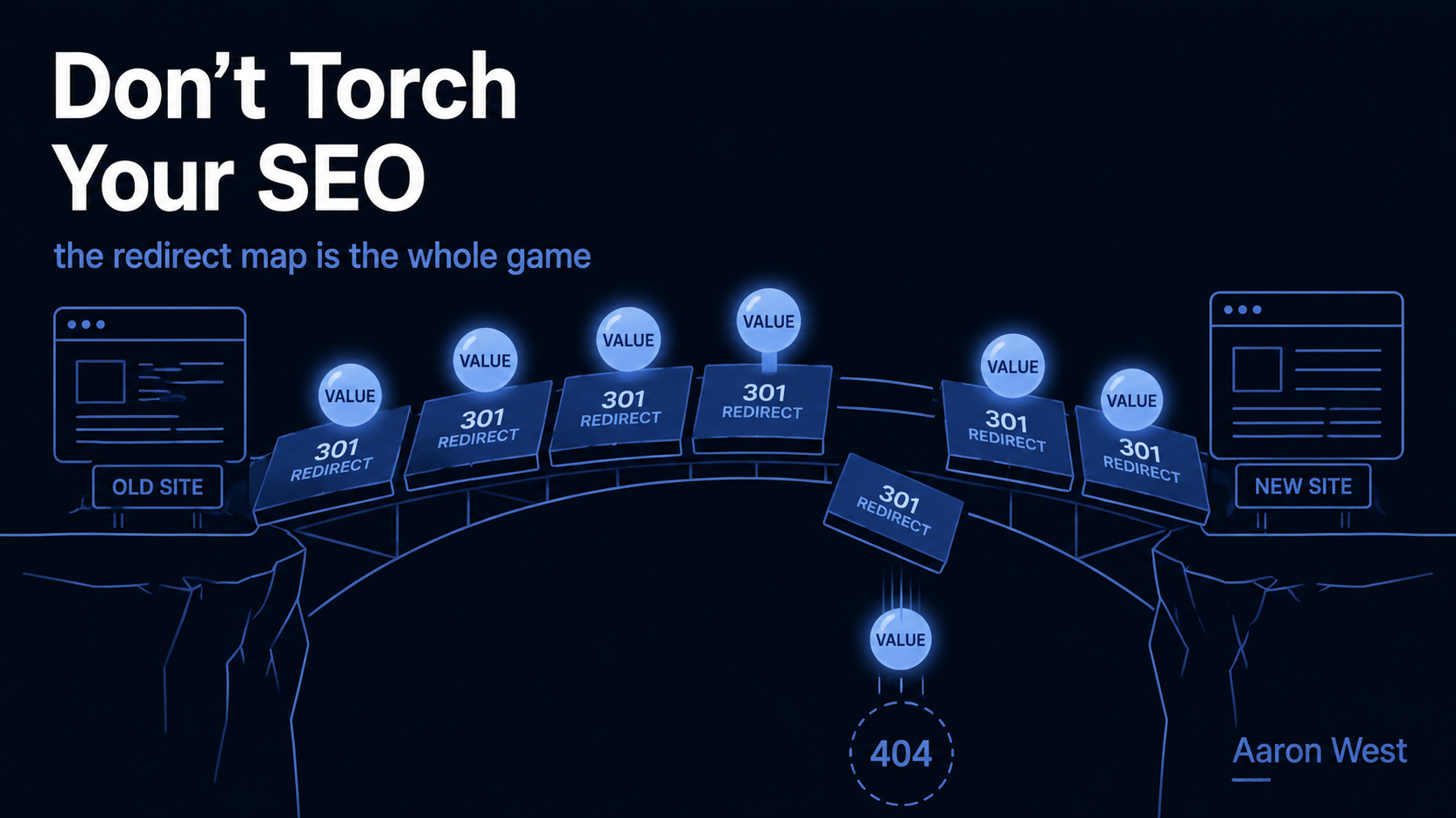
Table of Contents
- Why re-platforming is so risky
- The number one killer: URLs that change with nowhere to go
- The redirect map: the deliverable that saves the project
- The other things that quietly break
- The discipline that makes it survivable
- The honest note: should you even do it?
- What this comes down to
- A few common questions
Re-platforming, moving your store onto a new platform, is one of the riskiest projects in e-commerce, and the damage almost always shows up in the same place: the SEO you spent years building, gone overnight because the URLs changed and nothing told search engines where they went. The single most important re-platforming task isn't the new design or the data migration. It's the redirect map, the unglamorous spreadsheet that points every old address at its new home.
This is a core of the Platforms & Tech Stack cluster. Almost every re-platforming horror story is the same story, and it's entirely preventable.
Why re-platforming is so risky
A re-platforming project changes nearly everything at once: the URL structure, the templates, the underlying data model, sometimes the domain. Each of those is an independent chance to lose rankings, break links, or lose data, and you're rolling all the dice on the same day.
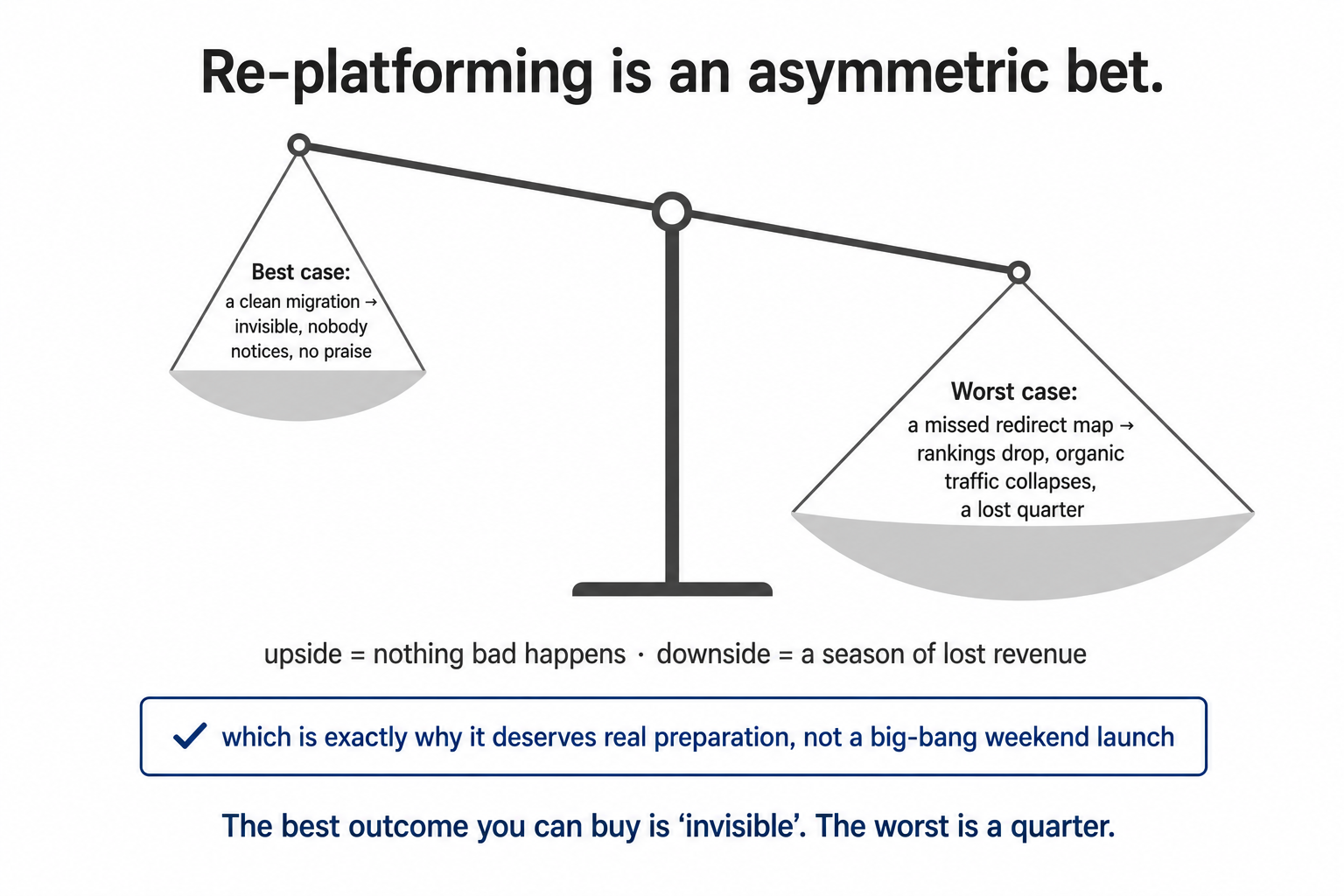
What makes it genuinely dangerous is that the downside is asymmetric. A good migration is invisible, traffic continues, customers don't notice, and nobody thanks you. A bad one can cost months: rankings drop, organic traffic falls off a cliff, and you spend the next quarter clawing back ground you already owned. The upside is "nothing bad happens" and the downside is "a season of lost revenue," which is exactly the risk profile that deserves real caution and real preparation.
The number one killer: URLs that change with nowhere to go
Here's the mechanism behind most of the disasters. Over the years, your existing URLs have quietly accumulated value, links pointing to them, rankings earned, search engines having indexed and learned them. That value is attached to the address, not just the page.
A new platform almost always generates a new URL structure. So the moment you launch, every old URL stops existing. A customer who clicks an old link, and a search engine that has the old address indexed, both hit a "page not found." Unless you have explicitly told them where each old page now lives, you have just thrown away years of accumulated SEO equity in an afternoon, and the new pages start again from nothing. This single issue, changed URLs with no redirects, is behind the overwhelming majority of "we re-platformed and traffic collapsed" stories.
The redirect map: the deliverable that saves the project
The fix is not clever. It's thorough. Before launch, you build a redirect map:
- List every live URL on the current site, every product, category, and content page that exists and has any value.
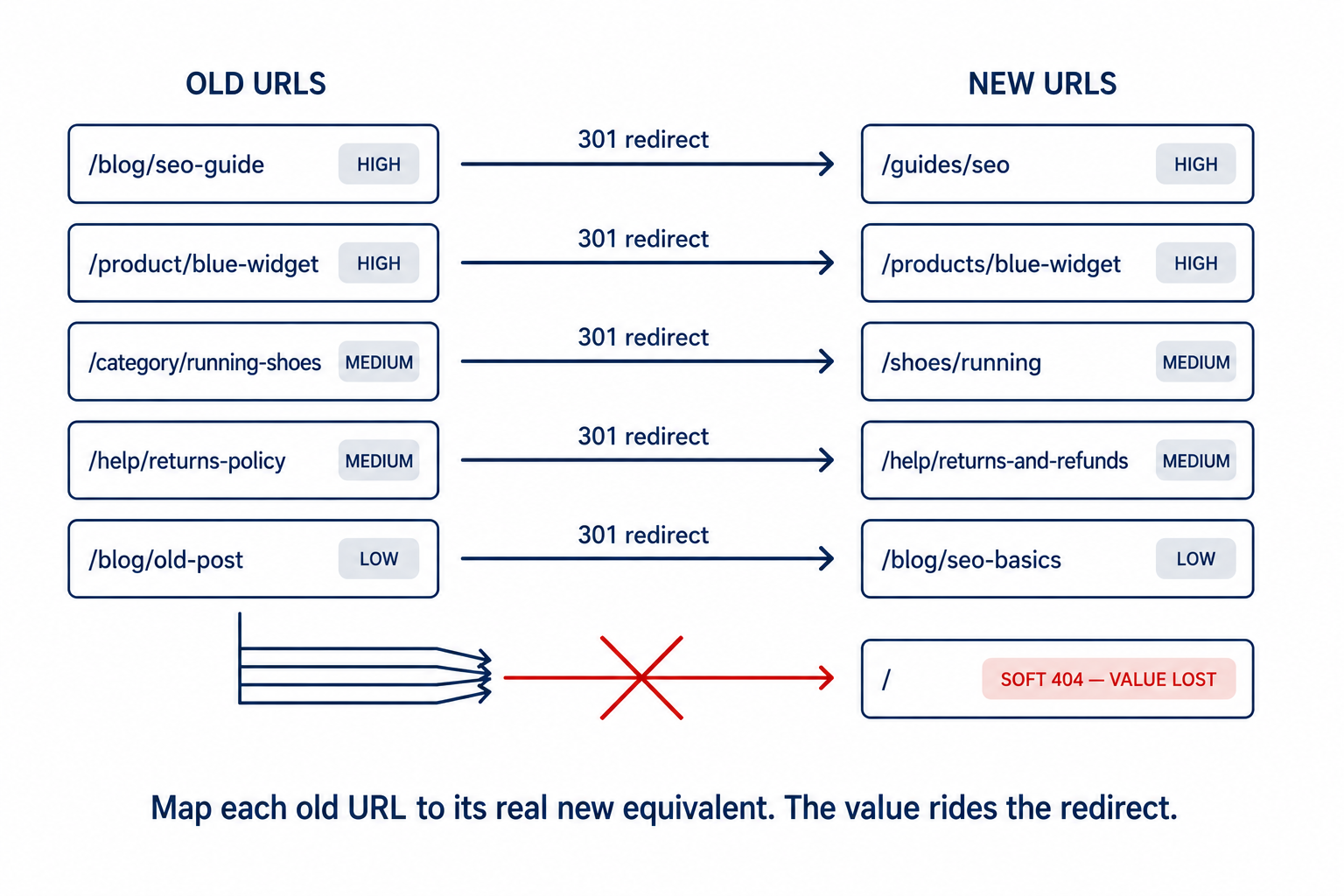
- Map each one to its new equivalent on the new platform, the specific new page, not a vague "somewhere over there."
- Set a 301 redirect (a permanent redirect) from each old URL to its new one, so anyone, human or search engine, arriving at an old address is sent cleanly to the new page, and the accumulated value transfers with them.
One discipline matters here: don't take the lazy shortcut of redirecting every old URL to the homepage. Search engines treat a redirect to an irrelevant page as a "soft 404", effectively the same as the page being gone, and you lose the value anyway. Each old page maps to its real new equivalent. That's the work, and it's the work people skip because it's a tedious spreadsheet, the same tedious spreadsheet that is the difference between a smooth migration and a lost quarter.
The other things that quietly break
The redirect map is the big one, but a migration breaks in several predictable places. Treat this as the checklist:
- Data integrity. Orders, customers, and product data don't always migrate cleanly. Verify the migrated data against the source, don't assume a tool moved everything correctly.
- Structured data and meta tags. New templates frequently drop the structured data and meta descriptions the old site had. Re-implement them, or you lose the machine-readability that helps you get found and cited.
- Internal links. Links inside your own content that point at old URLs need updating to the new ones, or they'll rely on redirects forever (or break).
- Analytics and tracking. Re-install and re-verify your analytics and tags on the new platform, or you'll be flying blind exactly when you most need to watch the numbers.
- A real staging test. Build and test the new site on staging before launch. Find the broken things in private, not in front of customers.
- Keep the old site reachable until the new one is fully verified, so you have something to fall back to if launch goes wrong.
The discipline that makes it survivable
Re-platforming fails when it's a big-bang weekend launch fuelled by hope. It survives when it's a planned, tested sequence. Build on staging, test everything, confirm the redirect map resolves correctly, and launch when the work is verified, not when the calendar says go. The correctness-over-calendar discipline that applies to anything high-stakes applies here in full.
Then, crucially, monitor closely for weeks afterward. Watch rankings, watch for crawl errors and 404s, watch organic traffic. The early signal of a missed redirect is a spike in "page not found" errors and a dip in a specific section's traffic, catch it in week one and you fix it before it compounds; miss it for a month and you're explaining a bad quarter.
The honest note: should you even do it?
Sometimes re-platforming is exactly right, you've genuinely outgrown the platform, and the constraints are now costing you more than the migration will. But sometimes it's an expensive way to avoid a problem that isn't really about the platform at all. A new platform won't fix a process problem, a merchandising problem, or a data problem you'll simply carry across with you. Before taking on this much risk, be honest that the move solves a real constraint, the kind the platform-decision framework helps you name, and isn't just the appeal of a fresh start.
What this comes down to
Re-platforming doesn't have to torch your SEO. The traffic collapse in those horror stories was never the new platform's fault, it was the redirect map nobody built. Map every old URL to its real new equivalent with permanent redirects, verify the data, re-implement the structure, test on staging, launch when it's verified, and watch the numbers closely afterward.
The boring spreadsheet is the whole game. Do it properly and the migration is invisible, which, for a re-platforming project, is the highest praise there is.
A few common questions
Why does re-platforming hurt SEO so often? Because a new platform almost always changes your URL structure, and your old URLs carry the SEO value you've built (links, rankings, indexing) attached to the address itself. When the URLs change and nothing redirects the old ones to their new equivalents, every old address becomes a "page not found," and years of accumulated value evaporate while the new pages start from zero. Changed URLs without redirects is behind the large majority of "we re-platformed and traffic collapsed" stories.
What is a redirect map and why does it matter? It's a list of every live URL on your current site mapped to its specific new equivalent on the new platform, with a 301 (permanent) redirect set for each. It matters because the 301 sends both visitors and search engines cleanly from the old address to the new page and transfers the accumulated value with them. The key discipline: map each page to its real equivalent, not the homepage, redirecting everything to the homepage is treated as a "soft 404" and loses the value anyway.
What else breaks during a re-platforming besides URLs? Data integrity (verify migrated orders, customers, and products rather than assuming), structured data and meta tags (new templates often drop them, so re-implement), internal links (update them to the new URLs), and analytics and tracking (re-install and verify). Test all of it on staging before launch, keep the old site reachable until the new one is verified, and monitor rankings and 404 errors closely for weeks afterward.
Should I re-platform at all? Only if it solves a real constraint. Sometimes you've genuinely outgrown the platform and its limits cost more than the migration will. But a new platform won't fix a process, merchandising, or data problem, you'll just carry that across with you. Given that re-platforming is one of the riskiest projects in e-commerce, be honest that the move addresses a real platform constraint and isn't just the appeal of a fresh start.
You should also read:
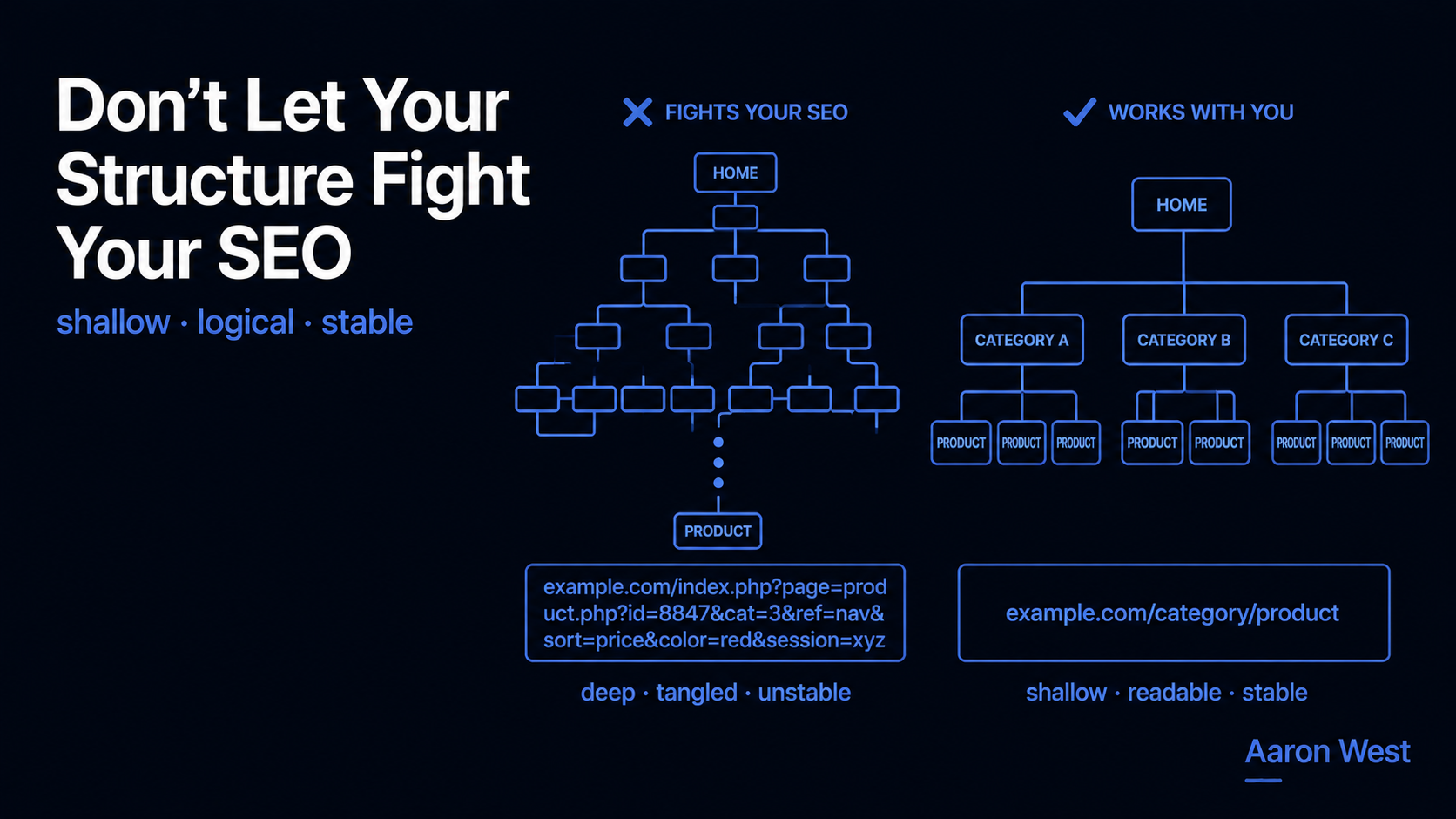
Site Architecture and URL Structure That Doesn't Fight Your SEO
Site architecture is how your pages are organised and linked together, and URL structure is the addresses that result from it. Together they decide how easily both people and search engines can understand and navigate your store. Good architecture is shallow, logical, and stable: important…
Continue reading...
Why Your Product Images Are Slowing Down Your Conversion Rate
The single biggest thing slowing down your online store is almost certainly the very thing you put there to sell the product: the images. On a typical e-commerce page, images make up more than half of everything the browser has to download, and unoptimised product…
Continue reading...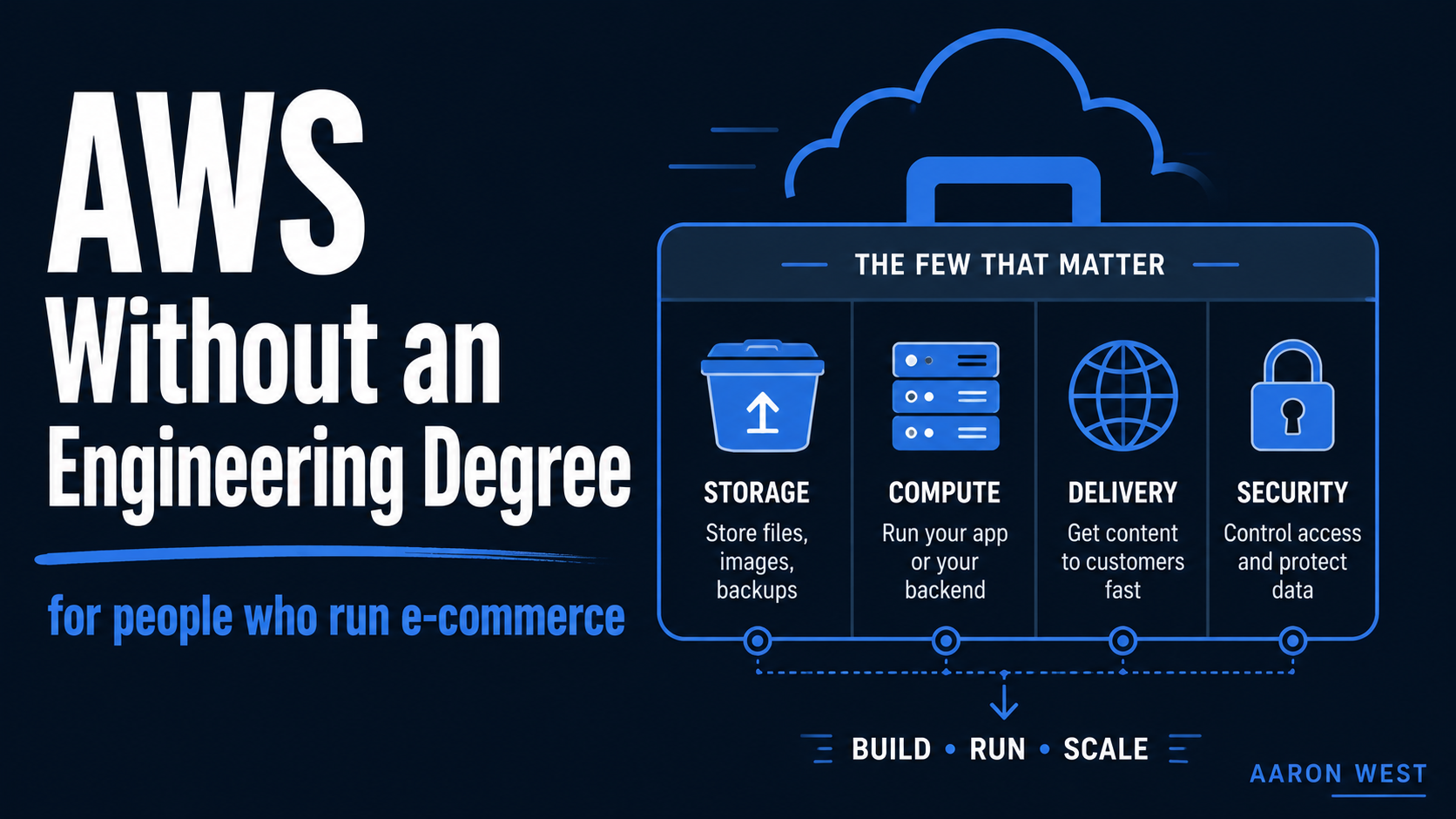
The E-Commerce Manager's Guide to AWS Without an Engineering Degree
You do not need to understand all of AWS. You need to understand maybe six services and one mental model, and that is enough to make good decisions, ask the right questions, and stop nodding along blankly when your developers or a vendor start talking…
Continue reading...