Gift Cards Are a Cash-Flow and Acquisition Tool, Not a Stocking Filler

Table of Contents
A gift card is two valuable things at once, and most stores treat it as neither. It is an interest-free advance, a customer paying you today for something you deliver later, and it is a customer-acquisition tool, because the person who redeems it is often someone who has never bought from you before. Sell it as a seasonal afterthought, a box you tick in December, and you leave both of those on the table.
This sits under the AOV anchor, which mapped the moves stores use to grow a basket. The gift card is the move that grows something else: your cash position and your customer base. Here is the honest case for taking it seriously all year, the one trap to avoid, and why a redemption should be treated as the start of a relationship rather than the end of a transaction.
What a gift card actually is
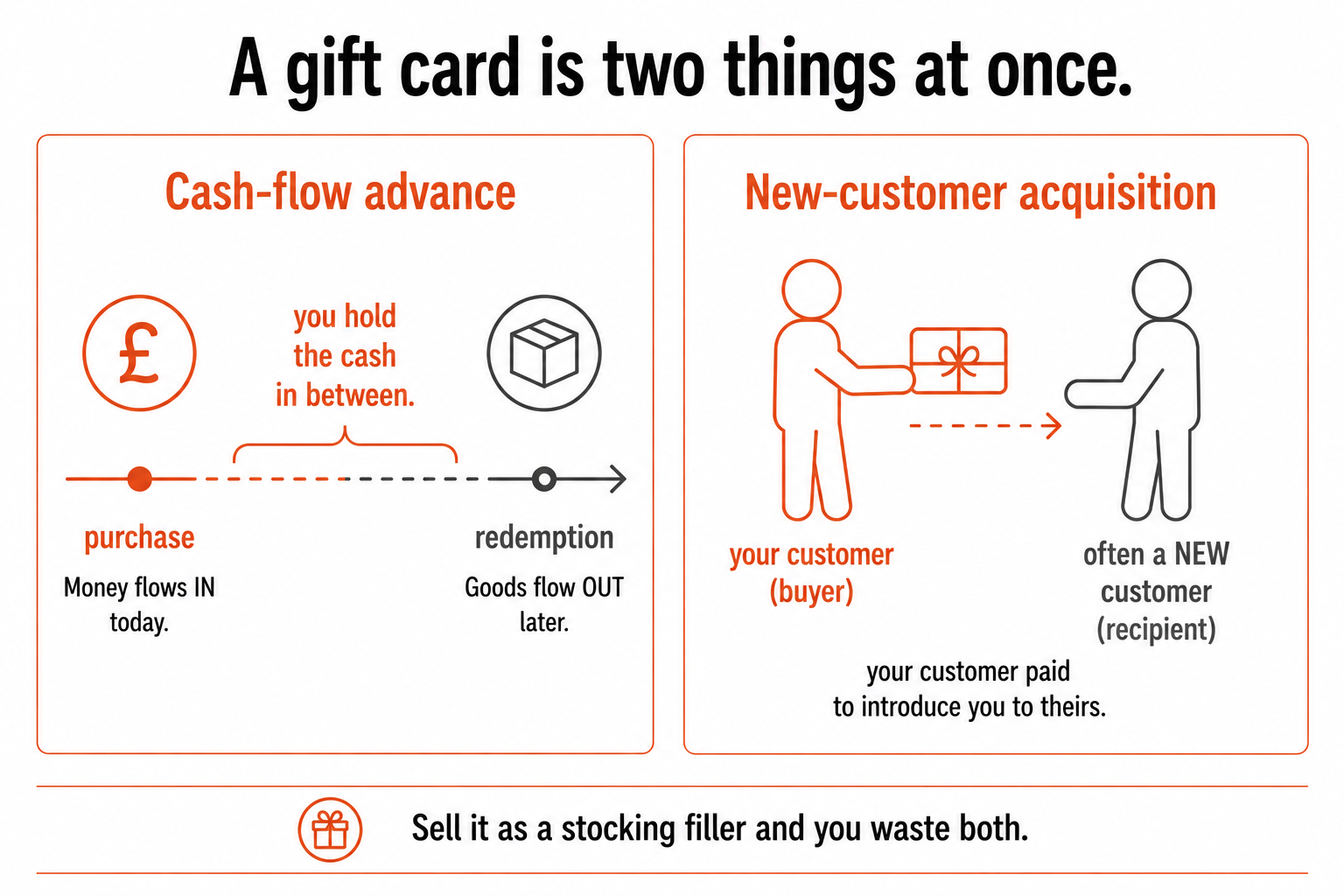
Strip away the wrapping and a gift card is a very old, very good piece of financial design. Someone gives you money now. You owe them goods later. In between, you are holding cash you have not yet had to deliver anything for.
That gap is the first source of value, and it is pure cash flow. The money lands in your account at purchase. The cost of fulfilling it lands whenever the card gets redeemed, which might be weeks or months later, and sometimes never. For a seasonal business, that timing is a gift in itself: cards bought in December against goods shipped in January and February smooth out the cliff that every retailer feels after the holidays.
The second source of value is quieter and bigger. A gift card almost always involves two people: the buyer and the recipient. The buyer is your existing customer. The recipient frequently is not. So one of your customers has just paid you to introduce you to someone new. That is acquisition, and the giver covered the cost.
The acquisition angle most stores ignore
Think about what happens when a card gets redeemed. A new person arrives at your store holding store credit they did not pay for, with a reason to spend it. They are about as warm as a first-time visitor ever gets.
Two things tend to follow. First, people rarely redeem a card for exactly its value. They find something they want, it costs a little more than the balance, and they top up the difference from their own pocket. The card becomes the floor of the order, not the ceiling. Second, and more important, that redemption is a first purchase. And a first purchase, as the CRM cornerstone argues, is the hardest one to get and the one that makes every future purchase likelier.
So the question a serious store asks is not "how many gift cards did we sell." It is "what happened to the people who redeemed them." If a redeemer arrives, spends their balance, and is never heard from again, you treated an acquisition like a transaction. The redemption is the moment to capture the relationship, the same way you would treat any first purchase as the start of something, not the end.
The trap: never build a strategy on breakage
Here is where gift cards tempt people into a bad idea. Some portion of card value never gets redeemed. The industry word for it is breakage, and on a spreadsheet it looks like free money: you took the cash and never had to ship anything.
Resist building anything on it. There are two reasons, one practical and one about who you want to be.
The practical reason: the rules on gift-card expiry and unredeemed balances are not yours to set freely. In many countries, including Germany, vouchers cannot simply expire whenever it suits you, and unredeemed balances can carry legal obligations. This varies by jurisdiction and none of it is legal advice, so the real instruction is to check your local rules before assuming an unused card is yours to keep.
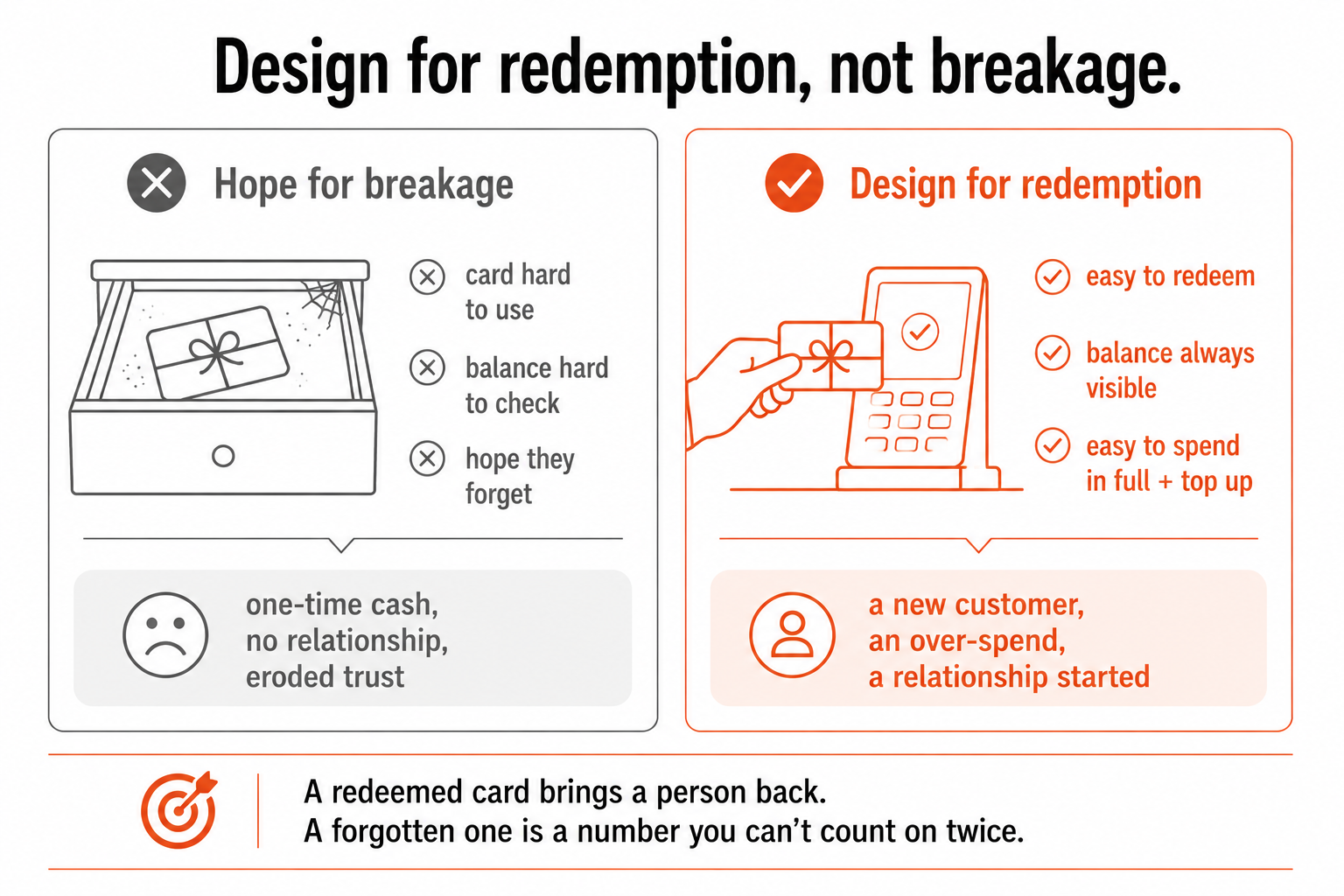
The reason that matters more: designing for breakage means designing for your customers not to get what they paid for. That is the opposite of how a brand earns trust. A business that quietly hopes you forget your balance is a business that has stopped competing on value. Design for redemption. Make the card easy to use, easy to find the balance, easy to spend in full and a little beyond. A redeemed card is worth more to you than a forgotten one, because a redeemed card brings a person back. A forgotten one just brings a one-time number you cannot count on twice.
Where stores get the execution wrong
The strategy is simple. The execution is where the value leaks. The common mistakes are easy to name and easy to fix:
- Hiding the gift card. If it only appears on a seasonal landing page in November, you have told customers it is a December product. It should be findable year-round, because gift-giving happens year-round: birthdays, thank-yous, apologies, "I don't know what they want."
- No digital option. A physical card has shipping time and shipping cost, and it cannot be bought at 11pm for a birthday tomorrow. A digital card delivered by email captures the last-minute buyer, who is one of the most common gift-card buyers there is.
- Friction in redemption. Every extra step between holding a card and spending it is a chance to give up. This is the same logic as the rest of the checkout: make the path obvious or lose people on it.
- Treating redemption as the finish line. The redeemer spent their balance and left. You captured a sale and missed a customer.
None of these need a clever tool. They need someone to decide the gift card is a real product with a real job, not a seasonal decoration.
What a gift card is actually for
A gift card is a customer paying you in advance and handing you a new customer at the same time. The cash helps your cash flow. The recipient grows your base. The redemption is a first purchase you should build on. The only way to waste all three is to treat the card as a stocking filler, sell it once a year, hope a few go unused, and never look at who walked through the door holding one.
Sell it as what it is, and a gift card stops being a seasonal nicety and becomes one of the few products in your store that pays you before you have done any work, and brings someone new while it does.
A few common questions
Do gift cards make money even when they're fully redeemed? Yes, and this is the point most people miss. The value is not only in unredeemed cards. A fully redeemed card still gave you the cash in advance, often brought a new customer (the recipient), and frequently led to an order larger than the card's value because people top up the difference. The redemption is where the relationship can start.
Should I rely on unredeemed cards (breakage) as profit? No. Treat it as an occasional accounting reality, never a strategy. Rules on expiry and unredeemed balances vary by country and can carry legal obligations (this is not legal advice, check your jurisdiction), and designing for customers not to use what they paid for erodes trust. Design for redemption instead.
Digital or physical gift cards? Offer both, but make sure digital exists. Digital cards capture the last-minute and remote buyer, cost nothing to deliver, and remove shipping friction. Physical cards still matter for in-person gifting and for people who want something to hand over.
When should I promote gift cards? Year-round, with a lift around obvious gifting seasons. Gifting is not only a December event. Birthdays, occasions, and "I don't know what to get them" happen every month, and a card that is easy to find all year sells all year.