Video and UGC: The Content That Actually Converts

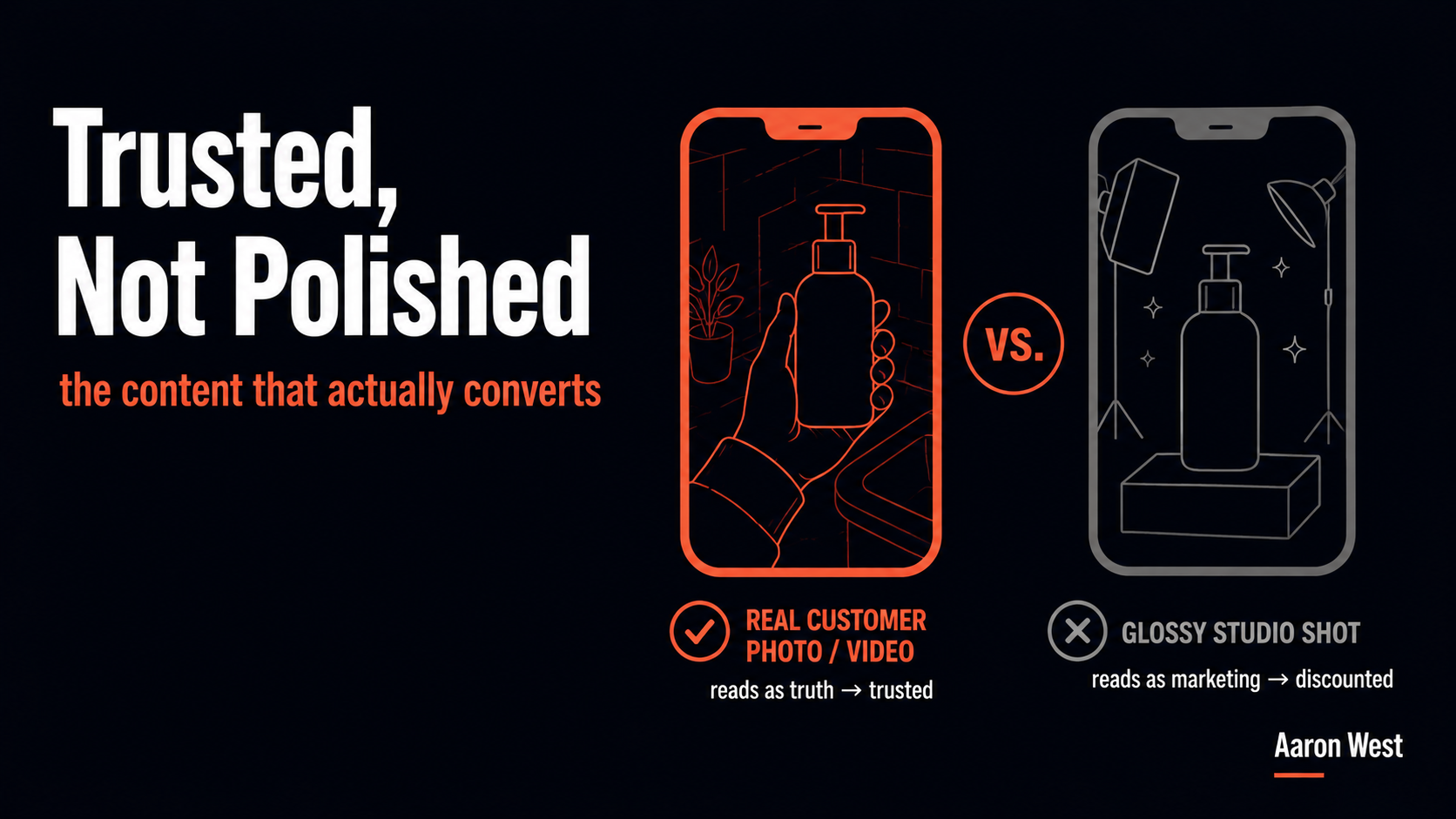
Table of Contents
Video and user-generated content convert better than polished brand content for one reason: they carry a trust and concreteness your own marketing can't manufacture. Customers believe other customers, and believe seeing a product in real use, far more than they believe a brand describing itself. Which is why, for content that actually converts, authenticity beats polish, and the instinct to make everything more professional is often the thing making it convert less.
This is a core of the Content & Organic Marketing pillar, under the cornerstone that content is an owned asset. The cornerstone was about content's job. This piece is about the two formats that do the conversion job best, and why they're the ones brands most often get wrong.
Why video and UGC convert
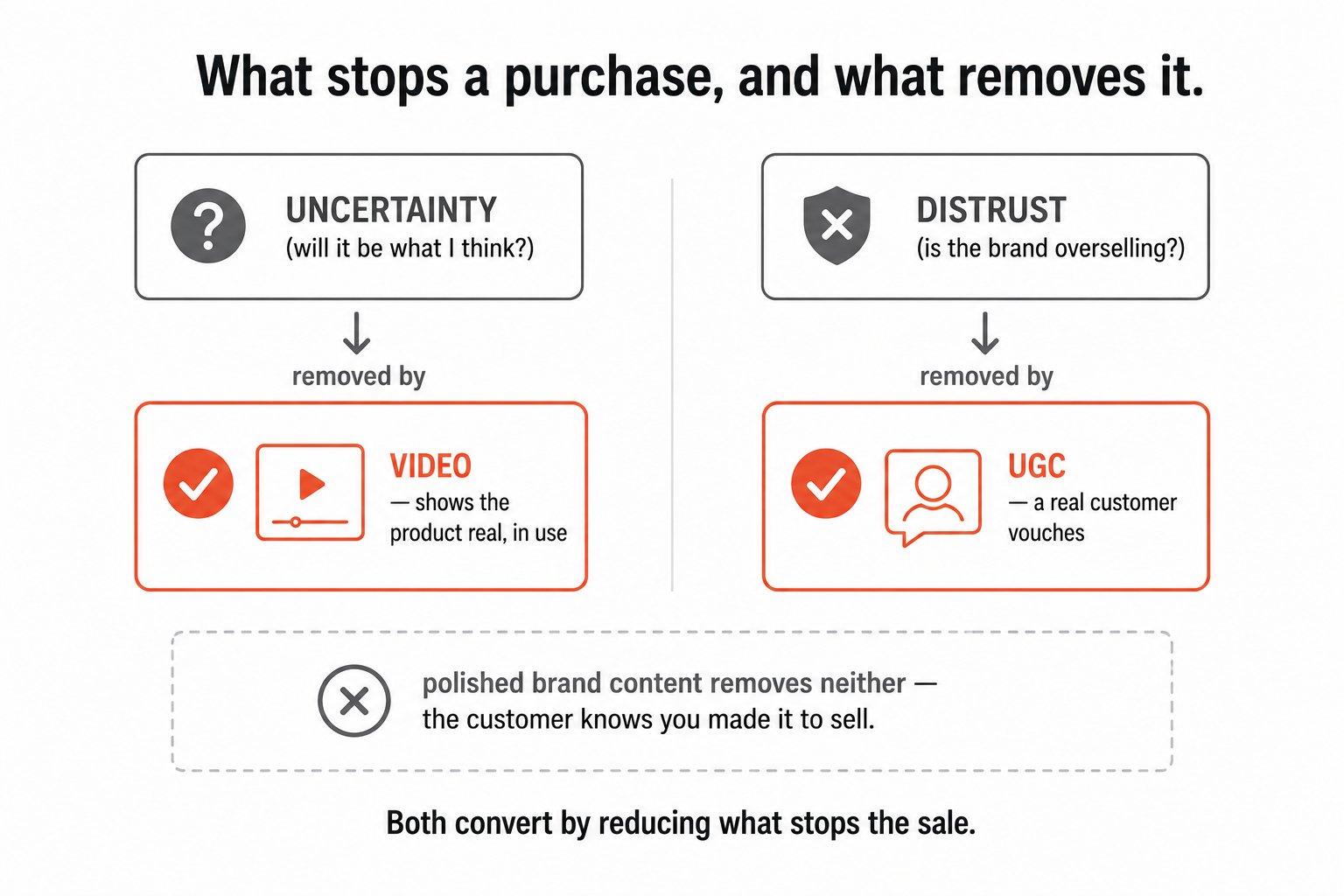
Two things stop a purchase: uncertainty (will this actually be what I think it is?) and distrust (is the brand overselling me?). Video and UGC each dismantle one of them in a way polished brand content can't.
Video reduces uncertainty by showing the product real, in use, from the angles and in the context a static image and a paragraph of copy never can. UGC reduces distrust by letting other customers vouch, which lands completely differently from the brand vouching for itself. Polished brand content does neither well, not because it's bad, but because the customer knows you made it to sell them something, and discounts it accordingly. The formats that convert are the ones the customer doesn't have to discount.
Authenticity beats polish
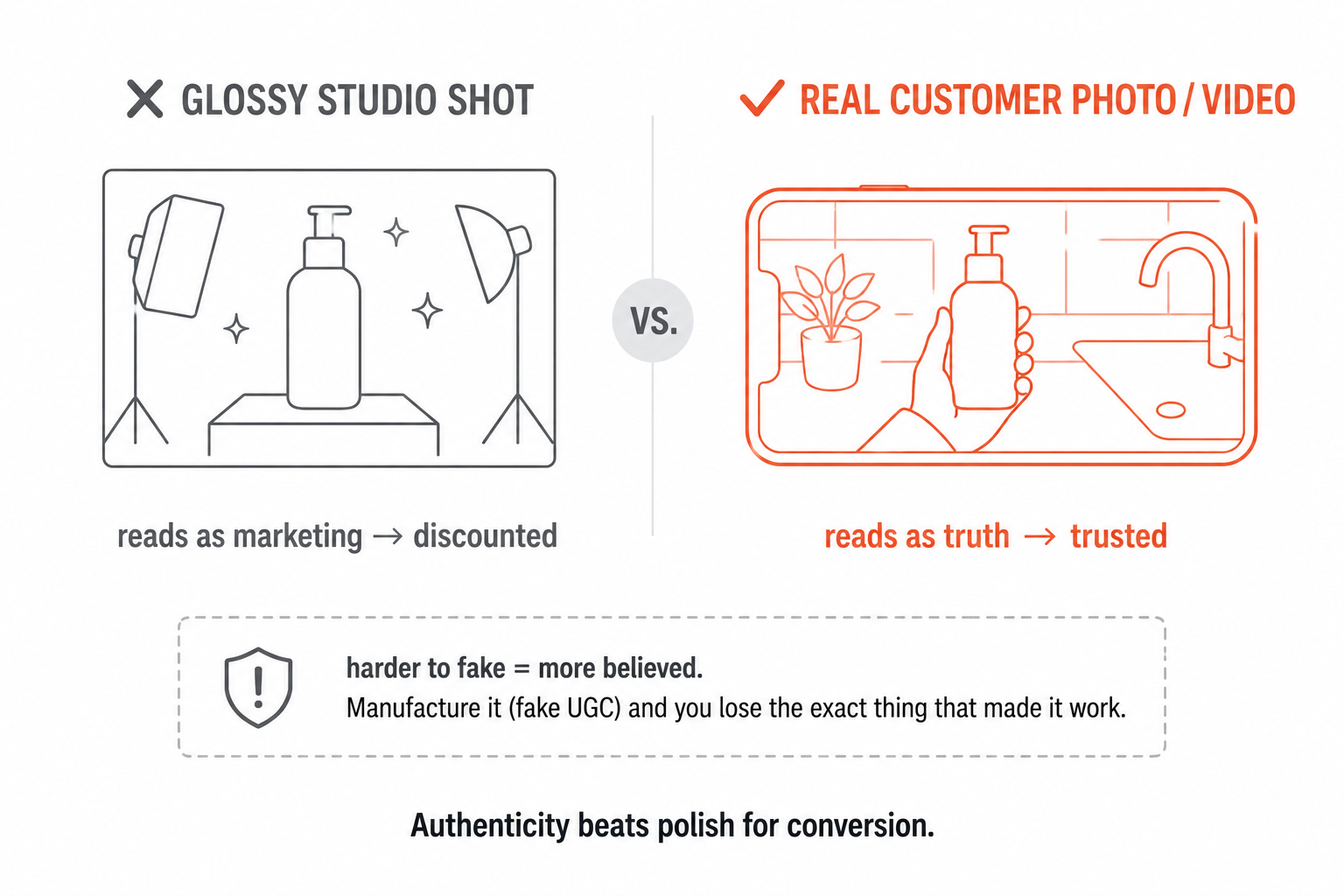
Here's the counterintuitive core, and it runs against every instinct a brand team has. The instinct is to invest in higher production: better cameras, cleaner sets, more professional everything. But for conversion, a slightly rough, real video or a genuine customer photo often beats a glossy studio shot, because polish reads as marketing and authenticity reads as truth. The shinier it looks, the more the customer's guard goes up, because they know who paid for the shine.
So the move isn't to out-produce. It's to out-authentic. The content that converts looks like it could have been made by a real person who actually used the thing, because that's exactly what makes it believable. This is hard for brands to accept, because authenticity means letting go of polish and control, the two things a marketing team is trained to maximise, which is precisely why the content that converts is so often the content nobody in the brand team would have signed off on.
Video: show the product working
The highest-converting video usually isn't an ad. It's the product demonstrated, in use, doing the thing the customer is trying to picture, at the angles, scale, and context a product image and a description can't fully convey. It answers the questions the product page leaves open: how big is it really, how does it move, what does it look like on a real person or in a real room, how does it actually work.
That does two jobs at once. It lifts conversion by removing the uncertainty that causes hesitation, and it reduces returns by setting an accurate expectation, the "not what I expected" return often traces straight back to a product the customer couldn't properly see before buying. A good demonstration video is the closest a customer gets to holding the product before it arrives, which is exactly why it converts and why it prevents the disappointed return.
UGC: borrow real customers' trust
User-generated content, customer photos, reviews, videos, unboxings, carries the credibility of a peer rather than a seller, and that's its whole power. It's the reviews and social-proof lever in a richer, more visual form: "here's what it actually looks like on a real person, in a real home, used by someone like me" is more persuasive than any brand shot, because the customer trusts the source. You didn't make it, which is exactly why it's believed.
The practical work is to make it easy for customers to create it, then curate and surface it near the decision, on the product page, beside the buy button, where the doubt peaks. UGC converts because it's not you saying it, so the goal is to collect and showcase the genuine article, not to imitate it.
The honesty mechanism (and its trap)
Here's why both formats work, stated plainly: they're harder to fake than a brand claim. A real customer's slightly imperfect photo signals "this is real" precisely because a brand wouldn't have produced it that way, and the difficulty of faking it is what makes it trusted. The authenticity isn't a nice side-effect; it is the conversion mechanism.
Which sets the trap. The moment you manufacture it, fake UGC, staged "authenticity," influencer content dressed up as a candid customer, you destroy the exact thing that made it work, and you take on real risk, because audiences are good at spotting it and the trust damage when they do is worse than never having tried. You can't fake your way to authenticity; the faking is self-defeating by definition. Collect the real thing, make more of it possible, and resist the urge to polish it back into marketing.
Where it fits, and why it's high-leverage
Video belongs on the product page, where it dispels purchase uncertainty at the decision. UGC belongs as social proof near that same decision. And both are unusually high-leverage because they do double duty in the content-as-asset sense: one genuine customer video can sit on the product page, anchor a social post, and feed an ad, converting in one place and distributing in another. Content that both converts and travels is the most efficient content there is, and video and UGC are the formats most likely to do both.
What this comes down to
The content that converts isn't the most polished; it's the most trusted, and trust comes from concreteness and authenticity, not production value. Video shows the product real enough to dispel the doubt that stops a purchase and the mismatch that causes a return. UGC lets other customers vouch in a way you never credibly could for yourself. Both work because they're harder to fake than a brand claim, which is also why faking them destroys them.
So stop trying to out-produce your customers' trust in each other. You can't win that contest with a bigger budget, the glossier you make it, the more it reads as the marketing customers discount. Borrow the trust instead: show the product working, surface the real customers, and resist the urge to polish the believability out of it.
A few common questions
Why do video and UGC convert better than polished brand content? Because they remove the two things that stop a purchase: uncertainty and distrust. Video reduces uncertainty by showing the product real and in use, from angles and context a static image can't convey. UGC reduces distrust by letting other customers vouch, which lands completely differently from a brand vouching for itself. Polished brand content does neither well, because the customer knows you made it to sell them something and discounts it accordingly.
Isn't more professional content always better? Not for conversion. A slightly rough, real video or a genuine customer photo often beats a glossy studio shot, because polish reads as marketing (the customer's guard goes up) while authenticity reads as truth (they trust it). The move isn't to out-produce, it's to out-authentic, content that looks like it was made by a real person who actually used the thing, because that's what makes it believable. This is hard for brands because authenticity means letting go of polish and control.
How does video reduce returns, not just lift conversion? By setting an accurate expectation. A demonstration video shows the product's real size, movement, and context, the closest a customer gets to holding it before it arrives, so they buy knowing what they're getting. The "not what I expected" return often traces straight back to a product the customer couldn't properly see beforehand, so a good video both lifts conversion (removes hesitation) and prevents the disappointed return (removes the expectation gap).
Can I create UGC myself if I don't have enough? No, manufacturing it is self-defeating. UGC works because it's harder to fake than a brand claim, a real customer's imperfect photo signals "this is real" precisely because a brand wouldn't have made it that way. Fake UGC or staged "authenticity" destroys the exact thing that made it work, and audiences are good at spotting it, with serious trust damage when they do. The right move is to make it easy for real customers to create content, then curate and surface the genuine article near the buying decision.
You should also read:
Content Marketing for E-Commerce That Isn't a Blog Nobody Reads
Most e-commerce content marketing fails for one reason: it's a blog nobody reads. Content produced because "we should have a blog," disconnected from the business, ranking for nothing and selling nothing. Content marketing isn't producing content; it's building an owned audience and an authority asset…
Continue reading...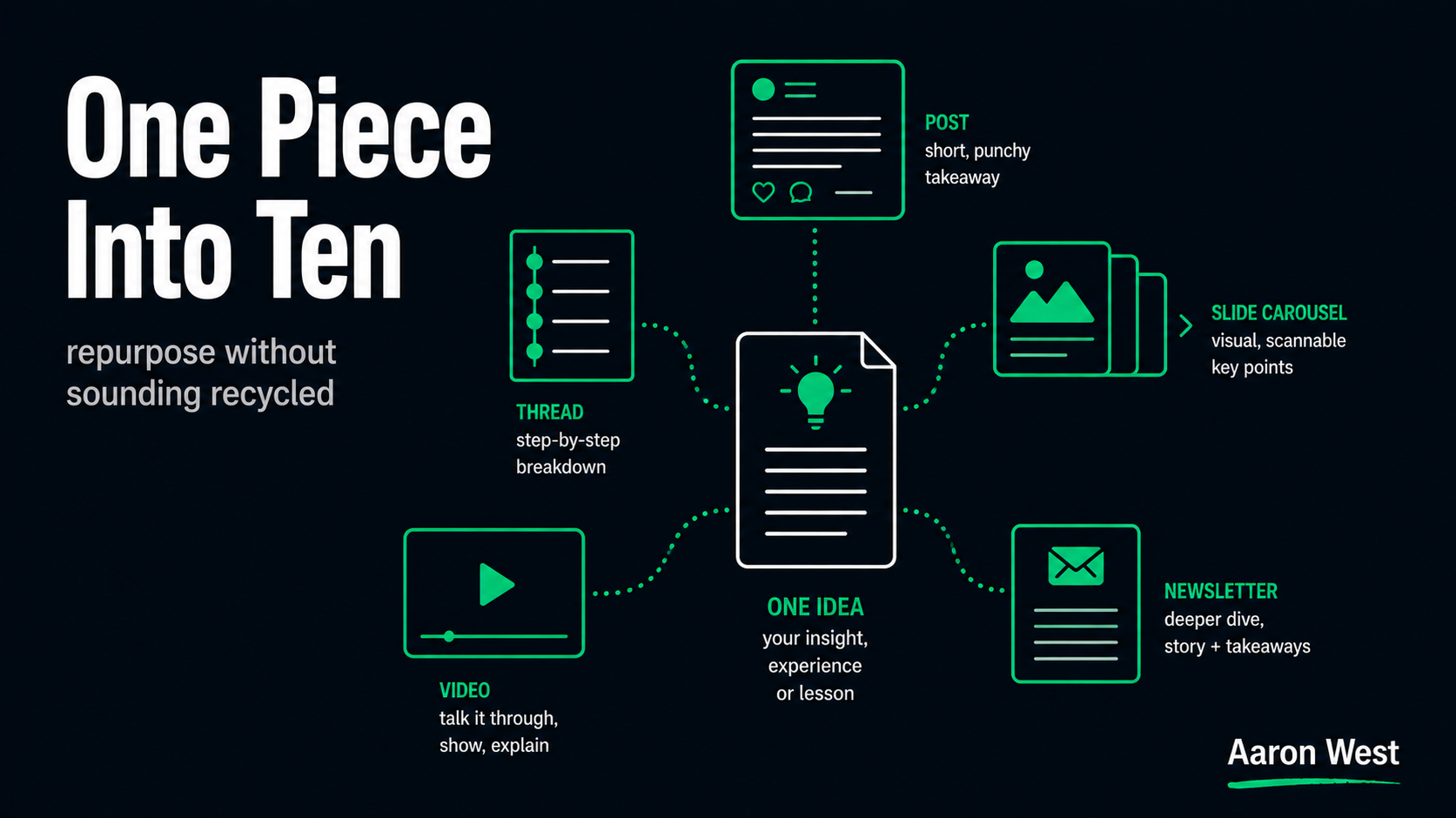
How I Use AI to Turn One Piece of Content Into Ten (Without It Sounding Recycled)
The promise of AI content repurposing is seductive: write one thing, turn it into ten, flood every channel. The reality is that most people do it badly, and badly here has a specific, recognisable shape, they take one post and paste a near-identical version onto…
Continue reading...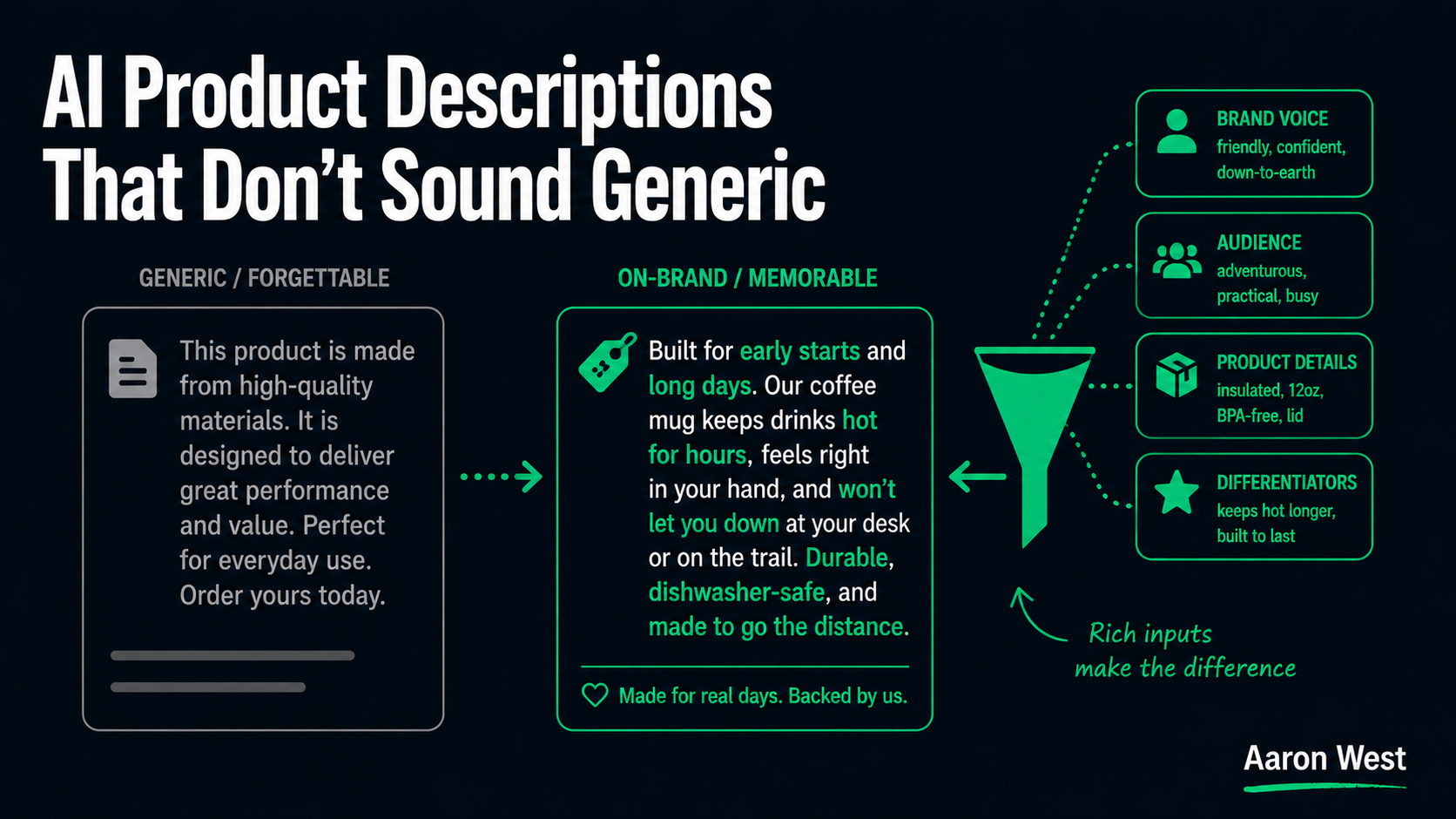
AI for Product Descriptions That Don't Sound Generic
The most common complaint about AI-written product descriptions is that they all sound the same, bland, interchangeable, like they could describe any product from any store. The complaint is fair, and here is the part nobody selling AI tools wants to say plainly: when AI…
Continue reading...