Peak Season Readiness: The Prep That Decides Your Biggest Quarter

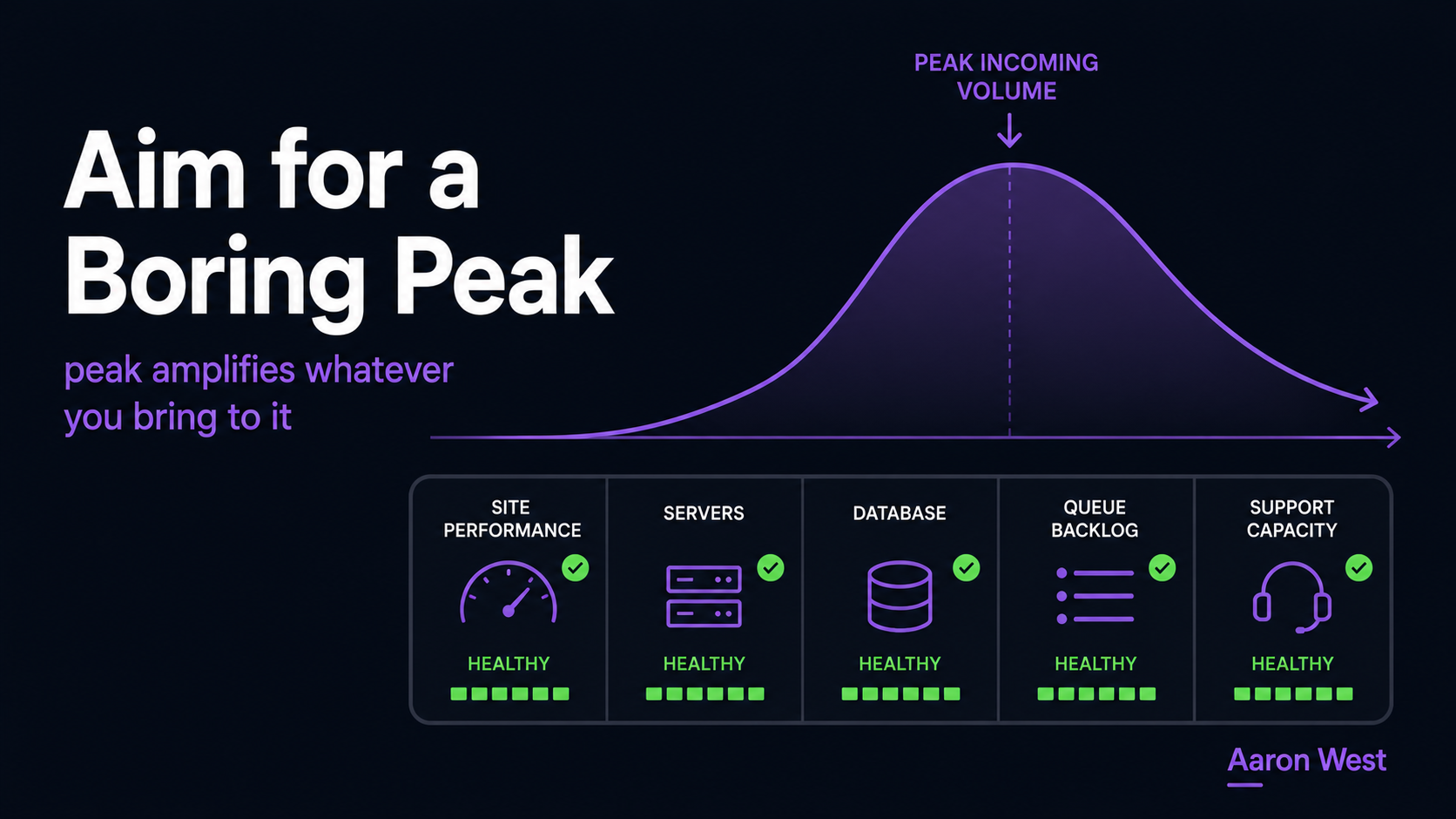
Table of Contents
Peak season isn't won during peak; it's won in the weeks of preparation before it. Black Friday, the holidays, whatever your spike is, peak is when every weakness in your operation gets amplified by volume at the worst possible moment, and you can't repair foundations while the flood is arriving. The goal of good preparation is a boring peak: everything you'd otherwise panic about was already handled in advance.
This closes the Operations, Scaling & Seasonality pillar, under the cornerstone about scaling without the chaos. Peak is where the cornerstone's lesson gets tested hardest: peak amplifies exactly whatever operation you bring to it.
Peak is won before it starts
The instinct is to treat peak as a sprint, a stretch you power through with heroics, long hours, and caffeine. But by the time peak arrives, the outcome is mostly already decided by the preparation. You cannot build capacity, fix the slow page, document the returns process, or train the support team while ten times your normal volume is hitting you. There's no time, and any change made under that pressure is itself a risk.
So the work is front-loaded or it doesn't happen. The quiet weeks before peak are when the quarter is actually won or lost, which is the opposite of how it feels, since nothing dramatic is happening yet. The drama comes later, and whether it's good drama (records) or bad drama (firefighting) was largely determined before it started.
Peak amplifies whatever you bring to it
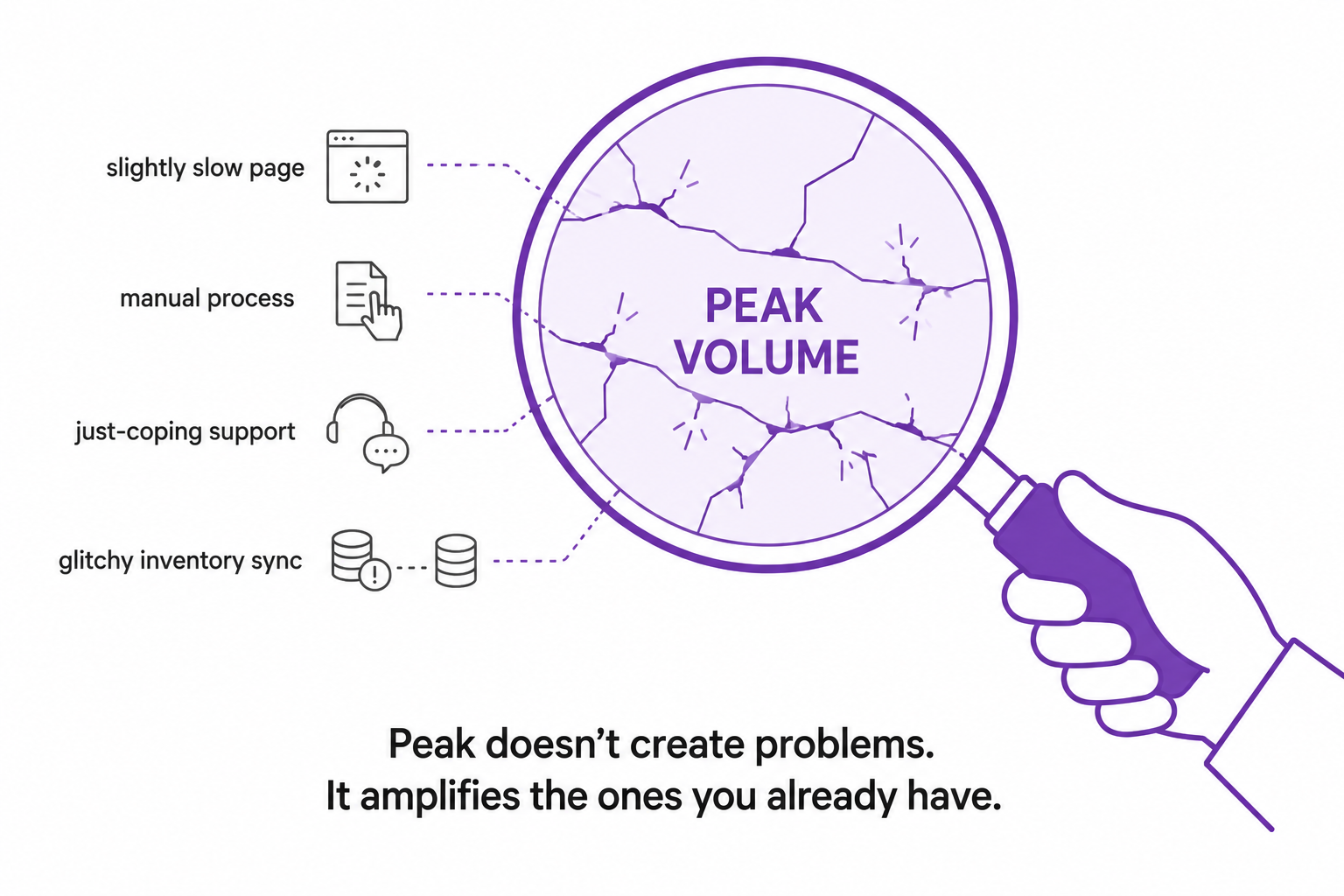
Here's the core principle, straight out of the scaling cornerstone: peak doesn't create new problems, it amplifies the ones you already have. Every weakness that's survivable at normal volume becomes acute under load:
- The slightly-too-slow page becomes a conversion disaster when traffic spikes.
- The manual process that's "fine" at normal volume collapses at ten times the orders.
- The support team that's just-coping drowns.
- The inventory sync that occasionally glitches oversells your hero product on the single biggest day of the year.
A calm, systematised operation gets busier at peak and holds. A chaotic one breaks. Peak is a magnifying glass held over your operation, and it magnifies the cracks just as faithfully as the strengths. Which means peak prep is really just the scaling work, done with a deadline.
The preparation, concretely
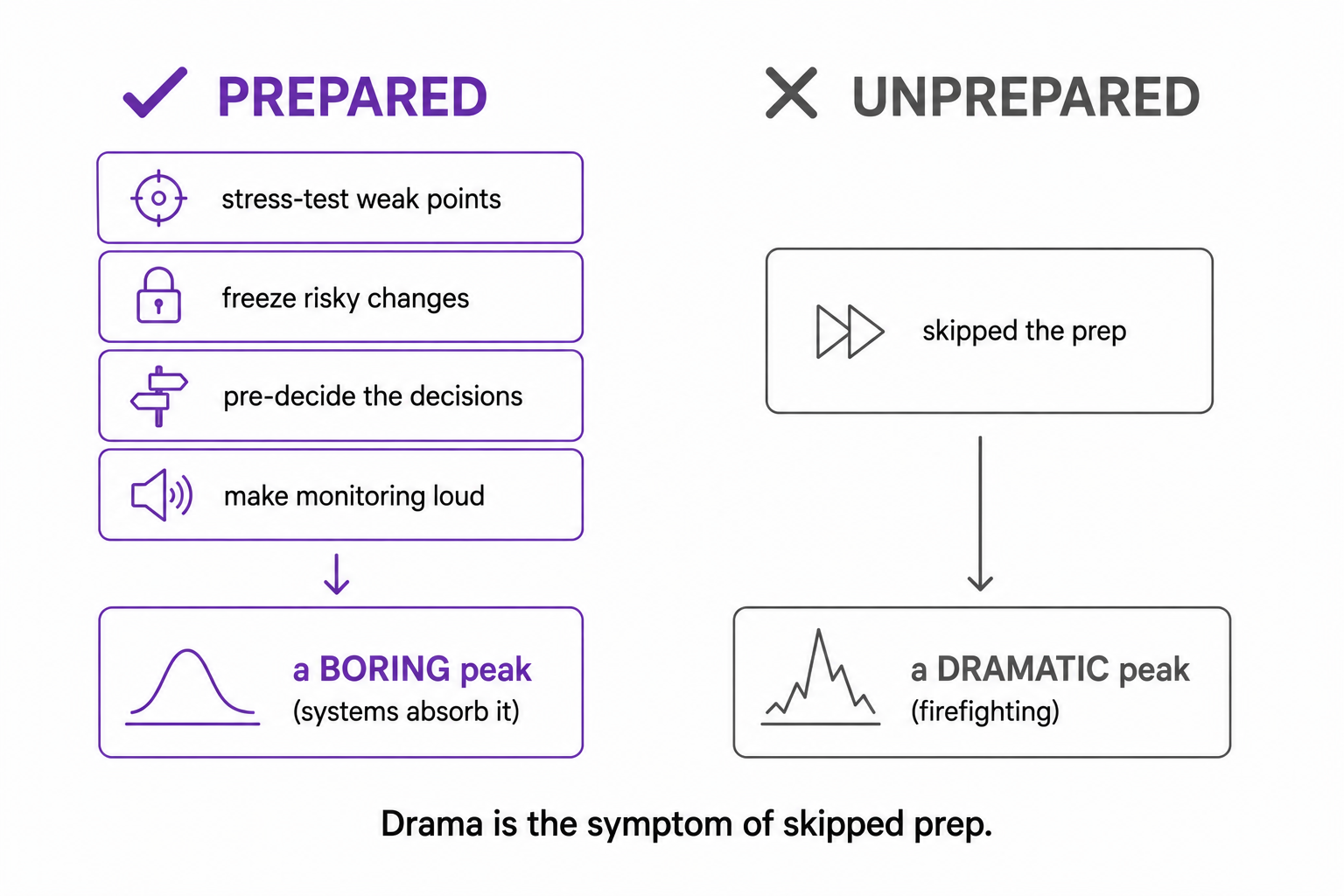
Good peak prep isn't vague "get ready." It's four specific kinds of work, done in advance:
- Stress-test the weak points before peak, not during. Find where the operation strains under high volume while you still have time to fix it: site speed and capacity, inventory accuracy and the risk of overselling, fulfilment throughput, support capacity. Look for the breaking points deliberately, in advance, rather than discovering them live on your biggest day.
- Freeze risky changes. Peak is not the time to launch the redesign, swap the payment provider, or deploy the big architectural change. Stability beats cleverness when the stakes are highest. Put a change-freeze in place before peak and resist the urge to ship anything risky into it.
- Pre-decide the decisions. Decide now, calmly, what happens when the hero product sells out, when the site slows under load, when support is overwhelmed, when a key supplier slips. A decision made in advance beats the same decision made in a panic at 2am, when judgment is worst and the cost of a wrong call is highest.
- Make the monitoring loud. At peak, a silent failure is catastrophic, because the volume compounds the damage fast and you're far too busy to be checking things manually. Ensure your systems will tell you immediately when something breaks. The error notification matters most precisely when nobody has spare attention to notice a problem the old way.
None of this is glamorous, and all of it is what separates a record peak from a broken one.
Don't forget the tail
Peak doesn't end when the sale does. The spike is followed by a tail, the returns wave, the support backlog, the fulfilment catch-up, and an operation that prepared only for the spike gets caught out by the aftermath. A surge of orders becomes a surge of returns and questions a few weeks later, and that wave lands on the same team that just got through the first one. Prep includes readiness for the tail, not only the peak itself, because a botched post-peak experience sours all the customers your peak just won.
Aim for a boring peak
Here's the reframe that should guide all of it: the best-run peak is anticlimactic. The team isn't heroically firefighting; the systems are absorbing the volume, the pre-made decisions are simply being executed, and the monitoring is quiet because things are working. Nobody's improvising, because everything that could be decided in advance was.
A dramatic peak, the all-hands panic, the 3am scramble, the "we nearly lost it" war story, is usually a sign of bad preparation, not bad luck. The war stories are fun to tell afterward, but they're evidence of work that should have happened earlier. Aim for boring. On the biggest day of your year, boring is the highest compliment your operation can earn.
What this comes down to
Peak season is a stress test you prepare for, not a sprint you power through, and it amplifies whatever operation you bring to it. The work that decides your biggest quarter happens in the quiet weeks before: stress-testing the weak points, freezing risky changes, pre-deciding the decisions, and making sure the monitoring will shout before a small failure becomes a big one. Then bracing for the tail that follows the spike.
Everyone obsesses over peak-season marketing, the deals, the campaigns, the countdown, and underinvests in peak-season operations, which is exactly backwards: the marketing drives the volume that lands on the operation, and if the operation buckles, the marketing just succeeded at breaking your own store. The deal you can't fulfil, on the page that won't load, is worse than no deal. Prepare the operation, and let peak be boring.
A few common questions
When is peak season actually won? In the weeks of preparation before it, not during. By the time peak arrives the outcome is mostly determined, because you can't build capacity, fix a slow page, or train a support team while ten times your normal volume is hitting you. The work is front-loaded or it doesn't happen. The quiet weeks before peak are when the quarter is won or lost, which is the opposite of how it feels, since nothing dramatic is happening yet, the drama comes later, and which kind it is was largely decided in advance.
Why does peak season break some operations and not others? Because peak amplifies whatever you bring to it rather than creating new problems. A slightly slow page becomes a conversion disaster under load, a manual process that's fine at normal volume collapses at ten times the orders, a glitchy inventory sync oversells your hero product on the biggest day. A calm, systematised operation gets busier and holds; a chaotic one breaks. Peak is a magnifying glass over your operation, so peak readiness is really just the scaling work done with a deadline.
What should peak preparation actually involve? Four things, done in advance: stress-test the weak points (site speed, inventory accuracy, fulfilment throughput, support capacity) while there's still time to fix them; freeze risky changes (peak is not the time to launch a redesign or swap a payment provider); pre-decide the decisions (what happens when the hero product sells out, the site slows, support is overwhelmed); and make the monitoring loud so systems tell you immediately when something breaks, since you'll be too busy to check manually. And prepare for the post-peak tail of returns and support, not just the spike.
What does a well-run peak look like? Boring. The team isn't heroically firefighting; the systems are absorbing the volume, the pre-made decisions are simply being executed, and the monitoring is quiet because things are working. A dramatic peak, the all-hands panic, the 3am scramble, is usually a sign of bad preparation rather than bad luck. The war stories are fun to tell but they're evidence of work that should have happened earlier. On the biggest day of your year, an anticlimactic peak is the highest compliment your operation can earn.
You should also read:
Processes and SOPs: The Boring Backbone of a Store That Scales
The standard operating procedure, the written-down "here's exactly how we do this," is the least glamorous and most underrated tool in e-commerce operations. It's what turns knowledge trapped in one person's head into something the whole team can do reliably and repeatedly, without that person,…
Continue reading...
Why Your Product Images Are Slowing Down Your Conversion Rate
The single biggest thing slowing down your online store is almost certainly the very thing you put there to sell the product: the images. On a typical e-commerce page, images make up more than half of everything the browser has to download, and unoptimised product…
Continue reading...
AI vs Machine Learning vs Deep Learning: The Distinction That Actually Matters
Artificial intelligence, machine learning, and deep learning are not three competing things you choose between. They are three nested ideas, each one a more specialised part of the one before it. AI is the big outer goal: machines doing things that would normally need human…
Continue reading...