The Hypothesis Comes Before the Test: Why Just Trying Stuff Isn't Experimentation

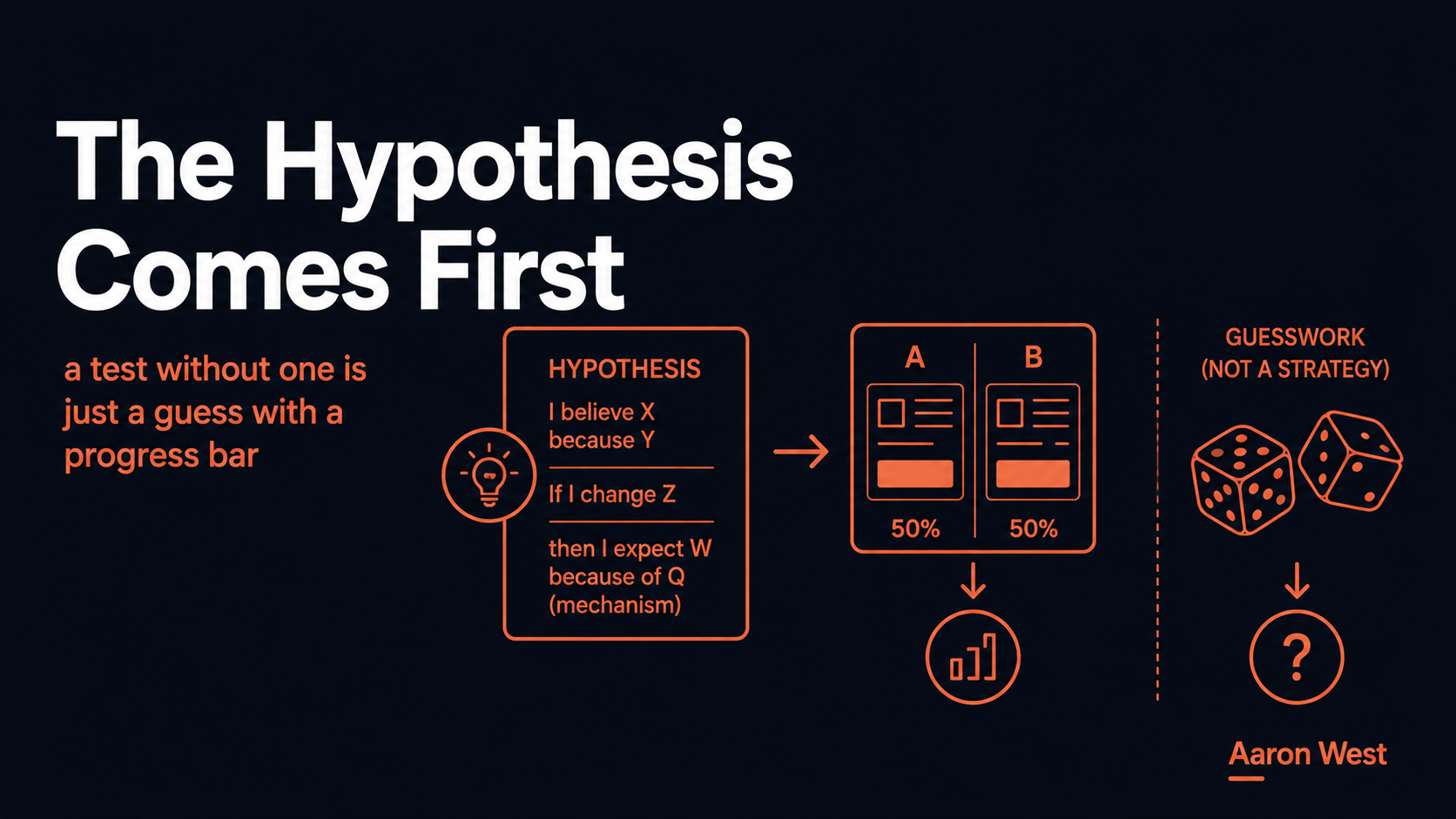
Table of Contents
Running an A/B test without a hypothesis isn't experimentation; it's gambling with extra steps. Without a hypothesis you can't learn anything you can reuse from the result, you just get a number you don't understand. The test isn't the experiment. The hypothesis is, because a real experiment starts with a belief and a reason, and that structure is what turns a result into learning instead of a one-off lottery win you can't explain or repeat.
This is a core of the Experimentation & CRO Methodology pillar, under the cornerstone that most of what you believe about your store is a guess. That piece said CRO is a way of thinking. This piece is about where that thinking actually lives: the hypothesis.
"Let's just try stuff" feels scientific, but isn't
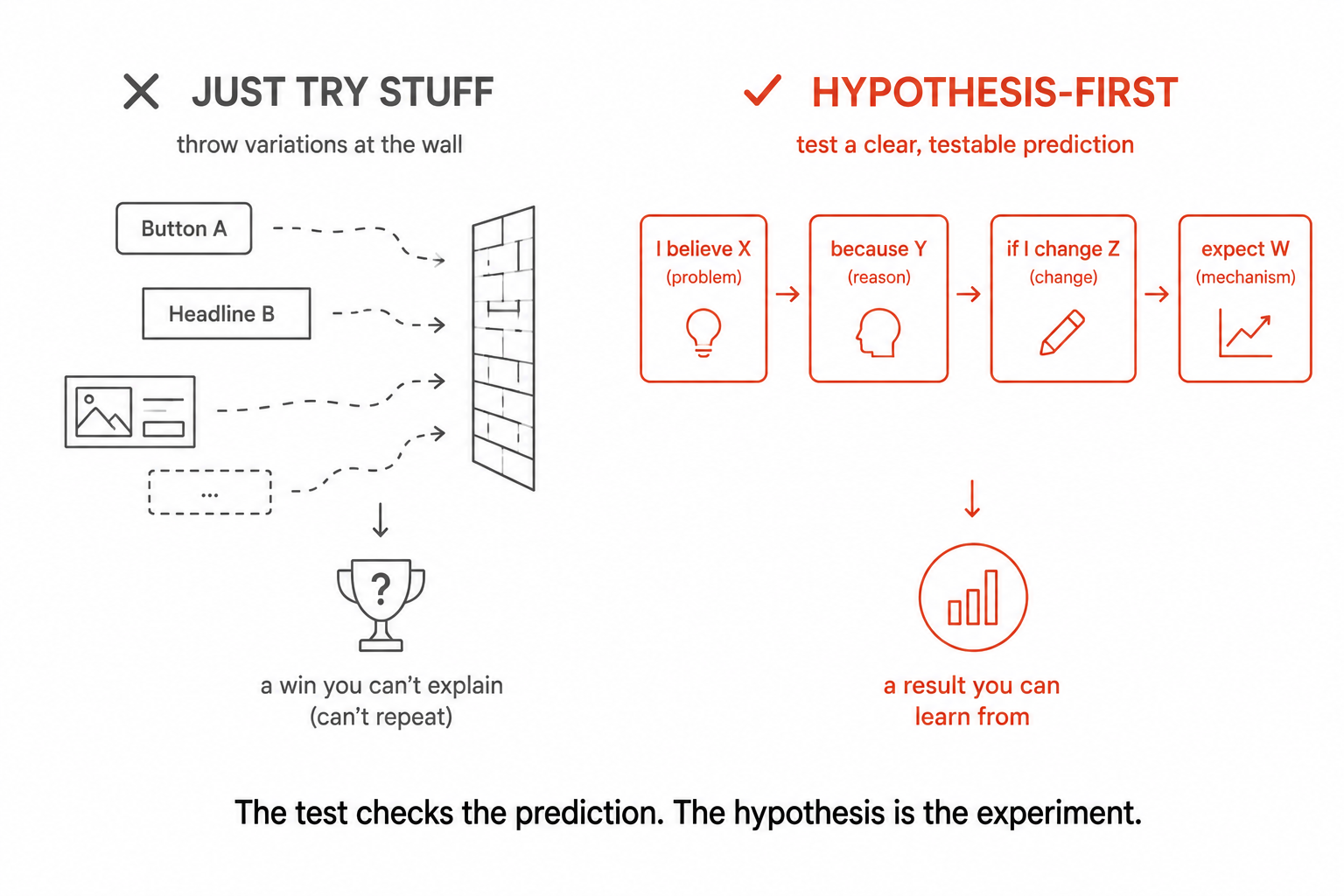
A great deal of what passes for testing is throwing variations at the wall. Try a green button. Try a different headline. Try moving the thing higher up. Keep whatever wins. It feels empirical, you're testing, you're being data-driven, you're letting the numbers decide. And it is almost entirely useless, because there's no hypothesis, which means the result teaches you nothing beyond that one specific case.
The tell is simple: when a "just try stuff" test wins, ask why it won. If the honest answer is "not sure, but version B got more conversions," you've learned nothing you can use again. You have a number, not an insight. Experimentation that produces numbers without understanding isn't experimentation; it's slot-machine product development with a dashboard attached.
The hypothesis is the experiment
Here's the shift. A real experiment has a structure, and the structure is the whole value:
I believe [something about my customers], because [evidence or reasoning], so if I change [this specific thing], I expect [this specific, measurable outcome], because [this mechanism].
Notice what's being tested there. It isn't really the green button. It's your understanding of your customers, your belief that they behave a certain way for a certain reason. The variant is just the instrument you use to check the prediction. The hypothesis is the actual subject of the experiment, and the test is merely the question you put to reality.
That's why "the test isn't the experiment, the hypothesis is" isn't wordplay. The test is a mechanical thing a tool runs. The experiment, the part that produces knowledge, is the belief you committed to before you looked, and the prediction you made from it. No hypothesis, no experiment, just a measurement of something you didn't have a theory about.
Why the hypothesis turns a result into learning
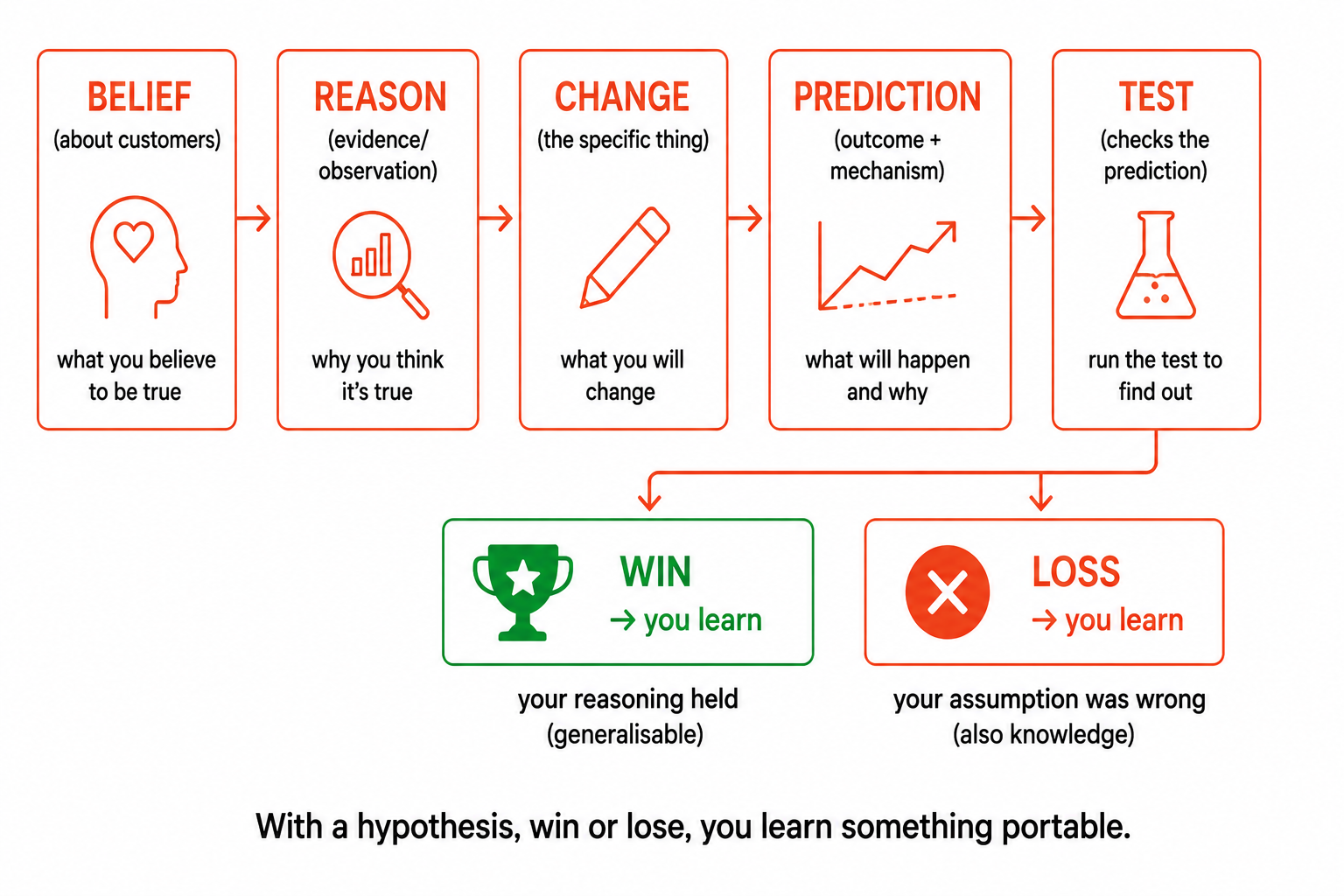
This is the practical payoff, and it works whether the test wins or loses. With a hypothesis, the result teaches you about your reasoning, not just the variant. Say you predicted that simplifying the checkout would lift conversion, because you'd observed customers abandoning at a confusing step. If it wins, you didn't just learn "version B won", you learned something generalisable: customers here respond to reduced friction at decision points, an insight you can now apply across the whole store. The win came with an explanation, and the explanation is the part that transfers.
Without the hypothesis, that same winning test teaches you only "version B got more conversions this once." A fact about one button, one time, that you can't extend, can't explain, and can't fully trust. The hypothesis is what makes the knowledge portable, what lets one test improve your understanding of everything else, rather than just settling one isolated question and leaving you exactly as ignorant about the next one.
The wins you can't explain are a trap
It's tempting to think an unexplained win is still a win, you got more conversions, who cares why. But an unexplained win is a trap. You can't repeat it, because you don't know what actually caused it. You can't build on it, because you don't understand the mechanism. And worst of all, you'll often misattribute why it won, "the green button worked, so let's make everything green", and confidently apply the wrong lesson everywhere, doing damage in the name of a result you misread. An unexplained win is barely distinguishable from luck, and luck doesn't accumulate into the customer understanding that the cornerstone called the real prize.
A hypothesis even makes a loss valuable
Here's the part that surprises people: a hypothesis makes a losing test valuable too. If your reasoning was sound, you predicted simplifying the form would help because customers seemed to struggle with it, and the test came back flat or negative, then you've learned something real: your assumption about your customers was wrong. They weren't actually struggling with the form, or the friction wasn't where you thought. That's genuine knowledge that sharpens your next hypothesis.
Without a hypothesis, a loss is just "version B didn't win", a dead end that teaches you nothing and sends you back to randomly trying things. With a hypothesis, even the losses pay you in understanding. Which means a well-designed experiment can't really fail to teach you something, win or lose, it updates your model of your customers. That's the difference between a programme that compounds and one that just churns out disconnected results.
What a good hypothesis actually needs
A usable hypothesis isn't elaborate, but it needs real parts, and "let's see what happens" has none of them:
- A belief about your customers, what you think is true of how they behave.
- A reason for the belief, ideally grounded in something real: your analytics, observed behaviour, a pattern you've seen. This is where looking at your data before testing matters, the reason is what stops the hypothesis being just another guess.
- A specific change, the thing you'll alter.
- A specific predicted outcome and a mechanism, what you expect to happen and why.
Compare the two: "let's try a shorter address form and see what happens" is not a hypothesis. "Customers abandon at the address form because it's long and repetitive, so shortening it should reduce abandonment at that step" is. The second one can be learned from. The first one can only be observed.
What this comes down to
The test isn't the experiment; the hypothesis is. "Let's just try stuff and keep what wins" feels like experimentation but produces wins you can't explain and losses you can't learn from, which is to say it produces almost no knowledge at all, just a stream of disconnected numbers and the illusion of being data-driven. It's the CRO-as-thinking discipline failing at the first step, because the thinking is supposed to live in the hypothesis, and there isn't one.
Start with a belief and a reason. Predict a specific outcome and a mechanism. Then the result, win or lose, teaches you something portable about your customers, and that accumulated understanding is the entire point of testing in the first place. Skip the hypothesis and you haven't run an experiment. You've just guessed, slowly, with a progress bar.
A few common questions
Why isn't "just trying things and keeping the winners" real experimentation? Because without a hypothesis the result teaches you nothing beyond that one case. The tell: when a "just try stuff" test wins, ask why it won, and if the honest answer is "not sure, but version B got more conversions," you have a number, not an insight. You can't repeat it (you don't know the cause), can't build on it, and will often misattribute why it won and apply the wrong lesson everywhere. It feels empirical and data-driven, but it's closer to slot-machine product development with a dashboard attached.
What makes the hypothesis "the experiment" rather than the test? Because what you're actually testing is your understanding of your customers, your belief that they behave a certain way for a certain reason, and the variant is just the instrument you use to check that prediction. The test is a mechanical thing the tool runs; the experiment, the part that produces knowledge, is the belief you committed to before looking and the prediction you made from it. No hypothesis means no experiment, just a measurement of something you didn't have a theory about.
How does a hypothesis turn a result into learning? It makes the result teach you about your reasoning, not just the variant. If you predicted that simplifying the checkout would lift conversion because you'd seen customers abandon at a confusing step, a win teaches you something generalisable (customers here respond to reduced friction) that you can apply elsewhere, and a loss teaches you that your assumption was wrong, which sharpens your next hypothesis. Either way the knowledge is portable. Without the hypothesis, the same test only tells you "version B won once," a fact you can't extend, explain, or fully trust.
What does a good hypothesis need to contain? Four things: a belief about your customers, a reason for it (grounded in your analytics or observed behaviour, not a hunch), a specific change you'll make, and a specific predicted outcome with a mechanism. "Let's try a shorter form and see what happens" has none of those and can only be observed. "Customers abandon at the address form because it's long, so shortening it should reduce abandonment there" has all of them and can be learned from. The reason is what stops the hypothesis being just another guess.
You should also read:
Experimentation and CRO: Most of What You Believe About Your Store Is a Guess
Most of what you believe about your store is a guess. Most e-commerce decisions are made on opinion, intuition, or copying competitors, and experimentation, A/B testing and structured conversion-rate optimisation, is the discipline of replacing those guesses with evidence about what actually works on your…
Continue reading...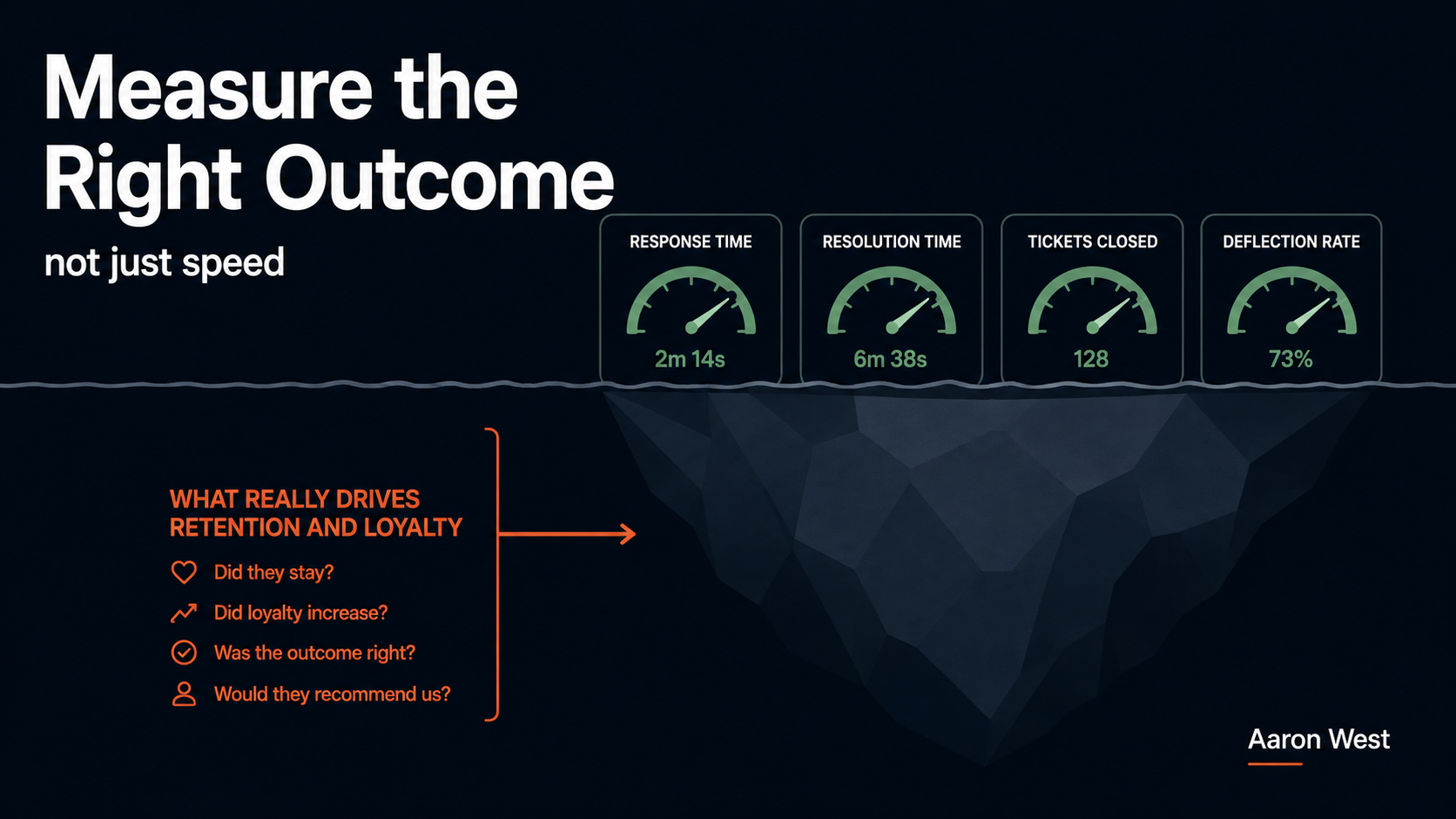
Support Metrics: Measure the Right Outcome, Not Just Speed
Most support metrics measure speed and cost: response time, average handle time, tickets closed per hour, SLA hit-rate, cost per contact. They're popular because they're easy to count and they roll up into tidy dashboards. The problem is that they reward the wrong behaviour. They…
Continue reading...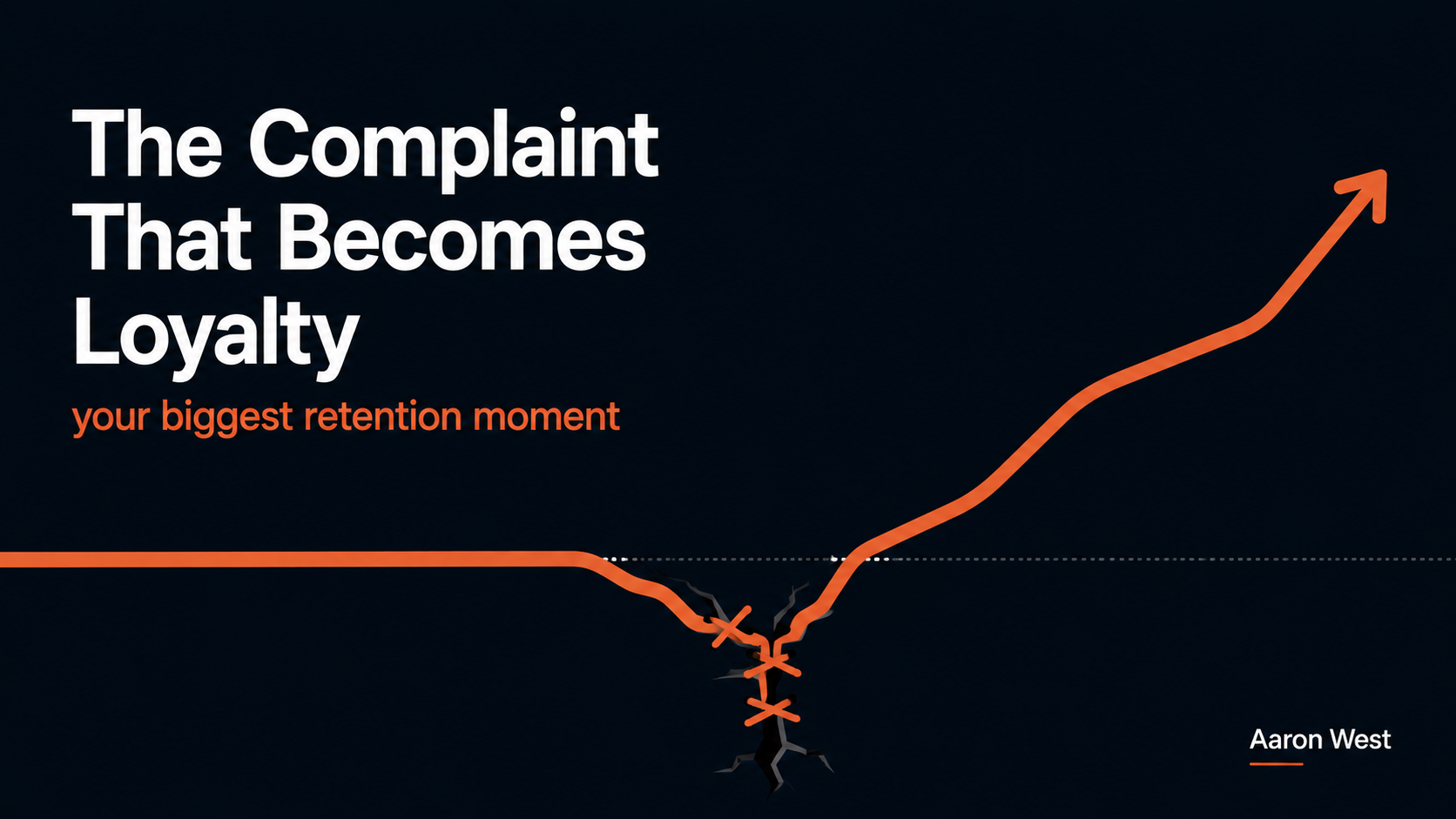
The Complaint That Becomes Loyalty
A complaint, handled well, can leave a customer more loyal than if nothing had gone wrong at all. That's the most counterintuitive and most useful fact in customer service: the moment something breaks is the moment you have the customer's full attention and your biggest…
Continue reading...