Support Metrics: Measure the Right Outcome, Not Just Speed

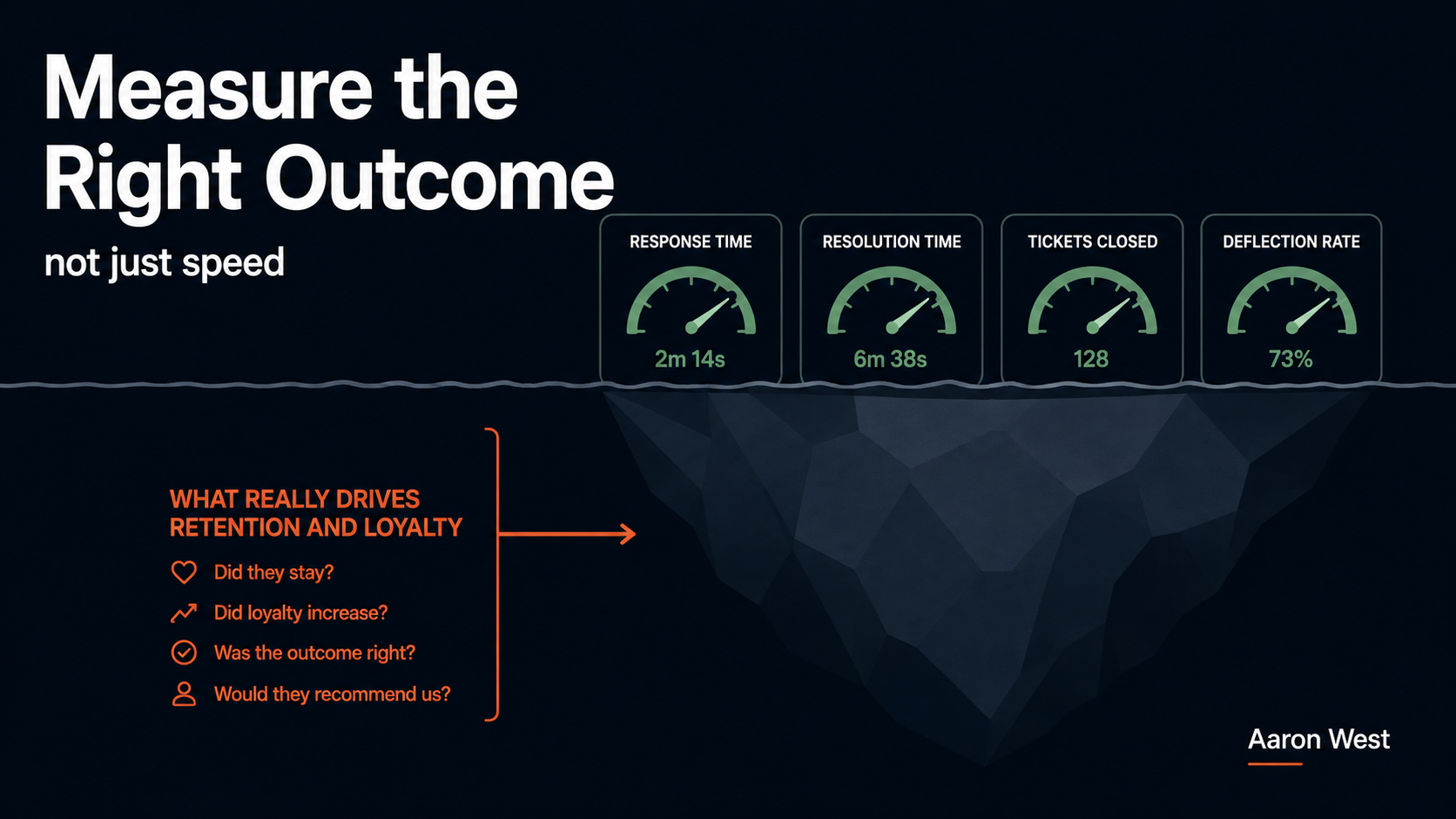
Table of Contents
Most support metrics measure speed and cost: response time, average handle time, tickets closed per hour, SLA hit-rate, cost per contact. They're popular because they're easy to count and they roll up into tidy dashboards. The problem is that they reward the wrong behaviour. They reward closing the ticket fast, not solving the customer's problem, and those are not the same thing. The metric that actually matters is the outcome: did the issue get resolved, and did the interaction strengthen the relationship or damage it.
This is a core of the Customer Service pillar, and it's the cornerstone's central warning made concrete. If support is a retention channel and you optimise for whatever you measure, then measuring only speed and cost will steer you, efficiently and confidently, away from retention. Here's how the standard metrics distort behaviour, and what to measure instead.
Why support defaults to speed and cost
The metrics support teams live by are almost all about how quickly and cheaply tickets move: how fast the first reply went out, how long the average contact took, how many were closed, whether the service-level agreement was hit, what each contact cost. They dominate because they're trivial to measure, they aggregate neatly across a team, and they fit perfectly inside the cost framing where support is an expense to shrink.
None of them is wrong to track. The problem is treating them as the goal rather than as constraints, because the moment a speed-or-cost number becomes the target, people optimise the number instead of the thing it was supposed to stand in for. This is just Goodhart's law in a support queue: when a measure becomes a target, it stops being a good measure, because everyone starts gaming the measure rather than pursuing the outcome it was a proxy for.
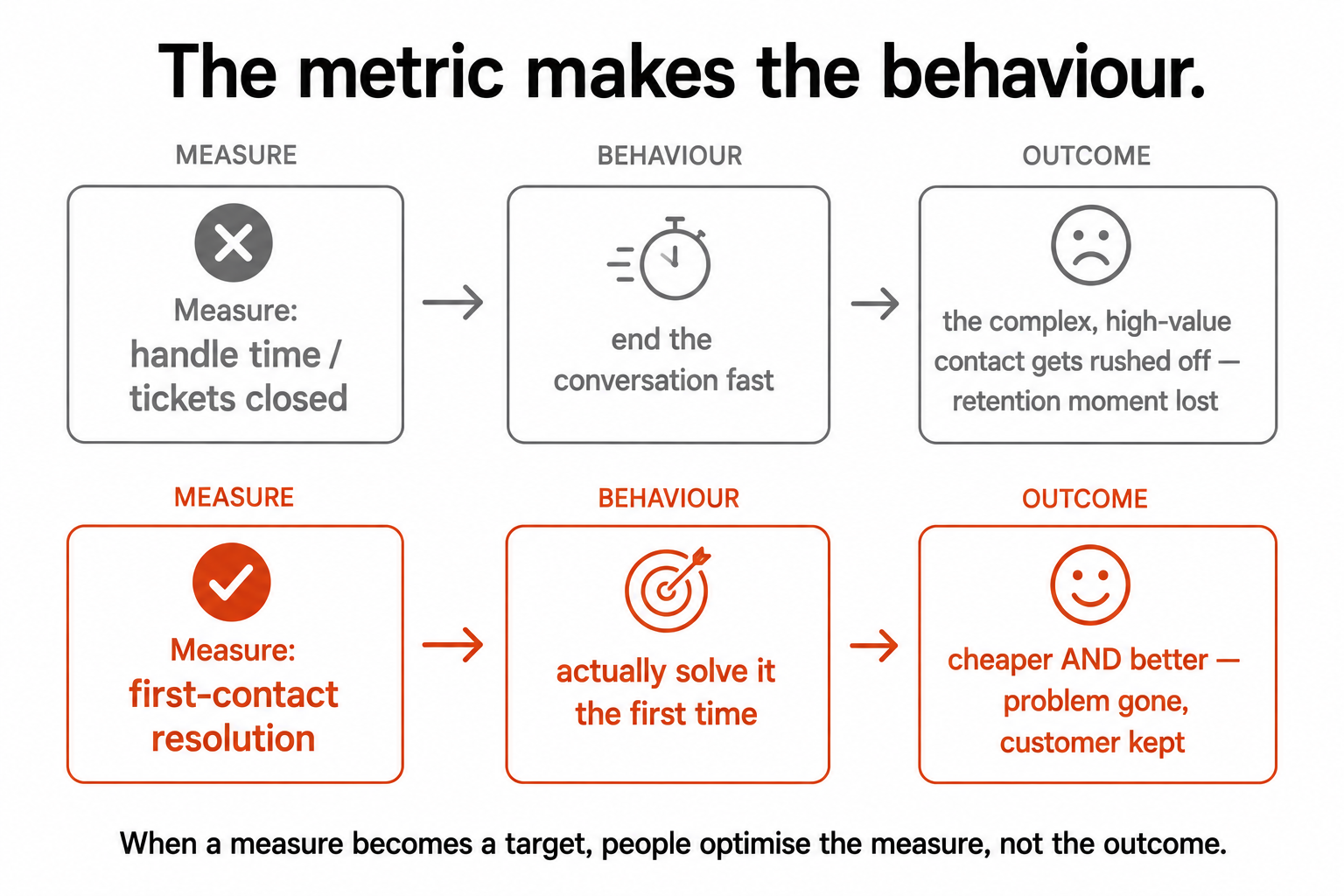
Watch what each one rewards once it's the target. Make average handle time the goal and agents learn to end conversations quickly, which means the customer with the genuinely complex problem, the retention moment from the cornerstone, gets rushed off the line. Make tickets-closed the goal and you get premature closes and reopen games. Make deflection rate the goal and you get the wall from self-service versus human support. Every one of these numbers, optimised, pushes the team toward looking efficient and away from actually helping.
The SLA trap
Service-level agreements deserve a special mention, because they're useful and dangerous in the same breath. An SLA, respond within an hour, resolve within a day, is genuinely valuable as a floor: a promise to the customer and a minimum standard for the team. The trouble starts when the floor quietly becomes a ceiling, and when hitting the SLA becomes the goal rather than a baseline.
The classic failure is the first-response SLA. "Acknowledge every contact within one hour" sounds customer-friendly, until it's gamed with an automated "we've received your message" that resets the clock and helps absolutely nobody. The metric goes green. The customer is no closer to a resolution. You've optimised the measurement and left the actual experience exactly where it was, or worse, because now the customer has had a hollow auto-reply instead of a real one. The SLA was met and the customer wasn't helped, and the dashboard cannot tell the difference.
That's the danger of any target: it's only ever a proxy, and a proxy under pressure gets satisfied in the cheapest way available, which is rarely the way that actually serves the customer. SLAs are worth having. They're just worth having as guarantees you keep, not scores you chase.
What's actually worth measuring
The good news is that better metrics exist, and they share one property: they're hard to game without genuinely helping the customer. That property is what you're looking for. Pick measures where the only way to make the number better is to actually do the thing support is for.
- First-contact resolution. Did the customer's problem actually get solved on the first interaction, not just answered or closed? This is the most useful metric in support because it aligns efficiency and quality: solving it once is cheaper for you and better for the customer. It's also hard to fake, since the giveaway, a repeat contact about the same issue, shows up on its own.
- Did it stay solved. Whether the same customer comes back about the same problem. A "resolution" that bounces back wasn't one. This catches the premature closes that ticket-count metrics reward.
- Relationship impact. Whether the contact made the customer more or less likely to stay. This is the retention link the cornerstone is built on, and it's where a satisfaction signal, used as a genuine read rather than a vanity score, earns its place.
- Cause data. What's actually generating the contacts. If the same complaint arrives a thousand times, that's not volume to process faster, it's a broken process pointing at itself, and fixing the cause does more for cost and retention than any handle-time improvement.
Notice that first-contact resolution quietly does the efficiency job too. Solving problems properly the first time is how you actually reduce volume and cost, far more durably than rushing people off the line, which just generates the repeat contact later. The outcome metric and the efficiency goal turn out to point the same way once you measure resolution instead of speed.
Use speed as a guardrail, not a goal
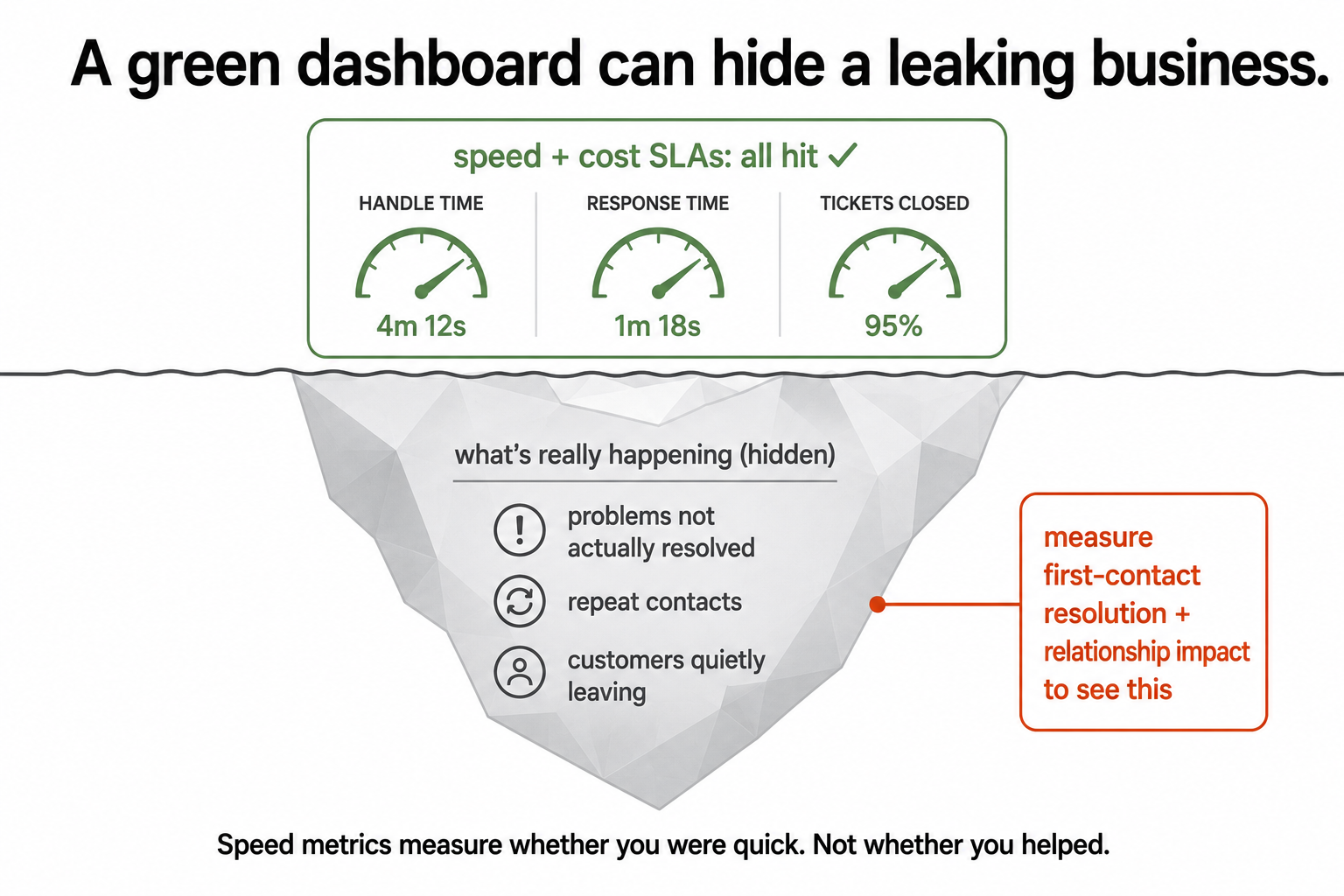
This isn't an argument to ignore speed. A customer left waiting in silence for two days is a real failure, and response time matters. The point is the role speed plays. Speed and cost are guardrails, constraints you respect so the experience doesn't fall below a floor, not the target you optimise toward. Fast and resolved is the goal. Fast but unresolved is failure wearing a green dashboard, and slow but resolved is usually better than fast but not.
The lived version of this is blunt: you can hit every SLA on the board and still lose customers, because the board measured whether you were quick, not whether you helped. I've watched teams celebrate a wall of green metrics while the thing those metrics were supposed to protect, customers staying, quietly eroded underneath, because nobody was measuring the only outcome that mattered.
So the discipline is to choose metrics that hurt to game. First-contact resolution is hard to improve without actually resolving things. Handle time is trivial to improve by rushing people. The first kind of metric makes your team better at the job; the second makes them better at the metric.
What this comes down to
A support dashboard full of green that measures only speed and cost is a machine for feeling efficient while losing customers. It tells you how quickly and cheaply you processed people, which is not the question. The questions that matter are whether the problem actually got solved and whether the customer is more or less likely to stay, and those are the numbers worth building your support operation around.
Measure the outcome, keep speed as a guardrail, and pick metrics where the only way to move the number is to genuinely help someone. Do that and your efficiency and your retention start pulling in the same direction instead of against each other, which is what good measurement is supposed to achieve in the first place.
A few common questions
What support metrics actually matter? The ones that measure outcomes rather than speed and cost: first-contact resolution (did it actually get solved the first time), whether it stayed solved (no repeat contact), the contact's impact on whether the customer stays, and cause data showing what's generating contacts. These share a useful property, they're hard to improve without genuinely helping the customer, unlike handle time, which is easy to improve by rushing people.
Are SLAs and handle-time targets bad? No, but they're guardrails, not goals. An SLA is valuable as a floor and a promise, and you don't want customers waiting in silence. The danger is making the target the objective, because then it gets gamed, like the automated "we received your message" that hits a first-response SLA while helping nobody. Respect speed as a constraint; optimise for resolution.
Why is first-contact resolution so important? Because it aligns efficiency and quality. Solving a problem properly the first time is cheaper for the business and better for the customer, and it's hard to fake, since a repeat contact about the same issue exposes a false resolution. Rushing people off the line to improve handle time just generates the repeat contact later, so measuring resolution reduces real cost more durably than measuring speed.
Can a support team hit all its targets and still be failing? Yes, easily. You can hit every speed-and-cost SLA on the board and still lose customers, because those metrics measure whether you were quick, not whether you helped. A wall of green can sit on top of unresolved problems, repeat contacts, and customers quietly leaving. That's why outcome and relationship measures matter: they reveal what the speed metrics hide.
You should also read:
Multilingual Support: The Reality Nobody Plans For
Supporting customers in multiple languages is not a translation problem. It's an operations problem. The naive version, translate your help articles and bolt machine translation onto the live chat, looks complete and breaks in ways that stay invisible right up until a frustrated customer is…
Continue reading...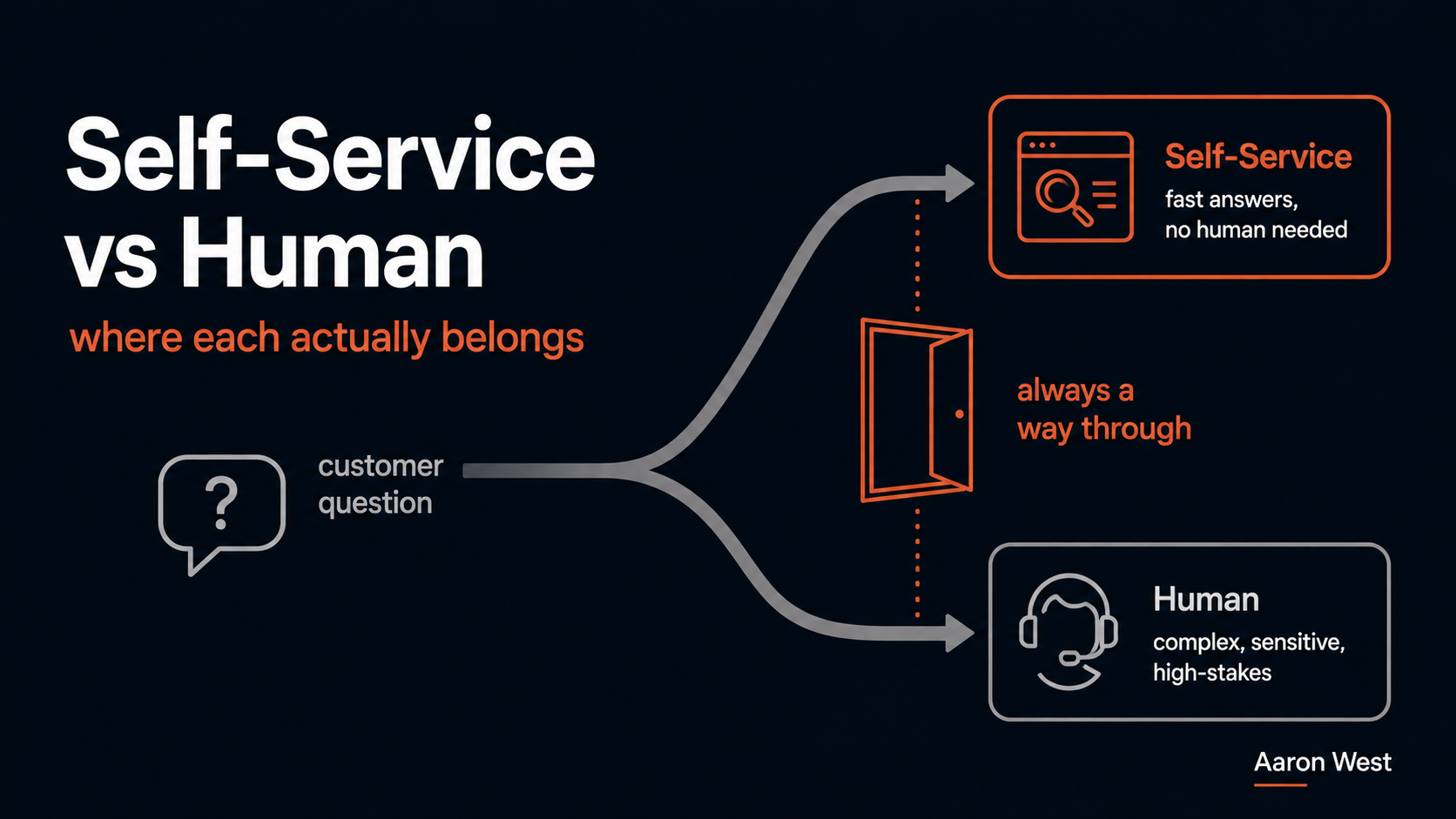
Self-Service vs Human Support: Where Each Actually Belongs
Self-service should handle the questions that don't need a human, so that humans are free for the ones that do. That's the whole rule, and almost every mistake in this area comes from breaking it in one of two directions: putting a human on work…
Continue reading...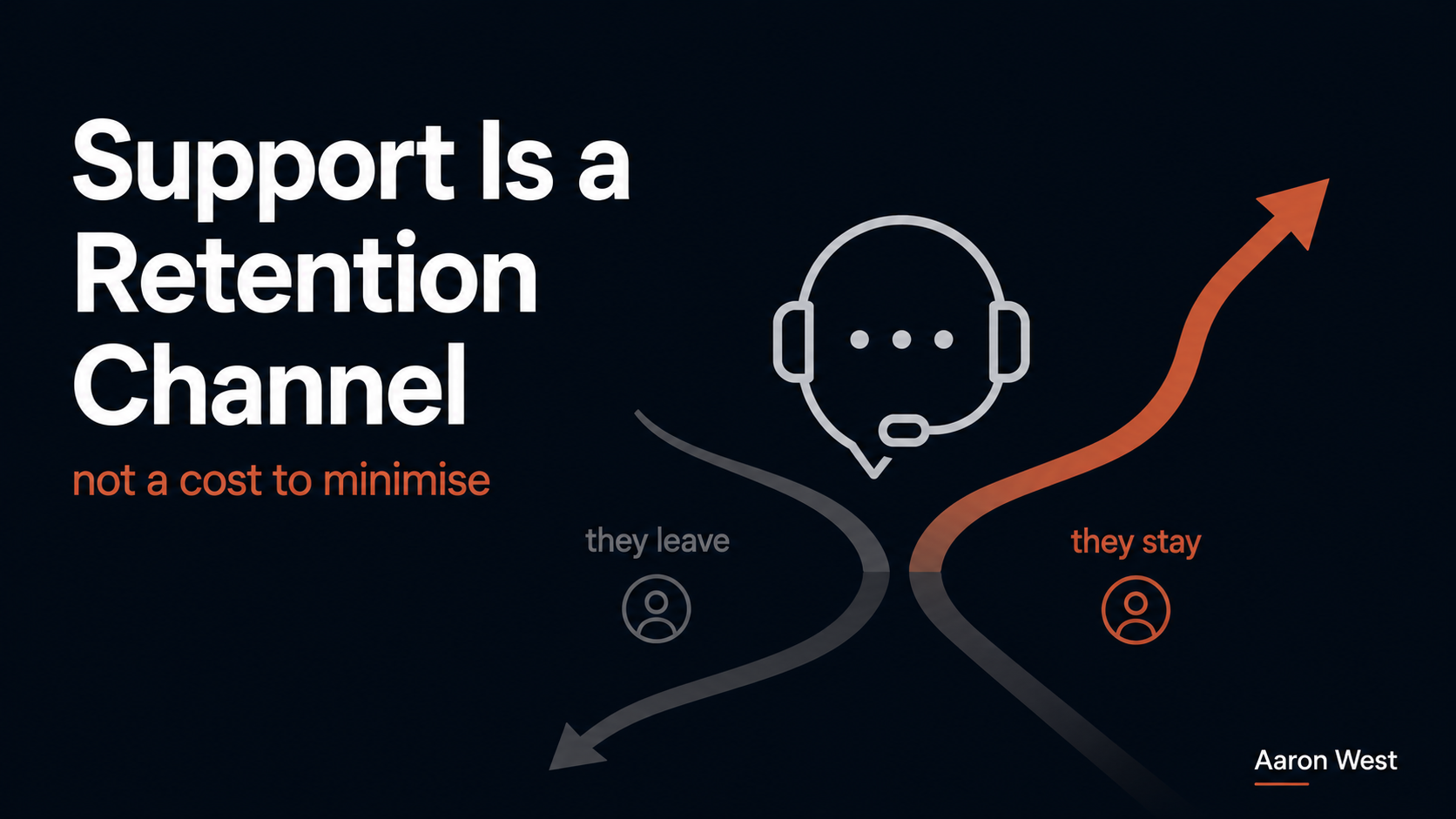
Support Is a Retention Channel, Not a Cost to Minimise
Most companies treat customer support as a cost centre to be minimised: deflect the tickets, cut the handle time, shrink the team, get the cost-per-contact down. That framing is the central mistake in how businesses think about support. Support is a retention channel. It's where…
Continue reading...