Replenishment and Subscribe-and-Save: The Low-Friction Subscription

Table of Contents
Replenishment, the subscribe-and-save model for things that run out, is the most natural and lowest-friction subscription there is, because it maps onto a real recurring need: the product runs out, the customer needs more, and the subscription simply removes the chore of re-ordering. It passes the "is there genuine recurring value" test by default, which is exactly why it works where bolt-on subscriptions fail. As long as you get the cadence right and make skipping, adjusting, and pausing effortless.
This closes the Subscriptions pillar, under the cornerstone that recurring revenue is earned, not locked in. The cornerstone warned that not everything should be a subscription. Replenishment is the case where the recurring value is built into the product itself, which is what makes it the model worth getting right.
Why replenishment is the easy subscription
Most subscriptions have to manufacture a reason to recur. Replenishment doesn't, because the reason is physical: consumables run out, on a rough and predictable cycle, and the customer is going to re-buy them anyway. All the subscription does is remove the friction of remembering and re-ordering. The convenience is the product.
That's why it sidesteps the trap the cornerstone described. A subscription bolted onto something with no recurring value fails because the customer notices there's no ongoing reason to pay. Replenishment has the opposite problem solved for it: the ongoing reason is that the thing genuinely runs out. The customer's interest (never run out, never have to think about it) and your interest (recurring revenue) are about as aligned as they ever get in commerce. Which is exactly why it's worth not botching.
The value is convenience, not the discount
Subscribe-and-save usually pairs automatic delivery with a modest saving, and it's easy to conclude the discount is the draw. It isn't. The real value is convenience, never running out, never re-ordering, with the saving working as a nudge that tips the decision, not the reason it holds.
Getting that wrong is expensive in a quiet way. If you lean on the discount as the value, you train customers to expect ever-deeper savings, and you erode the margin the recurring relationship was supposed to protect, the discounting-as-a-loan problem showing up inside the subscription. Keep the saving modest and let convenience do the work. People stay subscribed to replenishment because it spares them a chore, not because of a few percent off, and a relationship built on the chore-saving is far more durable than one built on the discount.
Cadence is the whole game
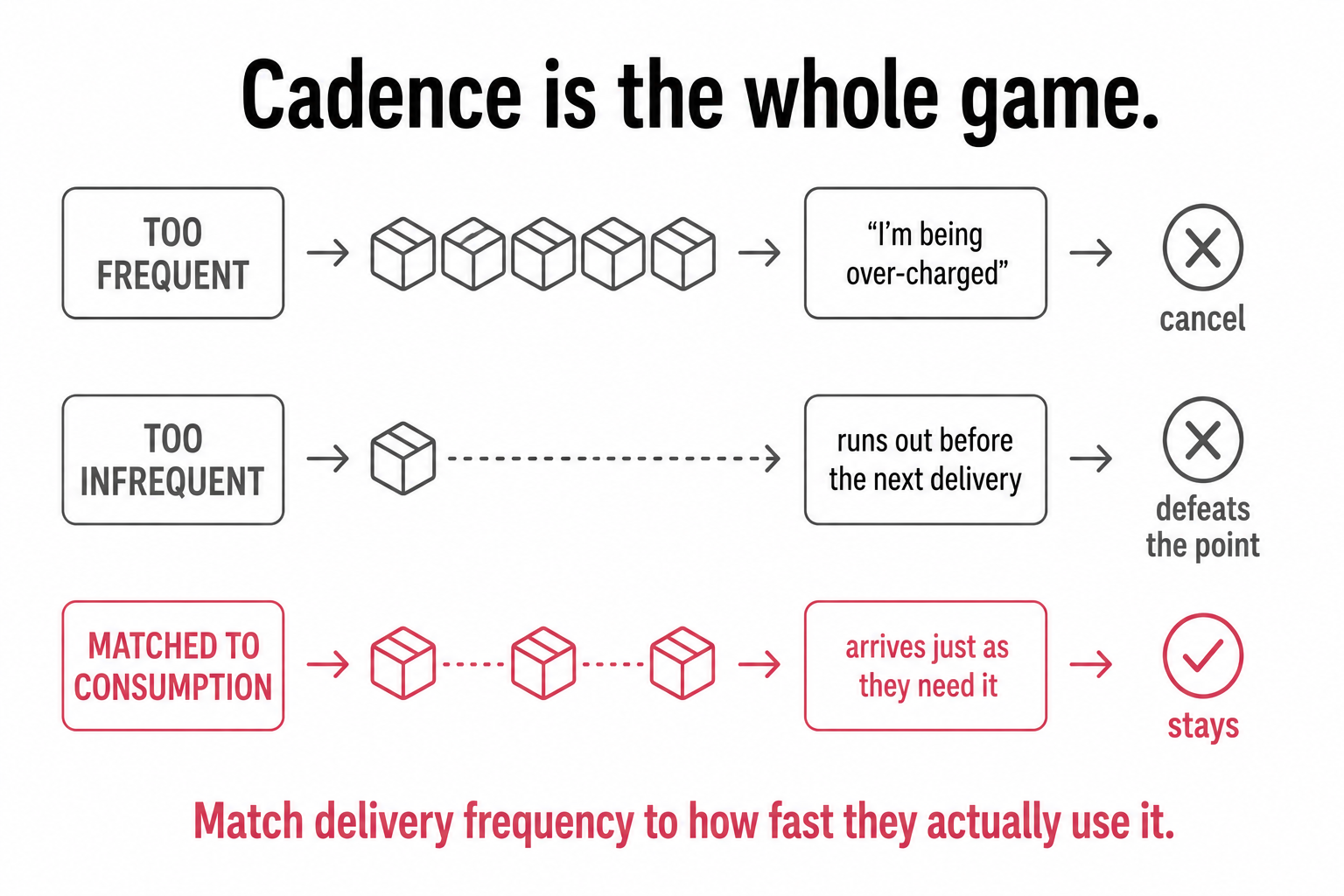
Here's the single biggest thing that decides whether replenishment works: cadence. The number one way a replenishment subscription churns is getting the delivery frequency wrong.
Ship more often than the customer actually uses the product, and the boxes pile up, they feel over-charged for stuff they didn't need yet, and they cancel, often with the resentment of someone who feels they've been quietly over-billed. Ship less often than they use it, and they run out, which defeats the entire purpose of subscribing. Matching delivery frequency to real consumption is the core design problem of the whole model, and it's harder than it sounds because consumption varies by household and by product.
So make the cadence the customer's to control, easily, and go further where you can: learn from their behaviour. Someone who keeps skipping is being shipped too often; someone who keeps placing extra one-off orders between deliveries is being shipped too rarely. The signals are there. Reading them and proactively suggesting the right cadence is the difference between a replenishment programme that quietly retains and one that quietly bleeds.
Skip, adjust, pause: the control that keeps it convenient
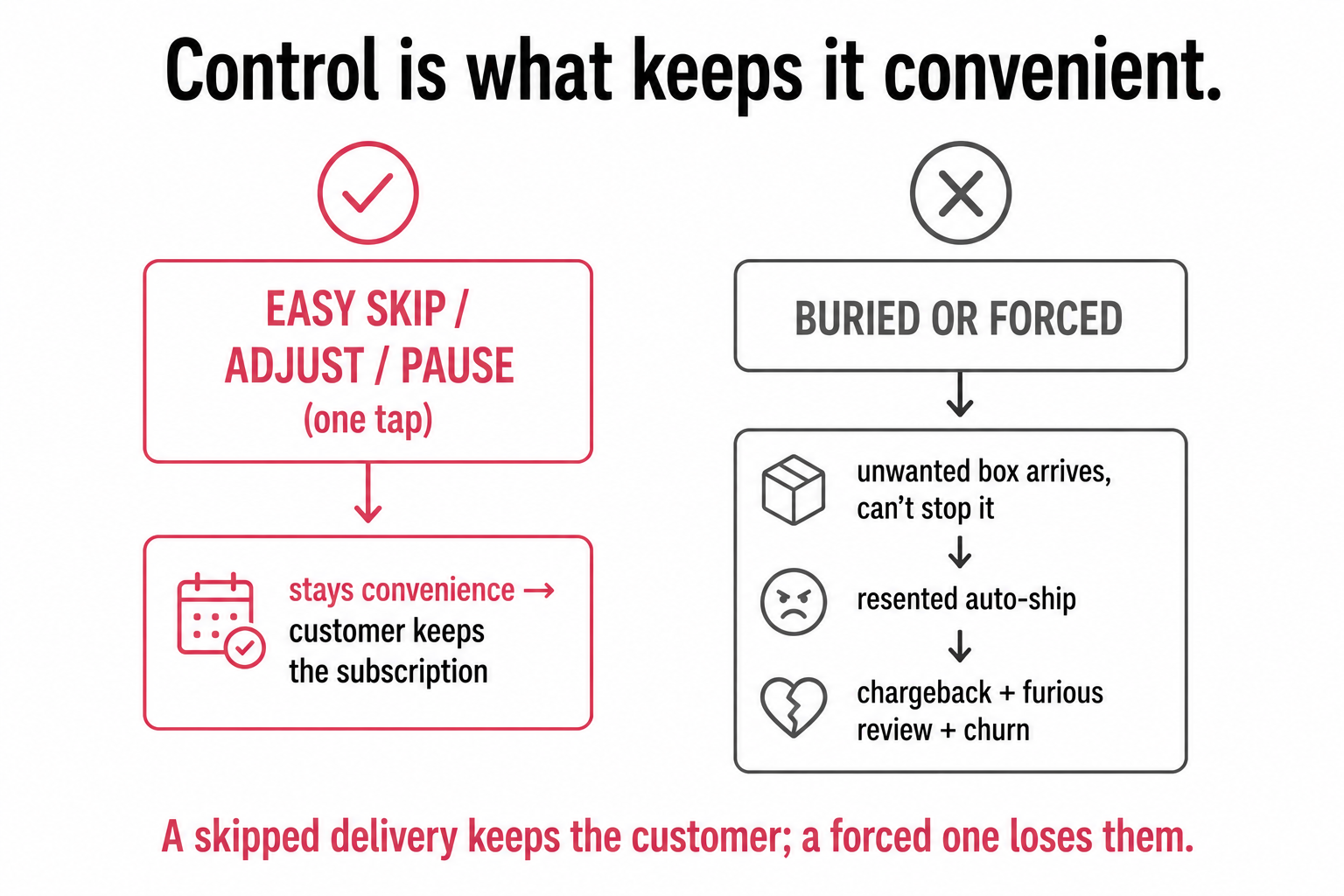
Replenishment lives or dies on control, and this is where the easy-to-leave principle from the UX piece applies to every single shipment, not just the cancellation. A customer who can't easily skip a delivery they don't need yet, bump the next one forward, change the frequency, or pause for a holiday, watches the convenience curdle into a grievance: a box arriving when they don't want it, that they couldn't stop.
That unwanted, unstoppable box is the fastest route to a chargeback and a furious review, the same trust failure the UX piece warned about, just at the level of the individual delivery. The logic is identical: serve the real need (let them skip, let them adjust) rather than maximise shipments. A skipped delivery keeps the customer for the next one; a forced delivery loses them entirely. One-tap skip is not a leak in your revenue; it's the thing that protects it.
The closest thing to durable recurring revenue
Put the pieces together and replenishment is, done well, the closest thing to durable recurring revenue in commerce. Because the need is genuine and recurring, it churns less than most subscriptions, if the cadence matches consumption and control is effortless. The re-sale the cornerstone said you have to win every cycle is, here, the easiest re-sale there is: the customer genuinely needs the next one. You're not persuading them to keep paying for something marginal; you're saving them a chore they'd otherwise do themselves.
The boundary matters, though. This works for true consumables, things consumed on a rough cycle. Force it onto durable goods or products with irregular, unpredictable need, and you're back to a bolt-on subscription with no real recurring value, the thing the cornerstone warned against. Replenishment is powerful precisely because the need is real; remove the real need and the power goes with it.
What this comes down to
Replenishment is recurring revenue at its most honest, because the customer genuinely needs the next one and you're just sparing them the chore of ordering it. The businesses that win it obsess over two things: cadence, delivering what the customer actually uses, when they use it, and control, making skip, adjust, and pause a single tap. Get those right and the convenience holds, the need keeps re-earning the subscription, and your interest and the customer's stay aligned.
Get them wrong, over-ship and bury the skip button, chasing the recurring revenue at the expense of the convenience that was the whole point, and the moment a box arrives unwanted and can't be stopped, the convenience becomes a grievance and the most natural subscription in commerce churns like any other. Serve the real need, and replenishment keeps re-earning itself, which is all any subscription was ever meant to do.
A few common questions
Why is replenishment the easiest subscription to get right? Because it maps onto a real recurring need rather than manufacturing one. Consumables run out on a rough, predictable cycle and the customer is going to re-buy them anyway, so the subscription just removes the chore of remembering and re-ordering, the convenience is the product. That sidesteps the trap that sinks bolt-on subscriptions (no ongoing reason to pay), because here the ongoing reason is that the thing genuinely runs out. The customer's interest and yours are about as aligned as commerce gets.
Isn't the discount the main reason people subscribe-and-save? No, the convenience is, never running out and never re-ordering, with the saving as a nudge that tips the decision rather than the reason it holds. Leaning on the discount as the value trains customers to expect ever-deeper savings and erodes the margin the recurring relationship was meant to protect. Keep the saving modest and let convenience do the work; a relationship built on the chore-saving is far more durable than one built on a few percent off.
What's the most common reason replenishment subscriptions churn? Wrong cadence. Ship more often than the customer uses the product and the boxes pile up, they feel over-billed, and they cancel; ship less often and they run out, which defeats the point. Matching delivery frequency to actual consumption is the core design problem. Make the cadence easy for the customer to control, and where you can, learn from behaviour, frequent skips mean you're shipping too often, frequent extra one-off orders mean too rarely, and proactively suggest the right frequency.
How important is it to make skipping and pausing easy? It's essential, it's the easy-to-leave principle applied to every individual shipment. A customer who can't easily skip a delivery they don't need yet, change the frequency, or pause watches the convenience curdle into a grievance, and an unwanted box they couldn't stop is the fastest route to a chargeback and a furious review. Serve the real need: a skipped delivery keeps the customer for next time, while a forced one loses them entirely. One-tap skip protects your revenue rather than leaking it.
You should also read:
Subscription Churn: The Metric That Runs the Whole Model
In a subscription business, churn, the rate at which subscribers cancel, is the metric that runs the whole model, because both your revenue and your losses compound. A small difference in monthly churn compounds into an enormous difference in how long customers stay and how…
Continue reading...
Subscription UX: Easy to Start, and Easy to Leave
The counterintuitive truth of subscription UX is that making it easy to leave matters as much as making it easy to start. The instinct is to add friction to cancellation in order to retain customers, and it backfires every time: it destroys trust, breeds anger…
Continue reading...
Subscriptions: Recurring Revenue Is Earned, Not Locked In
A subscription's appeal is predictable, recurring revenue, and the most dangerous way to think about that revenue is as "locked in." It isn't locked in. It's re-earned every cycle. A subscriber is quietly deciding to keep paying every period, and the moment the value they…
Continue reading...