Subscription UX: Easy to Start, and Easy to Leave

Table of Contents
The counterintuitive truth of subscription UX is that making it easy to leave matters as much as making it easy to start. The instinct is to add friction to cancellation in order to retain customers, and it backfires every time: it destroys trust, breeds anger and chargebacks, increasingly breaks the law, and the customer you trapped leaves more bitterly than the one you let go. Easy cancellation is not a leak to plug. It's an acquisition and retention asset, because it makes subscribing low-risk and makes the people who do leave willing to come back.
This is a core of the Subscriptions pillar, under the cornerstone that recurring revenue is earned, not locked in. The cornerstone argued that you re-earn the subscription every cycle. This piece is about designing the two moments that decide whether you get the chance to: the start and the exit.
Easy to start: set the "worth it" answer early
The start of a subscription sets the answer to the question the customer will ask every cycle thereafter: is this worth it? So the onboarding has three jobs. Make signup low-friction, so the decision to try is easy. Deliver value fast, so the customer feels the worth before the first renewal lands rather than paying ahead of any benefit. And be transparent about the terms, what they're paying, when they'll be billed, and how to manage or cancel it, because transparency up front builds the trust the whole recurring relationship runs on.
That last point matters more than it looks. A customer who signs up and immediately can't tell when they'll be charged, or senses the terms were designed to be missed, starts the relationship already suspicious, and suspicion is corrosive to a model built on repeated renewal. Clarity at the start is the cheapest trust you'll ever buy.
Easy to leave: the move everyone gets wrong
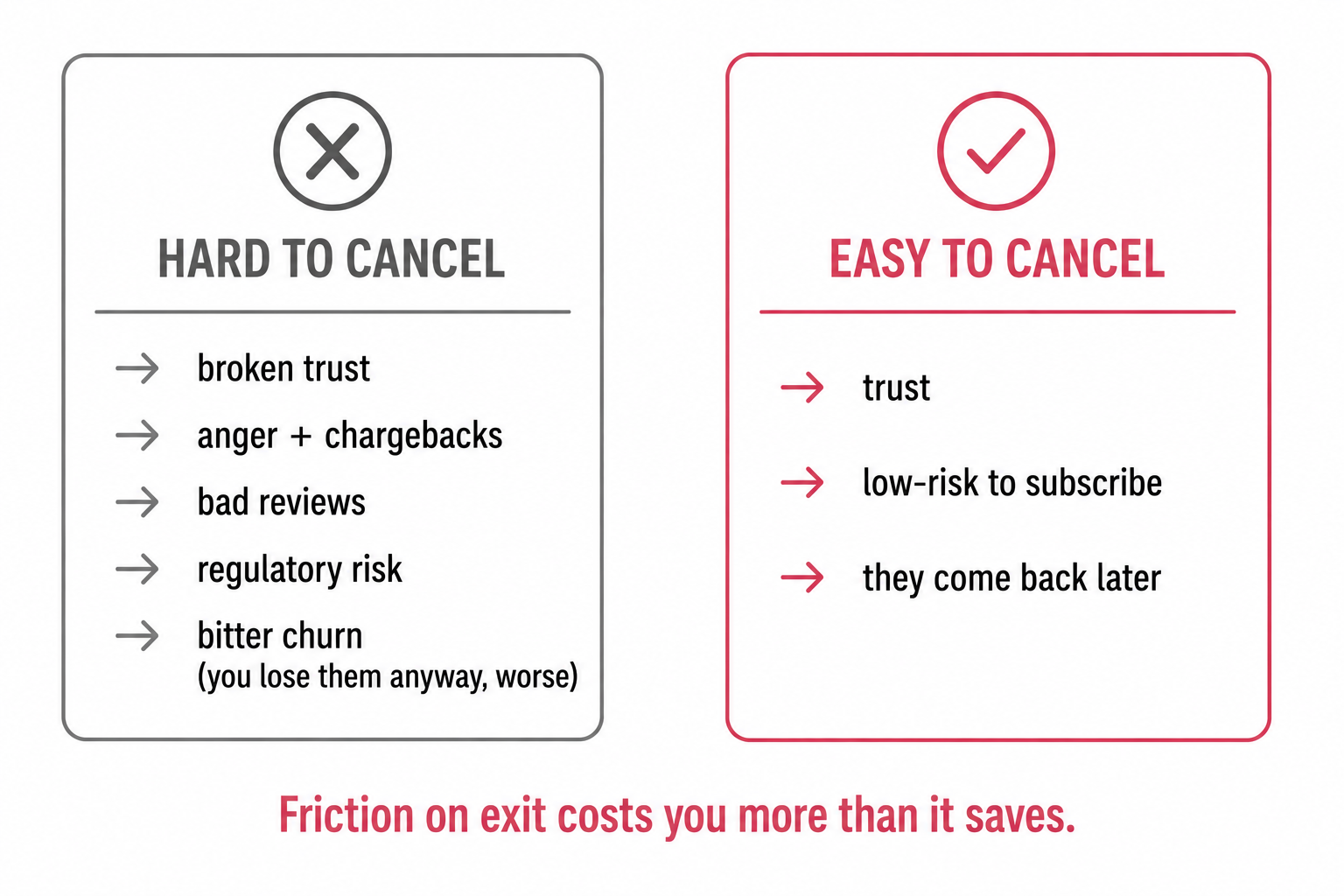
Now the counterintuitive part. The instinct is to make cancellation hard, hide the button, route people through a multi-step retention gauntlet, require a phone call, on the theory that friction reduces churn. It's one of the most self-defeating instincts in e-commerce, and it fails on four separate axes:
- It destroys trust. A customer who has to fight to leave never trusts you again, and tells other people exactly how hard it was. You don't get a quiet loss; you get an advocate against you.
- It breeds anger, chargebacks, and bad reviews. Trapped customers don't give up; they escalate, through their bank, through review sites, through every channel that's worse for you than a clean cancellation would have been.
- It increasingly breaks the law. Consumer-protection rules in many markets now move toward requiring that cancelling be as easy as signing up, so cancellation dark patterns are not just bad practice but a growing legal risk. (This isn't legal advice; check the current rules where you operate.)
- It doesn't even work. You rarely prevent the loss; you just delay it and poison it. The customer leaves anyway, later and angrier, having paid for a month or two they resented.
So friction-on-exit gives you a small, bitter, reputation-damaging delay in exchange for the trust of every customer who encounters it, including the ones who weren't even trying to leave but went looking for the cancel button just to check.
The cancellation flow is a trust test
Reframe the exit and it stops being a leak and becomes a brand moment. How you handle someone leaving is one of the most revealing things a customer experiences, and handling it gracefully pays off across time. Let them go cleanly, with their dignity and goodwill intact, and they leave thinking well of you, which means they recommend you, speak well of you, and are the easiest people in the world to win back later. The graceful exit is a long-game retention strategy, not a defeat.
And it works as an acquisition asset too, which is the part most businesses miss entirely. If leaving is genuinely easy, subscribing is low-risk, and low-risk decisions are easy to make. "Cancel anytime, in one click" is a conversion line, it removes the fear of being trapped that makes people hesitate to subscribe at all. Friction on exit quietly raises friction on entry: people are warier of signing up for something they suspect they can't easily escape. So the cancel button you were tempted to hide is actually part of your signup conversion.
The honest alternative to a trap
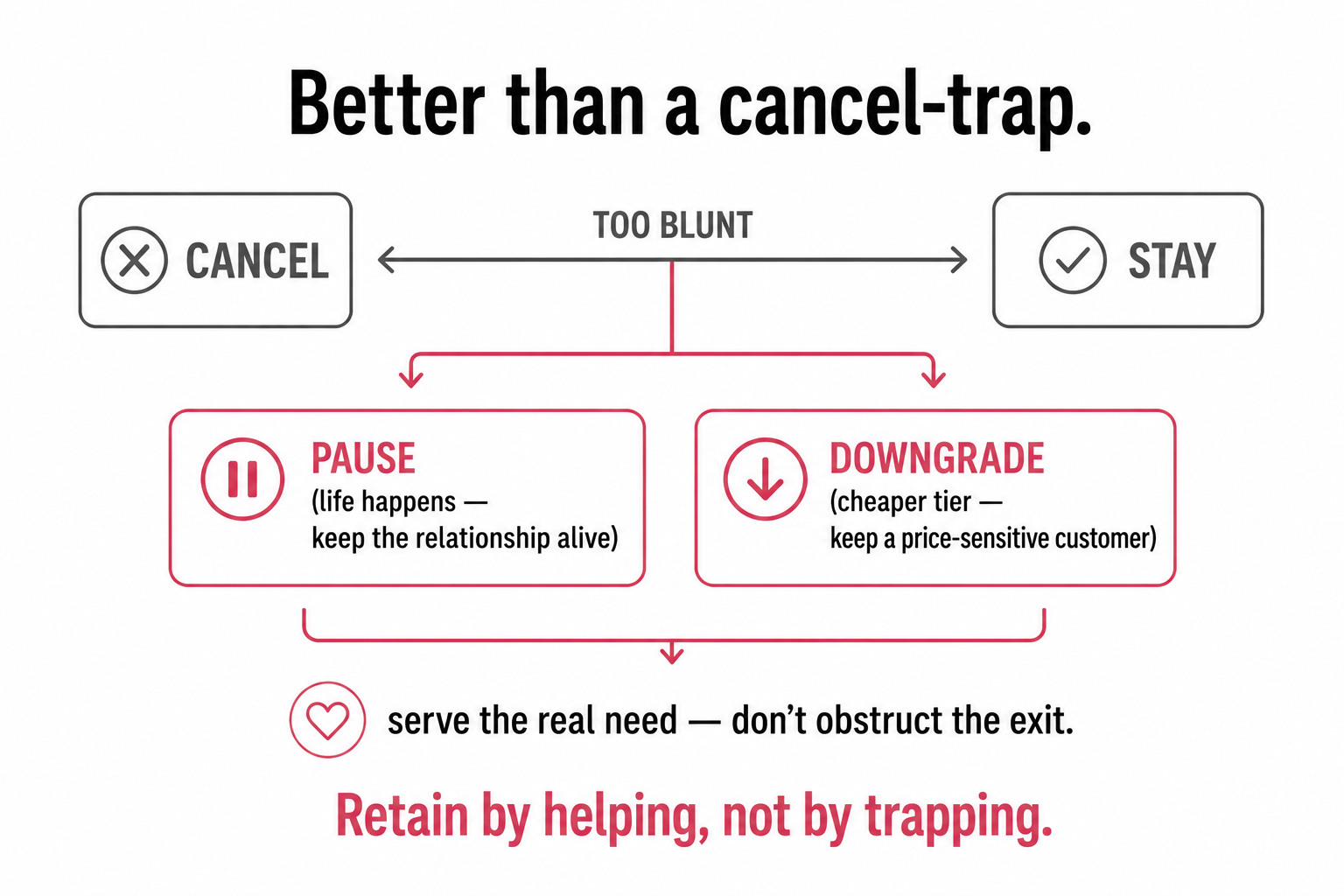
None of this means you can't try to retain a leaving customer; it means there's a line between a legitimate retention offer and a dark pattern. The legitimate version serves the customer's actual need instead of obstructing their exit, and the two most useful tools are pause and downgrade.
A lot of cancellations aren't "I never want this again", they're "not right now" or "this is more than I need". A binary stay-or-cancel forces those people to quit entirely. Offering to pause the subscription keeps the relationship alive through a gap that would otherwise have ended it, and offering a downgrade to a cheaper tier keeps a customer who'd have left over price. Both retain by genuinely serving the customer's situation, which is the honest move. The dishonest move, the multi-step gauntlet that obstructs the exit, retains by friction and poisons the relationship. Same goal, opposite ethics, opposite results. Offer the pause; never build the maze.
What this comes down to
Good subscription UX is easy to start, because the value is clear and arrives fast and the terms are transparent, and easy to leave, because trust is worth more than a trapped month. Offer a genuine pause or downgrade instead of a binary stay-or-quit, let the people who want out leave gracefully, and you win on every axis at once: you acquire more (because subscribing is low-risk), you retain more (because honest alternatives beat friction, and trust beats inertia), and you win back more (because nobody left angry enough to never return).
Treat the cancel button as the enemy, and you make an enemy of the customer. The exit is part of the product, and how you handle it is how you're remembered.
A few common questions
Why should cancellation be easy? Because making it hard backfires on every axis: it destroys trust, breeds anger, chargebacks, and bad reviews, increasingly runs into consumer-protection rules that require cancelling to be as easy as signing up, and it doesn't even prevent the loss, it just makes the customer leave later and angrier. Easy cancellation makes subscribing low-risk (which lifts signup conversion), signals confidence in your value, and makes the people who leave far more likely to come back. (Not legal advice; check the rules in your market.)
Doesn't easy cancellation increase churn? Not in the way that matters. Friction doesn't retain happy customers; it just briefly traps unhappy ones, who leave anyway, more bitterly and publicly. Meanwhile, hard cancellation quietly suppresses signups (people hesitate to join something they fear they can't escape) and destroys the goodwill that brings leavers back. Easy cancellation paired with genuinely delivered value retains customers who actually want to stay and loses, cleanly, the ones who don't, which is the healthy version of the model.
How do I make subscription onboarding good? Make signup low-friction, deliver value fast (so the customer feels the worth before the first renewal, not after), and be transparent about the terms, what they pay, when they're billed, and how to manage or cancel. The start sets the answer to the "is this worth it?" question the customer asks every cycle, and clarity up front is the cheapest trust you'll ever buy. A customer who can't tell when they'll be charged starts the relationship already suspicious.
What's a better alternative to a hard cancellation flow? Offer a pause or a downgrade instead of a binary stay-or-cancel. Many cancellations are really "not right now" or "more than I need," and a pause keeps the relationship alive through a gap that would otherwise end it, while a downgrade keeps a price-sensitive customer who'd have left. These retain by genuinely serving the customer's situation, the honest line, whereas a multi-step gauntlet retains by friction and poisons the relationship. Offer the pause; never build the maze.
You should also read:
Replenishment and Subscribe-and-Save: The Low-Friction Subscription
Replenishment, the subscribe-and-save model for things that run out, is the most natural and lowest-friction subscription there is, because it maps onto a real recurring need: the product runs out, the customer needs more, and the subscription simply removes the chore of re-ordering. It passes…
Continue reading...
Subscription Churn: The Metric That Runs the Whole Model
In a subscription business, churn, the rate at which subscribers cancel, is the metric that runs the whole model, because both your revenue and your losses compound. A small difference in monthly churn compounds into an enormous difference in how long customers stay and how…
Continue reading...
Subscriptions: Recurring Revenue Is Earned, Not Locked In
A subscription's appeal is predictable, recurring revenue, and the most dangerous way to think about that revenue is as "locked in." It isn't locked in. It's re-earned every cycle. A subscriber is quietly deciding to keep paying every period, and the moment the value they…
Continue reading...