Subscriptions: Recurring Revenue Is Earned, Not Locked In

Table of Contents
A subscription's appeal is predictable, recurring revenue, and the most dangerous way to think about that revenue is as "locked in." It isn't locked in. It's re-earned every cycle. A subscriber is quietly deciding to keep paying every period, and the moment the value they get drops below the price they pay, they leave. Recurring revenue is in some ways the most honest business model there is, because it puts the customer's renewal decision on a repeating schedule, and the businesses that win at it treat every cycle as a re-sale, not a capture.
This opens the Subscriptions & Recurring Revenue pillar, and it's the cornerstone the cluster links up to: the UX of starting and leaving, the churn that runs the model, and the low-friction replenishment subscription. All of it rests on one correction to the way most people think about recurring revenue.
The appeal, and the dangerous misreading
The appeal is genuine and worth being honest about. Recurring revenue is predictable, it compounds as you stack subscribers, it raises customer lifetime value, it makes planning and cash flow saner, and it earns a valuation premium because future revenue is more visible. There's a real reason every business wants a subscription line. None of that is the problem.
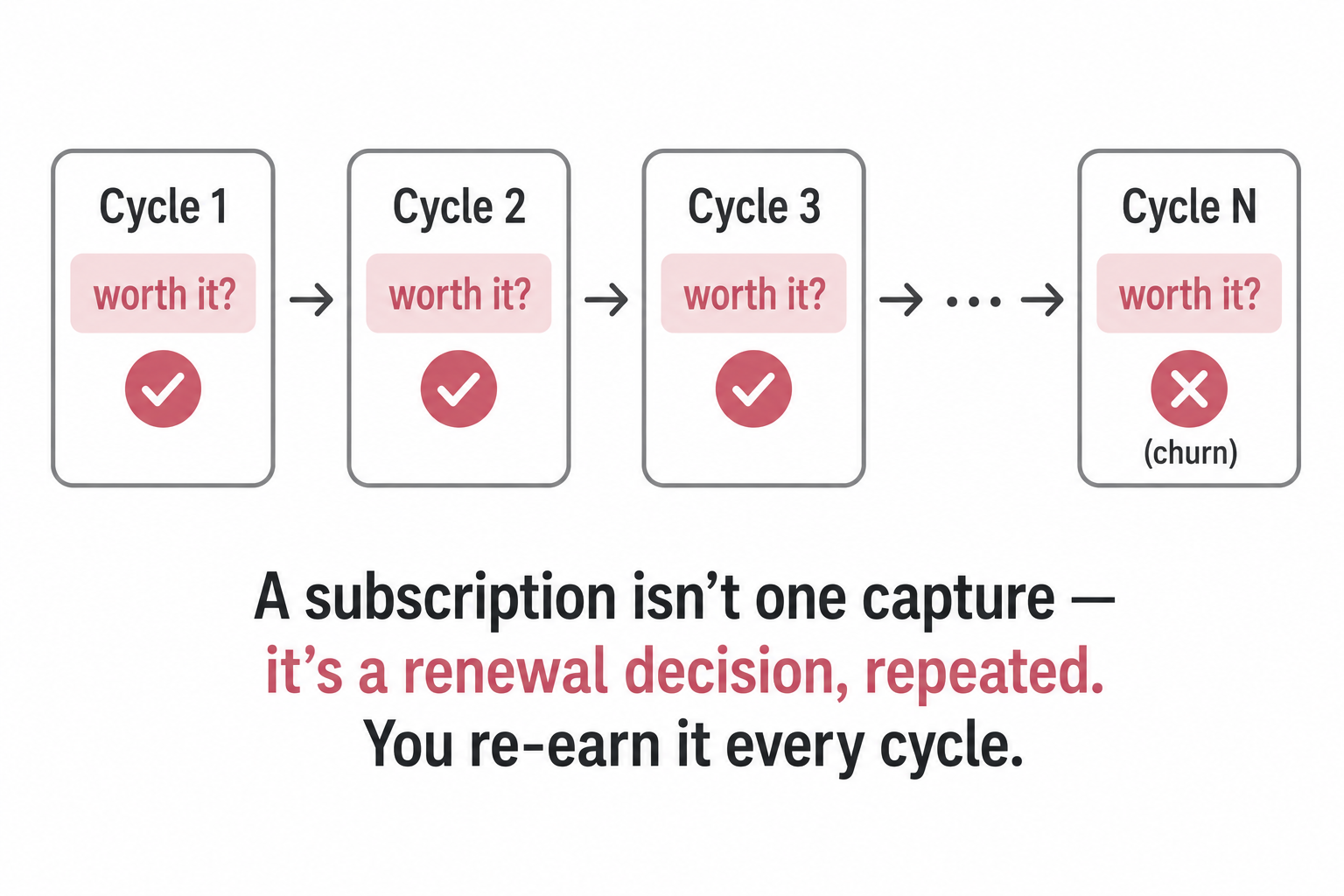
The problem is the misreading that rides along with it: "recurring revenue means locked-in customers." It doesn't. A subscription is not one capture; it's a series of renewal decisions. The customer re-decides, every cycle, whether to keep paying, and most of the time they make that decision quietly, by not cancelling, which is easy to mistake for loyalty when it's really just "still worth it, for now." You don't own the revenue. You re-earn it, on a schedule, for as long as you keep being worth the price.
Why "locked in" thinking corrupts the model
The lock-in mindset isn't just inaccurate; it's actively corrosive, because of what it makes a business do. Once you believe the customer is captured, you quietly stop working to deliver value, why bother, they're locked in, and you start leaning on inertia and friction to keep them: the renewal they forgot to cancel, the cancellation flow you made painful, the email you buried.
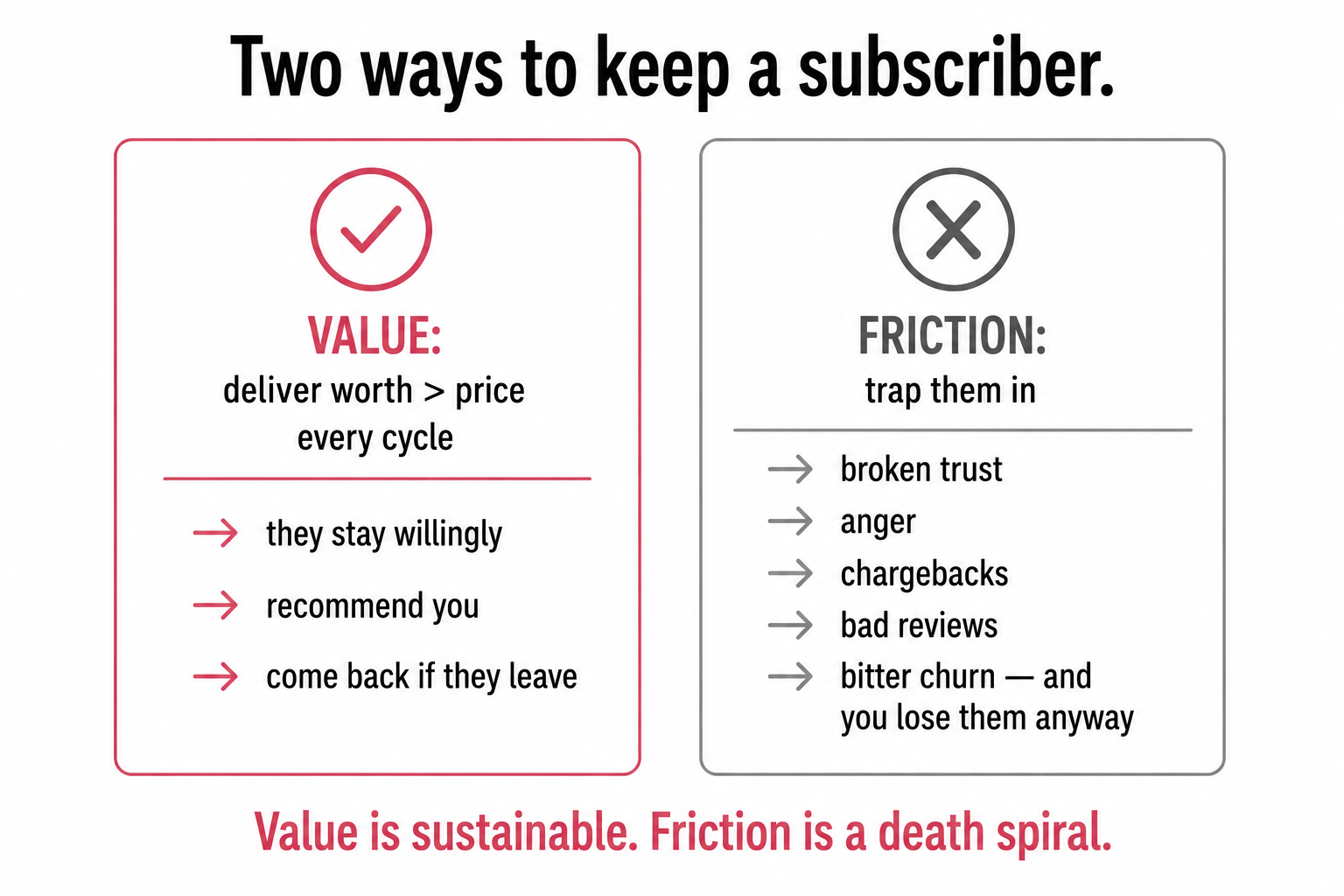
That's the death spiral. The value you deliver drifts down because you've stopped earning the renewal, so the only thing holding the customer is inertia, until the day they notice, and they always eventually notice. Then they leave, and because you relied on friction rather than value, they leave angry, they dispute the charge, they leave a review about how hard it was to cancel, and they tell people. The model that looked like captured revenue turns into a reputation problem. A subscription only works on continuously delivered value, and the lock-in mindset is precisely what stops you delivering it.
Every cycle is a re-sale
The healthier frame is to treat every billing cycle as a small re-sale. Each period, the customer is subconsciously asking one question, "is this still worth it?", and your entire job is to make the honest answer yes, again, through value you actually deliver. Not through making the question hard to act on.
That reframe changes where you put your effort. Instead of designing a better trap, you design a better ongoing experience: the next box that delights, the feature that keeps earning its place, the service that stays sharp. The re-sale framing is demanding, you never get to coast, but it's the only version of the model that's durable, because it aligns your incentive (keep the revenue) with the customer's interest (keep getting value). When those two are aligned, the recurring revenue is real. When you try to hold revenue without delivering value, you're just borrowing against a customer who's going to leave.
Make leaving easy (yes, really)
Here's the counterintuitive move the UX piece goes deep on, and it follows directly from everything above: make it easy to leave. The instinct is the opposite, add friction to cancellation so fewer people manage to do it, but trapping subscribers is self-defeating on every axis. It destroys trust, it generates anger and chargebacks and one-star reviews, it increasingly runs into consumer-protection rules that require cancelling to be as easy as signing up, and it doesn't even prevent the loss, it just makes the customer leave more bitterly, and badmouth you on the way out.
Easy cancellation does the opposite work. It makes subscribing low-risk, which lowers the barrier to starting in the first place, "cancel anytime" is a conversion line, not a leak. It signals confidence in your own value. And the customer who leaves easily and without resentment is the one most likely to come back later. Letting people go gracefully is a retention strategy measured across time, not a hole to plug. The exit experience is part of the product.
Retention is the business (and not everything should be a subscription)
Two points that the rest of the cluster builds on.
First, in a subscription model, retention isn't a marketing nicety, it is the business. Because the revenue compounds, a small change in how many subscribers you keep each cycle compounds into an enormous difference in what the business is worth, which is exactly what the churn piece is about. The companies that win at subscriptions are not the ones with the cleverest acquisition; they're the ones that keep the value above the price, cycle after cycle, and watch retention do the compounding.
Second, not everything should be a subscription. The model works when there's genuine recurring value or need, consumables that run out, a service that keeps delivering, content that keeps evolving. Bolting a subscription onto something with no real recurring value, purely to capture recurring revenue, fails, because the customer notices there's no ongoing reason to keep paying and cancels at the first prompt. Match the model to a real recurring need, or don't use it. A subscription without recurring value is just a trap with a billing schedule.
What this comes down to
Recurring revenue is the most attractive number in e-commerce and the most misunderstood. It isn't a customer locked in. It's a customer re-choosing you, on a schedule, for as long as you keep being worth it. The lock-in mindset, the belief that the revenue is captured, is precisely what kills the model, because it leads you to stop earning the renewal and start relying on friction, which works right up until the customer notices and leaves angry.
So treat the subscription as a promise you renew every cycle by delivering real value. Make leaving genuinely easy, because trust is worth more than a trapped month. Match the model to a need that's actually recurring. Do that, and the recurring revenue takes care of itself, because the customer keeps choosing it. Treat it as a trap, and you'll spend more energy keeping people in than it would have taken to keep them happy, and lose them anyway.
A few common questions
Why isn't recurring revenue "locked in"? Because a subscription is a series of renewal decisions, not one capture. The customer re-decides every cycle whether to keep paying, usually quietly, by not cancelling, and the moment the value they get drops below the price they pay, they leave. You don't own the revenue; you re-earn it on a schedule for as long as you stay worth the price. Treating it as locked in leads you to stop delivering value and rely on inertia, which is exactly what eventually drives customers out.
Why is making cancellation hard a mistake? Because trapping subscribers backfires on every axis. It destroys trust, generates anger, chargebacks, and bad reviews, increasingly runs into consumer-protection rules that require cancelling to be as easy as signing up, and it doesn't even prevent the loss, it just makes the customer leave more bitterly and badmouth you. Easy cancellation does the opposite: it makes subscribing low-risk (lowering the barrier to starting), signals confidence in your value, and makes the people who leave more likely to return. (This isn't legal advice; check the current rules in your market.)
What actually keeps subscribers? Delivered value, cycle after cycle. Treat every billing cycle as a small re-sale where the customer asks "is this still worth it?" and make the honest answer yes through the experience you provide, not through friction that makes the question hard to act on. That aligns your incentive (keep the revenue) with the customer's interest (keep getting value), which is the only durable version of the model. Retention, not acquisition, is where subscription businesses are won.
Should every business add a subscription? No. Subscriptions work when there's genuine recurring value or need, consumables that run out, a service that keeps delivering, content that keeps evolving. Bolting a subscription onto something with no real recurring value, just to capture recurring revenue, fails, because the customer notices there's no ongoing reason to keep paying and cancels at the first prompt. Match the model to a real recurring need, or a subscription is just a trap with a billing schedule.