Subscription Churn: The Metric That Runs the Whole Model

Table of Contents
In a subscription business, churn, the rate at which subscribers cancel, is the metric that runs the whole model, because both your revenue and your losses compound. A small difference in monthly churn compounds into an enormous difference in how long customers stay and how much they're worth, which is why you cannot out-acquire a high churn rate. A leaky bucket doesn't get full by pouring water in faster. Fixing churn is almost always higher-leverage than chasing more new subscribers, and it's the number most subscription businesses watch least.
This is a core of the Subscriptions pillar, under the cornerstone that recurring revenue is earned, not locked in. If the cornerstone's point is that you re-earn the subscription every cycle, churn is the number that tells you how well you're doing it.
Why churn runs everything
Recurring revenue compounds in your favour: a retained customer pays again and again, and the longer they stay, the more they're worth, with no repeat acquisition cost. Churn compounds against you in the mirror image: a lost customer doesn't just stop paying now, they take every future cycle with them.
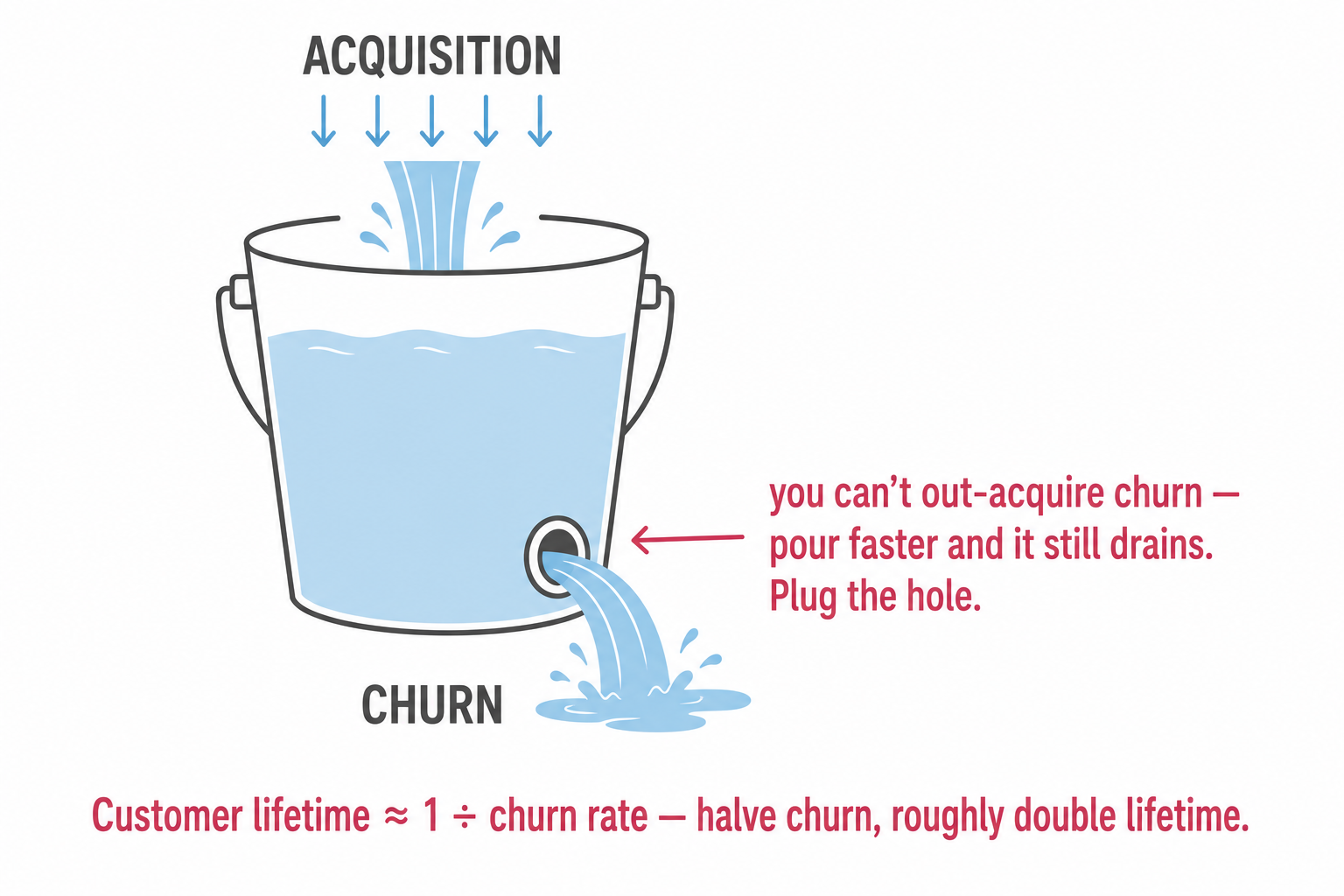
The relationship is close to arithmetic. Average customer lifetime is roughly one divided by your churn rate, so the swings are dramatic in a way that's easy to underestimate. As an illustration, not a claimed statistic, just the math: a customer base losing 5% of subscribers a month has an average lifetime around 20 months; cut that to 2.5% and the average lifetime roughly doubles to 40 months. You didn't change acquisition at all, and you roughly doubled what every customer is worth. That's why churn is the metric that runs the model: a one-point move in it reshapes the economics of the entire business.
The leaky bucket
Here's the image that should sit at the centre of how a subscription business thinks. Acquisition pours customers into a bucket. Churn is a hole in the bottom. If the hole is big, you can pour in new customers as fast as you like and the level barely rises, you're running faster just to stand still, and your acquisition cost climbs because you're constantly replacing people you should have kept.
Most subscription businesses over-invest in the tap and under-invest in the hole, because acquisition feels like growth, it shows up as new logos and rising sign-up numbers, while retention is quiet and unglamorous. But the math is unforgiving: a customer you keep is worth far more than a customer you acquire to replace one you lost, and plugging the hole compounds across your whole base, where a pour into the top is a one-time top-up. You cannot out-acquire churn. You can only out-retain it.
Voluntary versus involuntary churn
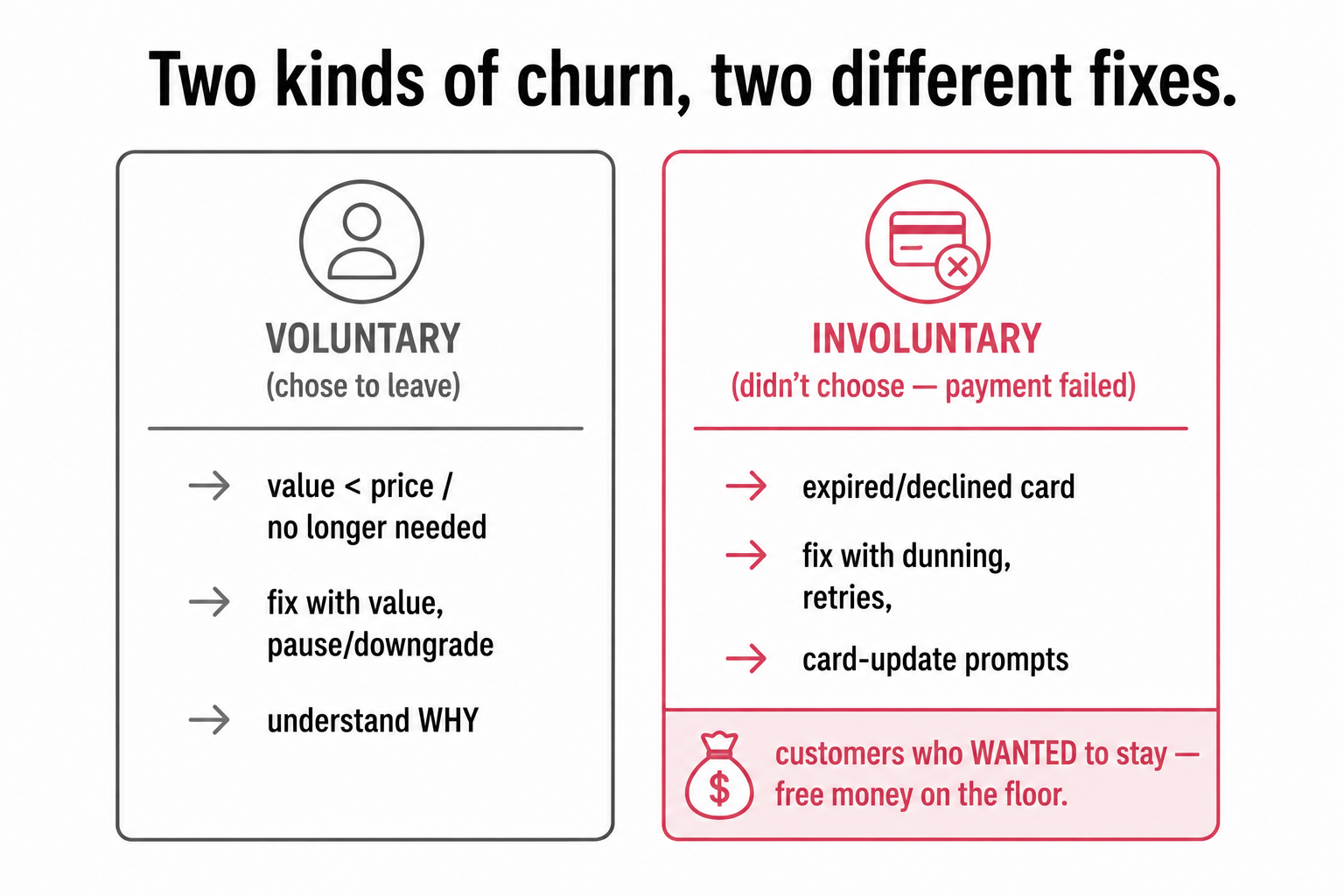
Not all churn is the same, and the single most useful thing you can do is split it into two kinds that need completely different fixes.
Voluntary churn is the customer choosing to leave: the value dropped below the price, they no longer need it, they found something better. This is the churn the rest of the cluster addresses, deliver more value, offer the pause or downgrade instead of a binary exit, and understand why they're going.
Involuntary churn is the customer who didn't choose to leave at all: their payment simply failed. An expired card, a declined transaction, a bank hiccup, and the subscription lapses even though the customer was perfectly happy to keep paying. This is a far larger slice of churn than most businesses realise, and it's the most fixable, because the customer wanted to stay. The fix is operational, not emotional: dunning, retrying failed payments intelligently, prompting customers to update an expiring card before it lapses, recovering the ones that fail. It ties straight to the payments work (failed payments are a payments problem) and to automation (dunning is textbook high-frequency, rules-based, automatable work). Recovering involuntary churn is often the single highest-ROI retention activity there is, because you're not winning anyone back, you're keeping customers who never meant to leave. It's free money on the floor.
Churn is a signal, not just a loss
Voluntary churn is feedback you're paid to receive. When a customer cancels, they're telling you the value dropped below the price for them, and a high or rising voluntary churn rate is your product or value problem surfacing in the one number that can't be spun. So the discipline is to track why people leave, not just that they did, which is exactly why the cancellation flow should capture the reason gracefully rather than fight the exit. Churn you understand is a roadmap; churn you only count is a mystery you'll keep paying for.
It helps to split it by timing, too. People who churn in the first cycle or two usually have an onboarding or expectation problem, they never got to the value, or they expected something different from what they bought. People who churn later usually have a sustained-value problem, the thing was worth it for a while and then stopped being so. Same number, different causes, different fixes: early churn sends you back to onboarding and the promise you made at signup, late churn sends you back to whether the ongoing experience still earns its renewal.
The leverage that no campaign can match
Put it all together and the strategic conclusion is hard to argue with. A small improvement in churn compounds across your entire subscriber base, every cycle, indefinitely. An acquisition push is a one-time top-up that itself leaks back out through the same hole. In a mature subscription business, reducing churn is almost always the highest-leverage growth move available, and yet it's the one that gets the least attention, because acquisition is visible and churn is quiet.
The businesses that win at subscriptions are the ones that fixate on the hole: they recover involuntary churn relentlessly, they learn from every voluntary cancellation, and they treat a one-point churn reduction as the serious growth lever it is. Halve your churn and you don't add a little growth at the margin, you roughly double how long every customer stays and what they're worth. There is no acquisition campaign that does that.
What this comes down to
Churn is the metric that runs a subscription business, because it's the one that compounds against you. You can't out-acquire it; a leaky bucket isn't fixed by pouring faster. So separate the customers who chose to leave (a value problem you fix with value, and the honest pause) from the ones lost to a failed payment (a systems problem you fix with dunning, and the highest-ROI retention work you can do). Learn why each cycle's leavers left, split early churn from late churn, and put your effort into the hole, not just the tap.
Do that, and the compounding that was working against you starts working for you instead. Because in a subscription, the customer you keep is worth a multiple of the one you replace, and the whole model turns on the number most people are too busy chasing growth to watch.
A few common questions
Why is churn the most important subscription metric? Because both your revenue and your losses compound, and churn governs the losing side. Average customer lifetime is roughly one divided by your churn rate, so a small change swings customer value dramatically, halving churn roughly doubles how long the average customer stays and what they're worth, with no change to acquisition. A one-point move in churn reshapes the economics of the whole business, which is why it's the number that runs the model.
What's the difference between voluntary and involuntary churn? Voluntary churn is the customer choosing to leave, the value dropped below the price, they no longer need it, or they found something better, and you fix it with more value, an honest pause or downgrade, and understanding why they left. Involuntary churn is the customer who didn't choose to leave at all: their payment failed (expired or declined card) and the subscription lapsed even though they were happy to pay. You fix that operationally with dunning, payment retries, and card-update prompts, and it's often the highest-ROI retention work because you're keeping customers who never meant to leave.
Why can't I just acquire my way past churn? Because of the leaky bucket. Acquisition pours customers into the bucket; churn drains them out. If the hole is big, you pour in new customers as fast as you like and the level barely rises, while your acquisition cost climbs because you're constantly replacing people you should have kept. A customer you keep is worth far more than one you acquire to replace a loss, and retention compounds across the whole base where acquisition is a one-time top-up. You can only out-retain churn, not out-acquire it.
Should I track why customers cancel? Yes, because voluntary churn is feedback. A cancellation tells you the value dropped below the price for that customer, and a rising rate is your value problem surfacing in a number that can't be spun. Capture the reason gracefully in the cancellation flow rather than fighting the exit, and split churn by timing: early churn (first cycle or two) usually signals an onboarding or expectation problem, while later churn signals a sustained-value problem. Churn you understand is a roadmap; churn you only count is a mystery you keep paying for.
You should also read:
Replenishment and Subscribe-and-Save: The Low-Friction Subscription
Replenishment, the subscribe-and-save model for things that run out, is the most natural and lowest-friction subscription there is, because it maps onto a real recurring need: the product runs out, the customer needs more, and the subscription simply removes the chore of re-ordering. It passes…
Continue reading...
Subscription UX: Easy to Start, and Easy to Leave
The counterintuitive truth of subscription UX is that making it easy to leave matters as much as making it easy to start. The instinct is to add friction to cancellation in order to retain customers, and it backfires every time: it destroys trust, breeds anger…
Continue reading...
Subscriptions: Recurring Revenue Is Earned, Not Locked In
A subscription's appeal is predictable, recurring revenue, and the most dangerous way to think about that revenue is as "locked in." It isn't locked in. It's re-earned every cycle. A subscriber is quietly deciding to keep paying every period, and the moment the value they…
Continue reading...