Product Descriptions: Writing for the Customer and the Machine

Table of Contents
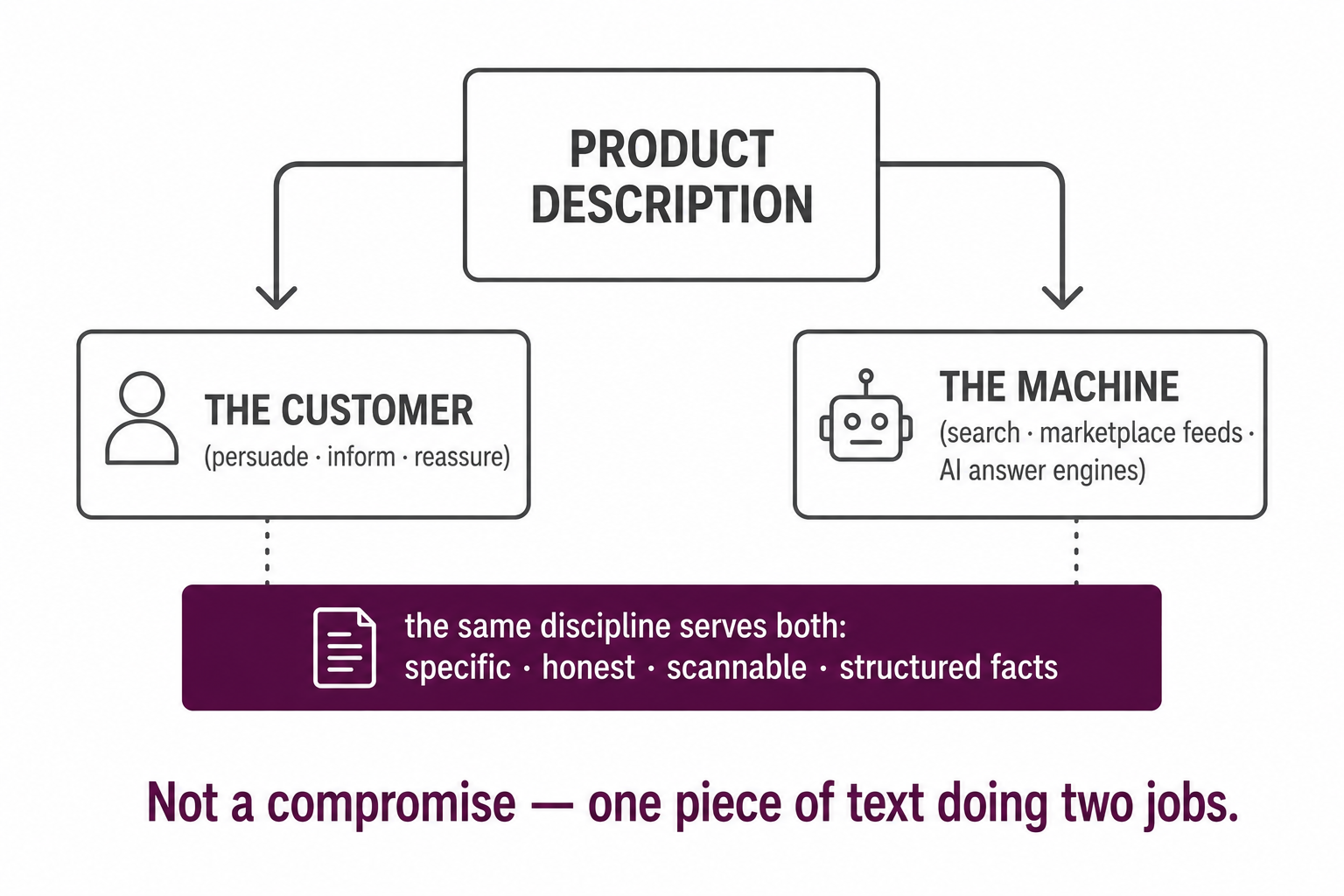
A product description has to do two jobs at once that usually pull against each other: persuade the person reading it (sell the product, inform them, reassure them) and feed the machine reading it (search engines, marketplace feeds, and increasingly AI answer engines that parse the text and decide what to surface). The good news is that the same discipline serves both. Be specific, be honest, be scannable, and keep the hard facts as structured data, and you write a description that sells to a human and informs a machine at the same time.
This is a core of the Catalog & Product Data pillar, under the cornerstone that product data is the foundation everything runs on. The description is the part of product data where persuasion and structure meet, which is exactly why it gets handled badly from both sides.
Two audiences, one piece of text
Most bad descriptions fail because they're written for only one of the two audiences.
Written purely for the human, with no thought for structure or how people search, a description can be charming and still be invisible, the customer who'd have bought it never finds it. Written purely for the machine, stuffed with keywords or copied from a data feed, it reads like noise and persuades no one, the customer finds it and leaves. The description has to work for both, and the trap is treating that as a compromise where each audience gets a worse result. It isn't. The things that genuinely persuade a person, clarity, specificity, honesty, structure, are the same things a machine can parse and surface. You're not splitting the difference; you're serving both with one disciplined piece of writing.
The persuasion job
For the human, a good description answers the real questions the customer is actually asking: what is this, will it work for me, what's it really like, why this one over the alternative. That sounds obvious, and most descriptions don't do it, they list features without translating them into what the feature means for the buyer. "Breathable membrane" is a feature; "stays dry in heavy rain without making you sweat" is what the customer wanted to know.
Specificity beats fluff every time. "High quality" and "premium" are words customers have learned to ignore; concrete details, the actual dimensions, the real material, what's in the box, how it behaves, build the confidence that gets the sale. And a good description pre-empts the doubts that otherwise cause both cart abandonment and returns: answering "will this fit," "is it the right size," "what's it compatible with" before the customer has to guess removes the hesitation that loses the sale and the wrong assumption that causes the return.
The honesty principle
This is where descriptions connect hardest to the rest of the operation. The description sets the expectation, and the expectation is what returns are measured against. Over-sell, and you don't win, you buy a return and a dent in trust, because the product can't live up to the description you wrote, and the gap comes back as a refund and a customer who won't believe your next description either.
So the best description isn't the most glowing one; it's the accurate one. Describing a product's limitations honestly, who it's not for, what it doesn't do, feels like leaving sales on the table and actually does the opposite: it builds trust, it sends the wrong-fit customer elsewhere before they buy and return, and it makes the right-fit customer more confident. Honest beats glowing, because honest sells once and keeps the sale, while glowing sells once and refunds it.
Writing for the machine (without writing for the machine)
The machine side has changed shape, and the old move is now the wrong move. Keyword-stuffing, cramming the same search term in repeatedly, used to be how you signalled relevance; it now reads as low-quality to both the algorithms and the humans, and it's a dead end. What works for the machine today is the same thing that works for the person: clear, specific language that matches how people actually search and ask.
That's especially true as AI answer engines become a discovery surface. They read descriptions to understand and surface products, and they reward exactly what a good human-facing description already has: specific, well-organised, honest information that answers real questions. It's the discoverability principle applied to the product description, you get surfaced and cited for being clearly and specifically useful, not for gaming a keyword. Write genuinely for the human and you're already most of the way to writing well for the machine.
One structural point ties this back to the data model: the description is for the story, and the hard specs belong as structured attributes, not buried in the prose. The description tells the customer why the product is right for them; the attributes hold the facts a filter, a feed, or an AI needs to parse. Keep them in their lanes and both jobs get easier.
The duplicate-content trap, and the scale problem
Two practical realities close this out.
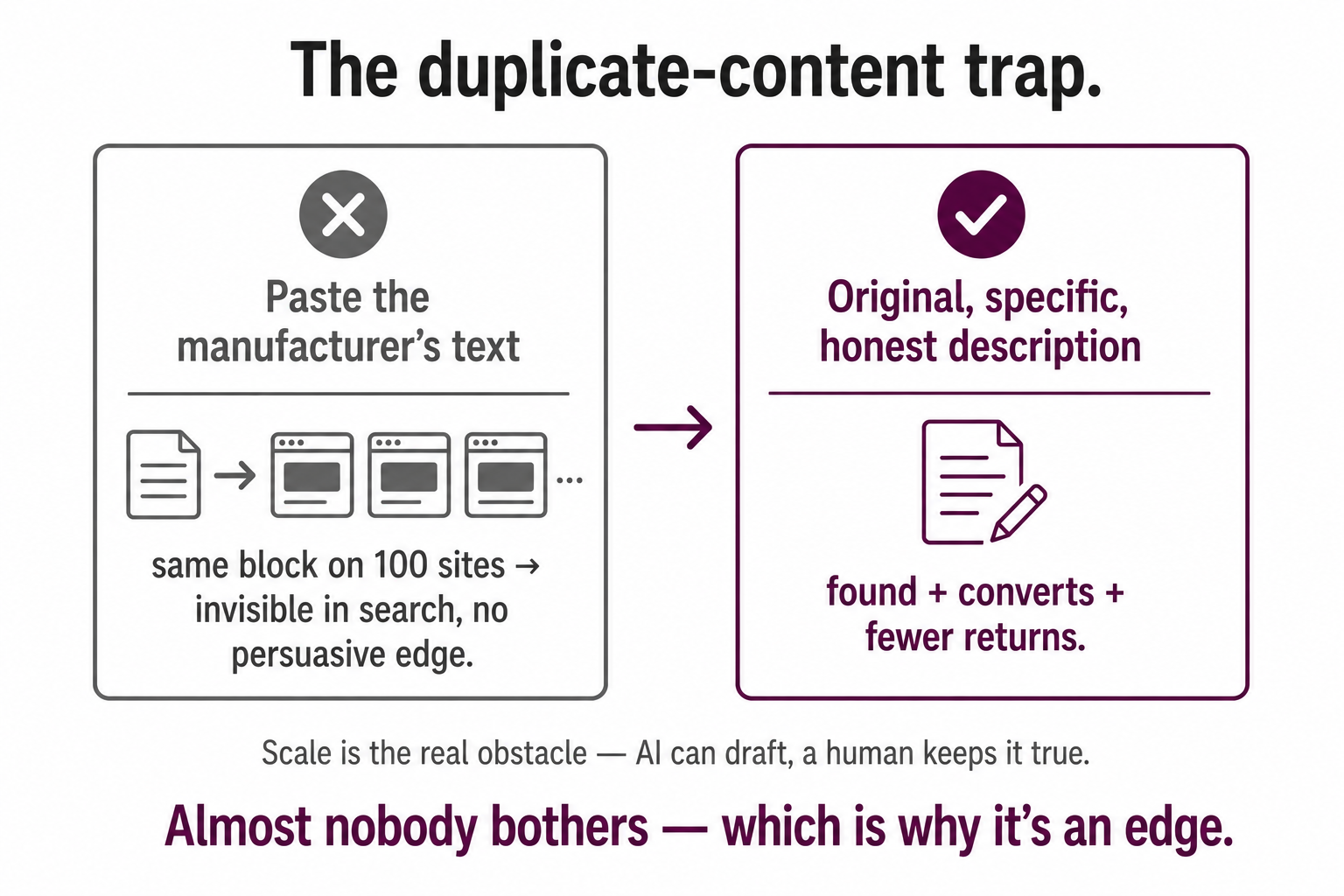
The duplicate-content trap: the easy move is to paste the manufacturer's description, which is exactly what every other store selling that product also does. The result is the same block of text on a hundred sites, which is invisible in search (nothing distinguishes you) and adds no persuasive edge (the customer has read it five times already). Original, specific descriptions are both a discoverability advantage and a conversion one, precisely because almost nobody bothers.
Which runs straight into the scale problem: writing original, honest, well-structured descriptions for a large catalogue is genuinely hard work, and that's the real-world reason so many stores fall back on boilerplate. This is where AI generation earns its place, drafting descriptions at scale, and it's covered in depth in the work on using AI to write product descriptions. The one guardrail that matters, and that piece goes into: AI drafts, a human ensures accuracy and honesty, because an AI that invents a spec or over-promises a benefit is just an automated way to manufacture returns. The judgment about whether the description is true stays human.
What this comes down to
A product description has to persuade the person and inform the machine, and the same discipline serves both: be specific, be honest, be scannable, and keep the hard facts as structured data rather than buried in prose. Write to genuinely sell to a human, by answering their real questions and telling them the truth, and the search engines and AI answer engines follow, because they're rewarding the same clarity. Write to game the algorithm, and you lose the human and, increasingly, the algorithm too.
The best description was never the most glowing one. It's the true one, told well, the one that sells the product to the right customer and sets an expectation the product can actually keep.
A few common questions
What makes a good product description? One that does two jobs at once: persuades the person (answers their real questions, translates features into benefits, pre-empts doubts) and informs the machine (clear, specific language search engines and AI can parse). The same discipline serves both, be specific rather than full of "premium" and "high quality" fluff, be honest, be scannable, and keep the hard specs as structured attributes rather than buried in the prose. Specificity and honesty are what persuade a human and what a machine rewards.
Should I write descriptions for SEO or for the customer? For the customer, and you'll get the machine almost for free. Keyword-stuffing is the old, broken move; it now reads as low-quality to both algorithms and humans. What works for search and AI answer engines today is exactly what persuades a person: clear, specific, honest information that answers real questions and matches how people actually search and ask. Writing genuinely for the human is most of the way to writing well for the machine.
Can I just use the manufacturer's description? You can, but it's a trap. The same block of text then appears on every store selling that product, which makes you invisible in search (nothing distinguishes you) and adds no persuasive edge (the customer has read it already). Original, specific descriptions are both a discoverability and a conversion advantage, precisely because almost nobody bothers. The obstacle is scale, which is where AI drafting helps, as long as a human keeps it accurate and honest.
Does an over-the-top description help sales? No, it usually buys a return. The description sets the expectation, and returns are measured against the expectation, so over-selling produces a product that can't live up to its own description, a refund, and a customer who won't trust your next one. The accurate description outperforms the glowing one because it sells to the right customer and keeps the sale, including being honest about who the product isn't for.
You should also read:
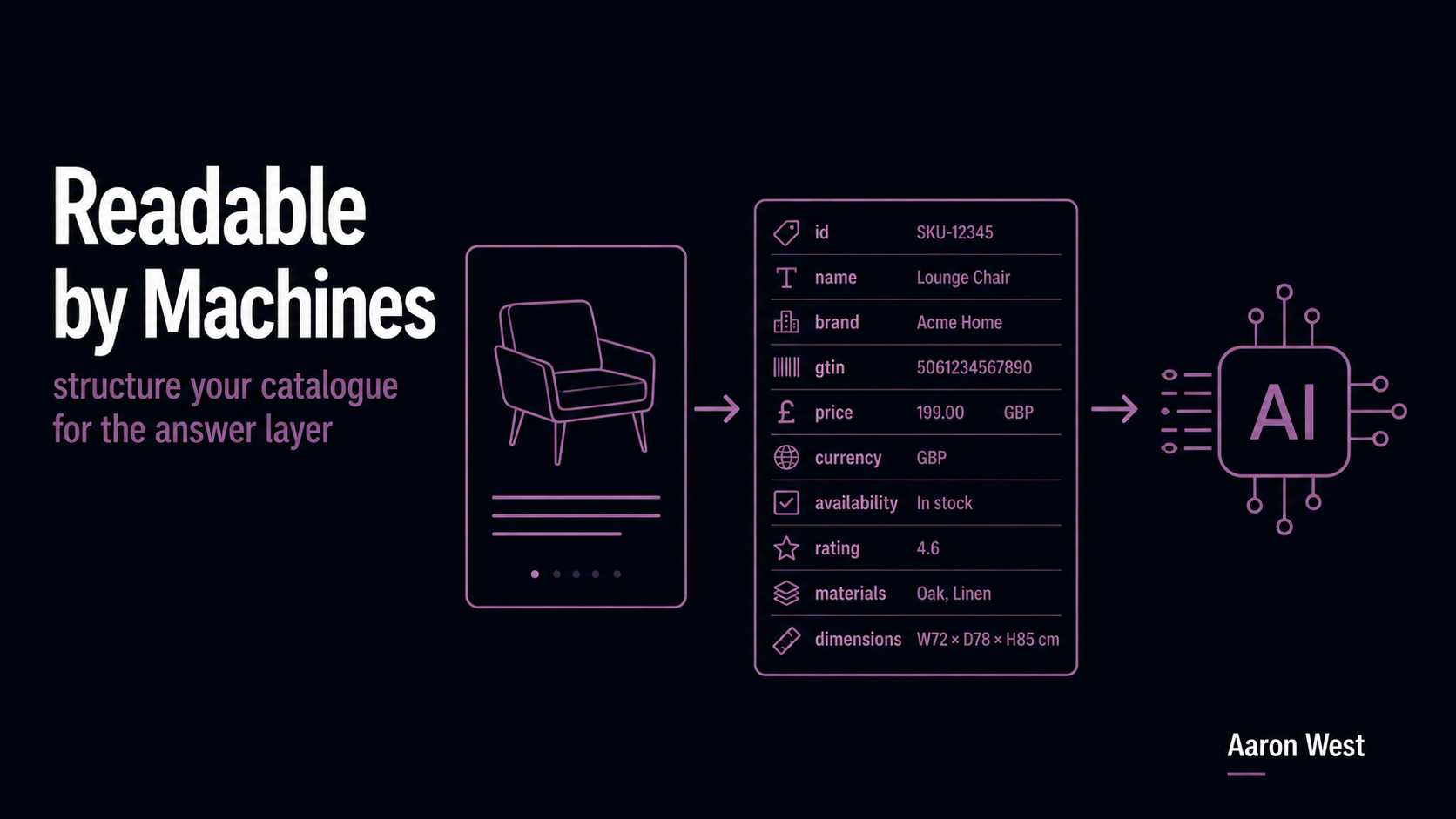
Structured Product Data: How to Make Your Catalog Readable by Machines and AI
You've structured your product data for your own site, and you've structured it for your channel feeds. There's a third reader you can't ignore: the open machine world, search engines' rich results and the AI answer and shopping engines that increasingly sit between customers and…
Continue reading...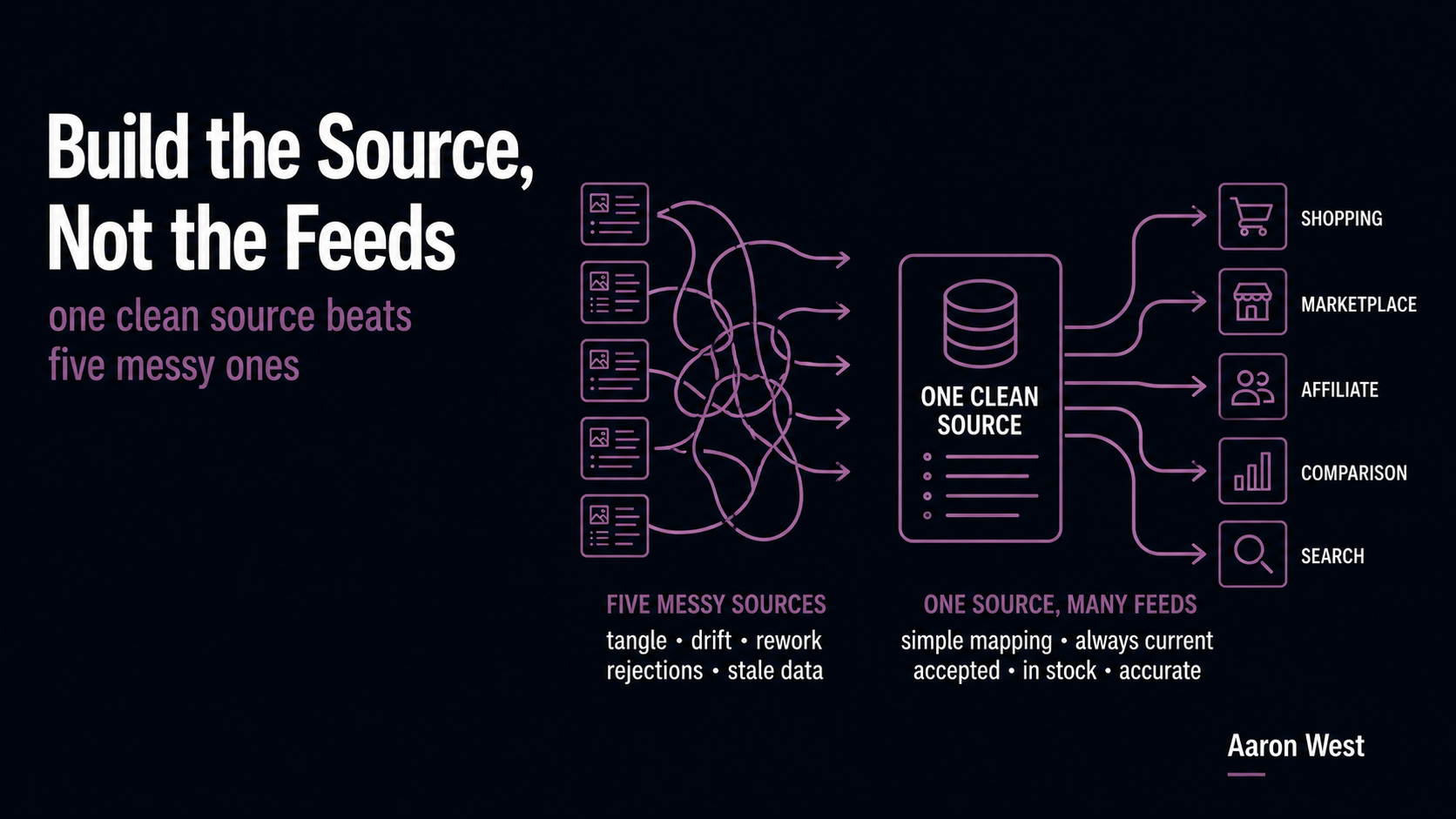
Product Feeds for Every Channel: Why One Clean Source Beats Five Messy Ones
A product feed is a structured export of your catalogue, formatted for a specific channel, and every channel you sell through runs on one: Google Shopping, marketplaces, affiliate networks, comparison sites, social commerce. The single most useful thing to understand about feeds is that they're…
Continue reading...
Product Imagery: The Standards That Quietly Decide Conversion
Product images are product data, not decoration, and online they are the single most important information source you have, because the customer can't touch the product, so the images effectively are the product. Consistent imagery standards, true colour, multiple angles, honest scale, zoom, context, and…
Continue reading...