What CRO Can't Fix: When the Problem Isn't the Page

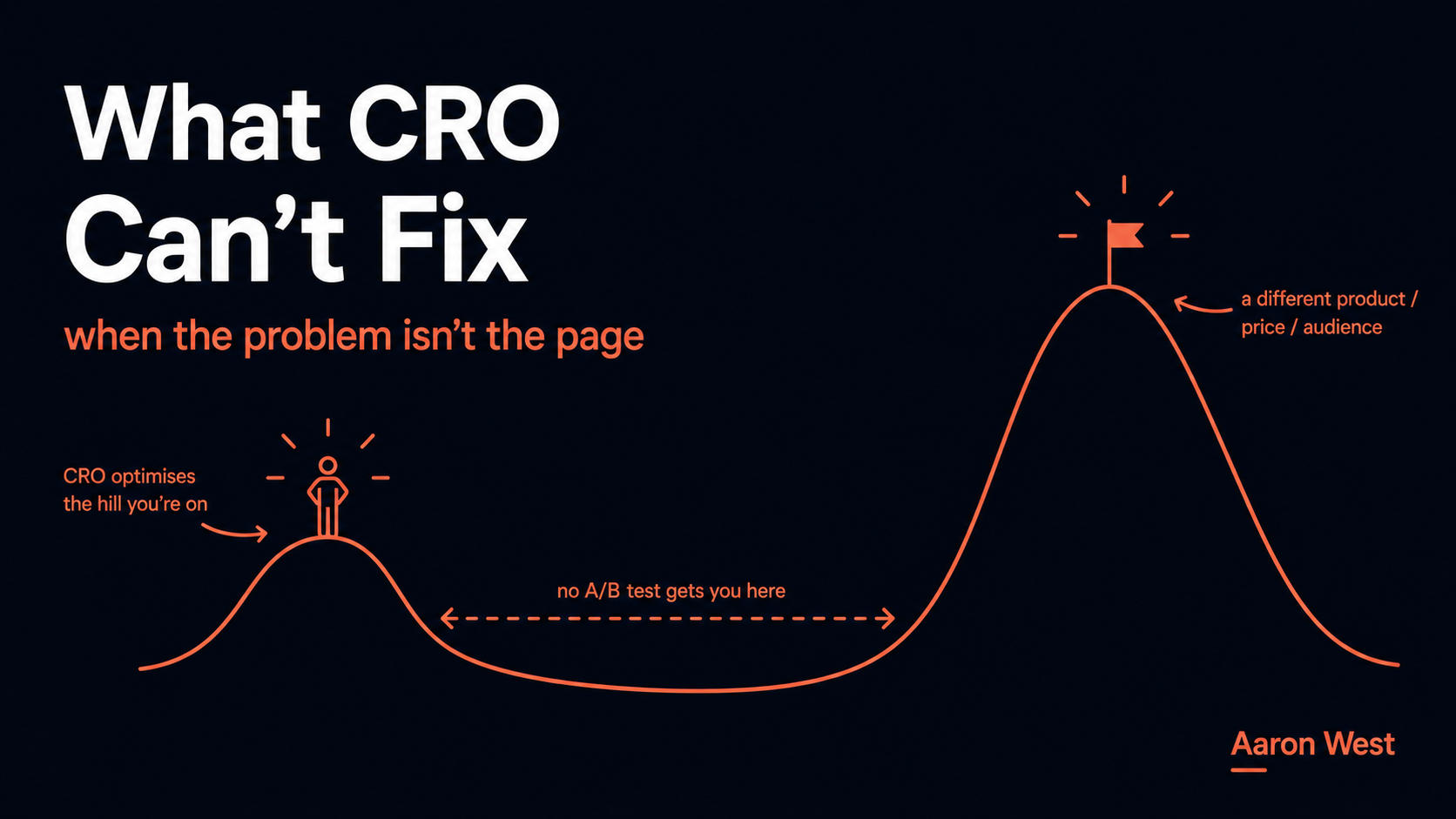
Table of Contents
Experimentation and CRO are powerful, but they optimise the thing you already have, they can't fix a fundamentally wrong thing. The most expensive mistake in CRO is endlessly testing the page when the real problem is the product, the price, the traffic quality, or the market. No button colour fixes a product nobody wants, at a price they won't pay, sold to the wrong audience. The discipline includes knowing when not to reach for a test at all.
This closes the Experimentation & CRO Methodology pillar, under the cornerstone that most of what you believe about your store is a guess. The cornerstone said CRO's value is that it stops you being confidently wrong. Part of that humility is recognising the problems testing simply can't solve.
The limit nobody puts on the box
CRO content sells testing as the answer to bad conversion, and sometimes it genuinely is. But CRO has a hard ceiling that rarely gets mentioned: it optimises what you have. It makes your existing product, at your existing price, for your existing traffic, convert somewhat better. What it cannot do is make a fundamentally wrong offer right.
And teams burn months not noticing the difference, running test after test on a page when the page was never the problem. They tweak the headline, move the button, try a new layout, get flat result after flat result, and conclude they need to test harder, when the honest conclusion is that the thing they're optimising isn't where the problem lives. Optimising the wrong thing very precisely is still optimising the wrong thing.
The local maximum
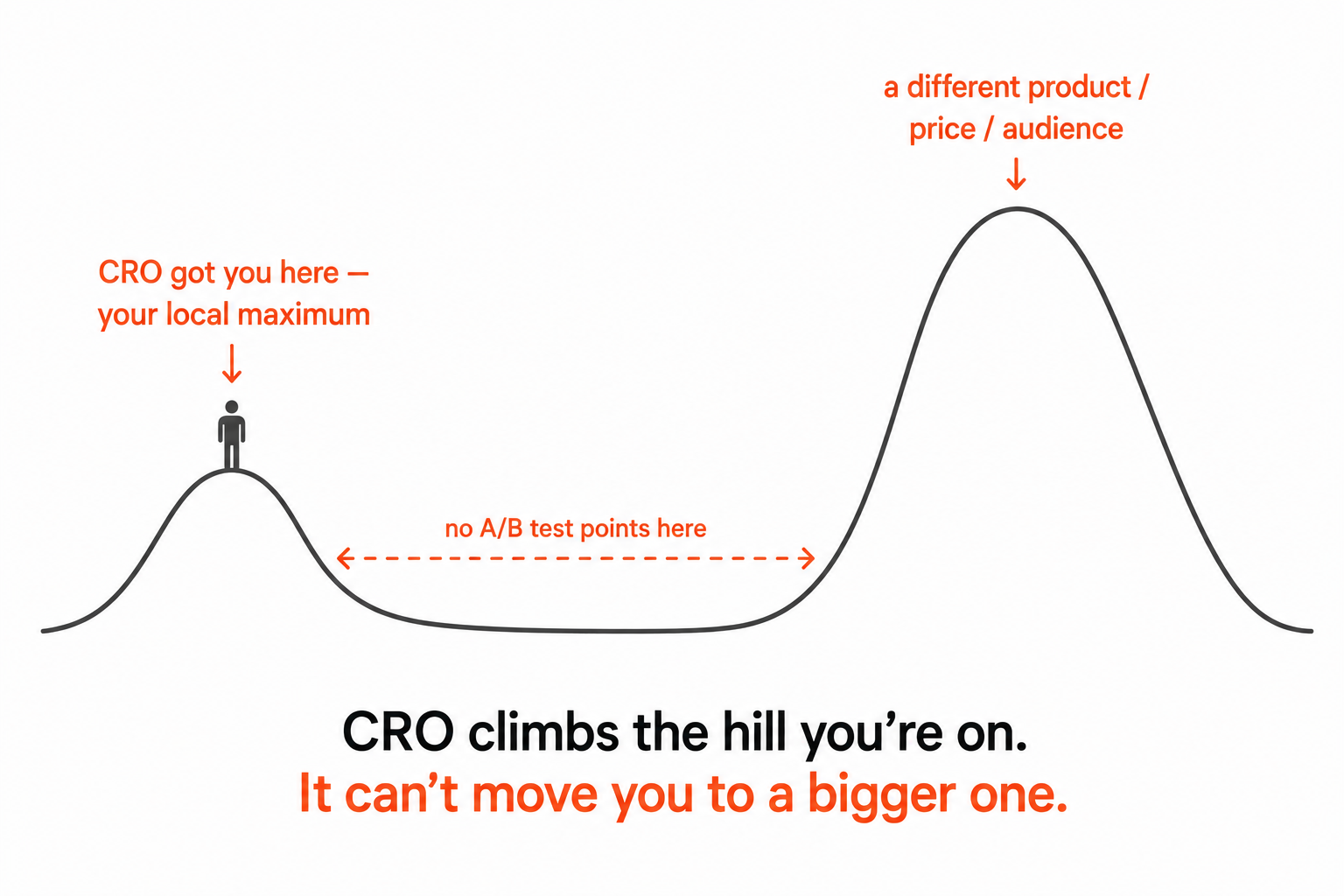
Here's the metaphor that makes the limit clear. Testing is hill-climbing: each test nudges you toward the best version of what you've got, step by step up your current hill, toward its peak. That peak is your local maximum, the best this product, at this price, for this audience, can convert. Reaching it is valuable, and CRO is the right tool for the climb.
But CRO cannot tell you that you're climbing the wrong hill, that a different product, a different price, or a different audience sits on a far taller hill nearby that would convert dramatically better. No A/B test points across the valley. Endless tweaking gets you to the top of a small hill and keeps you there, comfortably optimised, while the bigger hill goes unclimbed, because the tool that's serving you can only ever point uphill from where you're standing. You can be brilliantly optimised and still on the wrong hill.
The four things CRO can't fix
When conversion is bad, the cause is often upstream of the page entirely. Four common ones:
- A product people don't want. If the offer is weak, optimising the page just helps more people see clearly that they don't want it. A better product and catalogue is the fix, not a better button.
- A price the market won't pay. No checkout optimisation closes a fundamental price-value gap. If people think it's not worth the money, a smoother checkout just lets them reach that conclusion faster. That's a pricing question.
- The wrong traffic. This is the big, under-diagnosed one. If your ads bring people who were never going to buy, your page converts badly because the audience is wrong, not the page. You can optimise that page forever and it won't help, the fix is upstream, in the targeting. Bad traffic is a paid-media problem masquerading as a conversion problem.
- A trust or brand problem. If people don't trust the store, no microcopy tweak overcomes it. The reassurance has to be real, not optimised.
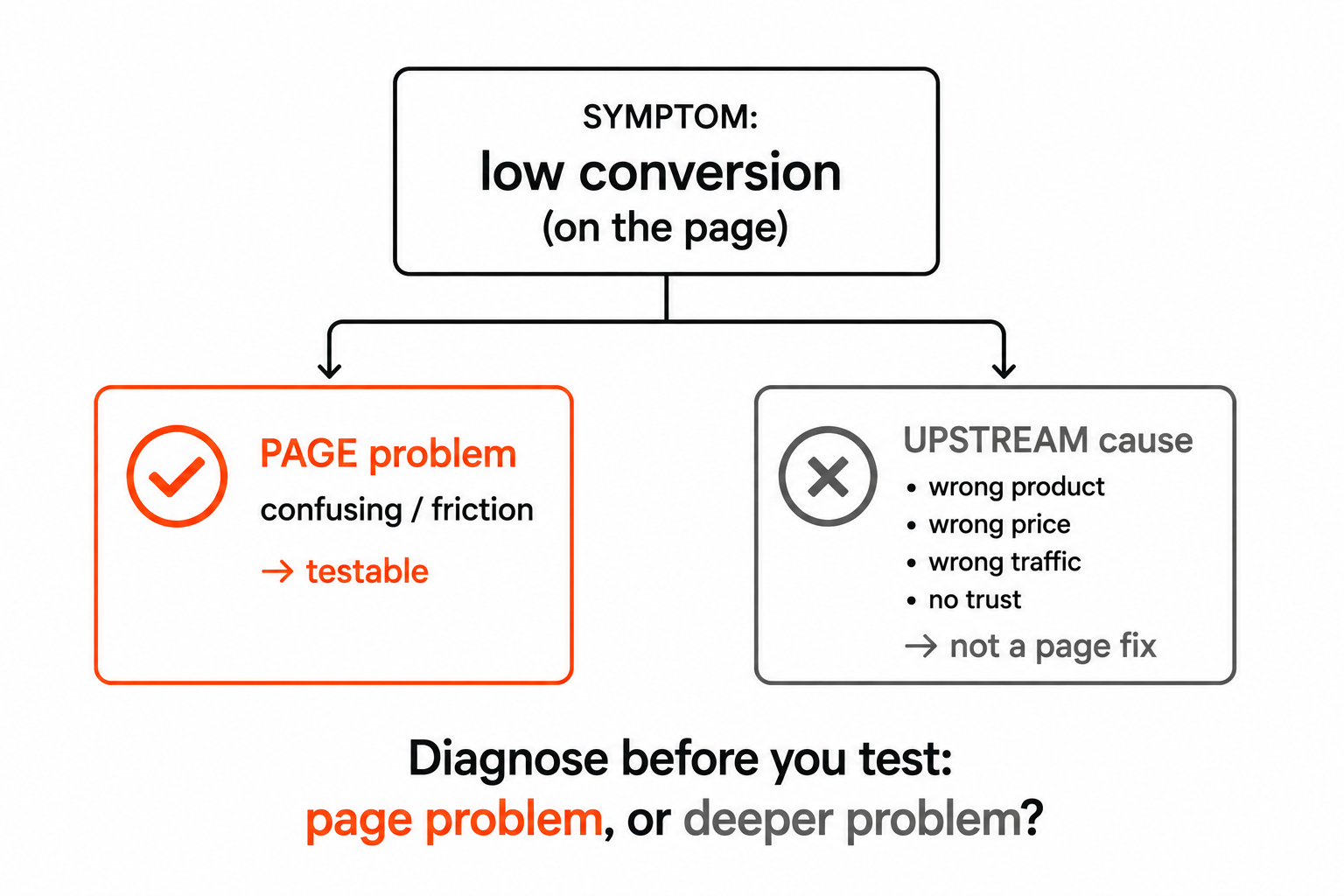
In all four, the symptom shows up on the page, low conversion, but the cause sits upstream. And you cannot fix an upstream cause by optimising a downstream symptom.
The question to ask before you test
So before reaching for an A/B test on a poorly-converting page, ask one diagnostic question: is this a page problem or a deeper problem? And use the qualitative evidence to answer it, because it usually tells you fast. Watch the recordings, read the funnel, talk to people. Are visitors bouncing because the page is confusing and they can't find or do what they came for, that's a page problem, and it's testable. Or are they looking, understanding perfectly, and deciding it's not for them, too expensive, or not trustworthy enough to risk, that's a deeper problem, and no page test will fix it.
Diagnosis before treatment. The instinct to immediately A/B test a conversion problem skips the diagnosis, and you can spend a very long time treating a symptom that was never going to respond to that treatment.
CRO is for refining a sound thing
None of this means CRO isn't worth doing, it means knowing what it's for. CRO earns its keep when the fundamentals are basically right and you're refining: a decent product, a fair price, reasonable traffic, and you're removing friction, improving clarity, and climbing your hill properly. That describes most stores most of the time, which is exactly why CRO is usually worth doing.
But it's a refinement tool, not a rescue tool. Pointed at a sound store, it compounds small gains into real ones. Pointed at a broken fundamental, it just optimises the brokenness with great precision. The cornerstone's humility, CRO stops you being confidently wrong, extends to this: part of not being wrong is recognising when the answer isn't another test, but a hard conversation about the product, the price, or who you're selling to. The mature practitioner reaches for a test less often than the beginner, because they know which problems testing can and can't touch.
What this comes down to
Experimentation is the best tool there is for refining a fundamentally sound store, and the wrong tool entirely for fixing a broken one. It climbs you to the top of the hill you're on; it cannot tell you you're on the wrong hill. So before you test, diagnose: page problem, or deeper problem? Because no amount of optimising the page will fix a product, a price, an audience, or a level of trust that was the real issue all along.
A lot of "our conversion is terrible, let's do CRO" energy is misdirected, the team would get far more from fixing the product or the targeting than from a year of button tests, but testing feels safer and more concrete than admitting the offer or the audience is wrong. CRO can quietly become a sophisticated way of avoiding the hard question. The most valuable CRO skill isn't running tests. It's knowing when the answer isn't a test at all.
A few common questions
Can CRO fix a low conversion rate on its own? Only if the cause is on the page. CRO optimises what you already have, it makes your existing product, at your existing price, for your existing traffic, convert somewhat better, but it can't make a fundamentally wrong offer right. If conversion is bad because the product is weak, the price is wrong, the traffic is the wrong audience, or people don't trust the store, then the symptom shows on the page but the cause is upstream, and you can't fix an upstream cause by optimising a downstream symptom. Diagnose first; reach for a test only if it's genuinely a page problem.
What's the "local maximum" problem in CRO? Testing is hill-climbing: each test nudges you toward the best version of what you've got, the top of your current hill, your local maximum. That's valuable, but CRO can't tell you you're climbing the wrong hill, that a different product, price, or audience would convert far better, because no A/B test points across the valley to a taller hill. Endless tweaking gets you comfortably to the top of a small hill and keeps you there while the bigger opportunity goes unclimbed. You can be brilliantly optimised and still on the wrong hill.
How do I tell a page problem from a deeper problem? Use qualitative evidence to diagnose before testing. Watch session recordings, read your funnel, talk to people. If visitors are bouncing because the page is confusing and they can't find or do what they came for, that's a page problem and it's testable. If they're looking, understanding it perfectly, and deciding it's not for them, too expensive, or not trustworthy enough, that's a deeper problem upstream, and no page test will fix it. The instinct to immediately A/B test skips this diagnosis, and you can spend a long time treating a symptom that was never going to respond.
So is CRO not worth doing? It's very much worth doing, when the fundamentals are right and you're refining: a decent product, fair price, reasonable traffic, and you're removing friction and improving clarity. That's most stores most of the time. CRO is a refinement tool, not a rescue tool, pointed at a sound store it compounds small gains into real ones; pointed at a broken fundamental it just optimises the brokenness precisely. The mature practitioner reaches for a test less often than the beginner, because part of not being confidently wrong is knowing when the answer is a hard conversation about the product or the audience, not another test.
You should also read:
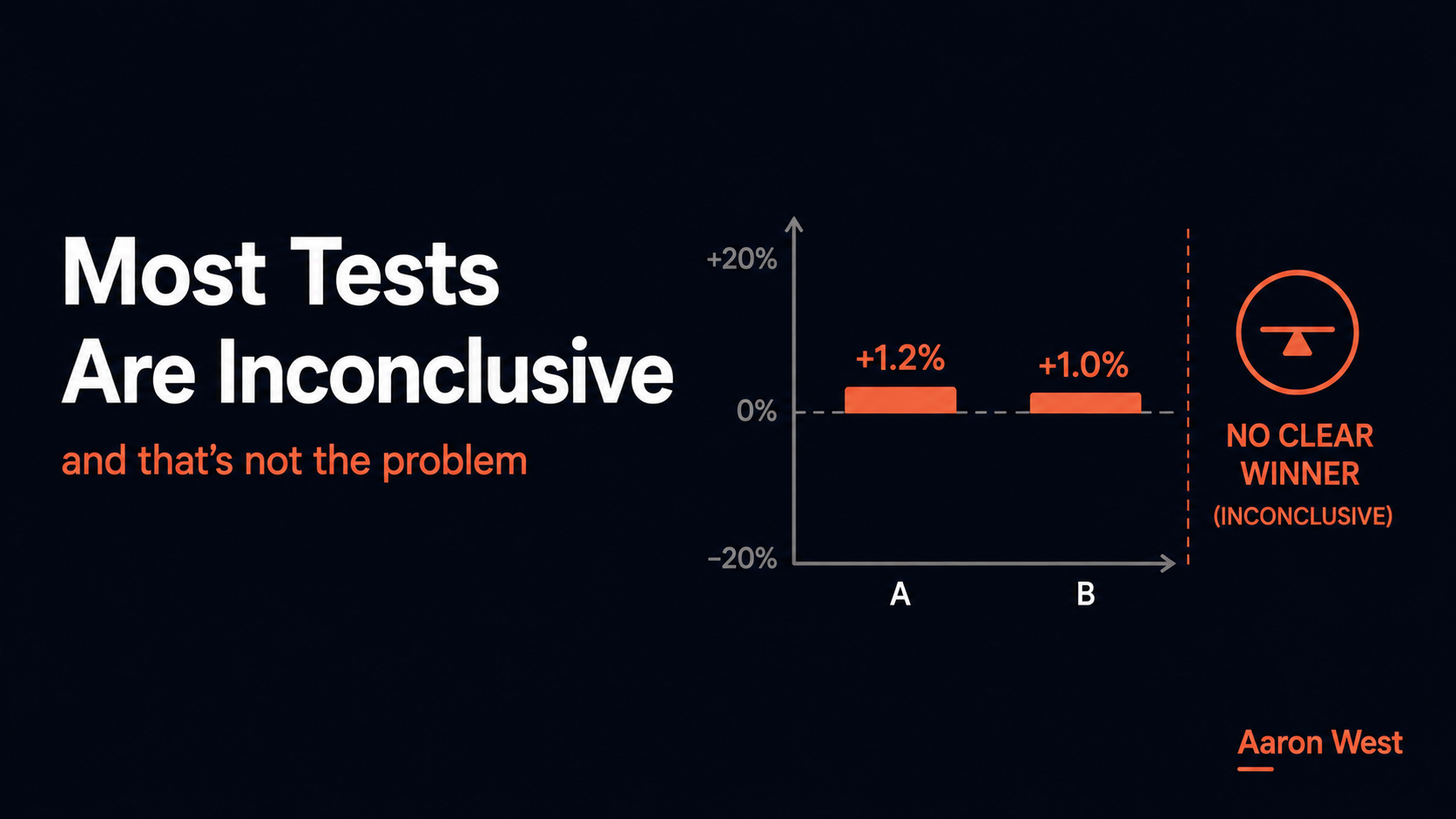
Why Most A/B Tests Are Inconclusive (and Why That's Not the Problem)
Most A/B tests come back inconclusive, with no clear winner, and that's not a failure of the test, it's the honest and common result of testing changes that mostly have small effects. The two ways people get this wrong are peeking and stopping the moment…
Continue reading...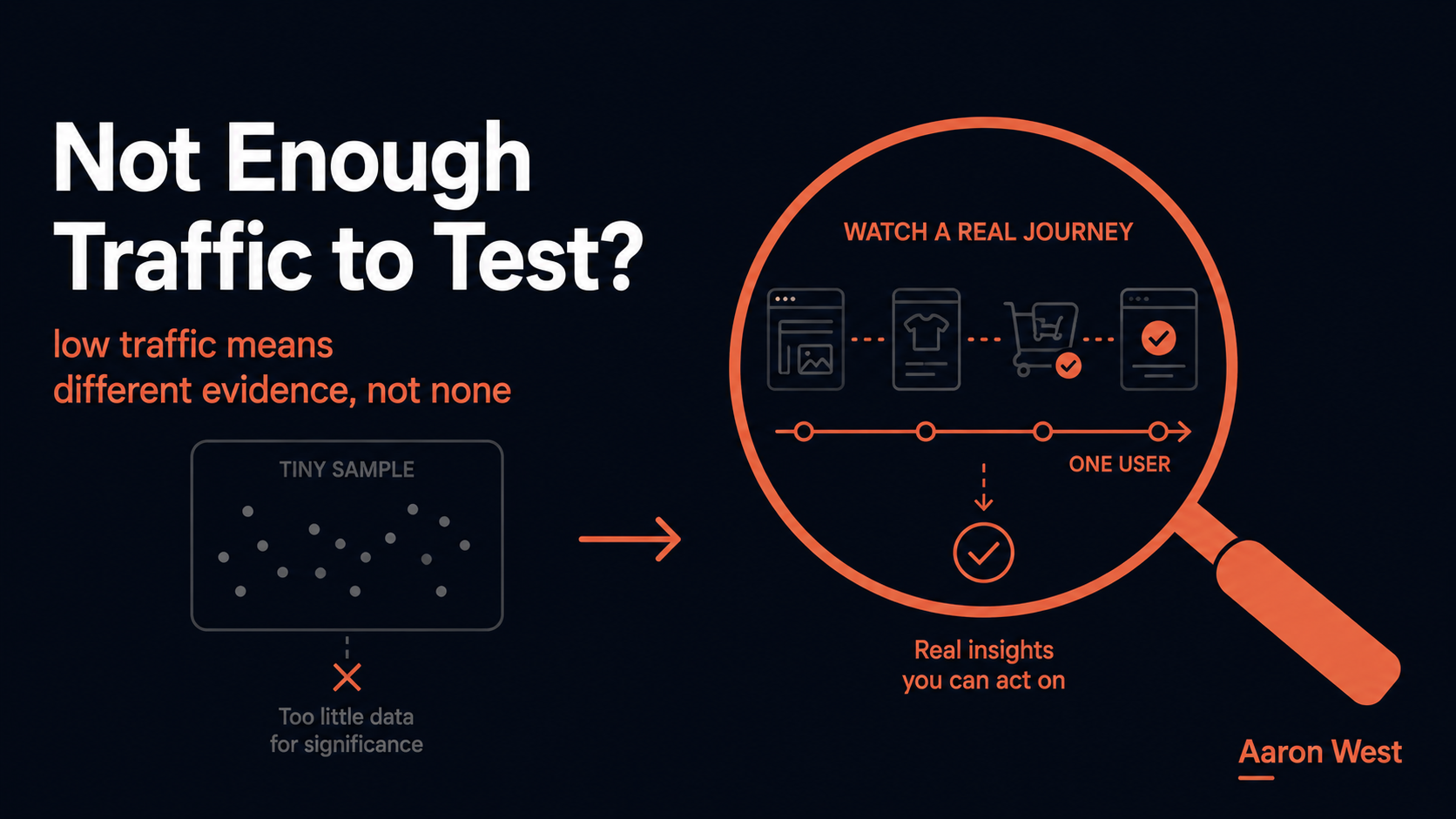
What to Test When You Don't Have the Traffic
Most CRO advice assumes you have the traffic to run clean A/B tests, and most stores don't. Trying to run statistical tests on low traffic produces confident-looking results that are really just noise, which is worse than not testing at all. When you don't have…
Continue reading...
Experimentation and CRO: Most of What You Believe About Your Store Is a Guess
Most of what you believe about your store is a guess. Most e-commerce decisions are made on opinion, intuition, or copying competitors, and experimentation, A/B testing and structured conversion-rate optimisation, is the discipline of replacing those guesses with evidence about what actually works on your…
Continue reading...